


Talk to a coach about Motivational coaching

Robert Bradley Singleton
Certified Master Spiritual Life Coach, Neuropsychologist, and Existential Therapist
Train with the best to be the best you! Don't...

Dr. Kate Watson
B.A Psychology, M.Ed. Psychological Counseling, Dr.PH in Public Health, Certified Health Coach, Certified Life Coach, Certified Mind and Body Specialist, Certified Women's Empowerment Coach, Certified Neurodiversity Coach
Dr. Kate Watson helps people with boundaries, coping strategies, and...

Angela Ebejer
Board Certified Coach
Coach with a Board Certified Coach to gain clarity, confidence,...

Mak Estill
Anxiety, Panic & Life Coach dedicated to coaching you into a life of lesser and lighter anxiety!
Founder and owner of Actionable Anxiety, a private coaching practice...

Elise Boren
Certified Life Coach, Communication Specialist and Sound Healer
Through listening and discussion we will create a plan to...

Vibeke Pedersen
Certified Life Coach / ThetaHealer®
Crush 2025

Ashley Godfrey
Certified Executive Function & Resilience Coach for ADHD!
I help ADHD/Neurodivergent clients in life management, career, wellness, &...

Marie Fredericks
Masters in Education, Certified Life and Health Coach - Confidence, Motivation and Positive Habits Coach
I help clients manage stress and anxiety by building self-confidence...
Keep Putting It Off? The Tiny Countdown Trick That Beats Procrastination Fast
Want to try this at home? No worries! Download a copy of our SMART Goals PDF Worksheet.
****
Why Starting Feels Harder Than Doing
Starting can feel strangely difficult, even when the task itself is not that hard.
You might know exactly what needs to happen. You might even care about the goal. But the moment you are supposed to begin, your brain starts negotiating.
Maybe you should check one more thing first. Maybe you need a better plan. Maybe you should wait until you have more time, more energy, more focus, or a cleaner workspace.
That little delay can turn into a full stop.
Need some in depth help with goal settings, motivation or productivity ? Drop on by our directories choc full of productivity coaches, accountability coaches, and goal-setting coaches, and start reaching those goals! Or click here to have us match you to the best.
The 3-2-1 Countdown Start is a simple way to interrupt that pattern. Instead of waiting until you feel ready, you count down and move before your brain has time to talk you out of it.
If you want to get more from your life, and are looking for concrete action steps to get you there, check out our Request a Coach page. It’s a “cut the fence-sitting and take action” way to tackle your issues and actually find success. To get off the fence and start to take action, click or tap here.
This is not about forcing yourself into a huge work session. It is not about becoming endlessly disciplined overnight. It is about making the first move small enough, fast enough, and clear enough that procrastination does not get to take over.
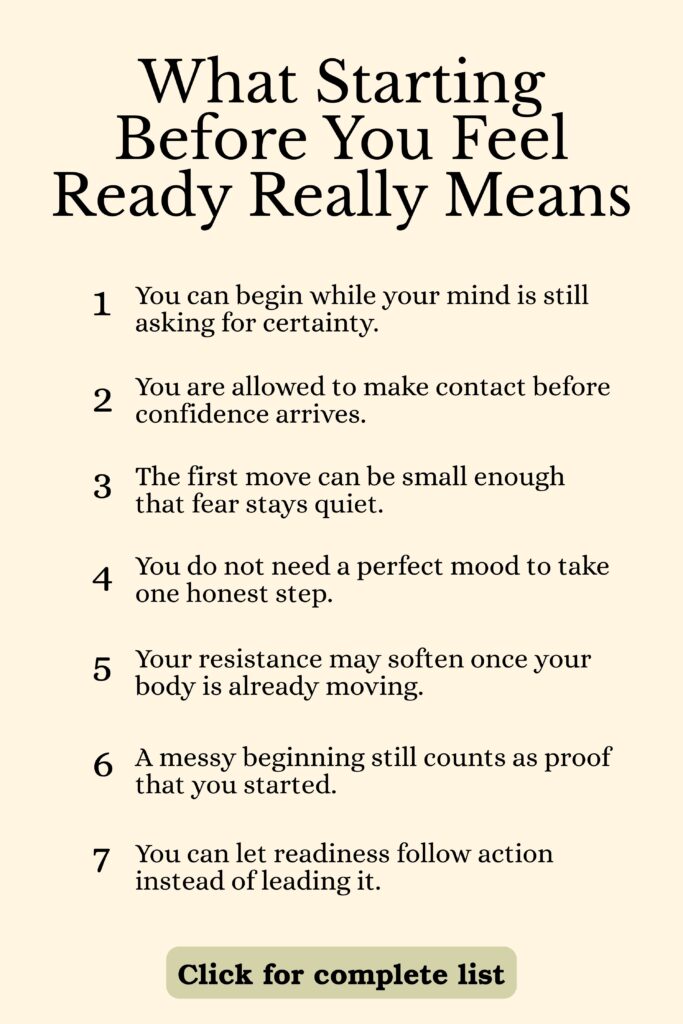
The method works best when you use it for a task you are already avoiding, such as:
- Opening a work document
- Sending a message
- Starting a workout
- Cleaning one small area
- Beginning a goal task
- Making a decision you keep delaying
- Returning to something you abandoned
The power is in the speed. You do not count down and then think. You count down and move.
The goal is not perfection. The goal is contact. You are getting your hands on the task, even if the first version is messy, tiny, or incomplete.
When you use this consistently, you start teaching your brain something important: starting does not need to be dramatic.
It can be quick.
It can be simple.
It can begin with “3, 2, 1.”
If you want to get more from your life, and are looking for concrete action steps to get you there, check out our Request a Coach page. It’s a “cut the fence-sitting and take action” way to tackle your issues and actually find success. To get off the fence and start to take action, click or tap here.
Choose the Task You Are Actually Avoiding
Before you use the countdown, get honest about what you are avoiding.
A lot of procrastination hides behind vague language. You tell yourself you need to “get organized,” “work on your goals,” “be productive,” or “catch up.” Those sound useful, but they are too broad to start.
Your brain cannot act on a foggy instruction.
Name the real task: Choose the specific thing you keep circling around. Instead of “work on my business,” say “write the first paragraph of the email.” Instead of “clean up,” say “clear the clothes from the chair.”
The more specific the task is, the easier it is to begin.
Shrink it into one visible action: Once you name the task, reduce it to the smallest physical step you can take. A visible action is something you can see yourself doing.
That might look like:
- Open the document
- Write one messy sentence
- Put the dishes in the sink
- Reply to one message
- Pull up the spreadsheet
- Put your shoes on
- Set the timer
- Move one item to its proper place
The smaller the starting action, the better. Your goal is not to impress yourself. Your goal is to remove the excuse that the task is too big to touch.
If you want to get more from your life, and are looking for concrete action steps to get you there, check out our Request a Coach page. It’s a “cut the fence-sitting and take action” way to tackle your issues and actually find success. To get off the fence and start to take action, click or tap here.
Avoid fake preparation: Watch for preparation that is really avoidance in disguise. Researching, reorganizing, planning, making a new list, checking tools, or changing your workspace can all feel productive while keeping you away from the task.
Ask yourself: “Does this directly begin the thing, or does it help me delay the thing?”
That question is useful because procrastination often dresses up as responsibility.
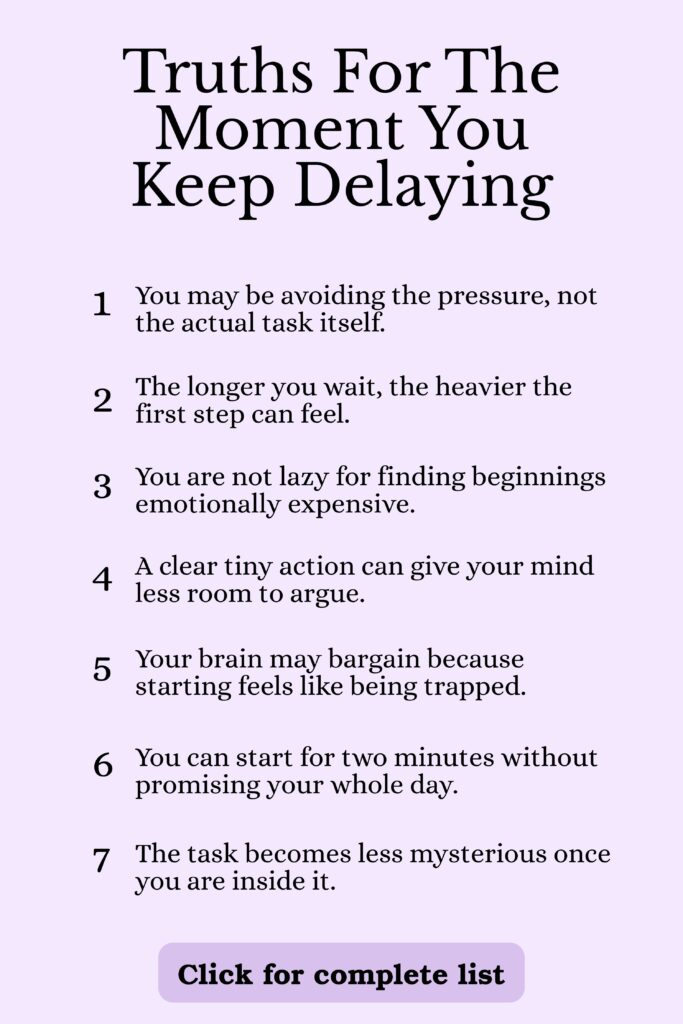
Make the action impossible to debate: Choose a first move so small that arguing with it feels ridiculous. “Write the entire report” is debatable. “Open the report and type one rough bullet” is much harder to argue with.
The countdown only works when the next action is clear. Before you count down, know exactly what your body will do on “1.”
Set a 2-Minute Start Window
A big reason people avoid starting is that starting feels like a trap.
You think, “If I begin, I have to finish.” Or, “If I open this, I’ll be stuck doing it for an hour.” That pressure makes even a small task feel heavier than it needs to be.
The 2-minute start window removes that pressure.
If you want to get more from your life, and are looking for concrete action steps to get you there, check out our Request a Coach page. It’s a “cut the fence-sitting and take action” way to tackle your issues and actually find success. To get off the fence and start to take action, click or tap here.
You are not committing to finishing. You are only committing to beginning.
Give yourself a tiny commitment: Decide that you only have to work on the task for two minutes. That is it. Two minutes is short enough that your brain has less room to panic, resist, or build a long argument against it.
You can do almost anything for two minutes.
This works especially well when your energy is okay, but not amazing. You are not completely drained, but you are also not feeling inspired. Instead of waiting for a burst of motivation, you use a tiny window to create motion.
Use the time as a doorway: The first two minutes are not meant to complete the task. They are meant to get you through the doorway.
For example:
- Two minutes of writing can break the blank page.
- Two minutes of cleaning can create one clear surface.
- Two minutes of planning can reveal the next step.
- Two minutes of replying can remove one nagging message.
- Two minutes of movement can shift your energy.
The point is to stop being outside the task.
Once you are inside it, the task often feels less dramatic.
If you want to get more from your life, and are looking for concrete action steps to get you there, check out our Request a Coach page. It’s a “cut the fence-sitting and take action” way to tackle your issues and actually find success. To get off the fence and start to take action, click or tap here.
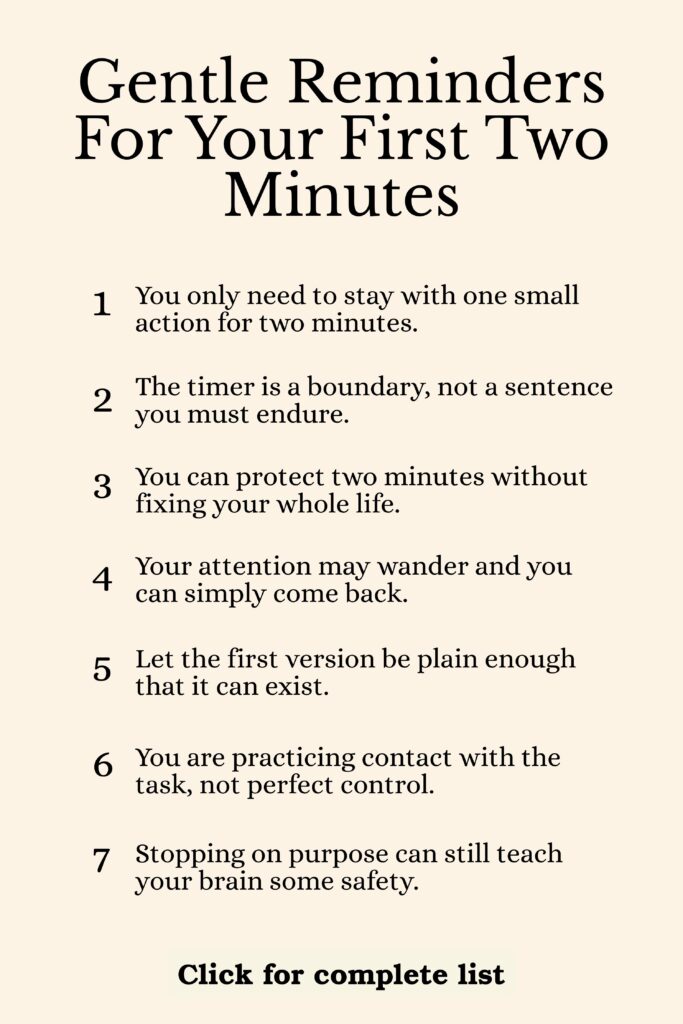
Remove the pressure to continue: Give yourself real permission to stop when the timer ends. This part matters. If your brain learns that “just two minutes” secretly means “now you must work for an hour,” it will stop trusting you.
Let two minutes count.
If you continue, great. If you stop, you still practiced starting.
Let momentum be optional: Sometimes the two-minute window turns into ten minutes. Sometimes it does not. Both outcomes are useful.
The win is not how long you worked. The win is that you started before procrastination took the wheel.
Use the 3-2-1 Rule Before Your Brain Negotiates
Once you know the task and the first action, use the countdown.
This is where the method becomes more than a nice idea. You are creating a hard break between thinking and doing.
The countdown gives your brain a simple instruction: movement starts now.
If you want to get more from your life, and are looking for concrete action steps to get you there, check out our Request a Coach page. It’s a “cut the fence-sitting and take action” way to tackle your issues and actually find success. To get off the fence and start to take action, click or tap here.
Count down out loud or in your head: Say “3, 2, 1” and move immediately on “1.” Do not pause after the countdown. Do not check whether you feel ready. Do not ask yourself whether this is the perfect time.
The pause is where negotiation sneaks back in.
If you count down and then sit still, your brain will start offering alternatives. Maybe later. Maybe after one more scroll. Maybe after you make tea. Maybe after you feel more focused.
The method works because you do not give that argument room to develop.
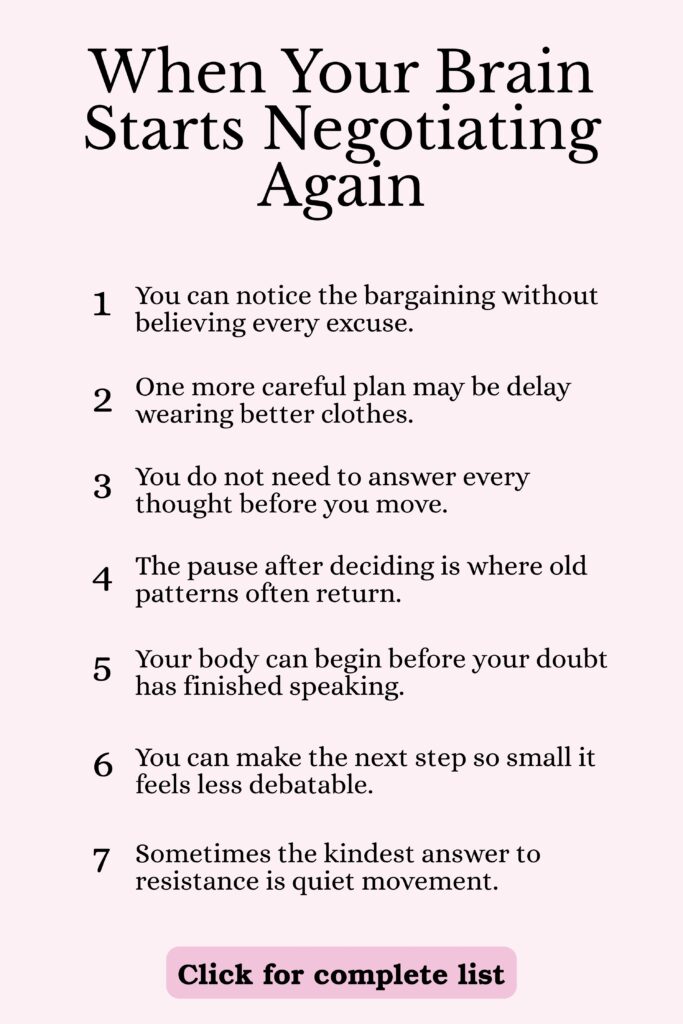
Pair the countdown with motion: The countdown should connect to a physical action. Thinking about starting does not count. Preparing to maybe start does not count.
On “1,” do something visible.
For example:
- Put your hands on the keyboard
- Open the document
- Stand up
- Pick up the laundry
- Click “compose”
- Put your phone face down
- Write the first word
- Start the timer
- Move toward the task area
This physical movement matters because procrastination often lives in stillness. Once your body moves, the mental resistance often loses some of its power.
If you want to get more from your life, and are looking for concrete action steps to get you there, check out our Request a Coach page. It’s a “cut the fence-sitting and take action” way to tackle your issues and actually find success. To get off the fence and start to take action, click or tap here.
Do not wait for a better feeling: You may still feel annoyed, tired, uncertain, or resistant after you start. That is fine. The countdown is not supposed to make you feel magically motivated.
It is supposed to help you act before motivation arrives.
Keep the rule clean: Do not add extra conditions. Do not count down and then decide you need the perfect playlist, perfect setup, or perfect mood.
The rule is simple: when you count down, you move.
That simplicity is what makes it useful.
Start With the Messiest First Version
A lot of procrastination comes from secretly expecting the first attempt to be good.
You do not just need to start the report. You need to write it well. You do not just need to clean the room. You need to do it properly. You do not just need to send the message. You need to say it perfectly.
That pressure makes the beginning feel bigger than it is.
If you want to get more from your life, and are looking for concrete action steps to get you there, check out our Request a Coach page. It’s a “cut the fence-sitting and take action” way to tackle your issues and actually find success. To get off the fence and start to take action, click or tap here.
The solution is to start badly on purpose.
Lower the quality bar on purpose: Your first move does not need to be polished. It needs to exist. A rough first sentence is better than a perfect sentence you never write.
Give yourself permission to begin with:
- A messy bullet list
- A rough draft
- A bad first sentence
- A quick brain dump
- A basic outline
- A half-organized pile
- A temporary placeholder
- A simple “good enough for now” version
This is not laziness. It is strategy. You are separating the act of starting from the act of improving.
Separate starting from polishing: Starting and polishing are different jobs. When you mix them together, you make the first step too heavy.
The beginning is allowed to be ugly. Editing comes later. Organizing comes later. Refining comes later. Making it impressive comes later.
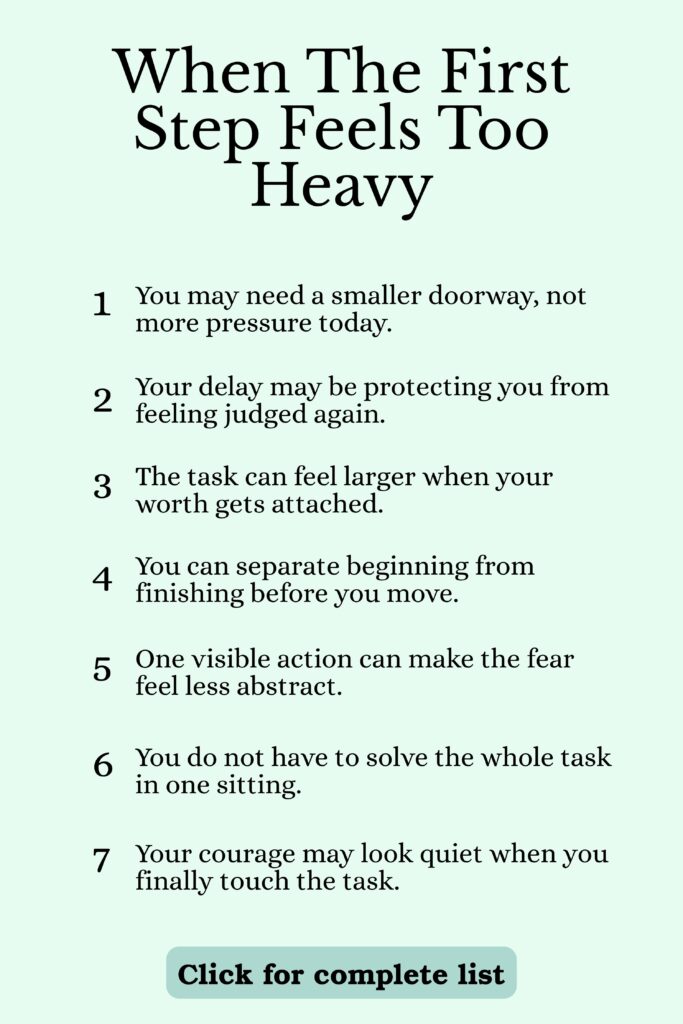
For now, you only need forward motion.
Use a starter phrase if you freeze: If your mind goes blank, use a sentence that gets words moving without requiring brilliance.
If you want to get more from your life, and are looking for concrete action steps to get you there, check out our Request a Coach page. It’s a “cut the fence-sitting and take action” way to tackle your issues and actually find success. To get off the fence and start to take action, click or tap here.
Try prompts like:
- “The first thing I need to do is…”
- “A rough version of this would be…”
- “I do not know exactly how to start, but…”
- “The next small step is…”
- “If this were easy, I would begin by…”
These phrases lower the pressure because they do not require you to sound finished.
Make progress visible fast: Give yourself a visible sign that the task has begun. Write one line. Move one object. Check one box. Open one tab. Put one item where it belongs.
Visible progress tells your brain, “We are already in motion.”
That matters because starting is often the hardest part. Once there is something on the page, in the folder, on the timer, or off the floor, the task becomes less abstract.
You are no longer thinking about beginning.
You have begun.
Use a Focus Cue to Stay With the First Step
The countdown gets you started, but your attention may still try to escape.
If you want to get more from your life, and are looking for concrete action steps to get you there, check out our Request a Coach page. It’s a “cut the fence-sitting and take action” way to tackle your issues and actually find success. To get off the fence and start to take action, click or tap here.
That is normal. Starting does not mean your brain suddenly becomes perfectly focused. It just means you have created enough motion to begin.
Now you need one small focus cue to stay with the first step long enough for the start to matter.
Pick one focus boundary: Choose a simple rule for the short start window. Do not make it complicated. You only need one boundary that protects the next few minutes.
Examples include:
- Phone face down
- One tab only
- No email checking
- No switching tasks
- No rewriting yet
- Timer stays on
- Stay in this document
- Finish one small action before moving
A focus boundary gives your attention fewer exits.
Keep your workspace boring: You do not need a perfect workspace, but you do need to remove the easiest distractions. If your phone is beside your hand, your brain will probably reach for it. If five tabs are open, your attention will wander.
Before you count down, remove the most tempting escape route.
This can be very quick:
If you want to get more from your life, and are looking for concrete action steps to get you there, check out our Request a Coach page. It’s a “cut the fence-sitting and take action” way to tackle your issues and actually find success. To get off the fence and start to take action, click or tap here.
- Close the extra tab
- Turn your phone over
- Put headphones on
- Move the distracting item
- Hide the open app
- Clear one small space in front of you
Do not turn this into a full workspace makeover. Just make the next two minutes easier to protect.
Use a repeat phrase: When your attention starts trying to leave, use a short phrase to bring yourself back.
Try:
- “Just this step.”
- “Two minutes counts.”
- “Start only.”
- “Stay here.”
- “One thing first.”
- “Not perfect, just moving.”
The phrase should be simple enough to remember when your brain is restless.
Return without drama: If you drift, do not turn it into a character judgment. You do not need to restart your whole day because you lost focus for a moment.
Just count down again.
3, 2, 1.
Return to the same first action.
If you want to get more from your life, and are looking for concrete action steps to get you there, check out our Request a Coach page. It’s a “cut the fence-sitting and take action” way to tackle your issues and actually find success. To get off the fence and start to take action, click or tap here.
That quick return is part of the skill.
Add a 5-Minute Follow-Through Option
Once the first two minutes are done, you have a choice.
You can stop, or you can add a small follow-through round. This is where the 5-minute option becomes useful.
The trick is to keep it optional. You are not trying to trick yourself into a long session. You are simply giving momentum somewhere to go if it has already started.
Offer yourself the next small round: When the two-minute timer ends, ask, “Can I do five more minutes?”
Do not ask, “Can I finish this?” That question is too big. It can bring the pressure right back.
Five minutes feels possible. Finishing may not.
If the answer is yes, set a five-minute timer and continue. If the answer is no, stop cleanly and leave a note for next time.
If you want to get more from your life, and are looking for concrete action steps to get you there, check out our Request a Coach page. It’s a “cut the fence-sitting and take action” way to tackle your issues and actually find success. To get off the fence and start to take action, click or tap here.
Choose the next obvious move: Do not use this moment to re-plan the entire project. Continue with the task already in front of you.
For example:
- Write the next paragraph
- Sort the next five items
- Reply to one more email
- Review the next section
- Add three more bullets
- Clear one more small area
- Save and label the file
- Draft the next message
The next step should be obvious, not impressive.
Stop before it becomes a battle: There is a difference between useful effort and turning the task into a fight. If the five-minute round feels doable, keep going. If resistance spikes hard, end the session on purpose.
Stopping intentionally is better than pushing until you feel defeated.
You want your brain to associate starting with something manageable. If every tiny start turns into a long, exhausting demand, you will resist the method next time.
Leave yourself a restart marker: Before you stop, write one simple note about where to begin next.
Examples:
If you want to get more from your life, and are looking for concrete action steps to get you there, check out our Request a Coach page. It’s a “cut the fence-sitting and take action” way to tackle your issues and actually find success. To get off the fence and start to take action, click or tap here.
- “Next: add the intro.”
- “Next: send this to Sarah.”
- “Next: sort the top drawer.”
- “Next: review bullet 3.”
- “Next: choose the first image.”
- “Next: open the spreadsheet and fill row 5.”
This makes the next countdown easier because you do not have to recreate clarity from scratch.
Prompt Set: What to Say When Your Brain Starts Bargaining
Your brain will bargain. That does not mean the method is failing. It means you caught the pattern.
The goal is not to silence every excuse forever. The goal is to have a better response ready when the excuses appear.
A prompt set gives you something practical to say when your mind starts looking for a way out.
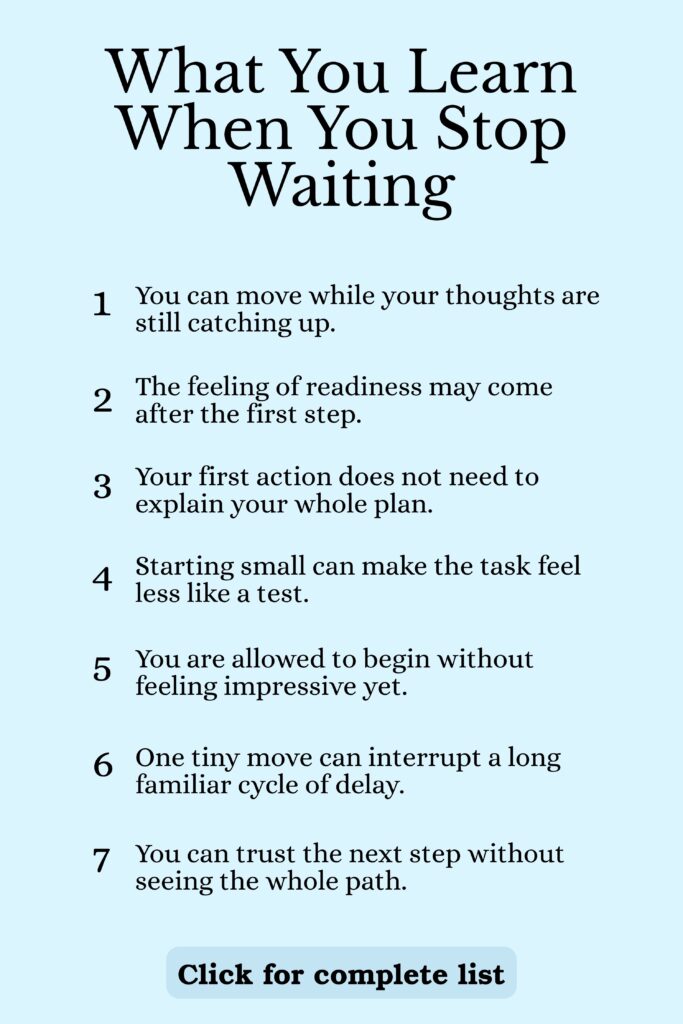
Use a no-debate prompt: Ask, “What is the first action I can take before I feel ready?”
This prompt works because it does not require readiness. It assumes action can happen first. That is often the shift people need.
You are not waiting for confidence. You are choosing motion.
Use a tiny-start prompt: Ask, “What would starting look like if I only had two minutes?”
If you want to get more from your life, and are looking for concrete action steps to get you there, check out our Request a Coach page. It’s a “cut the fence-sitting and take action” way to tackle your issues and actually find success. To get off the fence and start to take action, click or tap here.
This helps you shrink the task quickly. If your answer still sounds too big, make it smaller.
For example, “write the article” becomes “write the first rough heading.” “Organize the closet” becomes “take out the shoes from the floor.” “Fix my schedule” becomes “open the calendar.”
Use a focus prompt: Ask, “What distraction do I need to remove before I count down?”
Do not remove every distraction in your life. Remove the one that is most likely to steal the next few minutes.
Often, that is enough.
Use a momentum prompt: Ask, “What visible sign would prove I started?”
This helps you define the win. The visible sign might be a sentence, a moved object, a checked box, a timer running, or a file opened.
You need proof of motion, not proof of completion.
If you want to get more from your life, and are looking for concrete action steps to get you there, check out our Request a Coach page. It’s a “cut the fence-sitting and take action” way to tackle your issues and actually find success. To get off the fence and start to take action, click or tap here.
Use a tough-love prompt: Ask, “Am I actually unable to start, or am I trying to negotiate my way out of discomfort?”
This question is not meant to shame you. It is meant to make the pattern visible.
Sometimes you truly need rest, support, or more information. But often, the real issue is discomfort at the starting line.
When that is the case, count down and take the smallest next step.
How a Goal Setting or Productivity Coach Could Help
The 3-2-1 Countdown Start is simple enough to use on your own, but a coach can help if you keep getting stuck in the same place.
Sometimes the problem is not motivation. Sometimes the task is unclear, too large, emotionally loaded, or connected to a goal you have not fully defined.
A coach can help you see the difference.
Spot the real starting block: You may think you are lazy or undisciplined when the real issue is that your next step is too vague. A coach can help you identify where the delay actually begins.
If you want to get more from your life, and are looking for concrete action steps to get you there, check out our Request a Coach page. It’s a “cut the fence-sitting and take action” way to tackle your issues and actually find success. To get off the fence and start to take action, click or tap here.
For example, you might discover that you avoid a task because:
- You do not know the first step
- You are afraid of doing it badly
- You have too many choices
- The goal feels disconnected from your real priorities
- You are trying to do too much at once
- You have no clear finish line
- You only plan in big chunks
Once you know the real block, it becomes much easier to create a useful starting ritual.
Turn goals into startable actions: Big goals often sound inspiring but fail in daily life. “Grow my business,” “get healthier,” “be more consistent,” or “change careers” are not actions.
A coach can help turn those goals into weekly and daily moves that are small enough to begin.
That might mean creating a list of countdown-ready actions, such as:
- Write one pitch
- Walk for five minutes
- Review one job post
- Update one sentence in a resume
- Plan tomorrow’s first task
- Send one follow-up message
Build a personal countdown ritual: Not everyone starts the same way. Some people need a timer. Some need a written prompt. Some need a body-based cue, like standing up or opening a notebook.
A coach can help you design a version of the method that fits how your attention, energy, and workday actually function.
Create accountability without shame: Good accountability is not about being scolded. It is about noticing patterns and making the next attempt easier.
If you want to get more from your life, and are looking for concrete action steps to get you there, check out our Request a Coach page. It’s a “cut the fence-sitting and take action” way to tackle your issues and actually find success. To get off the fence and start to take action, click or tap here.
A coach can help you review what worked, what stalled, and what needs to change so starting becomes more repeatable.
Make the Countdown Start Work in Real Life
The countdown start becomes more powerful when you use it in ordinary moments, not just when you feel inspired.
Think of it as a tool you practice before common delay points. The more familiar it becomes, the less dramatic starting feels.
Use it before common delay points: Look for the places in your day where you tend to stall. These are perfect countdown moments.
You can use it before:
- Opening a difficult work task
- Starting a workout
- Cleaning one area
- Making a phone call
- Replying to a message
- Planning tomorrow
- Reading a document
- Returning to an abandoned project
- Beginning a goal-related habit
The countdown works well when the task is small but emotionally annoying. Those are the tasks that often waste the most mental energy because you keep thinking about them without doing them.
Attach it to an existing cue: Make the method easier to remember by pairing it with something that already happens.
For example:
If you want to get more from your life, and are looking for concrete action steps to get you there, check out our Request a Coach page. It’s a “cut the fence-sitting and take action” way to tackle your issues and actually find success. To get off the fence and start to take action, click or tap here.
- After coffee, count down and open the first task.
- After sitting at your desk, count down and start the timer.
- After a meeting ends, count down and send the follow-up.
- After lunch, count down and clear one small item.
- After opening your laptop, count down and begin the priority task.
Existing cues reduce the need to “remember to be disciplined.” The moment itself becomes the trigger.
Track starts, not finishes: If you only count finished tasks, you may miss the real progress. For this method, track how often you start.
You can mark a small check every time you use the countdown. This builds evidence that you are becoming someone who begins.
That evidence matters.
Repeat it until it feels automatic: The first few times may feel silly. That is fine. Many useful rituals feel too simple at first.
Keep practicing anyway.
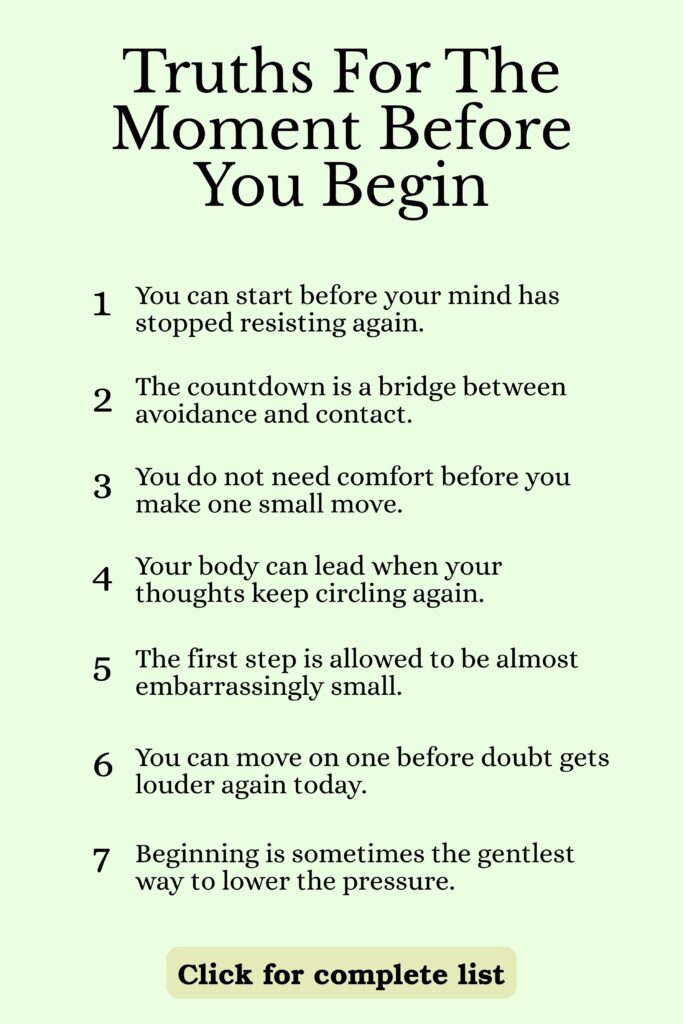
Over time, the countdown becomes a familiar bridge between avoidance and action. You stop waiting for the perfect feeling and start trusting the first move.
The First Move Is the Win
Want to try this at home? No worries! Download a copy of our SMART Goals PDF Worksheet.
If you want to get more from your life, and are looking for concrete action steps to get you there, check out our Request a Coach page. It’s a “cut the fence-sitting and take action” way to tackle your issues and actually find success. To get off the fence and start to take action, click or tap here.
Need some in depth help with goal settings, motivation or productivity ? Drop on by our directories choc full of productivity coaches, accountability coaches, and goal-setting coaches, and start reaching those goals! Or click here to have us match you to the best.
The 3-2-1 Countdown Start works because it makes action smaller than resistance.
You are not trying to overhaul your personality. You are not trying to become perfectly motivated. You are training yourself to begin before your brain turns a small task into a long negotiation.
That is the real value of this method.
A lot of goals do not fail because people are incapable. They fail because the starting point becomes too heavy. The task sits there, gathering pressure, until beginning feels harder than it needs to feel.
The countdown cuts through that pressure.
You choose the task. You shrink the first move. You count down. You act on “1.”
That is it.
If you want to get more from your life, and are looking for concrete action steps to get you there, check out our Request a Coach page. It’s a “cut the fence-sitting and take action” way to tackle your issues and actually find success. To get off the fence and start to take action, click or tap here.
Some days, the start will turn into a longer work session. Other days, it will only be two minutes. Both are useful because both teach your brain that starting is possible.
When you use this method, remember:
- The first action can be tiny.
- The first version can be messy.
- The first session can be short.
- The first win can simply be beginning.
You do not need to wait until your brain agrees. You do not need to feel fully ready. You do not need to solve every part of the task before touching the first part.
Count down.
Move.
Let the first step be small, visible, and real.
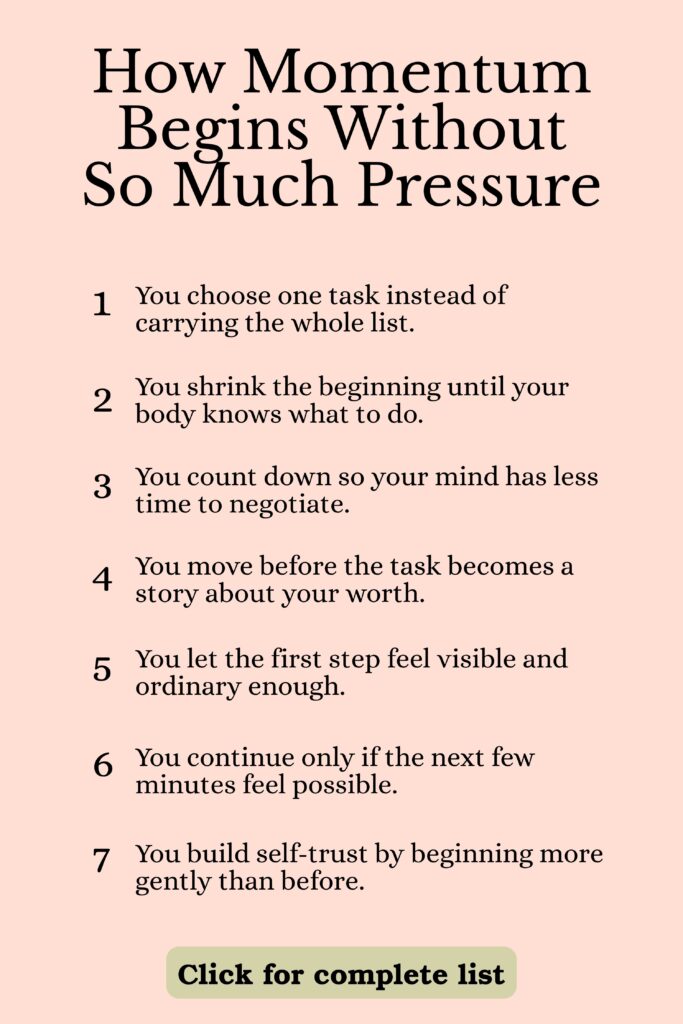
That is how momentum begins.
If you want to get more from your life, and are looking for concrete action steps to get you there, check out our Request a Coach page. It’s a “cut the fence-sitting and take action” way to tackle your issues and actually find success. To get off the fence and start to take action, click or tap here.
Read this next

Overcoming the Myth of Motivation
One of the biggest industries to evolve over the last few decades is the motivational industry. It’s everywhere, books, podcasts, social media, YouTube videos with swelling music and cinematic monologues. […]
Read More
Vision Board Ideas That Actually Help You Stay Focused on Your Goals
Try these vision board ideas that make goal setting feel clearer, calmer, and way easier to stick with every day.
Read More
How Can I Study Better? How to Improve Your Learning Experience
Do you know how to study better? It’s time to learn how to learn
Read More