


Talk to a coach about Motivational coaching

Robert Bradley Singleton
Certified Master Spiritual Life Coach, Neuropsychologist, and Existential Therapist
Train with the best to be the best you! Don't...

Diana Davis-Nanasi
ICF Certified Coach, helping clients overcome self-doubt, low confidence, stress managment
I understand life can become overwhelming; I am excited to...

Robert B Singleton, MCMA, MSc.
MSc. Metaphysical Sciences; B. Div., Divinity: Mindfulness and Positive Psychology fanatic
Positive Psychology and Mindfulness Specialties; NeuroScience and Trauma-informed

Dr. Kate Watson
B.A Psychology, M.Ed. Psychological Counseling, Dr.PH in Public Health, Certified Health Coach, Certified Life Coach, Certified Mind and Body Specialist, Certified Women's Empowerment Coach, Certified Neurodiversity Coach
Dr. Kate Watson helps people with boundaries, coping strategies, and...

Stephanie Peers
Somatic Coach | Midlife Transitions, Self-Trust & Personal Growth --> (Download my free Body-Led Clarity Guide in My Store!)
Body-led coaching for midlife women ready to trust themselves, set...

Claudia Silver
HDIP CBH - Cognitive Behavioural Hypnotherapist (UK Higher Diploma)
Certified Hypnotherapist for evidence-based help with stress, specific fears and...

Mak Estill
Anxiety, Panic & Life Coach dedicated to coaching you into a life of lesser and lighter anxiety!
Founder and owner of Actionable Anxiety, a private coaching practice...

Elise Boren
Certified Life Coach, Communication Specialist and Sound Healer
Through listening and discussion we will create a plan to...




Track Your Motivation, Not Your Whole Life: A 5-Minute Energy-and-Effort Log

Want to try this at home? No worries! Download a copy of our SMART Goals PDF Worksheet.
*****
Why Your Motivation Might Not Be the Real Problem
When you keep falling off a goal, it is easy to assume the problem is motivation.
You tell yourself you need more discipline. You wonder why you cannot just stick with the plan. You may even start thinking you are the kind of person who gets excited at the beginning, then gives up when life gets busy.
But inconsistency is not always a motivation problem.
Sometimes the real problem is low energy. Sometimes the plan is too big for the day you actually had. Sometimes you keep trying to do your hardest task at the worst possible time. Sometimes your schedule is overloaded, and your brain is quietly refusing to add one more thing.
That is why tracking your whole life can backfire.
A full habit tracker, mood tracker, sleep tracker, meal tracker, and productivity dashboard might sound helpful in theory. But when you are already tired, it can become another task to fail at.
If you want to get more from your life, and are looking for concrete action steps to get you there, check out our Request a Coach page. It’s a “cut the fence-sitting and take action” way to tackle your issues and actually find success. To get off the fence and start to take action, click or tap here.
A 5-minute energy-and-effort log is different.
It does not ask you to document everything. It asks you to notice just enough to understand what is getting in the way.
Instead of asking, “Did I succeed or fail today?” you ask:
- How much energy did I have?
- How hard did this feel?
- When did I try to do it?
- What made it easier or harder?
That tiny check-in can show you patterns you might otherwise miss.
Maybe you are not inconsistent. Maybe your goal is scheduled during your lowest-energy part of the day. Maybe the task has too much hidden friction. Maybe you need a smaller version for drained days.
The point is not to judge yourself more accurately.
The point is to adjust your plan more intelligently.
This article walks you through how to create a simple daily log that helps you spot whether low energy, overload, timing, or task friction is really causing your inconsistency. You do not need a complicated system. You only need five minutes, a few honest ratings, and a willingness to treat your behavior like useful information.
If you want to get more from your life, and are looking for concrete action steps to get you there, check out our Request a Coach page. It’s a “cut the fence-sitting and take action” way to tackle your issues and actually find success. To get off the fence and start to take action, click or tap here.
Need some in depth help with goal settings, motivation or productivity ? Drop on by our directories choc full of productivity coaches, accountability coaches, and goal-setting coaches, and start reaching those goals! Or click here to have us match you to the best.
1. Set Up a Log You Can Fill Out Even When You’re Tired
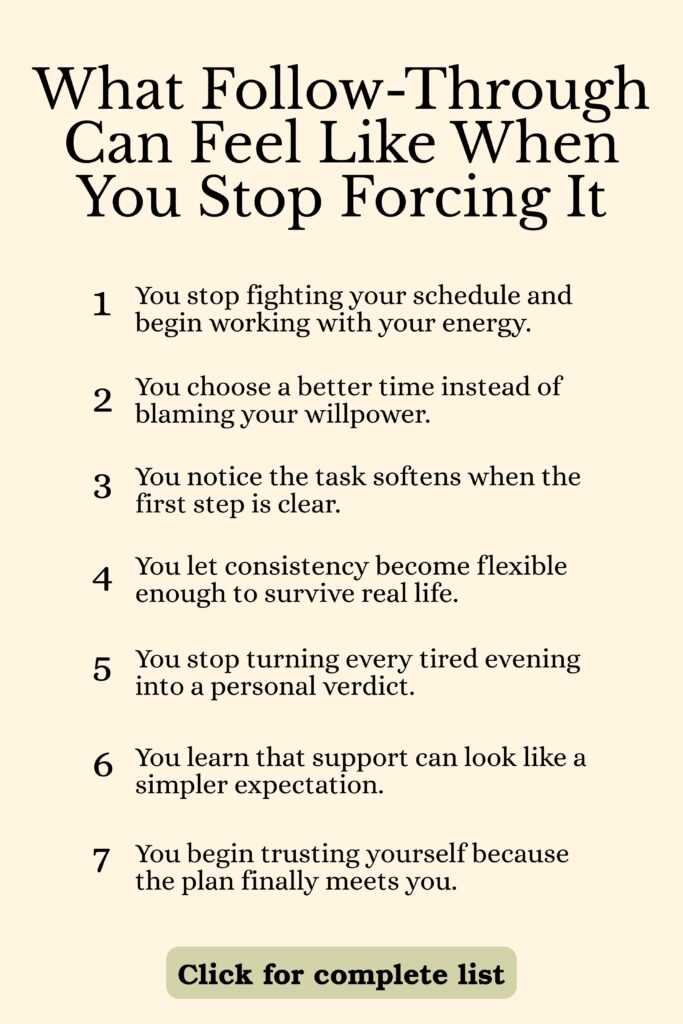
The best tracking system is not the prettiest one. It is the one you will still use when your energy is low.
If your log requires color coding, multiple apps, detailed journaling, and perfect daily entries, it may work for three days. Then it will probably become another thing you avoid. For this kind of check-in, simple is the whole strategy.
Start with a format that feels almost too easy.
You can use:
- A notes app
- A paper notebook
- A printable tracker
- A spreadsheet
- A habit app with custom notes
- A sticky note beside your desk
The tool matters less than the friction. If opening it feels annoying, choose something easier.
Use the same four fields every day:
- Energy
- Effort
- Timing
- One short note
That is enough.
If you want to get more from your life, and are looking for concrete action steps to get you there, check out our Request a Coach page. It’s a “cut the fence-sitting and take action” way to tackle your issues and actually find success. To get off the fence and start to take action, click or tap here.
You do not need to write a full recap of your day. You are only collecting clues.
- Choose the simplest format: Pick a place you can open in under ten seconds, because the log should feel like a quick check-in, not a daily writing assignment.
- Create only four daily fields: Track energy, effort, timing, and one short note so the system stays focused on what actually affects follow-through.
- Use quick rating scales: Rate energy from 1 to 5 and effort from 1 to 5, where 1 means very low and 5 means strong or demanding.
- Keep the note field tiny: Write one short phrase like “too many meetings,” “slept badly,” “started too late,” or “felt easier after lunch.”
Here is a simple version:
Date:
Energy: 2/5
Effort: 4/5
Timing: 8:30 p.m.
Note: Too tired after work
That one entry already tells you something.
It tells you the task was not just “not done.” It was attempted at night, with low energy, and it felt hard.
That is useful. That is the point.
Your log should be light enough that you can complete it even on the days when the goal itself does not happen.
2. Track Energy Before You Track Performance
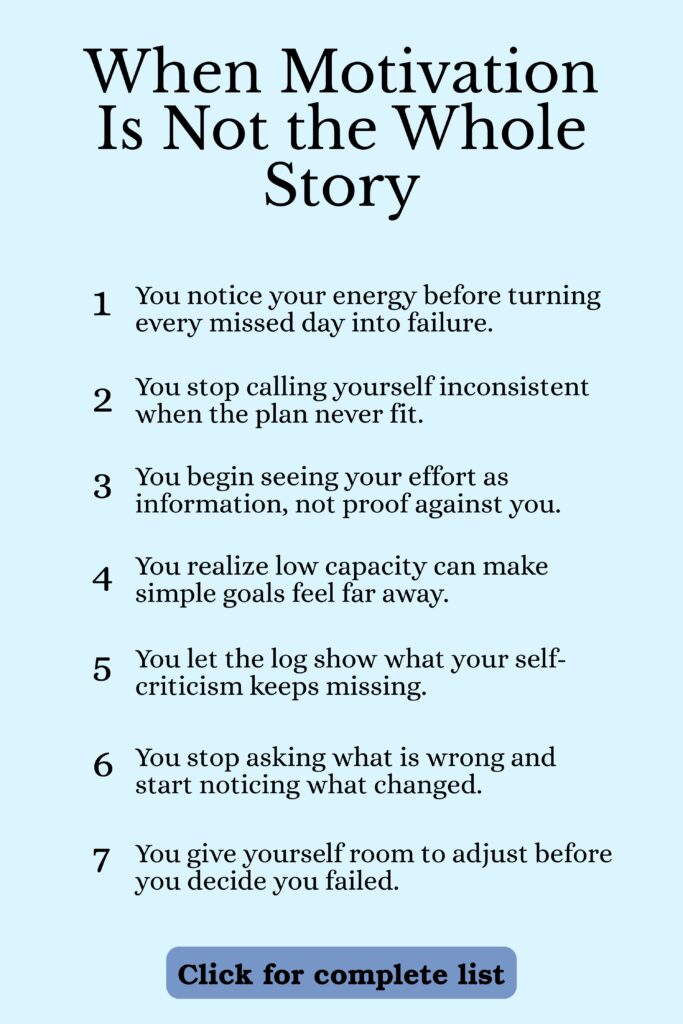
Most people track performance first.
If you want to get more from your life, and are looking for concrete action steps to get you there, check out our Request a Coach page. It’s a “cut the fence-sitting and take action” way to tackle your issues and actually find success. To get off the fence and start to take action, click or tap here.
They ask, “Did I work out?” “Did I write?” “Did I clean?” “Did I finish the thing?”
Those questions can be useful, but they leave out something important: what kind of capacity you had that day.
A task that feels doable on a high-energy morning can feel impossible after a long day of decisions, interruptions, errands, calls, and emotional noise. The task did not change. Your capacity did.
That is why energy needs to come before performance.
When you log your energy, you are not making excuses. You are identifying the conditions you are working with.
A simple 1 to 5 energy scale works well:
- 1 = barely functioning
- 2 = low energy
- 3 = okay, but not strong
- 4 = steady and capable
- 5 = energized and ready
You can also add a short label for the kind of tired you feel.
For example:
If you want to get more from your life, and are looking for concrete action steps to get you there, check out our Request a Coach page. It’s a “cut the fence-sitting and take action” way to tackle your issues and actually find success. To get off the fence and start to take action, click or tap here.
- Sleepy
- Mentally full
- Emotionally drained
- Physically tired
- Socially exhausted
- Overstimulated
- Flat or unfocused
This matters because different types of tired need different solutions.
Sleepy may mean you need an earlier bedtime or a lower-effort morning plan. Mentally full may mean you need fewer decisions before starting. Socially exhausted may mean you should avoid placing personal goals right after heavy meetings or family demands.
- Rate your energy honestly: Write down how much capacity you actually had before deciding what the day says about your discipline.
- Name the kind of tired you felt: Use plain labels like sleepy, drained, mentally full, or physically tired so you can see what kind of energy is missing.
- Compare energy to your goal size: Notice whether you expected a high-output task from a low-capacity day.
- Look for repeat energy dips: Watch for patterns like “always tired after work” or “better before lunch.”
This one shift can be powerful.
Instead of saying, “I never stick with things,” you may realize, “I keep putting my hardest goal into my lowest-energy window.”
That is not a character flaw.
That is a scheduling problem.
3. Separate Low Motivation From High Effort
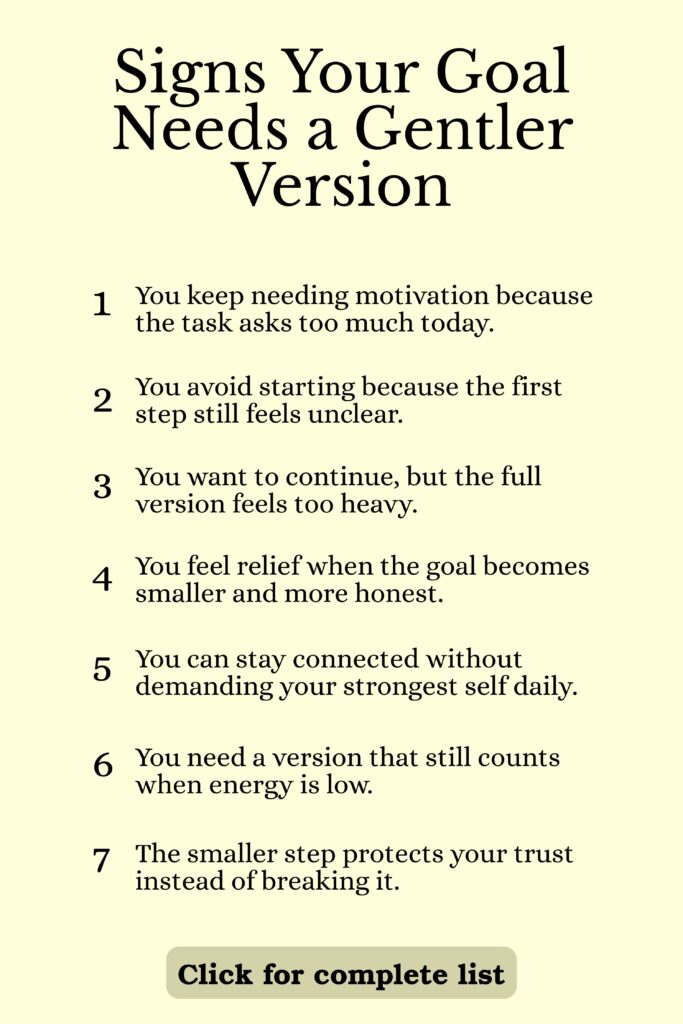
Sometimes you think you are unmotivated because a task feels too hard to start.
But “hard to start” can mean many different things.
If you want to get more from your life, and are looking for concrete action steps to get you there, check out our Request a Coach page. It’s a “cut the fence-sitting and take action” way to tackle your issues and actually find success. To get off the fence and start to take action, click or tap here.
It might mean the task is unclear. It might mean there are too many steps. It might mean you have not decided what “done” looks like. It might mean the task is emotionally loaded, boring, messy, or too big for the amount of time you have.
That is why your log should track effort separately from energy.
Energy is your capacity. Effort is the demand of the task.
A low-energy day can make a normal task feel harder. But even on a decent-energy day, some tasks still feel heavy because they contain hidden friction.
Use a 1 to 5 effort scale:
- 1 = very easy
- 2 = manageable
- 3 = takes some push
- 4 = hard to start or finish
- 5 = feels like a wall
This helps you notice when a task is repeatedly asking too much.
For example, “plan meals for the week” might sound like one task. But hidden inside it are several smaller steps:
- Check the fridge
- Choose recipes
- Think about schedules
- Make a grocery list
- Decide what to prep
- Possibly shop
- Possibly cook
No wonder it feels like a 5.
If you want to get more from your life, and are looking for concrete action steps to get you there, check out our Request a Coach page. It’s a “cut the fence-sitting and take action” way to tackle your issues and actually find success. To get off the fence and start to take action, click or tap here.
The problem may not be motivation. The problem may be that the task is not actually one task.
- Score how hard the task felt: Rate the effort required, not just whether you completed the action.
- Notice hidden friction: Look for unclear steps, missing supplies, too many decisions, or anything that made starting harder.
- Mark tasks that cost more than expected: If a “small” task keeps feeling like a 4 or 5, treat that as information.
- Shrink the next version: Turn the task into something smaller, like “open the document,” “choose one recipe,” or “put shoes by the door.”
This is where your log becomes more than a tracker.
It becomes a plan editor.
Instead of pushing yourself to “try harder,” you can ask, “How can I make this task cost less effort next time?”
That question is often much more useful.
4. Use Timing Clues to Find Your Natural Follow-Through Window
Timing can quietly make or break a goal.
You may be trying to build a habit at a time of day that works on paper but fails in real life. Maybe you planned to work out after dinner, but that is when your energy drops. Maybe you planned to write before bed, but your brain is already done. Maybe you planned to organize on Sunday night, but that is when you feel pressure about the week ahead.
A motivation tracker that ignores timing misses one of the biggest clues.
If you want to get more from your life, and are looking for concrete action steps to get you there, check out our Request a Coach page. It’s a “cut the fence-sitting and take action” way to tackle your issues and actually find success. To get off the fence and start to take action, click or tap here.
In your log, write down the rough time you tried to do the task, or the time you planned to do it and skipped it.
You do not need exact timestamps.
Simple notes work:
- Morning
- Before work
- Lunch
- Mid-afternoon
- After work
- After dinner
- Before bed
After a week or two, you may start seeing patterns.
Maybe your best window is earlier than you thought. Maybe your worst window is the one you keep forcing because it looks convenient. Maybe the task itself is fine, but the placement is wrong.
- Record when you tried: Note the time of day so you can see whether timing is helping or hurting your consistency.
- Compare your best and worst windows: Look for the times when starting feels lighter, distractions are lower, or your brain feels more available.
- Stop forcing the hardest slot: If evenings are consistently drained, stop treating evening failure as a discipline issue.
- Attach the task to a stronger anchor: Pair the action with something that already happens, like after coffee, before email, after school drop-off, or right after lunch.
The goal is not to find a perfect time. Most people do not have one.
The goal is to find a better time.
Even moving a task by 30 minutes can change how it feels. Doing it before you open your inbox may feel completely different from doing it after everyone has asked something from you.
If you want to get more from your life, and are looking for concrete action steps to get you there, check out our Request a Coach page. It’s a “cut the fence-sitting and take action” way to tackle your issues and actually find success. To get off the fence and start to take action, click or tap here.
Your log helps you stop guessing.
It shows you where follow-through naturally has more support.
5. Add One “Reason It Didn’t Happen” Without Blaming Yourself
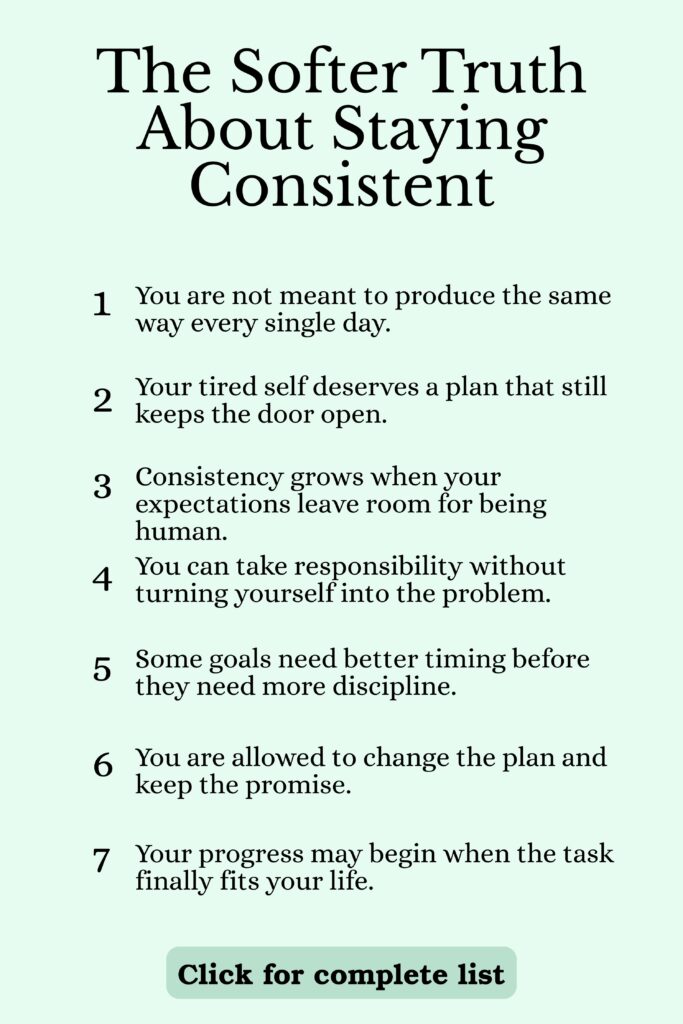
When a goal does not happen, most people write a story around it.
“I failed again.”
“I have no discipline.”
“I always do this.”
“I guess I did not want it enough.”
Those stories feel true in the moment, but they are usually too vague to help. They make you feel worse without showing you what to change.
If you want to get more from your life, and are looking for concrete action steps to get you there, check out our Request a Coach page. It’s a “cut the fence-sitting and take action” way to tackle your issues and actually find success. To get off the fence and start to take action, click or tap here.
A better approach is to choose one practical reason.
Not a dramatic reason. Not a self-critical reason. Just a usable one.
Try categories like:
- Low energy
- Overload
- Bad timing
- Task too big
- Forgot
- Unclear next step
- Too many decisions
- Not enough time
- Not actually important today
- Needed support
This turns a missed task into information.
For example, “I skipped my workout because I’m lazy” gives you nowhere to go. But “I skipped it because I got home late and the full workout felt too big” gives you a next step.
You can create a shorter workout. You can move it earlier. You can set out clothes in advance. You can decide that late days only require stretching.
That is useful.
- Pick one reason category: Choose the main reason the task did not happen so the pattern becomes easier to see.
- Avoid vague labels: Replace “I failed” with something specific like “started too late,” “too many steps,” or “energy was low.”
- Use the reason to adjust the plan: If the same reason repeats, change the system instead of repeating the same expectation.
- Keep the tone neutral: Treat the entry like dashboard data, not a character review.
This part of the log is especially helpful if you tend to blame yourself quickly.
If you want to get more from your life, and are looking for concrete action steps to get you there, check out our Request a Coach page. It’s a “cut the fence-sitting and take action” way to tackle your issues and actually find success. To get off the fence and start to take action, click or tap here.
You are not letting yourself off the hook. You are getting clearer.
There is a big difference between responsibility and self-criticism.
Responsibility says, “What can I change so this works better?”
Self-criticism says, “What is wrong with me?”
Your log should always point you back to the first question.
6. Review the Log Once a Week in 5 Minutes
Daily tracking is useful, but the real value appears when you review the pattern.
You do not need a long weekly reflection. You only need five minutes to scan your entries and look for repeats.
The goal is not to analyze every detail. The goal is to notice what happened more than once.
If you want to get more from your life, and are looking for concrete action steps to get you there, check out our Request a Coach page. It’s a “cut the fence-sitting and take action” way to tackle your issues and actually find success. To get off the fence and start to take action, click or tap here.
Look across the week and ask:
- When was my energy highest?
- When was my energy lowest?
- Which tasks felt harder than expected?
- What reason showed up most often?
- Did timing affect follow-through?
- What made things easier?
Circle or highlight anything that appears two or more times.
For example, you might notice:
- Low energy after work on Monday, Tuesday, and Thursday
- High effort every time you tried to meal plan
- Better follow-through before checking email
- Missed habits on days with back-to-back meetings
- Easier starts when the first step was already prepared
Now you have something to work with.
The key is to choose one adjustment for the next week.
Not five. Not a complete life reset. One.
- Scan for repeated patterns: Look for anything that shows up more than twice, because repeats are usually more useful than one-off bad days.
- Choose one adjustment only: Move the task, shrink the task, prep the first step, or change the reminder, but do not overhaul everything.
- Keep what already worked: Notice the conditions that helped you follow through and repeat them on purpose.
- Write one sentence for next week: Create a simple plan like “I will do this before lunch” or “On drained days, I only need the 2-minute version.”
A weekly review keeps the log from becoming passive tracking.
You are not collecting information just to collect it. You are using it to make your plan more realistic.
If you want to get more from your life, and are looking for concrete action steps to get you there, check out our Request a Coach page. It’s a “cut the fence-sitting and take action” way to tackle your issues and actually find success. To get off the fence and start to take action, click or tap here.
This is where the self-blame starts to loosen.
When you see the same pattern on paper, it becomes harder to believe the problem is simply that you are not trying.
You may be trying. You just may be trying against the same obstacle every day.
7. Build a Low-Energy Version of Every Important Goal
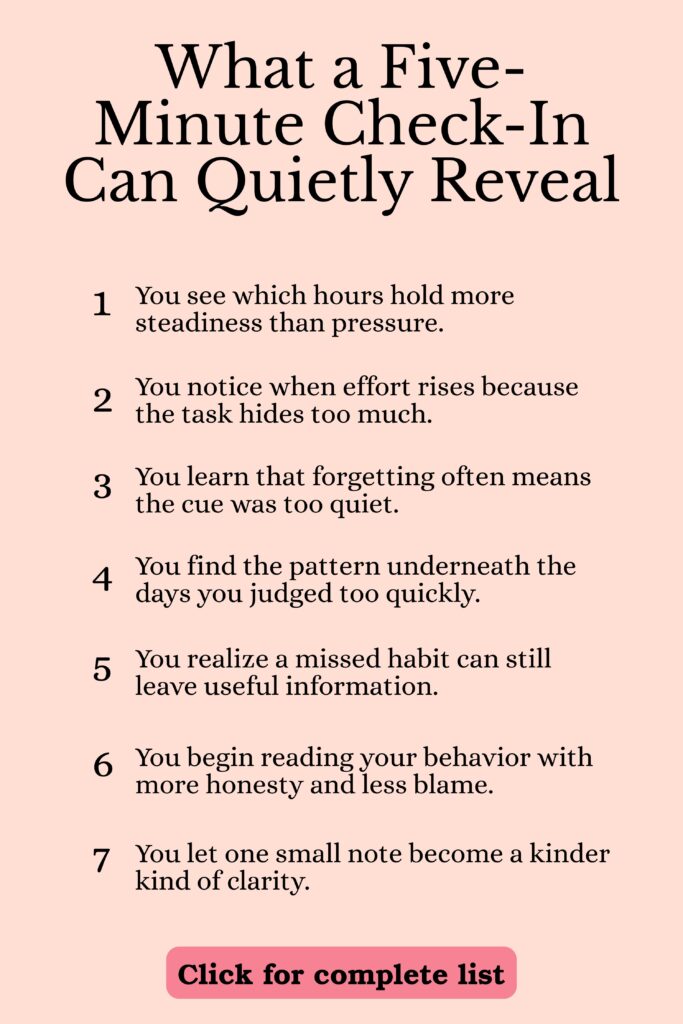
One of the best things your log can show you is when your plan needs a low-energy version.
Most people create goals for their best selves.
They imagine the version of themselves who slept well, has time, feels focused, and is ready to do the full routine. That version may exist sometimes. But it is not the only version who needs a plan.
Your tired self needs a plan too.
Your busy self needs a plan. Your emotionally drained self needs a plan. Your “I have ten minutes and no patience” self needs a plan.
If you want to get more from your life, and are looking for concrete action steps to get you there, check out our Request a Coach page. It’s a “cut the fence-sitting and take action” way to tackle your issues and actually find success. To get off the fence and start to take action, click or tap here.
This does not mean lowering your standards forever. It means keeping the habit alive when your capacity is lower than expected.
For every important goal, create three versions:
- Full version
- Medium version
- Minimum version
For example, if your goal is exercise:
- Full version: 45-minute workout
- Medium version: 15-minute walk
- Minimum version: 2 minutes of stretching
If your goal is writing:
- Full version: Draft 1,000 words
- Medium version: Write one section
- Minimum version: Open the document and write one messy sentence
If your goal is planning:
- Full version: Full weekly review
- Medium version: Choose top three tasks
- Minimum version: Pick tomorrow’s first task
- Define the full version: Write down what the goal looks like on a strong day when you have enough time and energy.
- Create the minimum version: Decide what counts on a drained day so you do not abandon the goal completely.
- Protect the habit thread: Use the low-energy version to stay connected to the routine without pretending every day is the same.
- Let the log tell you when to scale back: If energy is low and effort is high, use the smaller version before quitting the goal.
This is not cheating.
It is adaptive consistency.
The minimum version keeps the door open. It gives you a way to continue without demanding full output from a low-capacity day.
If you want to get more from your life, and are looking for concrete action steps to get you there, check out our Request a Coach page. It’s a “cut the fence-sitting and take action” way to tackle your issues and actually find success. To get off the fence and start to take action, click or tap here.
That is often what makes a goal sustainable.
8. Use the Log to Redesign Your Plan, Not Criticize Yourself
A tracker is only helpful if it leads to better decisions.
If your log becomes a place where you record failure after failure, it will feel heavy fast. The purpose is not to create written proof that you are inconsistent. The purpose is to help you redesign the plan until it fits your real life better.
Start by looking for mismatches.
A mismatch happens when your plan expects something your day cannot reliably provide.
For example:
- You planned a high-focus task during your most interrupted hour.
- You planned a full workout on your lowest-energy evening.
- You planned a complicated habit without preparing the first step.
- You planned too many changes at once.
- You expected motivation to solve a task that actually needs structure.
Once you see the mismatch, adjust the plan.
You might change the time, size, location, reminder, first step, or frequency.
If you want to get more from your life, and are looking for concrete action steps to get you there, check out our Request a Coach page. It’s a “cut the fence-sitting and take action” way to tackle your issues and actually find success. To get off the fence and start to take action, click or tap here.
Small changes can make a big difference.
If a task feels too big, shrink it. If it gets forgotten, make it visible. If it always fails at night, test it earlier. If it creates decision fatigue, decide the next step in advance.
- Match tasks to energy levels: Put demanding tasks into higher-energy windows and save easier maintenance tasks for lower-energy times.
- Remove one friction point: Use your notes to eliminate one recurring obstacle, such as unclear steps, missing materials, or too many decisions.
- Change the goal size before changing the goal: If the goal still matters but keeps failing, test a smaller version before dropping it.
- Track whether the adjustment worked: After a few days, check whether the new version lowered the effort score or improved follow-through.
This turns your goal into an experiment.
You are not asking, “Am I disciplined enough?”
You are asking, “What conditions make this easier to repeat?”
That question is kinder, but it is also more practical.
Because once you know the conditions that support consistency, you can build around them.
You stop relying on motivation to carry the whole plan.
If you want to get more from your life, and are looking for concrete action steps to get you there, check out our Request a Coach page. It’s a “cut the fence-sitting and take action” way to tackle your issues and actually find success. To get off the fence and start to take action, click or tap here.
What a Coach Can Help You See in Your Log
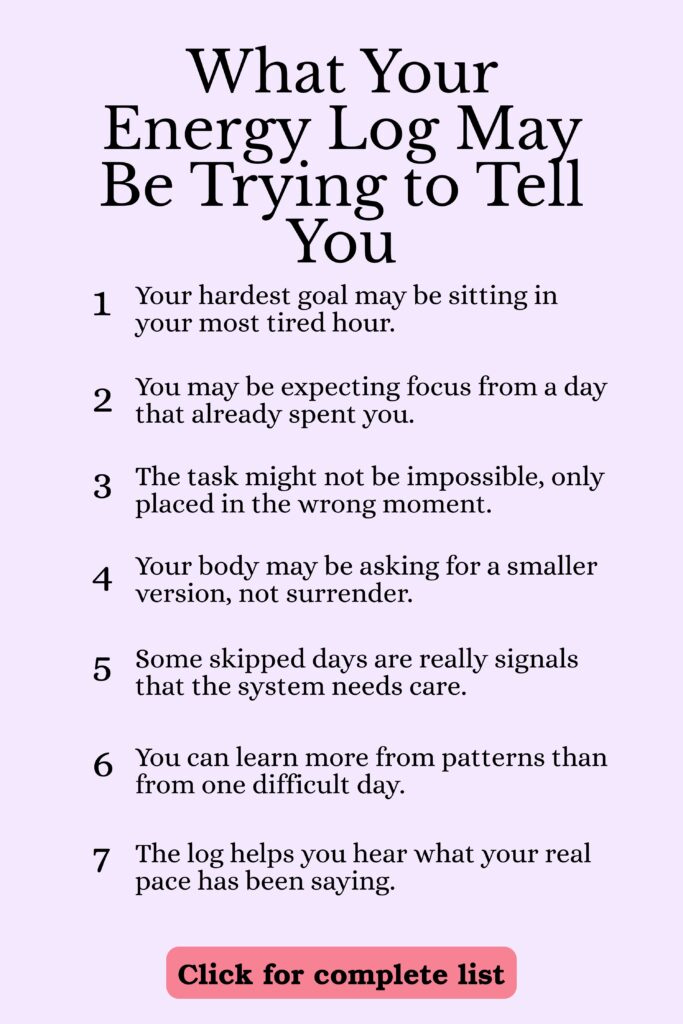
A 5-minute log can be useful on your own, but it can become even more powerful when someone helps you interpret the pattern.
A goal-setting coach, productivity coach, organizational coach, or life coach can help you look at the log without the self-blame that often comes up when you review your own behavior.
Sometimes the pattern is obvious to someone outside your head.
You may say, “I do not know why I keep failing at this.”
A coach might notice that every missed day comes after a packed schedule. Or that every high-effort rating happens when the task has no clear first step. Or that you are trying to build a routine during the part of the day when you have the least control.
The value is not that a coach magically fixes your motivation.
The value is that they help you turn the data into a better experiment.
- Spot patterns you might dismiss: A coach can help you notice repeated energy dips, overload cycles, and timing problems that you may be treating as personal failure.
- Separate excuses from useful data: A coach can help you tell the difference between avoidance and a plan that genuinely needs to be redesigned.
- Turn observations into experiments: Instead of saying “try harder,” a coach can help you test smaller steps, stronger anchors, or better timing.
- Build accountability around adjustments: Coaching can keep the focus on learning and follow-through, not perfection.
This can be especially helpful if you are hard on yourself.
If you want to get more from your life, and are looking for concrete action steps to get you there, check out our Request a Coach page. It’s a “cut the fence-sitting and take action” way to tackle your issues and actually find success. To get off the fence and start to take action, click or tap here.
When you are used to self-criticism, even useful data can feel like evidence against you. A coach can help you read the log more neutrally.
They may ask questions like:
- What happens right before this task gets skipped?
- What would make this easier by 20 percent?
- What is the smallest version that still counts?
- Where does this fit naturally in your day?
- Is this goal still aligned with what you actually want?
Those questions move you from blame to design.
And when your plan fits better, consistency often gets easier.
Common Log Patterns and What They Usually Mean
After you use your log for a week or two, certain patterns may start to repeat.
These patterns are helpful because they show you what kind of adjustment to try next. You do not need to guess blindly. Your entries can point you toward the most likely fix.
One common pattern is low energy plus high effort.
This usually means the task is too demanding for your current capacity. You may still care about the goal, but the version you are asking yourself to do is too large for that moment.
If you want to get more from your life, and are looking for concrete action steps to get you there, check out our Request a Coach page. It’s a “cut the fence-sitting and take action” way to tackle your issues and actually find success. To get off the fence and start to take action, click or tap here.
The adjustment is usually to shrink the task, move it to a better time, or create a low-energy version.
Another common pattern is good energy plus high effort.
This can mean the task itself has friction. Maybe the next step is unclear. Maybe the task involves too many decisions. Maybe you are avoiding it because it feels uncomfortable, boring, or emotionally loaded.
The adjustment is to clarify the first step, remove decisions, or break the task into smaller pieces.
Here are a few patterns to watch for:
- Low energy plus high effort: The task may be too big for your current capacity, so test a smaller version or move it to a stronger time of day.
- Good energy plus high effort: The task may be unclear, complicated, or emotionally heavy, so define the first step more clearly.
- Low energy plus low effort: This is a good window for maintenance habits, quick resets, or minimum versions.
- Good energy plus low effort: This is a strong window for consistency, slightly bigger goals, or tasks that usually get postponed.
- Repeated bad timing: The task may be placed in the wrong part of your day, even if the goal itself is realistic.
- Repeated “forgot” entries: The goal may need a stronger cue, visible reminder, or built-in anchor.
- Repeated “too big” entries: The goal needs a smaller starting point, not more pressure.
The goal is not to diagnose yourself.
The goal is to choose your next adjustment.
When you can name the pattern, the solution becomes less emotional and more practical.
If you want to get more from your life, and are looking for concrete action steps to get you there, check out our Request a Coach page. It’s a “cut the fence-sitting and take action” way to tackle your issues and actually find success. To get off the fence and start to take action, click or tap here.
The Real Win Is Knowing What to Adjust
The biggest benefit of a 5-minute energy-and-effort log is not that you become a perfect tracker.
You probably will not fill it out perfectly. You may miss a day. You may forget a few details. You may only use it during seasons when a goal feels stuck.
That is fine.
The real win is learning how to understand your inconsistency without immediately blaming yourself.
When you track energy, effort, timing, and one short note, you start to see the difference between a motivation problem and a plan problem.
You may discover that your goal is too large for your current season. You may discover that your best focus window is earlier than you thought. You may discover that low-energy days need a minimum version. You may discover that the task you keep avoiding is not hard because you are lazy, but because it has too many unclear steps.
That kind of information gives you choices.
You can move the task.
If you want to get more from your life, and are looking for concrete action steps to get you there, check out our Request a Coach page. It’s a “cut the fence-sitting and take action” way to tackle your issues and actually find success. To get off the fence and start to take action, click or tap here.
You can shrink the task.
You can prep the first step.
You can lower the effort.
You can protect your best energy window.
You can ask for support.
You can stop expecting the same output from every version of yourself.
The log is not there to control your whole life. It is there to help you notice what your life is already telling you.
If you want to start today, keep it very simple.
If you want to get more from your life, and are looking for concrete action steps to get you there, check out our Request a Coach page. It’s a “cut the fence-sitting and take action” way to tackle your issues and actually find success. To get off the fence and start to take action, click or tap here.
Tonight, write down:
- Energy: 1 to 5
- Effort: 1 to 5
- Timing: when you tried
- Note: one phrase about what helped or got in the way
That is enough.
Do it for a few days, then look for one pattern.
Not every pattern. Not your entire personality. Just one useful clue.
Because consistency usually improves faster when you stop asking, “What is wrong with me?” and start asking, “What needs to change so this is easier to repeat?”
*****
Want to try this at home? No worries! Download a copy of our SMART Goals PDF Worksheet.
Need some in depth help with goal settings, motivation or productivity ? Drop on by our directories choc full of productivity coaches, accountability coaches, and goal-setting coaches, and start reaching those goals! Or click here to have us match you to the best.
If you want to get more from your life, and are looking for concrete action steps to get you there, check out our Request a Coach page. It’s a “cut the fence-sitting and take action” way to tackle your issues and actually find success. To get off the fence and start to take action, click or tap here.
If you want to get more from your life, and are looking for concrete action steps to get you there, check out our Request a Coach page. It’s a “cut the fence-sitting and take action” way to tackle your issues and actually find success. To get off the fence and start to take action, click or tap here.
Read this next

Visualize Your Dream Into Reality
Here is a quick way to help you push through your comfort zone to bring a dream into reality.
Read More
8 Focus Setups for People Who Feel Busy but Get Nothing Finished
Busy all day but still getting nowhere? These focus setups help you find the real problem and finally start making progress that sticks.
Read More
How To Do a Coaching Assessment
Start your coaching with a self assessment to determine what is truly important to you.
Read More