




The 10-Minute Networking Follow-Up System for Busy Professionals

Want to try this at home? Download your free template now!
***
Most people do not struggle with networking because they are bad at talking to people. They struggle because the conversation ends, real life takes over, and the follow-up never happens.
That is where good opportunities quietly disappear. A thoughtful chat at a conference turns into a forgotten name in your notes app. A warm introduction fades because too many days pass. A promising connection gets buried under work, errands, and a hundred other things that feel more urgent in the moment.
The good news is that follow-up does not need to be complicated to work. It does not need a fancy CRM, a perfect template library, or an hour blocked off after every event. What it needs is a simple system you can repeat without thinking too hard about it.
That is what this article is built to give you.
This is not a guide for people who love spending their evenings crafting polished networking emails. It is for busy professionals who want a realistic way to stay top of mind after meetings, coffee chats, panels, conferences, introductions, and casual work conversations.
The core idea is simple. Instead of treating follow-up like a vague task you hope to remember later, you turn it into a short routine with a few clear steps:
If you want to get more from your life, and are looking for concrete action steps to get you there, check out our Request a Coach page. It’s a “cut the fence-sitting and take action” way to tackle your issues and actually find success. To get off the fence and start to take action, click or tap here.
- capture the contact
- sort the relationship
- send a quick message
- make the next step easy
- keep the connection warm over time
Each step is small on purpose. You should be able to move through the system quickly, even on a crowded day.
A good networking follow-up system does three important things. It helps you remember who matters, makes your messages feel more personal, and reduces the mental friction that causes procrastination. That matters because consistency usually wins over brilliance here. A short, timely message is far more useful than a perfect one you never send.
If networking has ever felt harder after the conversation than during it, you are not alone. The real challenge is rarely saying hello. It is knowing what to do next.
Once you have a repeatable process, staying in touch stops feeling awkward and starts feeling manageable. And that is often what turns one pleasant conversation into an actual professional relationship.
Need some business or career guidance? Drop on by our directories choc full of business coaches and career coaches to bring your business or career to the next level. Or click here to have us match you to the best.
Start with a fast contact capture habit
Start with a fast contact capture habit: Before the event details fade, save the person’s name, context, and one memorable detail in one place.
The biggest networking mistake usually happens before the follow-up message is even written. You meet someone interesting, have a solid conversation, tell yourself you will remember the details, and then by the next day everything has blurred together.
You remember their face, kind of. You remember the vibe of the conversation, maybe. But the specific detail that would make your follow-up feel natural is gone. That is why the first part of a good system is not messaging. It is capture.
If you want to get more from your life, and are looking for concrete action steps to get you there, check out our Request a Coach page. It’s a “cut the fence-sitting and take action” way to tackle your issues and actually find success. To get off the fence and start to take action, click or tap here.
You need one place where every new contact goes. It does not matter whether that is your phone notes app, a spreadsheet, your contacts app, a simple document, or a task manager. What matters is that you use the same place every time.
Your contact capture note should be simple. You are not writing a biography. You are preserving just enough information to make the next step easy.
Record these basics:
- full name
- where you met
- what they do
- one memorable detail from the conversation
- anything you promised to send or do
- any next step worth noting
That memorable detail matters more than people think. It might be a project they mentioned, a career move they are considering, a book they recommended, or even something personal but appropriate, like an upcoming trip or a professional milestone.
That one detail is often what saves your message from sounding generic.
For example, instead of writing “Met Sarah at panel,” write something like:
- Met Sarah after marketing panel
- Works in employer branding
- Mentioned hiring for a content strategist role
- Recommended I read her team’s annual report
- Said to send over my portfolio site
That takes less than a minute, but it gives you everything you need later.
The best time to do this is immediately after the conversation or during a break. If you wait until the end of the day, your brain will start blending people together, especially if you met several at once.
If you want to get more from your life, and are looking for concrete action steps to get you there, check out our Request a Coach page. It’s a “cut the fence-sitting and take action” way to tackle your issues and actually find success. To get off the fence and start to take action, click or tap here.
This habit may feel small, but it does heavy lifting. It protects the conversation while it is still fresh. It reduces the pressure to remember everything later. And it gives you the raw material for a follow-up that feels thoughtful instead of forced.
If you want your networking follow-up to feel easy, do not rely on memory. Build a capture habit that does the remembering for you.
Sort the contact by relationship value
Sort the contact by relationship value: Decide whether this is a recruiter, peer, mentor, potential client, collaborator, or weak tie so the follow-up feels appropriate.
Not every networking contact should get the same message. That is where a lot of people go wrong. They either send the exact same polite note to everyone, or they overthink each message because they have not decided what kind of relationship they are actually trying to build.
A quick category solves that problem.
After you capture the contact, sort them into a simple relationship type. You do not need a complicated system with ten labels. A few clear categories are enough to guide your tone, your timing, and your next step.
Useful categories might include:
- recruiter or hiring manager
- peer in your field
- mentor or senior professional
- potential client or referral source
- collaborator or industry partner
- weak tie you want to keep warm
This is not about putting people in boxes in a cold way. It is about making sure your follow-up matches the relationship and the opportunity.
If you want to get more from your life, and are looking for concrete action steps to get you there, check out our Request a Coach page. It’s a “cut the fence-sitting and take action” way to tackle your issues and actually find success. To get off the fence and start to take action, click or tap here.
For example, a recruiter probably needs a message that is clear, professional, and tied to the hiring conversation. A peer might respond better to something warmer and more conversational. A senior professional who offered advice may appreciate a thank-you and a thoughtful update later, rather than an immediate request.
When you skip this step, your messages can miss the mark. You may sound too casual with someone who expects clarity. Or you may sound too formal with someone who would rather have a simple, human note.
Sorting also helps you define the purpose of the follow-up. Ask yourself one question: what is the most natural outcome here?
That outcome might be:
- staying top of mind for a role
- building an ongoing professional relationship
- continuing a useful conversation
- opening the door to future collaboration
- simply leaving a good impression
You do not need every contact to turn into a call, a referral, or an opportunity. Sometimes the win is just being remembered positively.
Here is the real benefit of this step. It helps you stop writing as if every person has the same role in your network. They do not. And when your message reflects the actual context, it feels more respectful and more genuine.
A fast label gives your follow-up structure. It tells you how formal to be, what kind of value to offer, and whether you should ask for anything at all. That makes the writing easier and the message better.
Good networking follow-up is not just prompt. It is appropriate. Sorting your contacts makes that much easier.
If you want to get more from your life, and are looking for concrete action steps to get you there, check out our Request a Coach page. It’s a “cut the fence-sitting and take action” way to tackle your issues and actually find success. To get off the fence and start to take action, click or tap here.
Send a same-day or next-day message
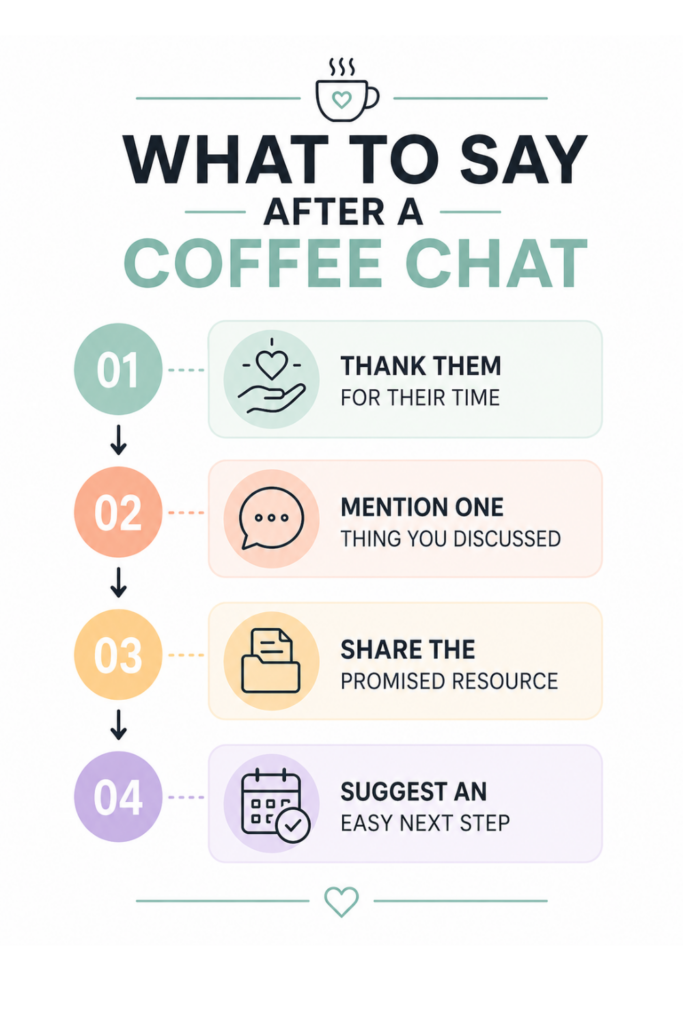
Send a same-day or next-day message: Follow up while the conversation still feels warm so your name stays attached to the interaction.
Timing matters more than people realize. A great follow-up sent a week later often feels colder than a simple one sent the next day. That is because networking momentum fades quickly, even when the conversation itself was genuinely good.
People are busy. They go from one meeting to the next, one inbox pile to another. If you want your name to stay attached to a positive interaction, reach out while the conversation is still fresh enough for them to place you easily.
That does not mean your message has to be perfect. In fact, waiting for the perfect wording is usually what creates delay. Your goal is not literary excellence. Your goal is warm recognition.
A same-day or next-day message works because it does three things:
- reminds them who you are
- signals professionalism and follow-through
- keeps the conversation open before it goes cold
Most networking follow-ups can be short. You do not need a long recap or an overly polished paragraph. You just need enough context and enough specificity to sound real.
A solid first follow-up usually includes:
- a greeting
- where you met or how you connected
- one detail from the conversation
- a thank-you, promised item, or simple next step
For example, if you met someone at an event, you might thank them for the conversation and mention the topic you discussed. If they shared advice, reference that advice. If you promised to send something, send it now. If they invited you to stay in touch, acknowledge that clearly.
If you want to get more from your life, and are looking for concrete action steps to get you there, check out our Request a Coach page. It’s a “cut the fence-sitting and take action” way to tackle your issues and actually find success. To get off the fence and start to take action, click or tap here.
What matters is speed plus relevance.
If you are nervous about sounding too eager, remember this: timely follow-up usually reads as organized, not pushy. Especially when the message is short and easy to respond to.
A delay can create a strange kind of pressure. After three or four days, people often start thinking they need to explain why they are writing late. After a week, the message starts feeling more awkward to send. After two weeks, many people give up entirely.
That is why the best rule is simple. Send it before your brain has time to turn it into a bigger deal than it is.
Even if the message is just a few sentences, it does important work. It confirms the connection happened. It shows that you pay attention. And it makes future outreach much easier because now there is already a thread, a message, or a moment to build on.
Fast follow-up is not about pressure. It is about preserving warmth.
Use a three-line follow-up formula
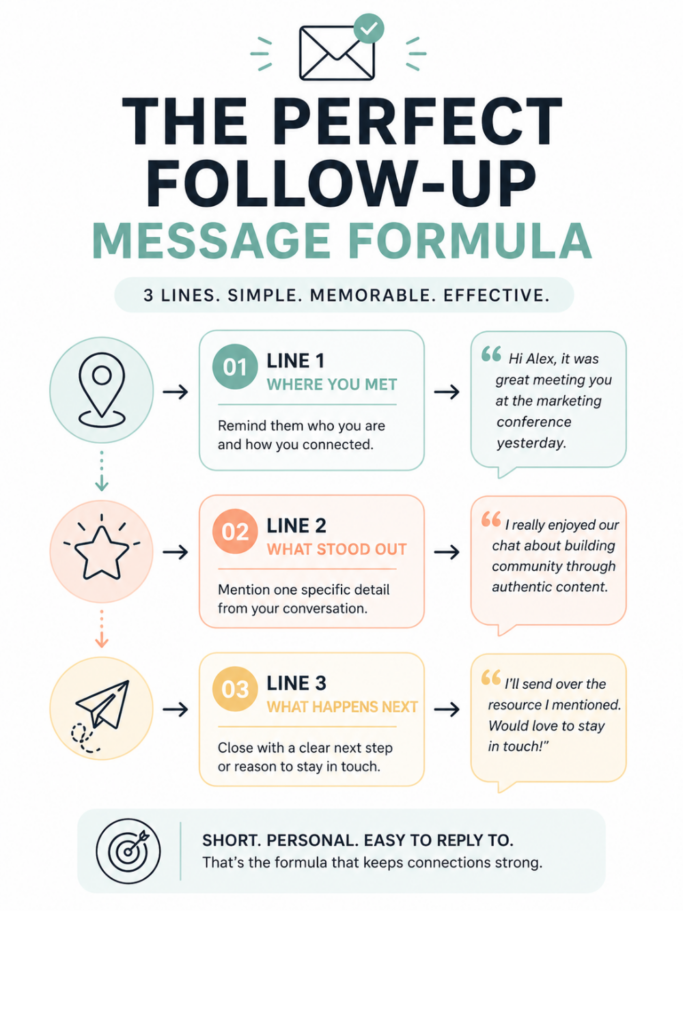
Use a three-line follow-up formula: Build every message around recognition, relevance, and response so it is easy to write and easy to answer.
One reason people avoid follow-up is that they sit down to write and suddenly everything feels weirdly high stakes. They do not know how formal to sound, how much detail to include, or whether they should ask for something right away.
If you want to get more from your life, and are looking for concrete action steps to get you there, check out our Request a Coach page. It’s a “cut the fence-sitting and take action” way to tackle your issues and actually find success. To get off the fence and start to take action, click or tap here.
A simple formula removes that friction.
The easiest version is a three-line structure built around recognition, relevance, and response. It keeps your message clear, personal, and low pressure. It also makes it much easier to write quickly without sounding generic.
Here is how it works.
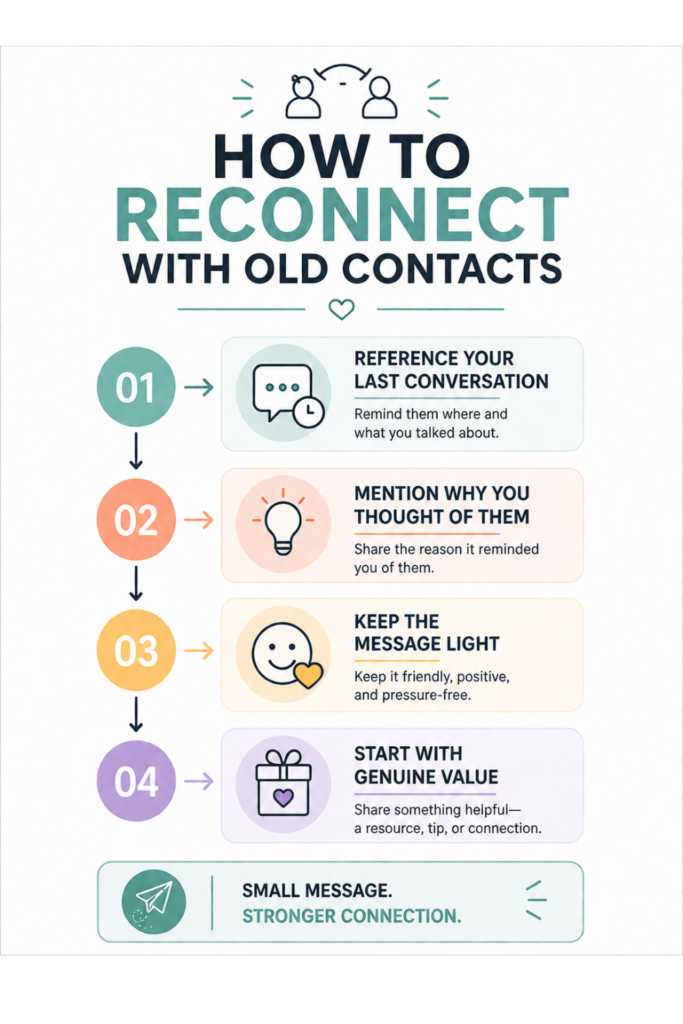
Recognition: Remind them who you are and where you met.
This gives the message immediate context and saves them from having to guess.
Relevance: Mention one specific detail from the conversation.
This is what makes the message feel human rather than copied and pasted.
Response: Give them a natural next step or close warmly.
That could be a thank-you, a promised resource, a short question, or a light invitation to stay in touch.
Here is what that can sound like in practice:
- Hi Maya, it was great meeting you after yesterday’s product panel.
- I really enjoyed hearing how your team approaches customer research before launching new features.
- Thanks again for sharing that. I’m sending over the article I mentioned, and I’d love to stay in touch.
That is short, but it works. It is clear. It is personal. It gives the other person something easy to hold onto.
If you want to get more from your life, and are looking for concrete action steps to get you there, check out our Request a Coach page. It’s a “cut the fence-sitting and take action” way to tackle your issues and actually find success. To get off the fence and start to take action, click or tap here.
This formula works well because it balances warmth and efficiency. It shows effort without forcing the reader through a long message. It also gives you a repeatable structure, which is useful when you are sending several follow-ups after an event.
You can adapt it depending on the situation:
- for recruiters, keep the tone direct and appreciative
- for peers, make it more conversational
- for mentors or senior contacts, show gratitude and thoughtfulness
- for collaborators, highlight the overlap or shared interest
The key is not to overstuff the message. Do not try to tell your full story. Do not add three different asks. Do not include unnecessary backstory.
A follow-up message is not meant to accomplish everything. It is meant to reopen the door.
When you use a formula like this, the message becomes easier to write because you are not starting from scratch each time. You are simply filling in three useful pieces. That lowers resistance, which means you are more likely to do it consistently.
And in networking, consistency matters more than writing something clever once in a while.
Create a 10-minute weekly relationship touchpoint
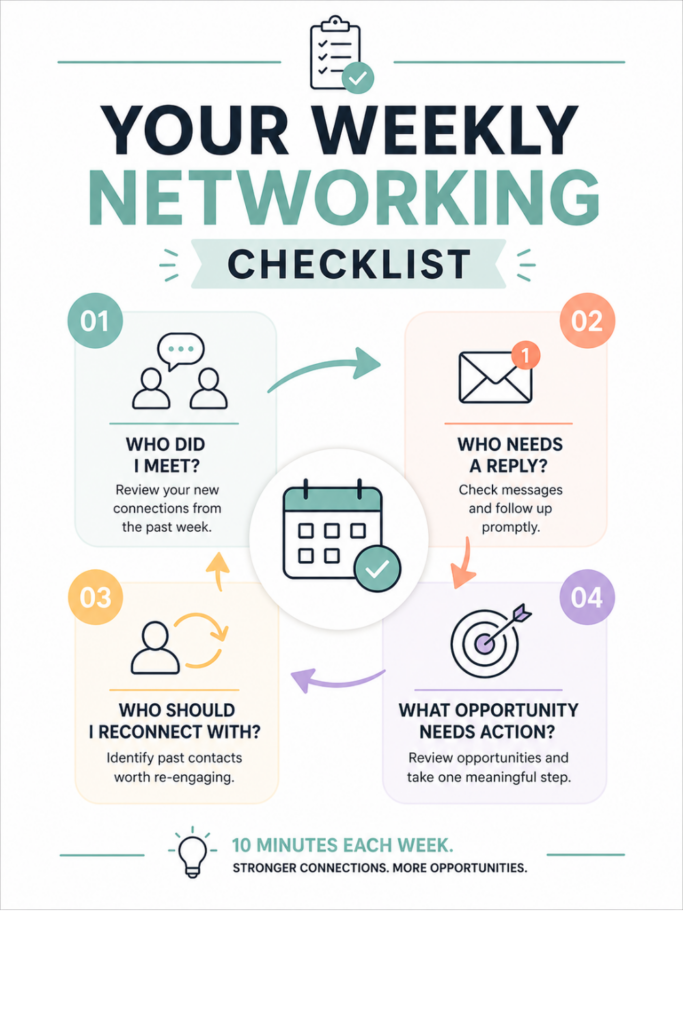
Create a 10-minute weekly relationship touchpoint: Keep good connections alive by using one short block each week to revisit recent contacts.
Most networking follow-up breaks down after the first message. People send one thank-you note, feel relieved, and then let the relationship drift because they do not have a habit for what comes next.
If you want to get more from your life, and are looking for concrete action steps to get you there, check out our Request a Coach page. It’s a “cut the fence-sitting and take action” way to tackle your issues and actually find success. To get off the fence and start to take action, click or tap here.
That is why a weekly touchpoint matters.
You do not need a long networking block on your calendar. In fact, that tends to make the task feel heavier than it needs to be. A short, recurring 10-minute session is often enough to keep your network warm and organized.
This tiny block works best when it has a specific purpose. You are not sitting down to “do networking.” You are reviewing recent contacts and deciding whether any small action is worth taking.
During your 10-minute check-in, you can:
- review people you met recently
- reply to messages you left hanging
- send any resource or link you promised
- follow up with one no-reply contact if appropriate
- reconnect with one older contact in a light way
- update your notes so nothing useful gets lost
The point is not volume. The point is continuity.
A lot of professional relationships stay alive through very small moments. A quick check-in. A shared article. A short congratulatory note when someone changes roles. A simple message saying you enjoyed reconnecting at an event.
These actions are small enough to fit into a busy life, but they are also what prevent your network from becoming a collection of missed opportunities.
This weekly touchpoint is especially useful for busy professionals because it keeps networking from becoming reactive. Instead of only reaching out when you need something, you create a rhythm of steady, low-pressure contact.
If you want to get more from your life, and are looking for concrete action steps to get you there, check out our Request a Coach page. It’s a “cut the fence-sitting and take action” way to tackle your issues and actually find success. To get off the fence and start to take action, click or tap here.
It also reduces guilt. When people do not have a routine, they often realize too late that they meant to follow up with someone weeks ago. Then the task feels awkward, which makes them avoid it further. A weekly check-in catches things earlier.
You can make this even easier by keeping a short list of categories inside your tracking system, such as:
- follow up this week
- waiting for reply
- reconnect later
- no action needed
That way, your 10-minute review becomes even faster.
The real power of this habit is that it turns networking into maintenance instead of drama. You do not need to rely on memory, motivation, or bursts of enthusiasm. You just need one small recurring window to keep the wheel moving.
That is how relationships stay active without taking over your schedule.
Make your follow-up easy to reply to
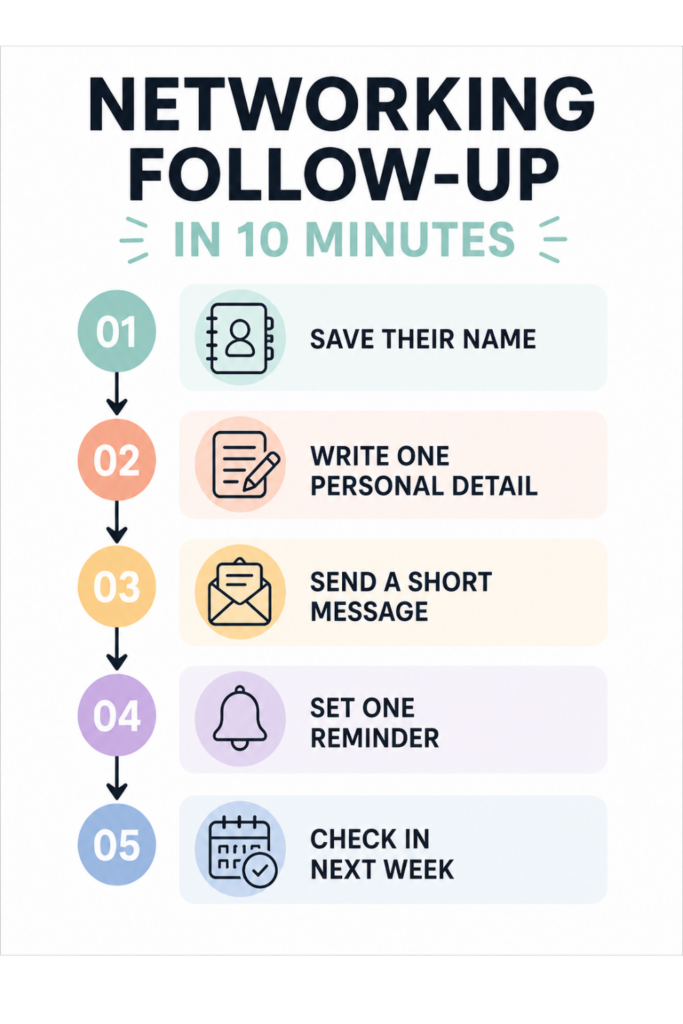
Make your follow-up easy to reply to: Ask for a small next step instead of a vague “let’s keep in touch” line.
One of the easiest ways to improve your networking follow-up is to reduce the effort required on the other person’s side. A message can be warm, polished, and thoughtful, but if the person has no clear idea how to respond, it often gets postponed and forgotten.
That is why vague closings tend to underperform.
If you want to get more from your life, and are looking for concrete action steps to get you there, check out our Request a Coach page. It’s a “cut the fence-sitting and take action” way to tackle your issues and actually find success. To get off the fence and start to take action, click or tap here.
Lines like “let’s keep in touch” or “would love to connect sometime” sound polite, but they leave too much work for the other person. They have to decide what that means, whether action is required, and how much time they should commit.
A better approach is to make the next step obvious and easy.
This does not mean every message needs an ask. It means every message should have a clear shape. If you do want a response, make it low pressure and specific.
Good next steps might include:
- sharing a resource you promised
- asking one simple follow-up question
- suggesting a brief coffee chat
- inviting them to send something they mentioned
- proposing a light future touchpoint
For example, instead of saying “Let’s stay connected,” you might say:
- I’d love to hear how your team approaches this if you ever have a minute to share.
- I’m sending the article I mentioned here in case it is useful.
- If it would be helpful, I’d be happy to continue the conversation over a quick coffee next week.
Each of those gives the recipient a much easier path.
The same principle applies when you are not asking for anything. Even then, the close should feel complete. A good ending signals what kind of relationship you are hoping to build without sounding needy.
Try to avoid these common mistakes:
If you want to get more from your life, and are looking for concrete action steps to get you there, check out our Request a Coach page. It’s a “cut the fence-sitting and take action” way to tackle your issues and actually find success. To get off the fence and start to take action, click or tap here.
- asking for too much too soon
- writing a long paragraph before getting to the point
- stacking multiple requests in one message
- sounding overly formal or stiff
- leaving the purpose of the message unclear
Small asks work well because they feel manageable. They also respect the fact that busy professionals are making quick decisions all day. If replying feels easy, the chance of getting a response goes up.
This is especially helpful if you are reaching out to someone senior, busy, or in high demand. They may be perfectly open to staying in touch, but they are much more likely to respond to something concise and specific than to a broad invitation with no clear path.
Good follow-up is not just about what you send. It is about how easy you make it for someone to say yes, reply, or remember you positively.
Build a simple system for no-reply contacts
Build a simple system for no-reply contacts: Decide in advance how and when to send one gentle second touch so promising connections do not disappear.
Not every good networking message gets a reply. That is normal.
People miss emails. They open a message while distracted and forget to come back. They intend to respond after a busy week and then lose track of the thread. A no-reply does not automatically mean disinterest, and treating it like rejection too quickly can cause you to drop connections that still had potential.
That said, you also do not want to chase endlessly. A simple second-touch rule keeps things balanced.
The easiest system is this: if the contact matters and your first message had a clear reason to continue the conversation, send one short follow-up after a reasonable gap. Then stop unless they respond or there is a new natural reason to reach out later.
If you want to get more from your life, and are looking for concrete action steps to get you there, check out our Request a Coach page. It’s a “cut the fence-sitting and take action” way to tackle your issues and actually find success. To get off the fence and start to take action, click or tap here.
That second message should feel light, respectful, and easy to ignore if the timing is not right. It should not sound hurt, apologetic, or overly persistent.
A gentle second touch might do one of these things:
- resurface the original note
- add a useful resource
- reconnect with a simple question
- close the loop on a shared topic
For example:
- Just wanted to circle back in case my earlier note got buried.
- I came across this article and thought of our conversation about internal mobility.
- Hope your week is going well. I wanted to follow up on the note below in case it is helpful to reconnect.
The tone matters a lot here. You are not calling attention to the silence in an awkward way. You are making it easier for them to re-engage if they want to.
It also helps to decide in advance which contacts are worth a second message. You do not need to follow up twice with everyone. Save that effort for people where the connection felt strong, relevant, or potentially valuable over time.
A simple filter can help:
- Did the conversation feel genuinely engaged?
- Was there a clear shared interest or next step?
- Would reconnecting make sense even if no opportunity comes from it right away?
If the answer is yes, a second touch is reasonable.
What matters most is that you remove emotion from the process. Instead of wondering endlessly whether you should reach out again, you have a small rule. One thoughtful follow-up. Then space.
If you want to get more from your life, and are looking for concrete action steps to get you there, check out our Request a Coach page. It’s a “cut the fence-sitting and take action” way to tackle your issues and actually find success. To get off the fence and start to take action, click or tap here.
That protects your time, preserves your confidence, and keeps promising contacts from slipping away just because inbox timing was bad the first time around.
Use a coach to sharpen your networking habits
Use a coach to sharpen your networking habits: Work with a career or communication coach to improve follow-up strategy, confidence, and consistency.
Sometimes the problem is not that you do not know networking matters. The problem is that you have patterns around it that are hard to fix on your own.
Maybe you meet people easily but never follow up. Maybe you draft messages and overedit them until they sound stiff. Maybe you only reach out when you need something, which makes networking feel transactional. Or maybe the whole process triggers enough discomfort that you keep putting it off.
This is where a coach can be surprisingly helpful.
A good career coach, communication coach, or even an organizational coach can help you turn networking from a vague intention into an actual system that fits your personality and workload. They can also help you identify where the friction is really happening.
For example, a coach may help you see that your real issue is not follow-up itself. It might be:
- perfectionism
- fear of sounding pushy
- difficulty asking for help
- weak personal organization systems
- uncertainty about your professional goals
- discomfort with self-advocacy
Once you know the real block, it becomes much easier to solve.
If you want to get more from your life, and are looking for concrete action steps to get you there, check out our Request a Coach page. It’s a “cut the fence-sitting and take action” way to tackle your issues and actually find success. To get off the fence and start to take action, click or tap here.
A coach can also help you build tools that are specific to your situation, such as:
- a small set of follow-up templates in your natural voice
- a weekly accountability routine
- a contact tracking method you will actually use
- scripts for common networking situations
- a strategy for reconnecting with cold contacts
That kind of support matters because many people know what they should do, but still do not do it consistently. Accountability helps bridge that gap.
Coaching is especially useful if networking matters to your growth right now. If you are job searching, changing industries, building a client base, trying to become more visible internally, or moving into leadership, the way you maintain professional relationships can have a real impact on opportunities.
A coach can also help you practice the softer parts of follow-up. Tone. Timing. Confidence. How to ask without sounding demanding. How to stay in touch without forcing it. How to make your outreach sound like you.
The goal is not to turn you into someone slick or overly social. It is to help you build a sustainable habit that supports the professional life you want.
Sometimes one outside perspective is what turns networking from a recurring stress point into a skill you trust yourself to use.
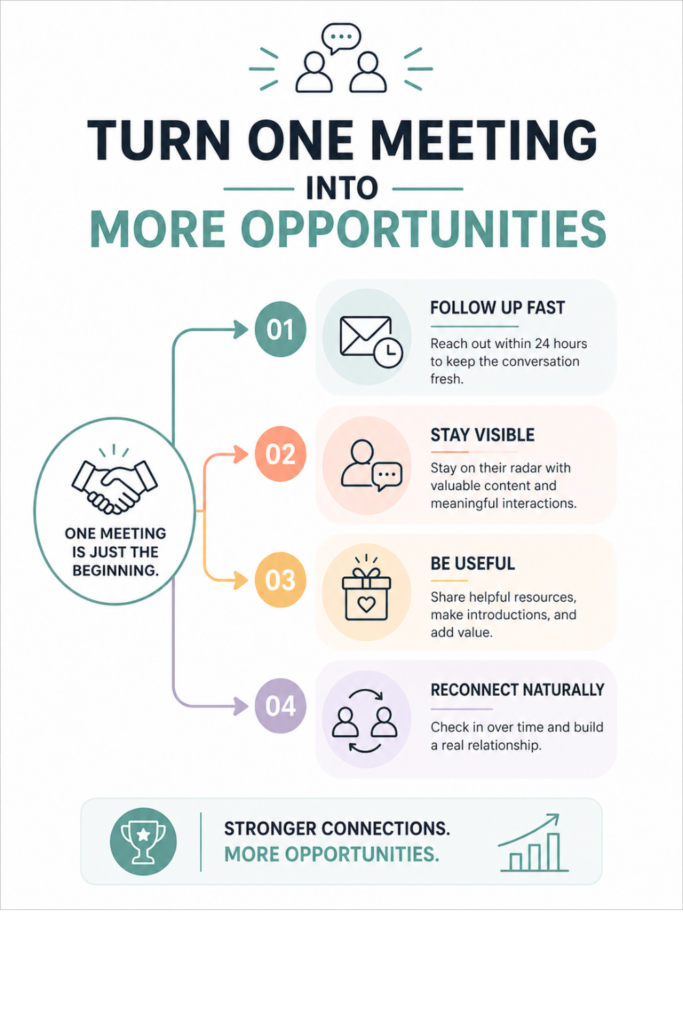
Turn one conversation into a long-term professional relationship
Turn one conversation into a long-term professional relationship: Think beyond the first thank-you note and plan how to reconnect naturally over time.
A lot of networking advice stops at the first follow-up. Send the thank-you note. Connect on LinkedIn. Maybe schedule coffee. That is useful, but it misses something important.
If you want to get more from your life, and are looking for concrete action steps to get you there, check out our Request a Coach page. It’s a “cut the fence-sitting and take action” way to tackle your issues and actually find success. To get off the fence and start to take action, click or tap here.
Strong professional relationships are rarely built in one exchange.
They grow through small moments over time. A person remembers you because you followed up well, yes. But they keep remembering you because the connection was reinforced later in ways that felt natural and relevant.
That is the shift worth making. Instead of asking, “How do I follow up once?” ask, “How do I stay meaningfully present without forcing contact?”
You do not need constant communication to do that. In fact, too much contact can feel unnatural. What you want is occasional relevance.
Simple ways to reconnect over time include:
- congratulating them on a promotion or new role
- sharing an article that fits a topic you discussed
- checking in after a project, event, or transition they mentioned
- reaching out when you see a genuine collaboration opportunity
- sending a brief update if they gave advice that helped you
These kinds of touchpoints work because they are grounded in context. They do not come out of nowhere. They feel like a continuation rather than a random ask.
One of the best long-term networking habits is updating people when their input mattered. If someone gave you advice and you acted on it, tell them. If they recommended a resource and it helped, say so. People like knowing that their time or insight had value.
It also helps to release the idea that every relationship must produce something immediate. Some of the strongest professional connections stay quiet for long stretches and then become relevant again later. A former peer becomes a hiring manager. A conference contact becomes a collaborator. A weak tie becomes a source of insight, referrals, or opportunity years later.
If you want to get more from your life, and are looking for concrete action steps to get you there, check out our Request a Coach page. It’s a “cut the fence-sitting and take action” way to tackle your issues and actually find success. To get off the fence and start to take action, click or tap here.
That is why staying top of mind matters.
You are not trying to occupy their attention all the time. You are trying to leave a strong enough impression, and maintain enough light contact, that when the right moment comes, your name still feels familiar in a good way.
This kind of networking is less performative and more relational. It is built on attention, memory, and occasional usefulness. That makes it more sustainable and usually more effective too.
A single conversation is a starting point. What turns it into something lasting is the way you continue showing up after it.
Make staying in touch easier than forgetting
The best networking follow-up system is not the most sophisticated one. It is the one you can actually use on a busy Tuesday when your inbox is full, your calendar is packed, and you do not feel like doing anything extra.
That is why simple beats impressive here.
If you can capture contacts quickly, sort them by relationship type, send a timely message, and check in once a week for ten minutes, you already have a system that puts you ahead of a lot of people. Not because it is flashy, but because it is consistent.
And consistency is what creates momentum.
If you want to get more from your life, and are looking for concrete action steps to get you there, check out our Request a Coach page. It’s a “cut the fence-sitting and take action” way to tackle your issues and actually find success. To get off the fence and start to take action, click or tap here.
A good follow-up system helps you in practical ways:
- you remember who you met
- your messages sound more personal
- you stop losing opportunities to delay
- you stay visible without being pushy
- you build relationships in small, manageable steps
It also changes how networking feels. Instead of becoming a pile of vague guilt and half-finished intentions, it becomes a repeatable process. That matters more than people think.
When a task feels undefined, it is easy to avoid. When it has structure, it becomes easier to start. And once you start, networking follow-up usually takes less time and less emotional energy than you expected.
The long-term payoff can be bigger than it looks in the moment. One quick thank-you note can lead to a coffee chat. One thoughtful update can keep you top of mind for an opportunity. One steady habit can quietly shape a stronger professional network over time.
You do not need to become a master networker overnight. You do not need the perfect template for every scenario. You just need a small system that makes staying in touch easier than forgetting.
That is the real goal.
Because the professionals who build strong networks are not always the loudest or most naturally outgoing. Often, they are just the ones who figured out how to follow up in a way that is timely, thoughtful, and easy to repeat.
*****
If you want to get more from your life, and are looking for concrete action steps to get you there, check out our Request a Coach page. It’s a “cut the fence-sitting and take action” way to tackle your issues and actually find success. To get off the fence and start to take action, click or tap here.
Want to try this at home? Download your free template now!
Need some business or career guidance? Drop on by our directories choc full of business coaches and career coaches to bring your career to the next level. Or click here to have us match you to the best.
If you want to get more from your life, and are looking for concrete action steps to get you there, check out our Request a Coach page. It’s a “cut the fence-sitting and take action” way to tackle your issues and actually find success. To get off the fence and start to take action, click or tap here.
Read this next

How to live your passion
Don’t just dream it, live it! Learn to make your true passion a central part of your life.
Read More
Dress to Impress: Affordable Tips for a Stylish Business Casual Wardrobe
Looking sharp at work does not have to cost a lot of money or cause stress. Anyone can create a business casual wardrobe on a tight budget by focusing on […]
Read More
I Have a Degree and Can’t Find a Job: Tips to Create a Personal Brand
I graduated… Now what??? Effective tips for success in planning your next steps after you receive your degree.
Read More