








Tell Me About Yourself: 10 Interview Answers for Career Changers, Graduates, and Mid-Career Pros

The first interview question sounds easy until you actually have to answer it.
“Tell me about yourself” is where a lot of strong candidates ramble, undersell themselves, or give a summary that sounds too broad to be useful. That is especially true if you are changing careers, just starting out, or trying to package years of experience without sounding stiff.
A strong answer does not need your whole life story. It needs a clear shape.
The best versions do three things fast:
- explain where you are professionally
- show why your background is relevant
- point naturally toward the role you want
That is why this article focuses on answer structures instead of generic advice. You do not need one perfect script for every interview. You need a version that fits your stage, your background, and the role in front of you.
Below, you will find 10 answer approaches you can adapt. Some are built for career changers. Some are better for graduates. Some help mid-career professionals sound more focused and memorable. All of them are designed to help you sound clear in the first two minutes, when interviewers are already forming impressions.
Need some career guidance? Drop on by our directories choc full of career coaches to bring your career to the next level. Or click here to have us match you to the best.
1. The Career Changer Answer That Connects Your Past to Your New Direction
Career changers often make one of two mistakes. They either spend too long explaining the old field, or they jump so quickly to the new one that the transition feels unsupported. The better approach is to connect the two clearly.
If you want to get more from your life, and are looking for concrete action steps to get you there, check out our Request a Coach page. It’s a “cut the fence-sitting and take action” way to tackle your issues and actually find success. To get off the fence and start to take action, click or tap here.
Your answer should make the interviewer feel like the move makes sense. That means showing continuity, not pretending your past no longer matters. Even if you are switching industries, you still bring patterns, strengths, and results that transfer.
A strong structure looks like this:
- where you have been
- what you learned there
- why those strengths fit the new role
- why you are making the move now
For example, someone leaving teaching for project coordination should not only say they want a change. They should explain that they have years of experience managing competing priorities, communicating with different stakeholders, staying organized under pressure, and keeping projects moving despite constant changes.
That sounds more credible because it is concrete. It helps the interviewer stop thinking about what you lack and start noticing what already fits.
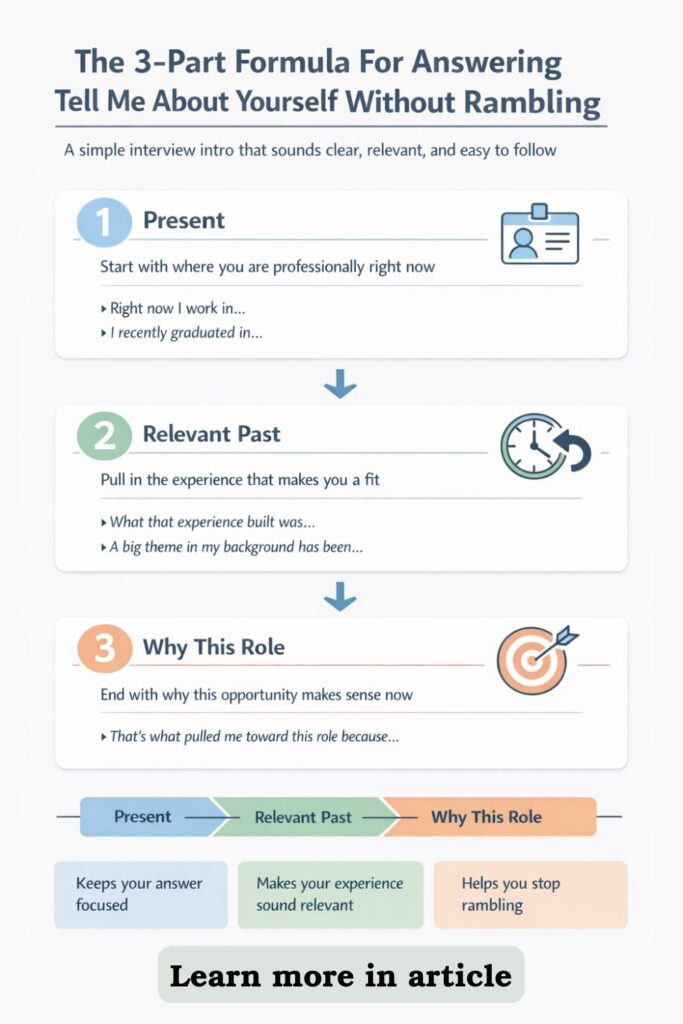
Try building your answer around phrases like these:
- “I’ve spent the last few years in…”
- “What that experience really strengthened was…”
- “That is one reason I’ve been moving toward…”
- “What excites me about this role is…”
You do not need to hide the pivot. You need to guide it.
It also helps to avoid defensive language. Do not frame the change as escaping, burning out, or being tired of your old field. Frame it as a move toward stronger fit. Interviewers usually respond better when your answer feels deliberate and forward-looking.
The goal is not to erase your previous path. It is to make that path feel like useful preparation for what comes next.
If you want to get more from your life, and are looking for concrete action steps to get you there, check out our Request a Coach page. It’s a “cut the fence-sitting and take action” way to tackle your issues and actually find success. To get off the fence and start to take action, click or tap here.
2. The Career Changer Answer That Explains a Bold Industry Switch Without Sounding Random
A bigger career shift needs more structure. If you are moving from one industry to another with little obvious overlap, the interviewer needs help connecting the dots quickly.
This is where many people lean too hard on passion. They say they have “always been interested” in the new field, but they do not show enough action behind that interest. Curiosity matters, but proof matters more.
A better answer pairs motivation with evidence.
You can shape it like this:
- a short summary of your previous background
- a clear reason you became interested in the new field
- specific steps you took to build experience
- how that preparation led you to this role
For example, someone moving from retail management into UX design should not stop at saying they love design. A stronger version would explain that years of customer-facing work sharpened their attention to user behavior, then mention a design course, portfolio projects, usability testing, or freelance work that helped them build real skills.
That creates trust. It shows you are not guessing your way into a new identity. You have already started doing the work.
Useful details might include:
- certification programs
- volunteer experience
- freelance projects
- self-directed portfolio work
- shadowing or mentoring
- relevant software or tools you learned
The tone matters too. You want the shift to sound intentional, not dramatic.
If you want to get more from your life, and are looking for concrete action steps to get you there, check out our Request a Coach page. It’s a “cut the fence-sitting and take action” way to tackle your issues and actually find success. To get off the fence and start to take action, click or tap here.
That means avoiding language like:
- “I just woke up one day and realized…”
- “I needed to get out of…”
- “I’m starting completely from scratch…”
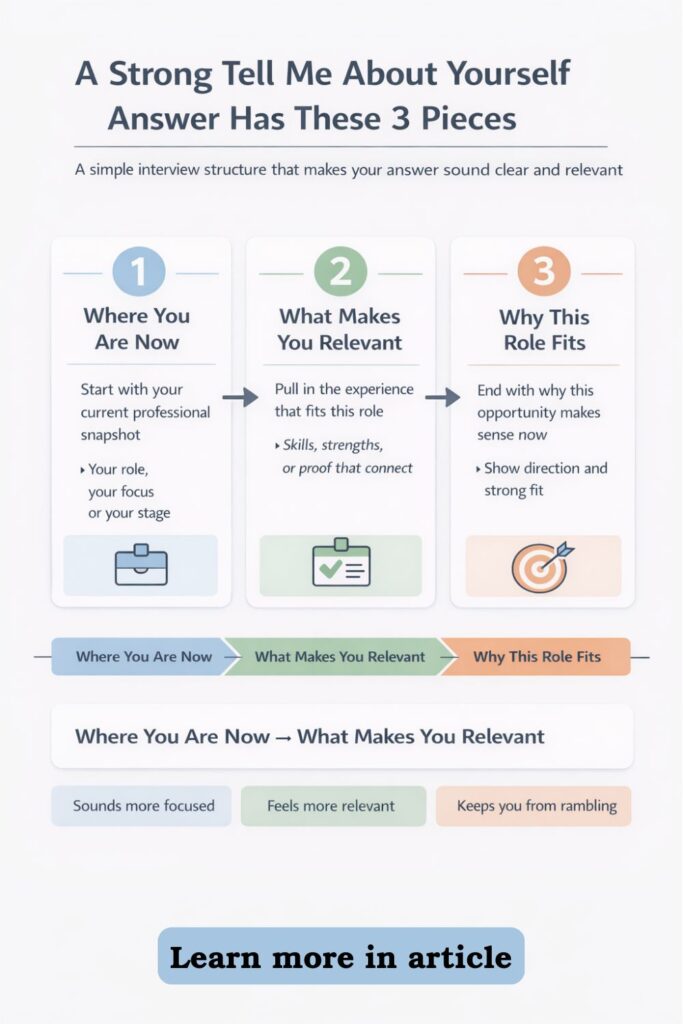
Instead, use language that shows a thoughtful progression. Something like, “Over time, I realized the part of my work I was most drawn to was…” sounds much steadier.
A bold switch becomes easier to believe when you can name the bridge. That bridge might be skill-based, project-based, or interest-based. What matters is that you make it visible.
The interviewer does not need a perfect match. They need a clear reason to trust the move.
3. The Graduate Answer That Makes Limited Experience Sound Relevant
Early-career candidates often worry they do not have enough to say. The real issue is usually not lack of experience. It is lack of framing.
If you are a graduate, your answer does not need to sound seasoned. It needs to sound relevant, capable, and specific. That means choosing the parts of your background that actually support the role instead of apologizing for being new.
Start with your strongest foundation. That might be:
- your degree or concentration
- an internship
- a capstone or thesis project
- student leadership
- campus work
- volunteer roles tied to the job
Then connect that experience to what kind of work you enjoy and what you want to contribute.
If you want to get more from your life, and are looking for concrete action steps to get you there, check out our Request a Coach page. It’s a “cut the fence-sitting and take action” way to tackle your issues and actually find success. To get off the fence and start to take action, click or tap here.
For example, a recent marketing graduate could say they studied communications with a focus on digital content, completed an internship where they helped with campaign calendars and social posts, and realized they enjoy the mix of creativity and organization that comes with marketing coordination.
That works because it sounds directional. It shows you are not just listing what happened. You are pulling meaning from it.
One thing to avoid is the filler-heavy answer. That is the version where you spend too much time saying you are hardworking, eager to learn, and excited for the opportunity. Those lines are fine, but they cannot carry the whole answer.
You need at least one concrete piece of evidence. It could be a project, a deliverable, or a responsibility you handled well. Even small examples help if they are specific.
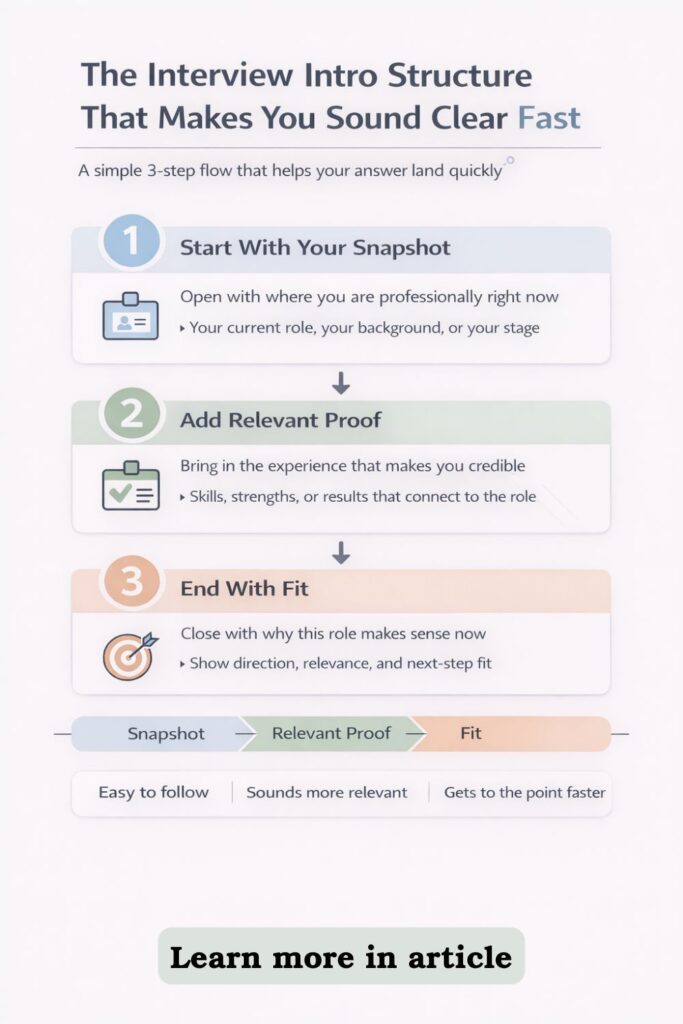
A helpful formula is:
- what you studied
- what experience you had during school
- what skills or interests became clear
- what kind of role you are now pursuing
That gives your answer momentum.
It also keeps you from sounding like you are waiting for someone to give you permission to begin. You are already in motion. Your goal is to show the interviewer that your academic and early practical experience point naturally toward this next step.
You do not need years of history. You need a clean story.
If you want to get more from your life, and are looking for concrete action steps to get you there, check out our Request a Coach page. It’s a “cut the fence-sitting and take action” way to tackle your issues and actually find success. To get off the fence and start to take action, click or tap here.
4. The Graduate Answer That Sounds More Confident and Less Generic
A lot of graduate answers sound interchangeable because they rely on broad traits instead of a clear theme. If everyone says they are motivated, organized, and passionate, nobody stands out.
One of the easiest ways to sound more confident is to choose one professional thread and build your answer around it. That thread gives the interviewer something to remember.
Your theme might be:
- research and analysis
- client or customer communication
- content creation
- operations and organization
- problem solving
- collaboration across teams
Once you choose the thread, support it with one example that proves it is real.
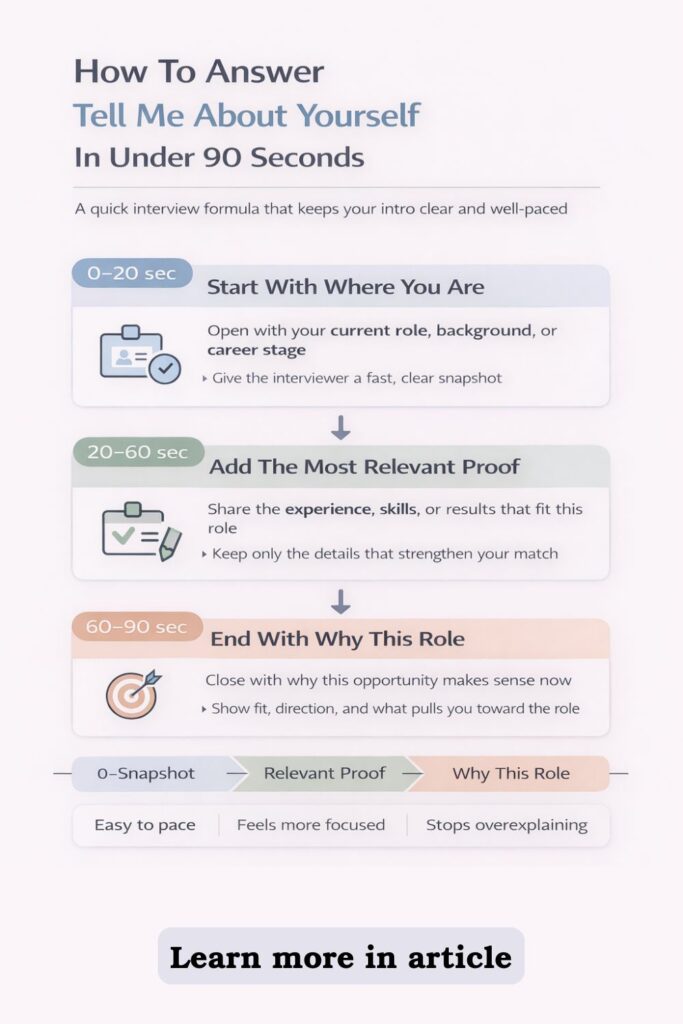
For instance, if your theme is problem solving, do not just say you enjoy solving problems. Mention a project where you had to fix a process, improve a result, or adapt when something changed. That example does not need to be huge. It just needs to be believable and tied to the role.
This makes your answer feel sharper because it has a point of view. It also helps you avoid the common trap of trying to mention everything at once.
A cleaner answer usually sounds like this:
- “I recently graduated in…”
- “One theme that came up across my coursework and internship experience was…”
- “For example…”
- “That is what led me to roles like this one…”
That structure sounds more mature because it shows you can identify your own strengths in a grounded way.
If you want to get more from your life, and are looking for concrete action steps to get you there, check out our Request a Coach page. It’s a “cut the fence-sitting and take action” way to tackle your issues and actually find success. To get off the fence and start to take action, click or tap here.
Confidence also comes from cutting weak phrases. Try to use fewer qualifiers like:
- “I guess”
- “kind of”
- “a little bit”
- “hopefully”
- “I don’t have much experience, but…”
Those phrases shrink your message. You do not need to oversell yourself, but you do want to sound settled in what you can offer right now.
The point of this answer is not to sound older or more experienced than you are. It is to sound like someone who understands their value and can speak about it clearly.
That alone makes a strong first impression.
5. The Graduate Answer for Someone With Internships, Part-Time Jobs, or Mixed Experience
Some graduates feel harder to package because their background looks mixed. Maybe you have an internship, a campus job, a side project, volunteer experience, and part-time work that does not directly match the role. That can feel messy if you try to explain it in order.
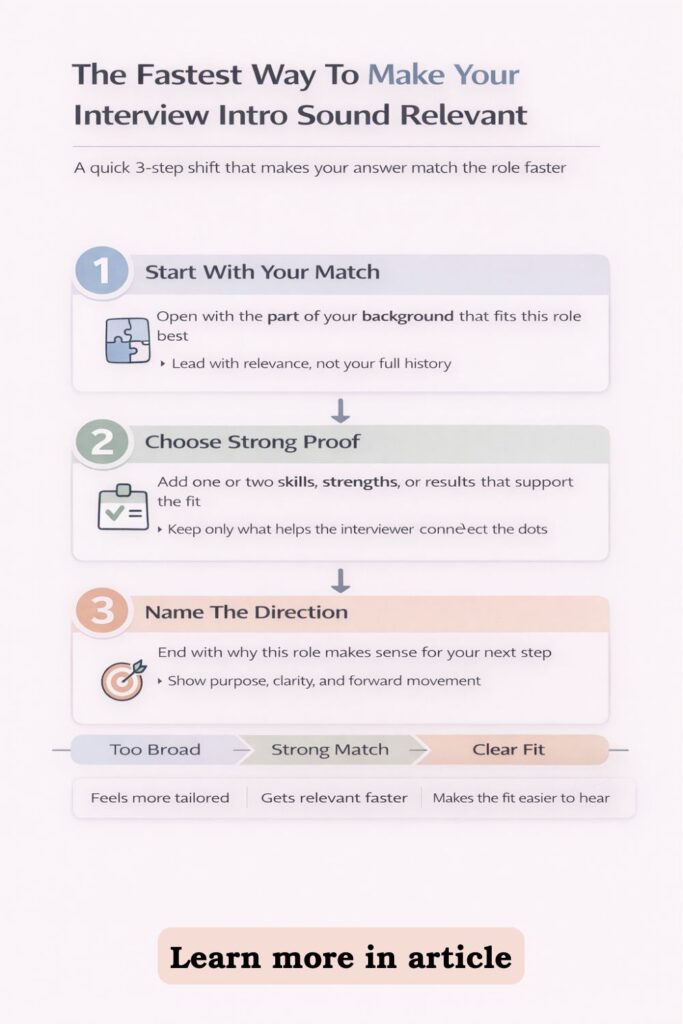
The fix is simple. Organize by skill instead of chronology.
A chronological answer often makes you sound scattered because it jumps from one context to another. A skill-based answer pulls those experiences together and gives them a common thread.
For example, maybe you worked retail during school, interned at a nonprofit, and helped run events for a student group. On paper, those look different. In an interview answer, they may all show customer communication, coordination, and adaptability.
If you want to get more from your life, and are looking for concrete action steps to get you there, check out our Request a Coach page. It’s a “cut the fence-sitting and take action” way to tackle your issues and actually find success. To get off the fence and start to take action, click or tap here.
That is the story you want to tell.
You can shape it like this:
- mention your degree or current stage
- group your experience under 2 or 3 repeatable strengths
- give one or two short examples
- close with the type of role you want now
That makes the answer feel much more intentional.
A good way to think about it is this: the interviewer is not asking for your full timeline. They are asking for your professional shape. What patterns show up across what you have done so far?
Those patterns might include:
- working well with people
- staying organized in fast-paced environments
- writing or presenting clearly
- solving practical problems
- handling detail-heavy tasks
- learning quickly in new settings
When you organize around patterns, your mixed background starts to look like proof instead of noise.
This is also a great strategy if you do not have one perfect internship that defines your path. Many graduates do not. That is normal. The key is showing that your experiences still point somewhere.
Your closing line matters here. After you summarize the patterns, bring the answer back to the role in front of you. That helps the interviewer see direction.
If you want to get more from your life, and are looking for concrete action steps to get you there, check out our Request a Coach page. It’s a “cut the fence-sitting and take action” way to tackle your issues and actually find success. To get off the fence and start to take action, click or tap here.
You want them to walk away thinking, “This candidate has done different things, but the strengths are consistent, and they know where they are headed.”
That is much stronger than trying to make every past role seem equally important.
6. The Mid-Career Answer That Positions You as Experienced but Still Adaptable
Mid-career professionals often face a different problem. They have plenty to say, but too much history can make the answer drag. The challenge is to sound established without sounding dated, rigid, or overly broad.
A strong mid-career answer starts with your lane.
That means summarizing three things quickly:
- your area of work
- your level of experience
- your core strengths
For example, instead of walking through every position, you might say that you have spent the last eight years in operations and client support, with a focus on process improvement, cross-functional coordination, and keeping service delivery running smoothly.
That immediately gives the interviewer a usable picture.
From there, move into growth. Show how your experience has expanded and why it still feels current. This is what keeps the answer from sounding static.
If you want to get more from your life, and are looking for concrete action steps to get you there, check out our Request a Coach page. It’s a “cut the fence-sitting and take action” way to tackle your issues and actually find success. To get off the fence and start to take action, click or tap here.
You might mention that over time you have taken on:
- more ownership
- bigger accounts or projects
- process improvement work
- team coordination
- systems or reporting responsibilities
That tells the interviewer you are not just experienced. You are still evolving.
It also helps to include language that signals flexibility. Mid-career candidates sometimes sound unintentionally fixed in their ways when they focus only on what they have already done. Balance that by showing how you adapt, learn new systems, or work across changing priorities.
This does not mean pretending to be early career again. It means showing that experience has made you more useful, not less open.
A clean structure is:
- who you are professionally
- what you have focused on
- how your responsibilities have grown
- why this next role fits
That final piece matters. Without it, your answer can sound like a biography instead of positioning.
The interviewer does not need your entire career journey. They need to understand the current version of you. What do you do well now? What kind of value do you bring now? Why are you a fit now?
When you answer that clearly, your experience starts to feel like an asset, not background noise.
If you want to get more from your life, and are looking for concrete action steps to get you there, check out our Request a Coach page. It’s a “cut the fence-sitting and take action” way to tackle your issues and actually find success. To get off the fence and start to take action, click or tap here.
7. The Mid-Career Answer That Balances Leadership and Hands-On Credibility
If you have led teams, owned projects, or managed major responsibilities, your answer needs balance. Too much focus on leadership can make you sound removed from the work. Too much focus on execution can undersell your scope.
The best answer shows both.
This is especially important if you are applying for roles where people want someone strategic but still practical. Employers often look for candidates who can lead, but they also want people who understand the work closely enough to make smart decisions.
A strong answer might include:
- your leadership scope
- the kind of teams or projects you have led
- the operational or practical work you stay close to
- the outcomes your leadership helped produce
For example, a marketing manager could say they have led small campaign teams and coordinated across design, content, and paid media, while also staying closely involved in messaging, timelines, and performance review.
That sounds better than simply saying, “I manage a team of five.”
Why? Because it gives shape to the leadership. It shows how you operate, not just what title you hold.
This is also where business impact helps. You do not need to recite huge numbers if that is not natural for your field, but you should tie your work to outcomes when possible.
If you want to get more from your life, and are looking for concrete action steps to get you there, check out our Request a Coach page. It’s a “cut the fence-sitting and take action” way to tackle your issues and actually find success. To get off the fence and start to take action, click or tap here.
That could include:
- improving efficiency
- supporting revenue goals
- increasing client satisfaction
- streamlining workflows
- reducing errors
- improving collaboration
Leadership sounds much stronger when it connects to real results.
It is also smart to avoid sounding too far removed from execution unless the role truly calls for that. Some mid-career candidates accidentally create distance by speaking only in abstract management language. That can make interviewers wonder whether the candidate still understands day-to-day realities.
A better tone is one that says, “I can lead, but I also know how the work gets done.”
That kind of answer often feels more grounded and more valuable.
The goal is to present yourself as someone who has enough experience to create clarity for others, but who still stays connected to the work itself. That combination tends to be memorable because it signals both authority and usefulness.
8. The Mid-Career Answer for Professionals Repositioning Themselves
Sometimes mid-career candidates are not just interviewing for the next obvious step. They are repositioning. Maybe they want to move into a different function, shift industries, step back from management, or target a role that uses only part of their past experience.
That can be tricky because a long work history gives interviewers a lot to latch onto. If you do not guide the story, they may focus on the wrong things.
If you want to get more from your life, and are looking for concrete action steps to get you there, check out our Request a Coach page. It’s a “cut the fence-sitting and take action” way to tackle your issues and actually find success. To get off the fence and start to take action, click or tap here.
This is why repositioning answers need editing.
You are not hiding your background. You are choosing what to foreground. The key is to bring forward the parts of your experience that match the role you want now, even if that is not the full picture of your past.
For example, someone who has managed teams but is applying for an individual contributor role may want to emphasize deep subject expertise, hands-on execution, and cross-functional collaboration more than people management.
That does not erase leadership experience. It simply keeps the answer aligned.
A helpful structure is:
- your current professional identity
- the most relevant strengths for this role
- selected past experience that supports those strengths
- why this move makes sense now
That middle section is where repositioning really happens. You are curating the evidence.
You may need to trim details like:
- older titles that distract from the target role
- responsibilities that make you seem overleveled
- side paths that confuse the story
- experiences that do not support the direction you want
This kind of editing is not dishonest. It is strategic. Interviewers do not need every chapter. They need the version of your background that answers one question: why you fit this job.
If you want to get more from your life, and are looking for concrete action steps to get you there, check out our Request a Coach page. It’s a “cut the fence-sitting and take action” way to tackle your issues and actually find success. To get off the fence and start to take action, click or tap here.
Your language should also make the shift feel intentional. Instead of sounding like you are backing away from something, frame the move around what you want to do more of. That keeps the answer positive and focused.
A repositioning answer works when it helps the interviewer stop comparing you to your old titles and start imagining you in the new role. That is the real job of the first two minutes.
9. The Universal Answer Structure for Anyone Who Freezes Under Pressure
Sometimes the problem is not your background. It is your nerves.
Even strong candidates can blank on this question because it is so open-ended. If that happens to you, stop trying to invent a perfect answer every time. Use a simple structure you can fall back on.
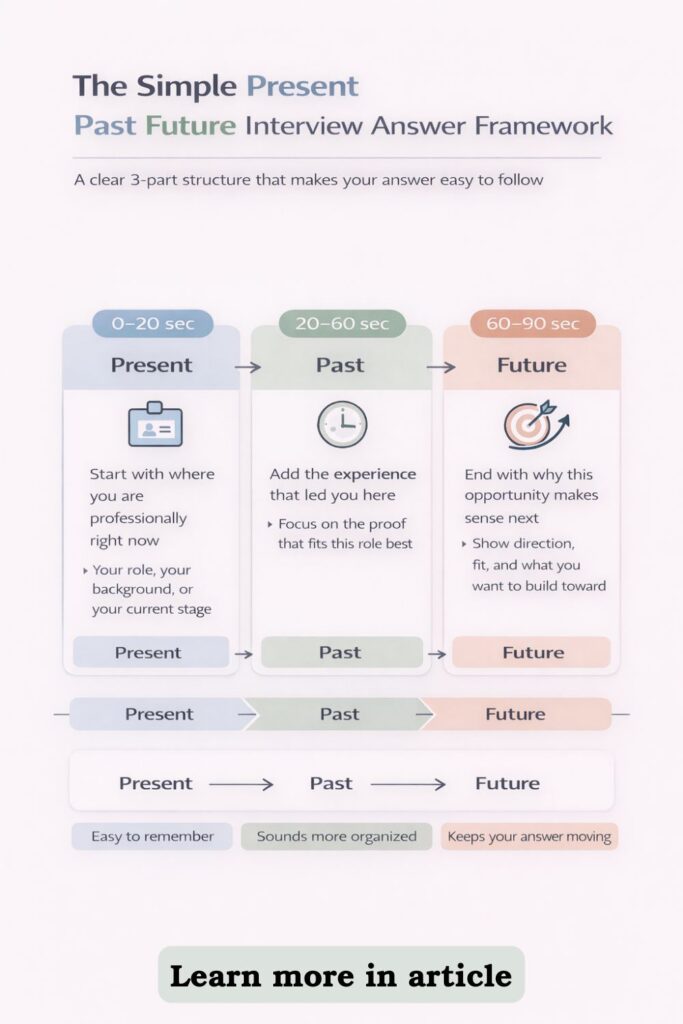
One of the most reliable is present, past, future.
It works because it gives your answer a beginning, middle, and end without forcing you into a long speech. It also works for almost any stage of career.
Here is the basic shape:
- Present: what you are doing now or where you are professionally
- Past: relevant experience that led you here
- Future: why this role is the next fit
For example, a candidate might say they are currently working in customer support with a growing focus on operations, that their past roles have strengthened communication and problem solving, and that they are now looking for a role where they can use those strengths in a more process-driven environment.
If you want to get more from your life, and are looking for concrete action steps to get you there, check out our Request a Coach page. It’s a “cut the fence-sitting and take action” way to tackle your issues and actually find success. To get off the fence and start to take action, click or tap here.
That is simple, but it works. It feels organized and easy to follow.
The main mistake people make with this format is spending too long in the past. The past should support the present, not take over the answer. In most cases, the most relevant experience should get the most attention, and older details should stay brief.
To make the structure even easier under pressure, prep one sentence for each part:
- one sentence for where you are now
- two or three sentences for relevant background
- one sentence for why this role fits
That gives you something you can remember without sounding robotic.
This format also helps if your background feels complicated. You do not need to solve every detail in your first answer. You need to sound clear enough that the interviewer can follow your trajectory.
The best part is that this structure is flexible. A graduate, a career changer, and a mid-career professional can all use it with different content.
When nerves hit, simplicity helps. A clear framework keeps you from wandering, and it gives you a steady way to start strong even if your adrenaline is high.
10. The Memorable Answer That Ends Strong Instead of Fading Out
A lot of people begin their answer reasonably well, then lose energy at the end. They list some background, trail off, and finish with something vague like, “So yeah, that is a little about me.”
If you want to get more from your life, and are looking for concrete action steps to get you there, check out our Request a Coach page. It’s a “cut the fence-sitting and take action” way to tackle your issues and actually find success. To get off the fence and start to take action, click or tap here.
That weak ending wastes the whole setup.
A stronger ending does one job: it turns your background into relevance. It tells the interviewer why what you just said matters for this role.
Think of your closing line as your positioning line. It should help the interviewer quickly understand your fit and direction.
Good endings often do one of these things:
- connect your experience to the role
- name the type of work you want more of
- explain why the opportunity stands out
- reinforce your strongest value
For example, instead of ending with a soft shrug, a candidate might say, “That is what has pulled me toward roles like this, where I can combine client communication with more project ownership.”
That feels finished. It gives the answer purpose.
You do not need to sound dramatic or overly polished. You just want to avoid the flat ending that makes your answer feel incomplete. A thoughtful close also helps guide the next part of the interview, because it naturally invites questions about the area you want to discuss more.
A few useful closing patterns are:
If you want to get more from your life, and are looking for concrete action steps to get you there, check out our Request a Coach page. It’s a “cut the fence-sitting and take action” way to tackle your issues and actually find success. To get off the fence and start to take action, click or tap here.
- “That is what led me to this opportunity.”
- “That is the kind of work I am excited to keep building on.”
- “That mix is why this role feels like such a strong fit.”
- “That is where I think I can add the most value.”
The right ending can also make you more memorable. Interviewers hear a lot of similar openings. A clean close helps your answer stick because it gives them a final takeaway.
Instead of leaving them to sort through your background on their own, you are doing the sorting for them.
That is what a strong answer always does. It reduces effort for the listener. It organizes your story in a way that makes you easier to understand, easier to remember, and easier to picture in the role.
How to Customize These Answers for Different Job Postings
Once you have a solid base answer, do not use it word for word for every interview. A good answer should be stable, but not frozen.
The core story can stay the same. What changes is the emphasis.
Before each interview, look closely at the job posting and ask:
- What seems most important in this role?
- Which strengths are mentioned more than once?
- Is the role more people-facing, technical, analytical, or operational?
- What kind of results or responsibilities seem central?
Then adjust your answer to match.
For example, if one marketing role leans heavily on analytics and another leans on content coordination, your core background may stay the same, but the examples you highlight should shift. That makes your answer sound tailored without making it sound rehearsed.
If you want to get more from your life, and are looking for concrete action steps to get you there, check out our Request a Coach page. It’s a “cut the fence-sitting and take action” way to tackle your issues and actually find success. To get off the fence and start to take action, click or tap here.
A practical way to prep is to keep one master version and swap in:
- a different opening phrase
- one different proof point
- a different final line tied to the role
That small change can make a big difference.
It also helps to mirror the language of the posting naturally. If the role emphasizes stakeholder communication, project ownership, or process improvement, and those things are genuinely part of your background, use those phrases. This makes it easier for the interviewer to hear the fit.
Just do not turn your answer into a keyword dump. It should still sound like a person talking.
Customization matters because interviewers are not only listening for polish. They are listening for relevance. They want to know whether you understand what this job requires and whether you can place yourself inside that picture.
A reusable answer is helpful. A slightly adjusted answer is stronger.
That is the balance to aim for: consistent enough that it feels natural, specific enough that it feels chosen for the opportunity in front of you.
What to Cut So Your Answer Stays Sharp
A strong answer is not just about what you include. It is also about what you leave out.
If you want to get more from your life, and are looking for concrete action steps to get you there, check out our Request a Coach page. It’s a “cut the fence-sitting and take action” way to tackle your issues and actually find success. To get off the fence and start to take action, click or tap here.
Most weak versions are too long because they try to cover everything. That usually leads to extra detail that does not improve the interviewer’s understanding.
Things to cut or reduce:
- full personal history
- unrelated early jobs
- every title in chronological order
- long explanations of why you left each role
- repeated claims about being hardworking or passionate
- vague filler about loving challenges or people
You also want to watch for tone mistakes.
Some answers sound apologetic. Others sound over-rehearsed. Some drift into jargon. Some stay so general that the interviewer still does not know what the candidate actually does well.
If your answer has any of these habits, tighten it:
- too many qualifiers
- too many buzzwords
- not enough specifics
- no clear ending
- no connection to the role
A good test is this: if someone heard your answer once, could they repeat the main point back to you? If not, it probably needs editing.
You do not need more content. You need clearer content.
It is also worth timing yourself. For most interviews, a strong answer usually lands somewhere around 60 to 90 seconds when spoken naturally. That is enough room to sound thoughtful without turning the opening question into a monologue.
If you want to get more from your life, and are looking for concrete action steps to get you there, check out our Request a Coach page. It’s a “cut the fence-sitting and take action” way to tackle your issues and actually find success. To get off the fence and start to take action, click or tap here.
The sharpest answers feel selective. They sound like you know what matters and trust that the rest can come out later in the interview.
That restraint reads as confidence.
Make Your First Two Minutes Count
“Tell me about yourself” is not just a warm-up question. It is your chance to frame the interview before the interviewer starts filling in the blanks for you.
That is why structure matters so much.
Whether you are changing careers, graduating, or interviewing mid-career, the goal is the same. You want to sound clear, relevant, and easy to follow. You want the interviewer to understand what kind of professional you are and why this role makes sense.
Need some career guidance? Drop on by our directories choc full of career coaches to bring your career to the next level. Or click here to have us match you to the best.
The easiest way to improve your answer is to stop chasing a perfect script and start using a repeatable shape. Pick the version that matches your stage. Make it specific. Keep it focused. Practice it out loud until it sounds like you, not a template.
That is when the answer starts working.
If you want to get more from your life, and are looking for concrete action steps to get you there, check out our Request a Coach page. It’s a “cut the fence-sitting and take action” way to tackle your issues and actually find success. To get off the fence and start to take action, click or tap here.
Not because it sounds impressive. Because it sounds clear. And in interviews, clear is often what people remember most.
If you want to get more from your life, and are looking for concrete action steps to get you there, check out our Request a Coach page. It’s a “cut the fence-sitting and take action” way to tackle your issues and actually find success. To get off the fence and start to take action, click or tap here.
Read this next
13 Essential Job Coaching Tips: Career Coaching Plan from a Recruitment Coach
A recruitment coach passes on his top tips when you’re looking for a job.
Read More
Dress to Impress: Affordable Tips for a Stylish Business Casual Wardrobe
Looking sharp at work does not have to cost a lot of money or cause stress. Anyone can create a business casual wardrobe on a tight budget by focusing on […]
Read More
I Have a Degree and Can’t Find a Job: Tips to Create a Personal Brand
I graduated… Now what??? Effective tips for success in planning your next steps after you receive your degree.
Read More