







No Callbacks? 9 Resume Fixes to Make Before Your Next Application
It is frustrating to send out applications, know you can do the work, and still hear nothing back.
When that happens, people often assume the problem is their background. They think they need more experience, better connections, or a completely different career direction. Sometimes that is true. But often, the real problem is simpler: the resume is not helping the right things land fast enough.
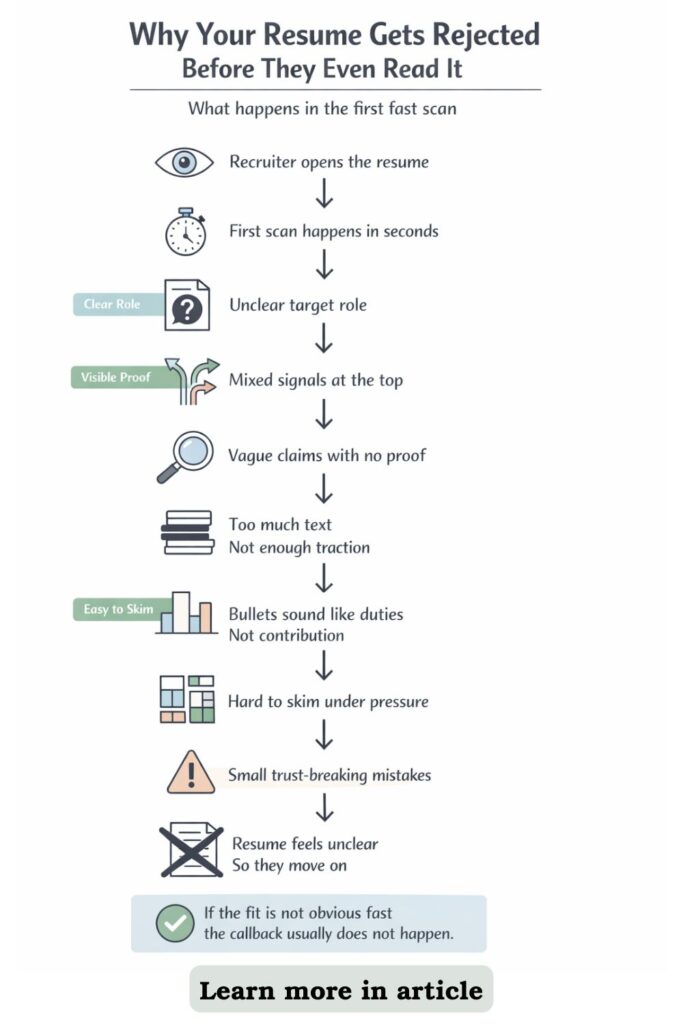
A recruiter usually does not begin with a deep read. They begin with a scan.
In that quick pass, your resume is answering silent questions:
- What role is this person actually going for?
- Do they look relevant right away?
- Does this feel credible?
- Is this easy to review?
- Does this person sound strong enough to interview?
If the page creates hesitation instead of clarity, you may lose the opportunity before your actual experience gets a fair chance.
That is why small resume fixes matter so much.
A stronger resume does not need to sound flashy. It needs to reduce doubt. It needs to make your direction feel obvious, your value feel real, and your background feel easy to trust. That is especially important in a crowded market where recruiters are moving quickly and comparing similar candidates side by side.
This article is a practical before-you-apply pass.
If you want to get more from your life, and are looking for concrete action steps to get you there, check out our Request a Coach page. It’s a “cut the fence-sitting and take action” way to tackle your issues and actually find success. To get off the fence and start to take action, click or tap here.
You are not going to rewrite your whole career story from scratch. You are going to tighten the parts that most often weaken a resume without the applicant realizing it. That means fixing unclear openings, vague proof, heavy wording, flat bullets, poor scanability, missing context, weak tailoring, trust-breaking errors, and final-review gaps.
As you read, think of this less like writing advice and more like a quality-control checklist.
You want your resume to do three things well:
- Show what role you fit
- Prove why you are credible
- Make the next step feel easy
If your experience is stronger than your results suggest, these fixes are exactly where to start.
Need some career guidance? Drop on by our directories choc full of career coaches to bring your career to the next level. Or click here to have us match you to the best.
1. Fix the first few lines so they stop raising questions
The top of your resume has one job: remove confusion fast.
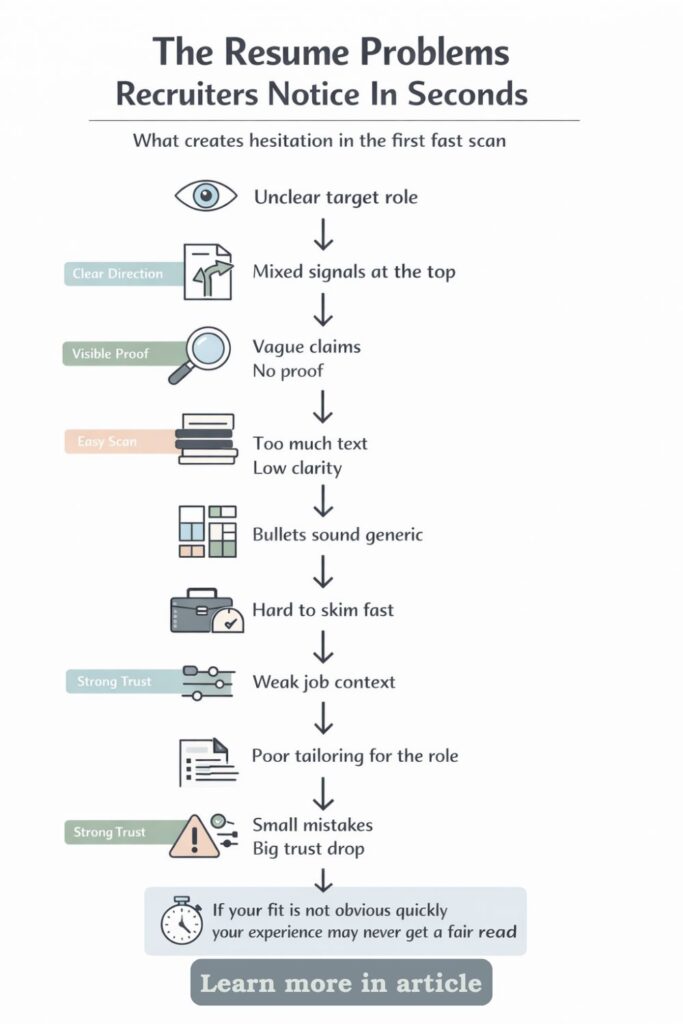
If a recruiter lands on your page and cannot tell what kind of role you want within a few seconds, the rest of the document has to work much harder. That uncertainty can quietly hurt you, especially when your background could fit more than one path.
A weak opening often sounds broad, safe, or generic. It might say “experienced professional,” “results-driven team player,” or “motivated self-starter.” None of those lines gives the reader a clear frame.
If you want to get more from your life, and are looking for concrete action steps to get you there, check out our Request a Coach page. It’s a “cut the fence-sitting and take action” way to tackle your issues and actually find success. To get off the fence and start to take action, click or tap here.
A stronger opening gives immediate direction.
Instead of opening vaguely, make the first lines answer these questions:
- What role are you targeting?
- What type of work do you do best?
- What part of your background is most relevant here?
For example, compare these two approaches:
- “Experienced professional with strong communication and organizational skills”
- “Customer Success Specialist with SaaS support experience across onboarding, retention, and account communication”
The second version instantly gives the reader something concrete to hold onto.
This does not mean you need a dramatic headline. It means you need a useful one.
Look closely at the top section of your resume and check whether your signals match. Your title, summary, skills, and recent experience should all point in the same direction. If one section says operations, another sounds like marketing, and another leans administrative support, the page starts to feel unfocused.
That mixed message creates doubt.
To tighten the top of your resume:
If you want to get more from your life, and are looking for concrete action steps to get you there, check out our Request a Coach page. It’s a “cut the fence-sitting and take action” way to tackle your issues and actually find success. To get off the fence and start to take action, click or tap here.
- Use a role-specific headline if it fits your target
- Open your summary with actual positioning, not soft traits
- Keep the first 10 to 15 lines aligned around one career direction
- Remove anything that introduces an off-target identity too early
This is especially important if you are changing industries or applying across adjacent roles.
You do not need to hide every past responsibility. But you do need to control what the reader sees first. The opening should guide interpretation, not leave it up to chance.
If the first few lines make your direction clear, the rest of the resume becomes easier to understand and easier to believe.
2. Replace vague claims with visible evidence
A lot of resumes sound confident without actually proving anything.
That is one of the biggest reasons qualified candidates get overlooked. The page uses strong words, but the reader cannot see enough evidence to trust them. When that happens, the resume feels polished on the surface but weak underneath.
Words like these are common:
- strategic
- detail-oriented
- proactive
- organized
- results-driven
- strong communicator
None of those terms is automatically bad. The problem is when they appear without visible support.
If your summary says you are highly organized, the bullets below it should show systems, coordination, deadlines, moving parts, or workload management. If you say you are results-driven, the resume should include measurable outcomes, improvements, or performance indicators.
If you want to get more from your life, and are looking for concrete action steps to get you there, check out our Request a Coach page. It’s a “cut the fence-sitting and take action” way to tackle your issues and actually find success. To get off the fence and start to take action, click or tap here.
Otherwise, the page starts to feel self-descriptive instead of evidence-based.
A better rule is simple: claim less, prove more.
You can do that by adding concrete proof in places where vague language usually sits. Look for opportunities to include:
- numbers
- percentages
- timeframes
- volumes
- team size
- client type
- platforms or systems
- project scope
- business outcomes
Even small details help.
Compare these two bullet styles:
- “Strong communicator who supported client relationships”
- “Managed client communication across 40+ active accounts, resolving service issues and supporting renewals”
The second version does not brag. It just gives the recruiter something real to evaluate.
This kind of proof matters because recruiters are reading for trust. They want to know whether your wording matches reality. Specifics make your experience easier to picture, easier to compare, and easier to believe.
As you revise, ask yourself:
If you want to get more from your life, and are looking for concrete action steps to get you there, check out our Request a Coach page. It’s a “cut the fence-sitting and take action” way to tackle your issues and actually find success. To get off the fence and start to take action, click or tap here.
- What did I actually handle?
- How much of it did I handle?
- What changed because I did it well?
- What context would make this sound more real?
You do not need to turn every line into a data-heavy performance statement. But you do want the resume to move away from personality claims and toward visible evidence.
A recruiter is much more likely to respond to a resume that shows value than one that simply announces it.
If your experience is stronger than your current resume sounds, this is often where the gap starts to close.
3. Cut details that make the resume feel heavier without making it stronger
A crowded resume does not always look more impressive.
Sometimes it just looks harder to review.
One of the most useful edits you can make before applying is not adding better content. It is removing weaker content that slows the reader down. Many resumes lose power because they contain too much information that does not improve the case.
This kind of weight shows up in a few common ways:
- long summaries that repeat obvious points
- too many bullets under every role
- outdated skills that add no real value
- repetitive phrases across multiple jobs
- filler lines that sound professional but say very little
When the page gets heavy, your best material has to compete with everything else.
If you want to get more from your life, and are looking for concrete action steps to get you there, check out our Request a Coach page. It’s a “cut the fence-sitting and take action” way to tackle your issues and actually find success. To get off the fence and start to take action, click or tap here.
That is a problem because recruiters do not reward completeness. They reward clarity. If the strongest parts of your experience are buried inside extra wording, the page may feel less impressive than it actually is.
Try looking at your resume with one question in mind: does this line strengthen my fit for this role?
If the answer is no, it may need to go.
This does not mean cutting everything down to the point of vagueness. It means protecting the lines that carry weight and trimming the ones that create drag.
Start with these targets:
- summary lines that repeat the headline
- job bullets that only describe routine duties
- older experience that no longer supports your direction
- generic software lists
- soft skills with no supporting proof
- duplicate achievements worded slightly differently
A good resume often feels lighter after a strong edit, not thinner.
That is because the content left behind has more purpose. Each line earns its place. Each section moves the reader forward. The page becomes easier to scan, easier to process, and easier to remember.
This is especially important if you are trying to keep your resume to one or two pages without sacrificing impact.
If you want to get more from your life, and are looking for concrete action steps to get you there, check out our Request a Coach page. It’s a “cut the fence-sitting and take action” way to tackle your issues and actually find success. To get off the fence and start to take action, click or tap here.
Instead of asking, “What else can I fit in?”
Ask:
- What is the strongest case I can make with the space I have?
- What content supports that case most directly?
- What is taking up room without improving my odds?
The goal is not to tell your whole story. The goal is to make the right story easier to see.
Cutting wisely can make a resume feel sharper, more modern, and more callback-worthy almost immediately.
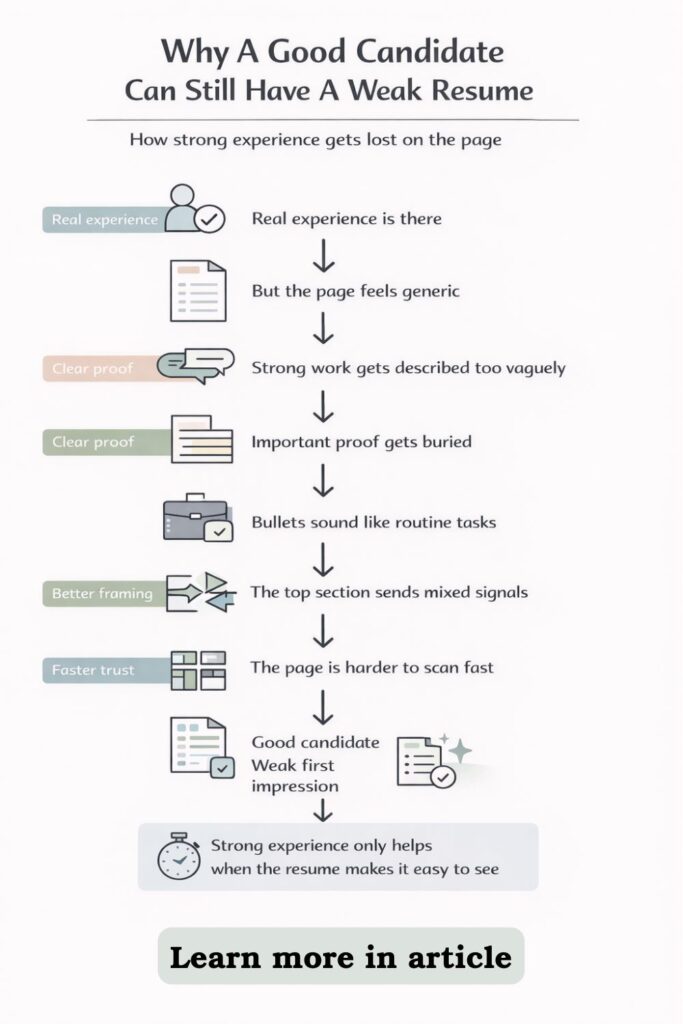
4. Rewrite bullets to show momentum, not maintenance
A lot of resume bullets sound like job descriptions copied into past tense.
That is a problem because job descriptions tell a recruiter what the role was supposed to include. They do not tell them what you actually contributed. If your bullets read like static maintenance, your experience can feel flatter than it really was.
Weak bullets often start like this:
- Responsible for…
- Helped with…
- Worked on…
- Assisted in…
- Managed daily tasks related to…
These phrases are not always wrong, but they rarely create momentum.
If you want to get more from your life, and are looking for concrete action steps to get you there, check out our Request a Coach page. It’s a “cut the fence-sitting and take action” way to tackle your issues and actually find success. To get off the fence and start to take action, click or tap here.
A stronger bullet makes the work feel active. It shows movement, progress, ownership, improvement, or judgment. It helps the recruiter understand what changed because you were there.
Good bullets often highlight things like:
- improvements you made
- problems you solved
- processes you supported under pressure
- results you helped drive
- decisions you influenced
- scope you handled consistently
That does not mean every bullet needs a dramatic achievement. But it should feel like it reflects real contribution, not just assigned duties.
Compare the difference:
- “Responsible for scheduling meetings and handling team calendars”
- “Coordinated scheduling across multiple stakeholders, managing calendar conflicts and keeping meetings on track for a fast-moving team”
The second version still describes support work, but it sounds more valuable because it shows function, complexity, and contribution.
When rewriting bullets, try this structure:
- start with a strong verb
- name the work clearly
- add context or scale
- show the impact if possible
Useful verbs include:
- coordinated
- streamlined
- improved
- supported
- led
- reduced
- resolved
- created
- launched
- organized
- tracked
- analyzed
Also look for bullets that are technically true but too generic to help you. These are often the first ones to cut or combine.
If you want to get more from your life, and are looking for concrete action steps to get you there, check out our Request a Coach page. It’s a “cut the fence-sitting and take action” way to tackle your issues and actually find success. To get off the fence and start to take action, click or tap here.
A good rule: if a bullet could appear on almost anyone’s resume in that role, it probably needs more specificity.
Your goal is to help the recruiter picture your work in motion.
They should be able to sense that you were not just present in the role. You were doing something useful inside it. Even in junior or support positions, that shift matters. Momentum makes you sound stronger. It also makes your experience easier to remember after a quick scan.
If your current bullets feel flat, this is one of the highest-impact edits you can make before the next application.
5. Make the document easier to skim under pressure
A strong resume is not just written well. It is reviewed well.
That means the page has to work for a rushed reader, not just a careful one. Even good content can underperform if the layout makes it hard to process quickly. When the resume feels dense, cluttered, or visually tiring, recruiters may miss your strongest material.
Scanability is not cosmetic. It is functional.
A recruiter under time pressure is looking for quick traction. They want to identify fit without hunting through walls of text. If your layout slows that process down, you create friction before your content has a chance to help you.
If you want to get more from your life, and are looking for concrete action steps to get you there, check out our Request a Coach page. It’s a “cut the fence-sitting and take action” way to tackle your issues and actually find success. To get off the fence and start to take action, click or tap here.
Common scanability problems include:
- very long paragraphs
- bulky bullet points
- uneven spacing
- sections blending together
- too much bolding
- poor hierarchy between headings and content
- important details buried in the middle of dense text
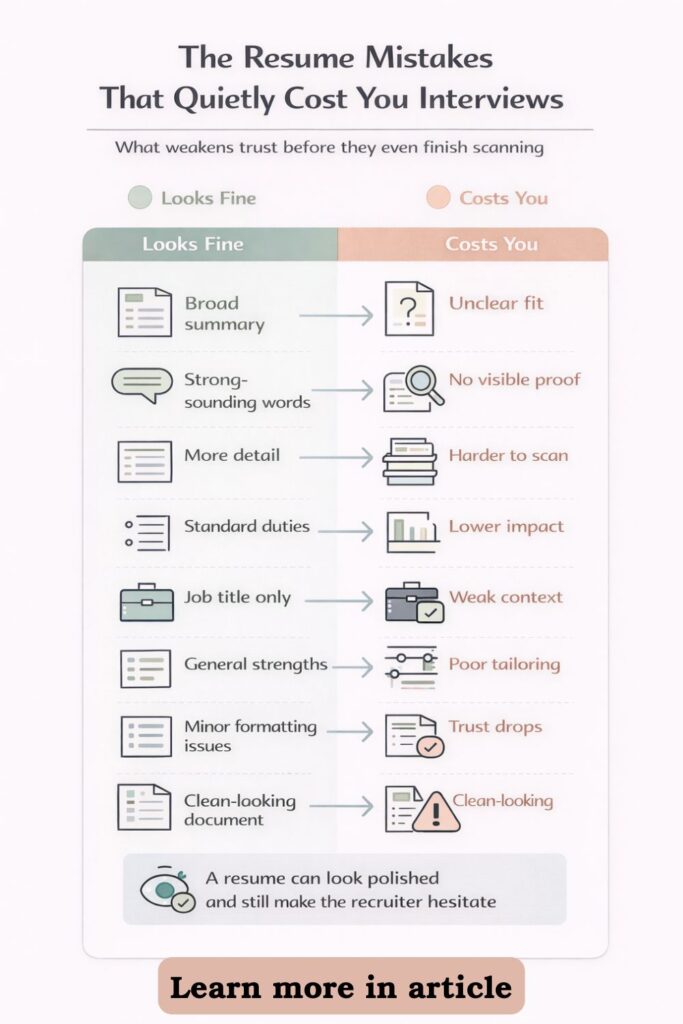
A cleaner layout helps the eye move naturally.
That means each section should feel easy to enter. Headings should be clear. Bullets should be concise enough to skim. The most relevant information should appear where attention lands early.
A few practical fixes can make a big difference:
- keep bullets to one or two lines where possible
- break up heavy summaries into shorter blocks
- use spacing consistently between roles and sections
- keep job titles, companies, and dates easy to identify
- avoid visual clutter from over-formatting
- place the strongest evidence in the top half of the first page
Think of your resume like a guided reading experience.
You are helping the recruiter notice the right things in the right order. First they should understand your direction. Then they should see relevant experience. Then they should spot proof. Then they should feel that the page is polished and easy to trust.
That flow matters.
It is also worth checking whether your strongest bullets are buried too low under each job. If the best material is hidden beneath three weaker lines, many readers may never get there. Lead with higher-value content when possible.
If you want to get more from your life, and are looking for concrete action steps to get you there, check out our Request a Coach page. It’s a “cut the fence-sitting and take action” way to tackle your issues and actually find success. To get off the fence and start to take action, click or tap here.
A resume does not need to look trendy or heavily designed to scan well. In most cases, simple and clean works best.
What matters is that the document feels easy to review under pressure. If a recruiter can understand your fit quickly and move through the page without strain, you have already improved your chances of getting to the next step.
6. Strengthen the credibility of each job entry
Sometimes a resume sounds decent, but the experience still feels thin.
That usually happens because the job entries lack context. The recruiter sees action verbs and task language, but they do not get enough information to judge the level, scope, or seriousness of the work. Without that context, even solid experience can look smaller than it really was.
Each role on your resume should help answer a few unspoken questions:
- What kind of environment was this?
- How much responsibility did this person handle?
- How complex was the work?
- At what level were they operating?
You do not need to overload every role with background. But you do want to include the details that make the work feel real and proportionate.
Helpful context can include:
- industry or business type
- client type
- number of accounts, projects, or requests handled
- cross-functional collaboration
- tools or systems used
- reporting level
- pace or volume of work
- ownership over a recurring process
For example, “managed onboarding” is more believable and useful when paired with context like “for new SaaS clients” or “across 20 to 30 accounts per month.”
If you want to get more from your life, and are looking for concrete action steps to get you there, check out our Request a Coach page. It’s a “cut the fence-sitting and take action” way to tackle your issues and actually find success. To get off the fence and start to take action, click or tap here.
The same applies to titles.
Sometimes a job title sounds more senior than the bullets beneath it, or the opposite. That disconnect can raise questions. A coordinator title with only vague admin bullets may seem weaker than it needs to. A manager title with no proof of leadership or oversight may feel inflated.
Your job entries should feel internally aligned.
To strengthen them, look for places where you can add one or two details that help the reader understand the scale of what you did. Not everything needs a number, but each role should feel grounded enough that a recruiter can place you accurately.
Try checking each entry for these elements:
- clear function
- relevant scope
- visible contribution
- believable level
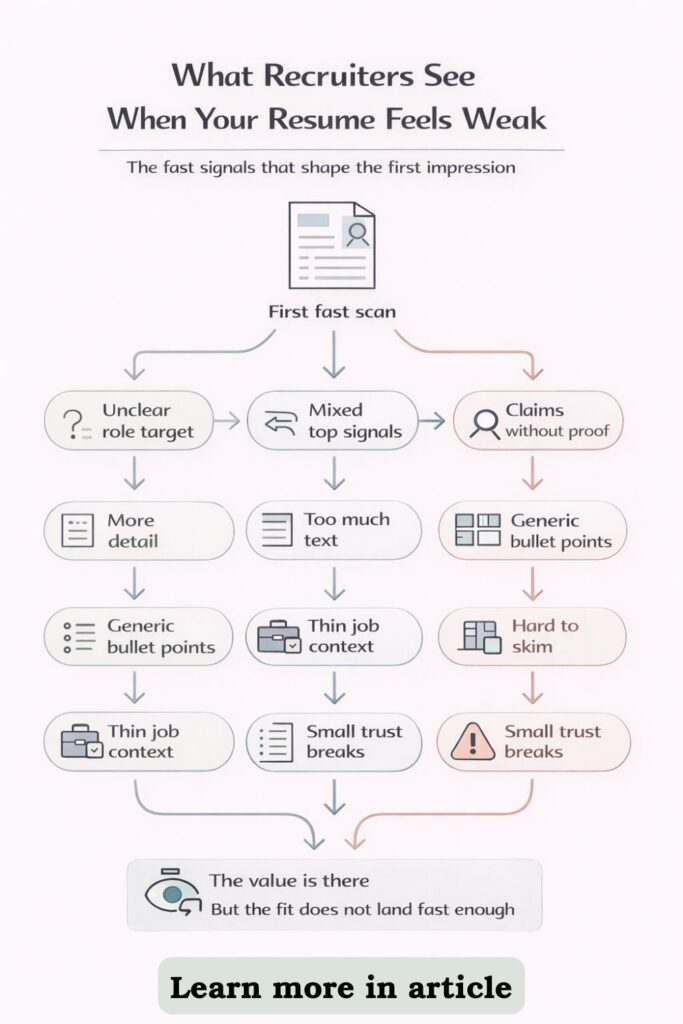
This is especially important if your work happened in smaller companies, broad roles, or job titles that vary a lot across industries. The more room there is for interpretation, the more helpful context becomes.
A credible job entry helps your resume feel stronger without sounding louder.
It gives the recruiter confidence that your experience is not being oversold, undersold, or left too open to guesswork. That confidence matters. When your roles feel real and well-framed, the page becomes easier to trust and easier to move forward with.
If you want to get more from your life, and are looking for concrete action steps to get you there, check out our Request a Coach page. It’s a “cut the fence-sitting and take action” way to tackle your issues and actually find success. To get off the fence and start to take action, click or tap here.
7. Tailor for the job without sounding copied
A resume can be polished, well-written, and still feel irrelevant to a specific role.
That is why tailoring matters. Recruiters want to see signs that your background matches the priorities of the job in front of them, not just that you are generally employable. When your resume feels mass-sent, it creates distance. When it feels chosen, it creates traction.
Tailoring does not mean rewriting every line from scratch for every application.
It means adjusting emphasis so the most relevant version of your experience is the one that shows up first. It also means borrowing the employer’s language carefully, without making the resume sound forced or copied.
Start by studying the job posting for patterns.
Look for repeated ideas such as:
- client communication
- cross-functional coordination
- data reporting
- operational support
- lead generation
- onboarding
- project ownership
- process improvement
- stakeholder management
If certain terms or themes appear multiple times, they matter. Your resume should reflect those priorities naturally across the headline, summary, skills, and bullet points.
That can look like:
If you want to get more from your life, and are looking for concrete action steps to get you there, check out our Request a Coach page. It’s a “cut the fence-sitting and take action” way to tackle your issues and actually find success. To get off the fence and start to take action, click or tap here.
- moving a more relevant bullet higher within a role
- adjusting a headline to better match the target function
- trimming less relevant content
- adding keywords tied to the employer’s needs
- rephrasing existing experience in language closer to the posting
The key is to customize emphasis, not invent fit.
You should never force your resume to sound like something you are not. But you do want to present the parts of your background that best support this specific opportunity. That is what makes the page feel intentional.
Be careful not to overdo the wording match.
If the resume copies phrases too closely, it can sound artificial. Instead, aim for alignment in meaning and priorities. Show that you understand the role and have relevant experience to bring into it.
A good tailored resume makes a recruiter think, “Yes, this person looks connected to what we need.”
That is very different from, “This person seems fine, but I would have to figure out how they fit.”
Before applying, ask yourself:
- Does this version reflect the role’s main priorities?
- Are my strongest relevant points easy to find?
- Did I reduce content that distracts from the fit?
When you tailor well, the resume does not just sound stronger. It sounds more specific, more considered, and more likely to earn a callback.
If you want to get more from your life, and are looking for concrete action steps to get you there, check out our Request a Coach page. It’s a “cut the fence-sitting and take action” way to tackle your issues and actually find success. To get off the fence and start to take action, click or tap here.
8. Watch for the small mistakes that quietly break trust
Some resume problems are big and obvious.
Others are small enough to slip through, but strong enough to weaken the whole impression. These are the mistakes that make a recruiter pause, even if they cannot explain exactly why the page feels less polished.
Trust is fragile on a resume.
If the document contains small inconsistencies, sloppy formatting, or avoidable errors, the reader may start wondering what else is inaccurate. That kind of doubt can hurt even when your actual experience is good.
Common trust-breakers include:
- inconsistent date formatting
- switching between past and present tense incorrectly
- uneven bullet punctuation
- random capitalization differences
- spacing issues between sections
- job titles that do not match LinkedIn
- company names written inconsistently
- typos in prominent areas
- awkward or incomplete sentences
None of these things alone always kills a resume. But together, they can make the document feel less careful.
And in many roles, carefulness matters.
That is why proofreading should go beyond spelling and grammar. You are not just checking for errors. You are checking for confidence leaks. Anything that makes the page feel less controlled can quietly work against you.
If you want to get more from your life, and are looking for concrete action steps to get you there, check out our Request a Coach page. It’s a “cut the fence-sitting and take action” way to tackle your issues and actually find success. To get off the fence and start to take action, click or tap here.
A strong final review should include:
- dates lined up and formatted consistently
- verb tense checked across every role
- section spacing reviewed from top to bottom
- bullet style kept uniform
- capitalization made consistent for titles and headings
- links tested
- names, tools, and employers checked for accuracy
It also helps to review the resume slowly in a different format. Print it, export it to PDF, or read it on another screen. Errors often become more obvious when the page looks slightly different.
Another smart step is to read only the first word of each bullet, then only the dates, then only the headings. That helps isolate inconsistencies you might miss when reading for meaning.
A recruiter may not consciously remember every small flaw. But they will notice the overall feeling.
You want that feeling to be: clean, consistent, reliable.
Those traits make your experience easier to trust. And when the page feels trustworthy, it becomes easier for someone to say yes to a phone screen or first interview.
9. Check whether the resume makes the next step feel easy
At some point, every resume has to answer the real question: does this make a recruiter feel comfortable moving this person forward?
That question matters more than many job seekers realize.
If you want to get more from your life, and are looking for concrete action steps to get you there, check out our Request a Coach page. It’s a “cut the fence-sitting and take action” way to tackle your issues and actually find success. To get off the fence and start to take action, click or tap here.
A resume is not judged only on whether the content is decent. It is also judged on whether the document makes the next step feel simple. If a recruiter has to work too hard to understand your fit, estimate your level, or justify your relevance, they may move on to a candidate who feels clearer.
Your resume should lower effort, not create more of it.
By the final review stage, ask whether the page does these things quickly:
- makes your target role obvious
- shows relevant experience near the top
- includes enough proof to support your claims
- feels polished and consistent
- gives a strong reason to schedule a screen
This is where a short recruiter-style pass helps.
Try looking at the resume for ten seconds, then stop. Ask yourself what you would know if you were the recruiter. Could you answer these questions?
- What role is this person going for?
- Are they at the right level?
- What do they seem strongest at?
- Is the document easy to trust?
- Would I want to learn more?
If too many of those answers feel fuzzy, the page still needs work.
This final check is less about writing and more about decision-making. You are reviewing the resume as a tool meant to support action. The best resumes do not tell every detail. They deliver enough clarity and confidence to earn the next conversation.
It also helps to compare your resume against the specific posting one last time. Not to obsess over every keyword, but to confirm that the strongest overlap is visible.
If you want to get more from your life, and are looking for concrete action steps to get you there, check out our Request a Coach page. It’s a “cut the fence-sitting and take action” way to tackle your issues and actually find success. To get off the fence and start to take action, click or tap here.
Before you send the application, review for:
- clarity
- relevance
- proof
- consistency
- skimmability
That last pass often catches things you miss while drafting. A vague opening. A buried achievement. A bullet that sounds weaker than the one below it. A skill section that feels off-target. Small changes here can make the whole document feel more decisive.
Your goal is simple: send a version that makes it easier for someone to say yes than to say no.
That is what a good before-you-apply checklist is really for.
What to do when your experience is solid but still looks weak on paper
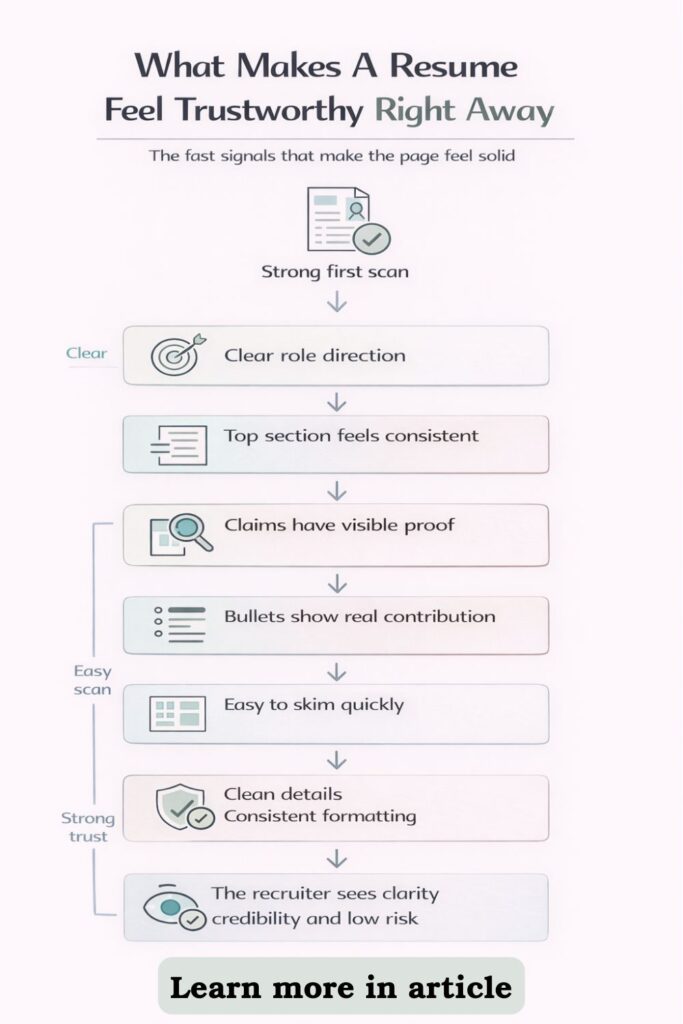
One of the most discouraging situations is knowing you have done meaningful work, but seeing it land flat on the page.
This happens all the time.
People assume their experience is the issue when the bigger problem is presentation. They have handled real responsibility, solved real problems, supported real outcomes, but their resume reduces that work into vague, routine, or generic language. As a result, the document undersells them.
This is especially common when you:
If you want to get more from your life, and are looking for concrete action steps to get you there, check out our Request a Coach page. It’s a “cut the fence-sitting and take action” way to tackle your issues and actually find success. To get off the fence and start to take action, click or tap here.
- stayed in one company for a long time
- worked in support-heavy or hybrid roles
- never had flashy job titles
- are used to describing your work modestly
- wrote the resume quickly from memory
Strong experience can look weak when it is buried under task wording.
For example, someone may have coordinated moving parts across teams, handled client issues under pressure, or kept operations running smoothly. But if the bullet only says “assisted with daily administrative tasks,” the value disappears.
That does not mean you need to exaggerate. It means you need to frame the work accurately.
To improve weak presentation, go back through each role and ask:
- What problems did I help solve?
- What did people rely on me for consistently?
- What work would have been harder if I were not there?
- What outcomes, deadlines, or relationships was I helping protect?
These questions often reveal stronger material than the original draft captured.
You may also need to separate “what I did” from “how important it was.” Many applicants stop at the task and never describe the significance. That is where better context, better verbs, and better prioritization come in.
A few upgrades can make a big difference:
- replace routine phrasing with contribution-based phrasing
- lead with your strongest bullets instead of your safest ones
- add scale or complexity where relevant
- remove low-value details that dilute the stronger points
Do not assume the market is judging your raw experience alone.
If you want to get more from your life, and are looking for concrete action steps to get you there, check out our Request a Coach page. It’s a “cut the fence-sitting and take action” way to tackle your issues and actually find success. To get off the fence and start to take action, click or tap here.
It is judging the version of that experience your resume makes visible. If the page is weak, the signal is weak. That is fixable. Sometimes the right edit is not about becoming more qualified. It is about finally presenting the qualification you already have.
How to know whether your resume still feels generic
A generic resume is not always badly written.
Sometimes it is polished, organized, and technically correct. The problem is that it could belong to almost anyone in your field. It gives a broad impression of competence, but not a strong sense of who you are, what you do best, or why your version of the background stands out.
That is where callbacks often stall.
Recruiters compare candidates constantly. If your resume sounds interchangeable, you become easier to pass over. Even if nothing is wrong, nothing feels memorable enough to move you forward.
A useful test is simple: could another candidate in a similar role swap names with you and still claim most of the page?
If the answer is yes, the resume probably needs more specificity.
Generic resumes often rely too heavily on:
If you want to get more from your life, and are looking for concrete action steps to get you there, check out our Request a Coach page. It’s a “cut the fence-sitting and take action” way to tackle your issues and actually find success. To get off the fence and start to take action, click or tap here.
- broad soft skills
- standard responsibility lists
- common verbs with no context
- summaries that could fit almost any applicant
- skill sections packed with familiar filler
- achievement bullets missing scale or business meaning
To make the resume feel more distinct, look for places where real specificity should show up.
That might include:
- the type of clients you worked with
- the industry environments you know
- the tools you use well
- the kind of pressure you handled
- the results you influenced
- the problems you became trusted to solve
You do not need to sound unusual for the sake of it. You just need the page to reflect your actual experience clearly enough that it stops sounding interchangeable.
Try reviewing your resume with these questions:
- What on this page feels specific to me?
- What details show my real working environment?
- What lines would still make sense if copied onto ten other resumes?
- Where can I replace broad wording with grounded wording?
Often, the strongest fixes are small.
A better headline. A summary with clearer positioning. A bullet with real scope. A skill section trimmed to what matters. A few role-specific details that make your background feel more concrete. These shifts do not make the resume louder. They make it more believable and more individual.
A recruiter does not need your resume to sound dramatic.
They need it to sound real, relevant, and distinct enough to remember. That is what helps a generic resume turn into a stronger callback signal.
If you want to get more from your life, and are looking for concrete action steps to get you there, check out our Request a Coach page. It’s a “cut the fence-sitting and take action” way to tackle your issues and actually find success. To get off the fence and start to take action, click or tap here.
Send a resume that feels easier to trust
The best resume advice is often less glamorous than people expect.
You usually do not need more buzzwords, more design, or more content. You need a document that helps the right person understand your fit quickly and trust what they are seeing. That is what moves applications forward.
A strong resume is not a full biography.
It is a decision tool. It helps a recruiter answer a practical question: should this person move to the next step? Every section on the page should support that decision by making your direction clearer, your proof stronger, and your experience easier to review.
That is why these nine fixes matter.
They help you:
- reduce confusion at the top of the page
- replace vague language with visible evidence
- cut weight that weakens your message
- make bullets sound active and valuable
- improve scanability under pressure
- add context that strengthens credibility
- tailor more effectively
- catch trust-breaking errors
- do a real final review before applying
If your resume has not been getting callbacks, do not assume the answer is always “get more experience.”
Sometimes the answer is “make the experience you already have easier to see.”
If you want to get more from your life, and are looking for concrete action steps to get you there, check out our Request a Coach page. It’s a “cut the fence-sitting and take action” way to tackle your issues and actually find success. To get off the fence and start to take action, click or tap here.
That is good news, because it means the next improvement may be closer than it feels.
Need some career guidance? Drop on by our directories choc full of career coaches to bring your career to the next level. Or click here to have us match you to the best.
Before you send your next application, give your resume one more pass with fresh eyes. Look for hesitation points. Look for weak signals. Look for places where the page is asking the recruiter to do too much guesswork.
Then fix those first.
The goal is not perfection. The goal is a stronger impression.
You want the person reading your resume to understand what role you fit, believe the evidence in front of them, and feel that taking the next step would be worth their time. When your resume does that well, callbacks become much more likely.
If you want to get more from your life, and are looking for concrete action steps to get you there, check out our Request a Coach page. It’s a “cut the fence-sitting and take action” way to tackle your issues and actually find success. To get off the fence and start to take action, click or tap here.
Read this next

Tweet your Way to a New Career
Social media applications, and especially Twitter, offer an incomparable opportunity to develop a wide professional network, meet new people and find new career opportunities. The first step is to fill […]
Read More
Dress to Impress: Affordable Tips for a Stylish Business Casual Wardrobe
Looking sharp at work does not have to cost a lot of money or cause stress. Anyone can create a business casual wardrobe on a tight budget by focusing on […]
Read More
What to Say After a Networking Event: Simple Follow-Up Messages That Actually Get Replies
Most people send follow-ups that feel forgettable even when they have strong career motivation. Visit to see how to apply a simple timeline using effective communication skills, productivity tips, and career goals that lead to real replies. Save this so your career advice stays ready after every event.
Read More