





Coffee Chat Questions for Introverts: 32 Easy Prompts That Don’t Feel Forced (Downloadable Template)

Want to try this at home? Download your free template now!
***
Coffee chats can feel strangely high pressure when you are an introvert.
On paper, they sound simple. You meet someone, ask a few questions, learn about their work, and maybe build a helpful professional connection. In real life, they can feel like a test you did not study for. You are supposed to sound curious but not stiff, confident but not self-promotional, friendly but not fake. That is a lot to juggle while also trying to think of what to say next.
For introverts, the hardest part is often not the conversation itself. It is the fear of awkwardness. It is the worry that you will run out of questions, fall back on small talk, or say something that sounds too rehearsed. It is also the pressure to talk about yourself in a way that feels polished, even when that is not how you naturally communicate.
The good news is that a strong coffee chat does not depend on being naturally chatty.
It depends on having good prompts.
When your questions are thoughtful, specific, and easy to answer, the conversation starts carrying more of the weight for you. You do not have to force chemistry. You do not have to “perform.” You just need a few solid ways to open, a few ways to follow what the other person says, and a few ways to keep the exchange useful without sounding stiff.
If you want to get more from your life, and are looking for concrete action steps to get you there, check out our Request a Coach page. It’s a “cut the fence-sitting and take action” way to tackle your issues and actually find success. To get off the fence and start to take action, click or tap here.
This article gives you exactly that.
You will find 25 introvert-friendly coffee chat prompts woven through a simple framework you can actually use. These are not random questions pulled from a networking script. They are designed to help you:
- keep the conversation flowing naturally
- learn useful career information
- avoid panic-filled small talk
- ask for insight without awkward self-promotion
- leave the conversation feeling more grounded than drained
You do not need to become more outgoing to have better career conversations.
You just need better questions, and a better way to use them.
Need some business or career guidance? Drop on by our directories choc full of business coaches and career coaches to bring your business or career to the next level. Or click here to have us match you to the best.
Start with a low-pressure opener that gives the other person something easy to answer
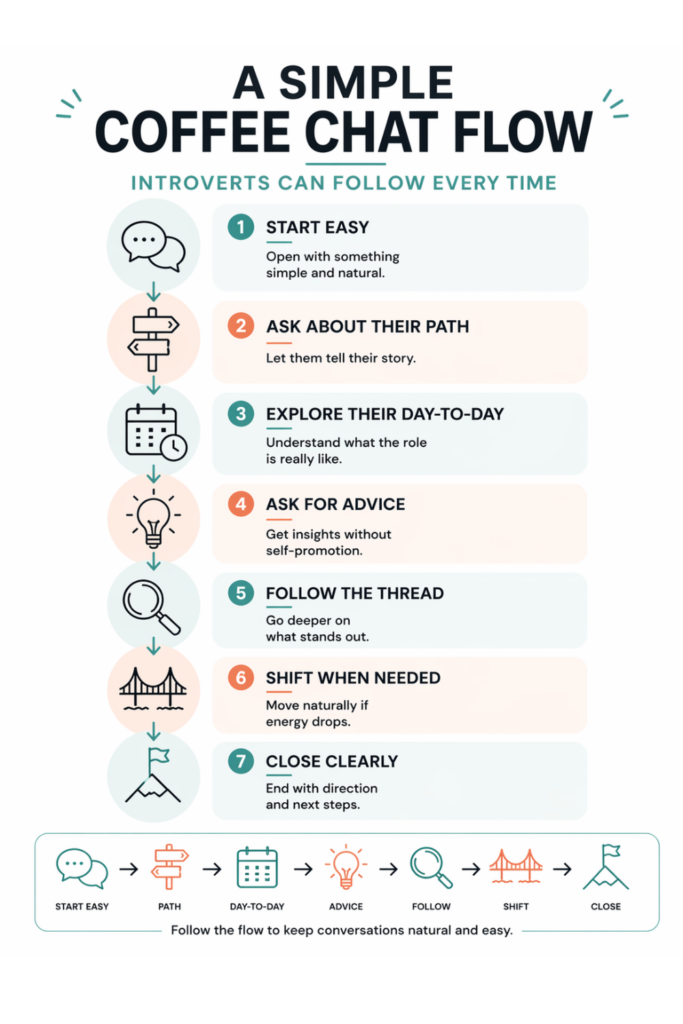
The first few minutes of a coffee chat matter more than most people realize.
If the opening feels stiff or vague, both people start working too hard. You are trying to find the “right” question. They are trying to figure out what kind of conversation this is supposed to be. That is when things start feeling forced. A low-pressure opener solves that problem by giving the other person something simple, familiar, and easy to answer.
This is why introverts usually do better with context-based openers than generic icebreakers.
If you want to get more from your life, and are looking for concrete action steps to get you there, check out our Request a Coach page. It’s a “cut the fence-sitting and take action” way to tackle your issues and actually find success. To get off the fence and start to take action, click or tap here.
You do not need to warm the room up with polished small talk. You just need to make the first question clear enough that the other person can respond without guessing what you mean. In a career conversation, the easiest place to start is with their path, their role, or the kind of work they are doing now.
Try prompts like these:
- What first drew you into this kind of work?
- How did you end up in your current role?
- What has your career path looked like up to this point?
- What do you spend most of your time on in your role right now?
- What surprised you most when you started working in this field?
These work well because they do not put pressure on either person to be clever. They invite a real answer, not a polished one. They also tend to open a story, which is helpful when you are nervous. Stories give you more to work with than short, factual answers.
A good opener also helps you avoid the most common introvert trap: starting too abstractly.
Questions like “Do you have any advice for me?” are not bad, but they ask a lot too early. The other person has no context yet. It is much easier to begin with something grounded and then let the conversation deepen naturally.
If you want to make the opening feel even smoother, add one sentence of setup before your first question. For example:
- I’ve been exploring this area, and I was really curious how people actually get into it.
- I’d love to hear a bit about how your path unfolded.
- I’m trying to understand what this kind of role looks like in real life.
That kind of framing helps the chat feel purposeful without feeling formal.
A simple opener does not make you sound basic. It makes you sound clear. And clear is one of the most underrated strengths an introvert can bring into a career conversation.
If you want to get more from your life, and are looking for concrete action steps to get you there, check out our Request a Coach page. It’s a “cut the fence-sitting and take action” way to tackle your issues and actually find success. To get off the fence and start to take action, click or tap here.
Use path questions to keep the conversation flowing without small talk
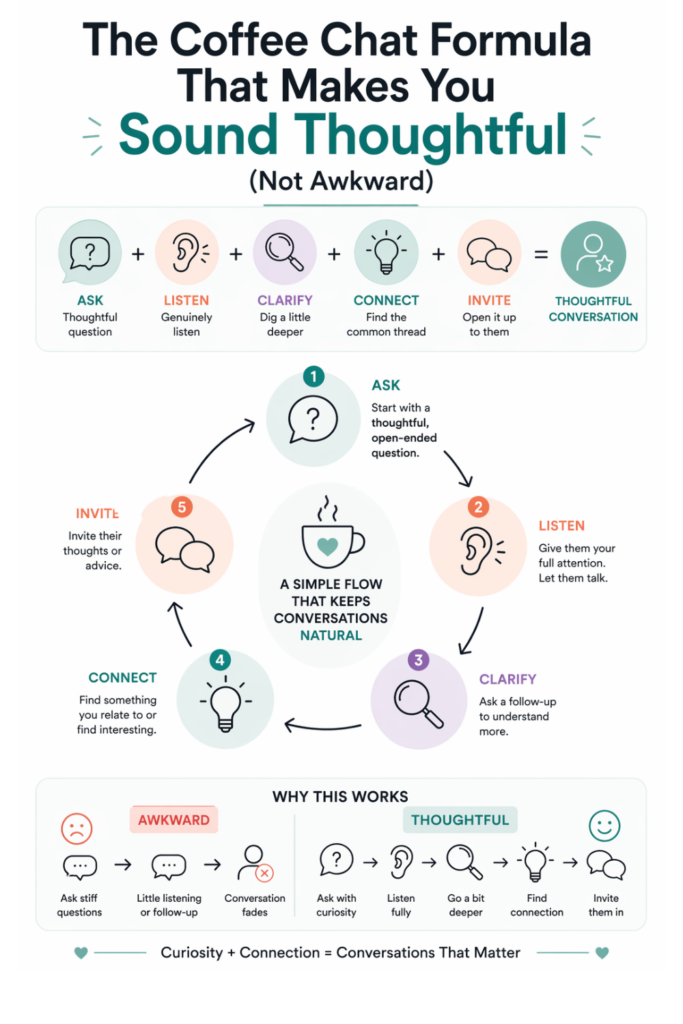
Once the conversation has started, many introverts feel a second wave of pressure.
The opening question is over, and now they have to keep the momentum going. This is usually the moment when people either panic and jump into unrelated questions, or default to empty small talk that does not help the conversation go anywhere useful. Path questions are what keep that from happening.
A path question focuses on movement.
It asks how someone went from one stage to another, what shaped a decision, or what changed along the way. These questions are especially helpful because they make a career conversation feel like a story instead of an interview. And once someone starts telling a story, you usually do not need to work as hard to keep things flowing.
Here are a few strong path questions:
- What was the turning point that led you in this direction?
- Did you always know you wanted to do this, or did it evolve over time?
- What role or experience helped you make the biggest leap?
- Was there a point when you realized this path was the right fit?
- What did your transition into this kind of work actually look like?
These questions work because they create natural follow-ups.
If someone says, “Honestly, I sort of fell into it,” you can ask how that happened. If they mention a difficult career pivot, you can ask what made that transition hard. If they say one early role taught them a lot, you can ask what it taught them specifically. You are not inventing conversation from scratch anymore. You are following the shape of what they already shared.
That is the real secret.
If you want to get more from your life, and are looking for concrete action steps to get you there, check out our Request a Coach page. It’s a “cut the fence-sitting and take action” way to tackle your issues and actually find success. To get off the fence and start to take action, click or tap here.
Good follow-up questions do not come from being brilliant on the spot. They come from paying attention to what has already been offered and pulling on the most interesting thread.
When you listen for turning points, pay attention to things like:
- a career change
- an unexpected opportunity
- a hard lesson
- a first big break
- a role they almost did not take
- a skill they had to learn the hard way
Each of those can lead to a deeper question without making the chat feel heavy.
Path questions are also useful because they help you learn something real. Titles can sound polished and linear from the outside. Career paths usually are not. When you ask how someone actually got from one point to the next, you learn what the polished version leaves out. That is often the most useful part of the whole conversation.
For introverts, this is a gift. You do not need to fill space with chatter. You just need to stay curious about what changed, what mattered, and what happened next.
Ask day-to-day reality questions so you learn what the job is actually like
A lot of career conversations stay too polished to be useful.
You hear about titles, teams, promotions, and milestones, but not what the work actually feels like on a Tuesday afternoon. That is why day-to-day reality questions matter. They shift the conversation from surface-level impressions to practical understanding. And for introverts, that is often where the chat starts feeling more comfortable too.
It is easier to ask thoughtful questions when the topic is concrete.
If you want to get more from your life, and are looking for concrete action steps to get you there, check out our Request a Coach page. It’s a “cut the fence-sitting and take action” way to tackle your issues and actually find success. To get off the fence and start to take action, click or tap here.
You are no longer trying to impress someone with big career ambition. You are simply trying to understand what their role is like in real life. That lowers the pressure and makes the whole exchange feel more grounded.
Try questions like these:
- What does a typical week look like in your role?
- What kinds of tasks take up most of your time?
- What parts of the job do people usually misunderstand?
- What tends to be more challenging than it looks from the outside?
- What part of your work gives you the most energy?
These questions are especially helpful if you are exploring a role, field, or industry and want a clearer picture of fit. The answers can tell you more than a polished job description ever could. Someone might describe their work as strategic, but then explain that most of their week is actually spent in meetings, managing expectations, or solving operational problems. That kind of detail matters.
As you listen, notice the emotional texture of what they say.
Pay attention to:
- what sounds energizing
- what sounds draining
- what sounds repetitive
- what sounds ambiguous
- what sounds collaborative
- what sounds high pressure
You do not need to interrogate those details. Just notice them. If something stands out, ask a follow-up question that helps you understand it better.
For example:
- You mentioned the role is more cross-functional than people expect. What does that look like day to day?
- You said the work moves fast. What kind of pace are we talking about?
- It sounds like communication is a huge part of the role. Was that something you expected?
Questions like these help you move beyond title envy.
If you want to get more from your life, and are looking for concrete action steps to get you there, check out our Request a Coach page. It’s a “cut the fence-sitting and take action” way to tackle your issues and actually find success. To get off the fence and start to take action, click or tap here.
They make the conversation more useful because they help you compare the job to your real preferences, strengths, and working style. That is especially important for introverts, who often need a role to feel sustainable, not just impressive.
A coffee chat should not just tell you what a role is called.
It should help you picture what it is actually like to live inside it.
Use advice questions that let you get help without awkward self-promotion
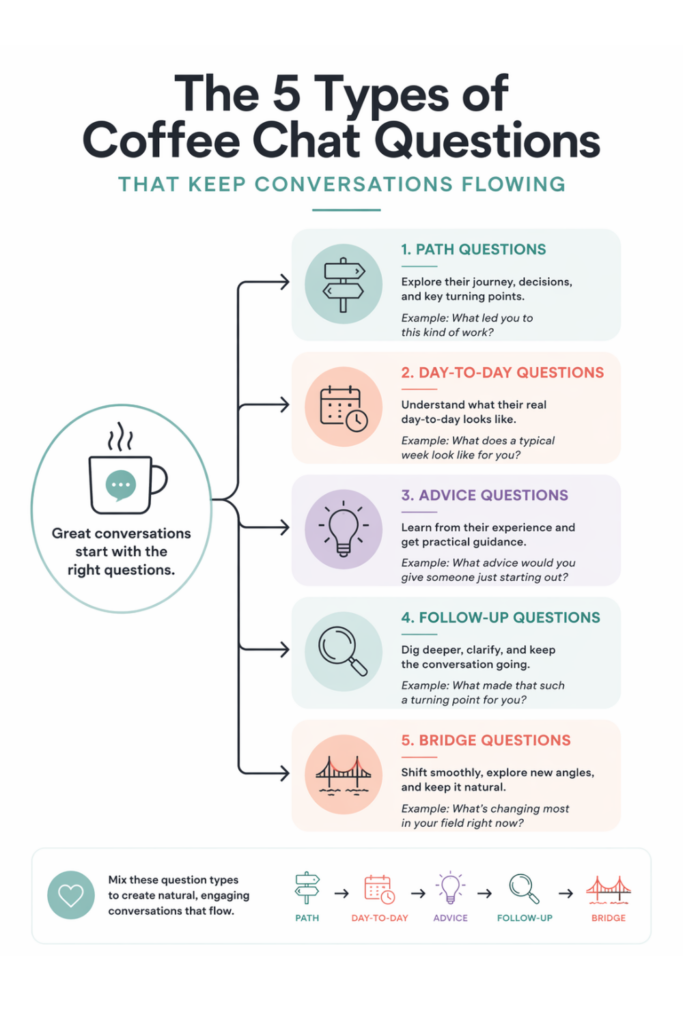
One of the most uncomfortable parts of a coffee chat for introverts is the moment they feel they are supposed to “sell themselves.”
Even if no one has asked for a pitch, the pressure can sneak in anyway. You start wondering how much to share, how polished to sound, and whether you are supposed to somehow prove that you are ambitious, capable, and worth helping. That tension makes a lot of people either over-explain or say almost nothing.
Advice questions give you a better option.
They let you ask for something valuable without turning the conversation into a performance. Instead of trying to impress the other person first and then hope they offer insight, you can ask directly for guidance in a way that feels natural, specific, and respectful.
Here are a few strong prompts:
If you want to get more from your life, and are looking for concrete action steps to get you there, check out our Request a Coach page. It’s a “cut the fence-sitting and take action” way to tackle your issues and actually find success. To get off the fence and start to take action, click or tap here.
- If you were starting in this area now, what would you focus on first?
- What skill do you think matters more than people realize in this kind of role?
- What do early-career people often get wrong about this path?
- Is there anything you wish you had learned sooner?
- What would make someone stand out in a thoughtful way in this field?
These work because they center the other person’s experience, not your performance.
That takes pressure off you. You are not trying to prove you belong in the room. You are inviting them to share what they know. Most people respond well to that because it feels easier and more genuine than a forced networking exchange.
If you do want to add context about yourself, keep it brief and targeted. This is where introverts often help themselves by saying less, not more. You do not need to explain your whole background. You only need enough information for the other person to understand why your question matters.
For example:
- I’ve been trying to figure out whether this kind of work would be a good fit for me, especially because I like analytical work more than highly public-facing roles.
- I’m early in exploring this path, so I’m curious what you think is worth paying attention to first.
- I’ve done some related work, but I still feel unclear on what really matters in this space.
That kind of context is honest and helpful.
It also keeps you from slipping into self-promotion disguised as background. Long explanations can make you feel safer because they give you something to say, but they often make the conversation heavier. A short frame plus a clear question works much better.
You do not need to be impressive to ask good career questions.
You just need to be clear enough to make the other person’s insight easy to share.
If you want to get more from your life, and are looking for concrete action steps to get you there, check out our Request a Coach page. It’s a “cut the fence-sitting and take action” way to tackle your issues and actually find success. To get off the fence and start to take action, click or tap here.
Ask better follow-ups so you do not run out of things to say
A lot of people think the hardest part of a coffee chat is coming up with great original questions.
Usually, that is not the real problem.
The real problem is not knowing how to follow an answer without jumping awkwardly to a new topic. That is where introverts often freeze. They are listening, but they are also worrying about what comes next. Then the other person finishes talking, there is a small pause, and suddenly the whole conversation feels fragile.
Better follow-ups fix that.
The easiest way to follow up is to pull one thread from what the other person just said and stay with it for a little longer. You do not need to come up with something brilliant. You just need to notice what was most specific, surprising, or emotionally charged in their answer.
Here are a few follow-up patterns that work almost anywhere:
- What made that such a turning point?
- What did that transition teach you?
- What was the hardest part of that at the time?
- How did you know it was the right move?
- What would you do differently now?
These are useful because they are flexible.
You can use them after a story about a promotion, a career pivot, a failed project, a difficult manager, or an unexpected opportunity. They help the conversation deepen naturally instead of widening too fast.
If you want to get more from your life, and are looking for concrete action steps to get you there, check out our Request a Coach page. It’s a “cut the fence-sitting and take action” way to tackle your issues and actually find success. To get off the fence and start to take action, click or tap here.
Another strong move is to reflect back one phrase before asking your next question. For example:
- You mentioned the role became much more strategic over time. What changed?
- You said the team culture made a huge difference. What specifically stood out?
- You mentioned burnout was a factor. How did that affect your next decision?
That reflection shows you were listening. It also gives the other person a clear entry point into their next answer.
If you tend to go blank in conversations, it helps to memorize a few fallback follow-ups. Think of them as your quiet safety net. You may not need them every time, but having them in your head can lower the panic enough that you listen better.
A simple set might be:
- What happened next?
- What made that difficult?
- What helped most?
- Was that what you expected?
- How do you think about that now?
These are not flashy questions. That is why they work.
A strong conversation does not depend on constant novelty. It depends on whether the other person feels like their answers are being noticed and used. Follow-ups are what create that feeling. And for introverts, they are one of the easiest ways to sound thoughtful without forcing anything.
Keep the chat balanced so it feels natural instead of one-sided
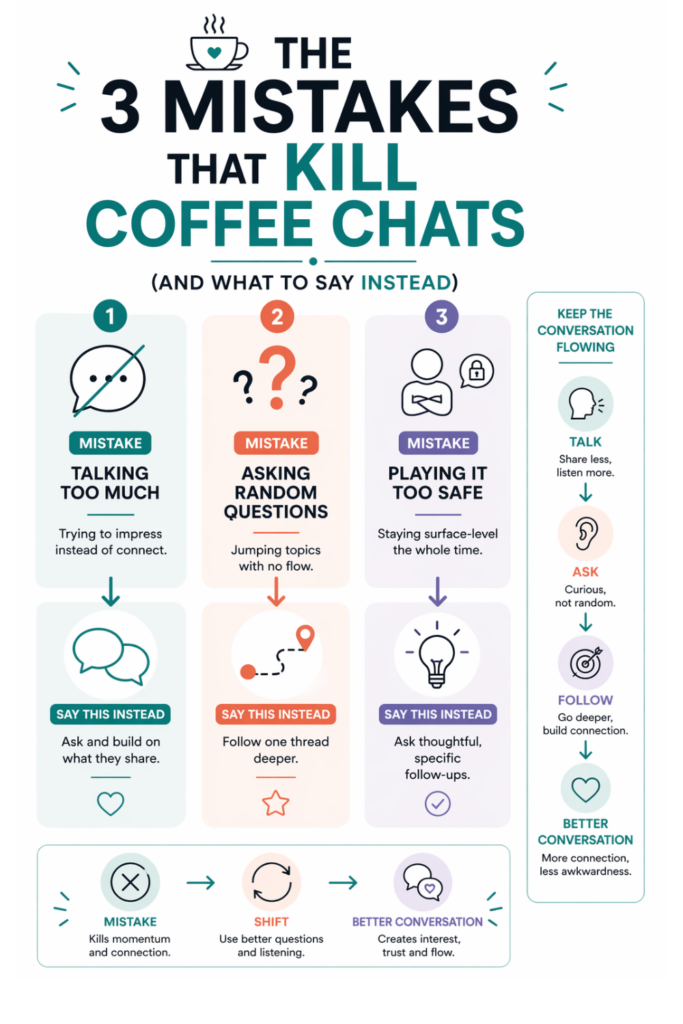
A coffee chat should not feel like an interrogation.
It also should not feel like a monologue where you talk too much because you got nervous and started filling space. The most natural conversations usually have a quiet balance to them. The other person shares, you ask, you respond, and sometimes you offer a small piece of your own perspective so the interaction feels mutual.
If you want to get more from your life, and are looking for concrete action steps to get you there, check out our Request a Coach page. It’s a “cut the fence-sitting and take action” way to tackle your issues and actually find success. To get off the fence and start to take action, click or tap here.
For introverts, this balance can be tricky.
Some introverts stay so focused on asking good questions that they end up sounding formal or distant. Others share too much when they get a chance because they are relieved to have something prepared. Neither approach is wrong, but both can make the conversation feel less natural than it needs to.
A balanced chat usually includes three things:
- clear, thoughtful questions
- brief, relevant responses from you
- enough space for the other person to keep talking
That middle piece matters. You do not need to tell your whole story, but it helps to occasionally let the other person know what is resonating or why you are asking.
For example:
- That’s helpful because I’ve been trying to figure out whether I’d enjoy that kind of work day to day.
- I relate to that. I do my best thinking in quieter settings too.
- That’s interesting. I hadn’t realized how much of the role involved stakeholder communication.
Small responses like these make the exchange feel more human. They also prevent the conversation from becoming overly transactional.
At the same time, keep your additions short. A coffee chat is not the time to over-explain every thought. If you notice yourself talking for too long, pause and hand the conversation back naturally.
You can do that with simple transitions like:
If you want to get more from your life, and are looking for concrete action steps to get you there, check out our Request a Coach page. It’s a “cut the fence-sitting and take action” way to tackle your issues and actually find success. To get off the fence and start to take action, click or tap here.
- I’d love to hear more about that.
- How did that play out for you?
- Was that something you expected going in?
Another important part of balance is silence.
Many introverts assume a short pause means the conversation is failing. Usually it does not. A brief pause often just means someone is thinking. If you can get comfortable with a second or two of quiet, the whole chat starts feeling less frantic. You do not have to rush in every time.
A good coffee chat does not require nonstop momentum.
It just needs a steady rhythm. When you stop trying to over-manage every moment, you give the conversation room to feel real. That often helps introverts come across at their best: calm, observant, and genuinely interested.
Prepare a few bridge questions for the moments when the energy drops
Even a good conversation can hit a flat patch.
Maybe one topic wraps up cleanly. Maybe the other person gives a shorter answer than expected. Maybe you feel your mind go blank for a second and panic starts creeping in. This is where bridge questions help. They give you a smooth way to move the conversation forward without sounding abrupt or robotic.
A bridge question is not a dramatic pivot.
It is simply a question that reconnects the chat to something useful when the energy starts to dip. Instead of scrambling for a brand new topic, you move into another question category that still fits the overall purpose of the conversation.
If you want to get more from your life, and are looking for concrete action steps to get you there, check out our Request a Coach page. It’s a “cut the fence-sitting and take action” way to tackle your issues and actually find success. To get off the fence and start to take action, click or tap here.
Good bridge questions often focus on:
- industry trends
- role expectations
- useful skills
- common mistakes
- career growth
- lessons learned
Here are a few examples:
- What seems to be changing most in your field right now?
- Are there skills becoming more important in this kind of role?
- What do you think people tend to underestimate about this path?
- What advice would you give someone trying to explore this area thoughtfully?
- What tends to separate people who grow quickly from people who stall?
These are especially helpful because they reopen depth.
You are not falling back on filler. You are moving into another meaningful part of the conversation. That keeps the chat from feeling awkward even if there was a small lull right before it.
It also helps to prepare your bridge questions before the meeting instead of trusting yourself to invent them in real time. You do not need a giant list. Three to five is enough. The point is not to follow a script word for word. The point is to reduce the mental pressure that makes introverts feel like one awkward pause means the whole chat is going badly.
You might organize your bridge questions like this:
If the chat feels too surface level: Ask about lessons learned or what surprised them.
If the chat feels too abstract: Ask what day-to-day work actually looks like.
If you want to get more from your life, and are looking for concrete action steps to get you there, check out our Request a Coach page. It’s a “cut the fence-sitting and take action” way to tackle your issues and actually find success. To get off the fence and start to take action, click or tap here.
If the chat starts slowing down: Ask about trends, advice, or how the field is changing.
If the chat is almost done: Ask what they would recommend exploring next.
That kind of simple system makes a huge difference.
A conversation does not need to flow perfectly from beginning to end. It just needs a few good transitions. Bridge questions give you those transitions. They help you recover your footing quietly, which is one of the most useful skills an introvert can bring into any professional conversation.
Know how to end strong without making it weird
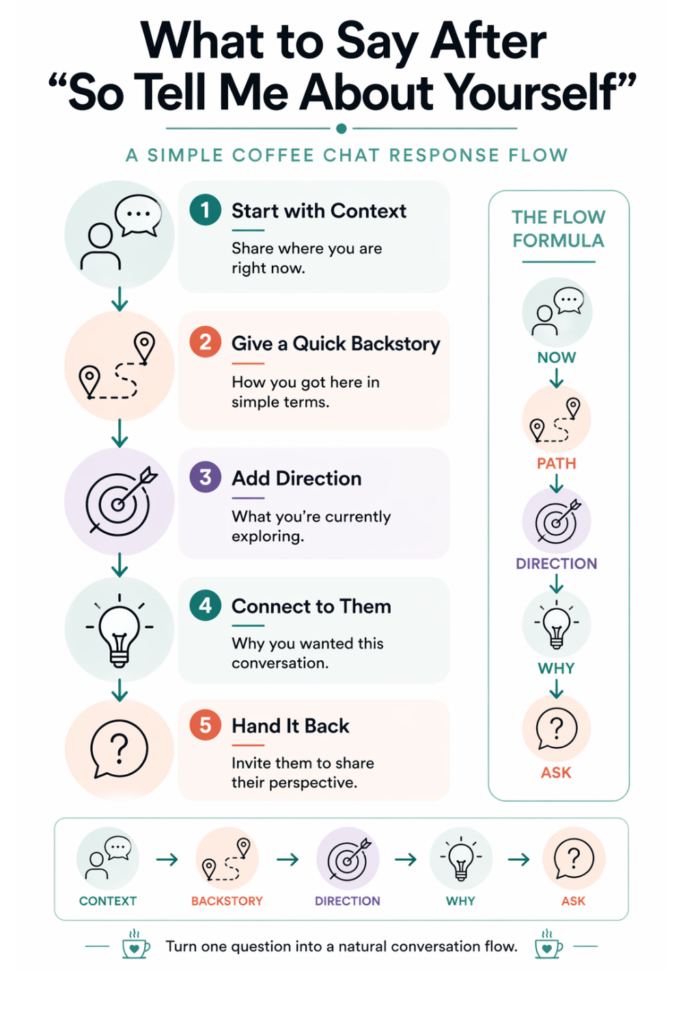
A lot of people handle the middle of a coffee chat better than the ending.
They can ask questions, listen well, and keep the conversation going, but when it starts winding down, they are not sure how to close without sounding abrupt, overly formal, or awkwardly grateful. So they either drag it out too long or end with something vague like, “Well, this was great.”
A stronger ending is usually much simpler than people think.
You do not need a polished speech. You just need to do two things well:
If you want to get more from your life, and are looking for concrete action steps to get you there, check out our Request a Coach page. It’s a “cut the fence-sitting and take action” way to tackle your issues and actually find success. To get off the fence and start to take action, click or tap here.
- reflect one useful takeaway
- make one clean closing move
Reflecting a takeaway helps the conversation feel complete. It shows that you were listening and that the chat mattered. It also makes your appreciation sound more genuine because it is tied to something specific.
For example:
- I really appreciated hearing how your career path evolved over time. That made the process feel a lot more real and less linear.
- It was especially helpful to hear how much the role depends on communication, not just technical skill.
- What you said about learning through smaller transitions really stuck with me.
A sentence like that lands much better than a generic thank you on its own.
After that, your closing move can stay simple. Depending on the conversation, you might ask one final practical question or just wrap up warmly. Here are a few options:
- Is there anything you’d recommend I read, follow, or explore next?
- If I want to understand this field better, what would be a smart next step?
- Thank you again. This gave me a much clearer picture of the path.
- I really appreciate your time. This was incredibly helpful.
You do not need to force a big ask.
In fact, introverts often do better when they do not treat every coffee chat as a networking opportunity that must turn into something more. Sometimes the best ending is simply respectful, thoughtful, and easy. That leaves a stronger impression than trying to squeeze in a request that does not fit the moment.
It also helps to notice the natural signs that the chat is wrapping up. The other person may glance at the time, summarize something they said earlier, or shift into broader advice. When that happens, do not panic and suddenly launch a new topic. Let the conversation land.
Ending well is less about saying the perfect thing and more about signaling that you know how to close with clarity.
If you want to get more from your life, and are looking for concrete action steps to get you there, check out our Request a Coach page. It’s a “cut the fence-sitting and take action” way to tackle your issues and actually find success. To get off the fence and start to take action, click or tap here.
That matters. A clean ending makes the whole conversation feel smoother. It leaves both people with the sense that the time was well spent, which is exactly what you want.
How a coach could help you get better at coffee chats
If coffee chats consistently leave you drained, flustered, or disappointed, it may not mean you are bad at them.
It may just mean you need more structure than generic advice gives you.
This is one area where a good coach can be surprisingly helpful. Not because you need someone to turn you into an extrovert, but because a coach can help you understand your own conversation patterns and build a process that works with your personality instead of against it.
A coach can help you spot things that are hard to notice on your own.
For example, you may realize that you:
- over-prepare and sound too scripted
- under-prepare and go blank too easily
- ask strong opening questions but weak follow-ups
- avoid talking about yourself even when it would help
- explain too much when you feel nervous
- leave conversations without asking for the information you really wanted
These are not character flaws. They are patterns. Patterns can be adjusted.
A coach could help by walking through real examples of past conversations and identifying where the tension started. Maybe you were asking questions that were too broad. Maybe you were not framing your goals clearly enough. Maybe you were trying so hard not to sound self-promotional that you made it harder for the other person to help you.
If you want to get more from your life, and are looking for concrete action steps to get you there, check out our Request a Coach page. It’s a “cut the fence-sitting and take action” way to tackle your issues and actually find success. To get off the fence and start to take action, click or tap here.
They can also help you build a repeatable system before the conversation even starts.
That might include:
- choosing 5 to 7 go-to questions that match your goals
- practicing brief ways to explain your career interests
- preparing 3 bridge questions for awkward pauses
- identifying what kind of follow-up feels natural for you
- figuring out how to close clearly without rushing
For career-related coffee chats, a coach can be especially useful if your conversations tend to touch on goals, transitions, confidence, or decision-making. You may not just need better networking skills. You may need help getting clearer on what you want from these conversations in the first place.
That clarity changes everything.
When you know what you are trying to learn, what kind of roles fit your working style, and what questions help you get honest answers, coffee chats stop feeling like vague social pressure. They start feeling like useful, manageable conversations.
A coach cannot remove every awkward moment.
But they can help you create enough structure that awkward moments no longer control the whole experience. For introverts, that can make career conversations feel a lot more doable.
Turn these prompts into a personal coffee chat system
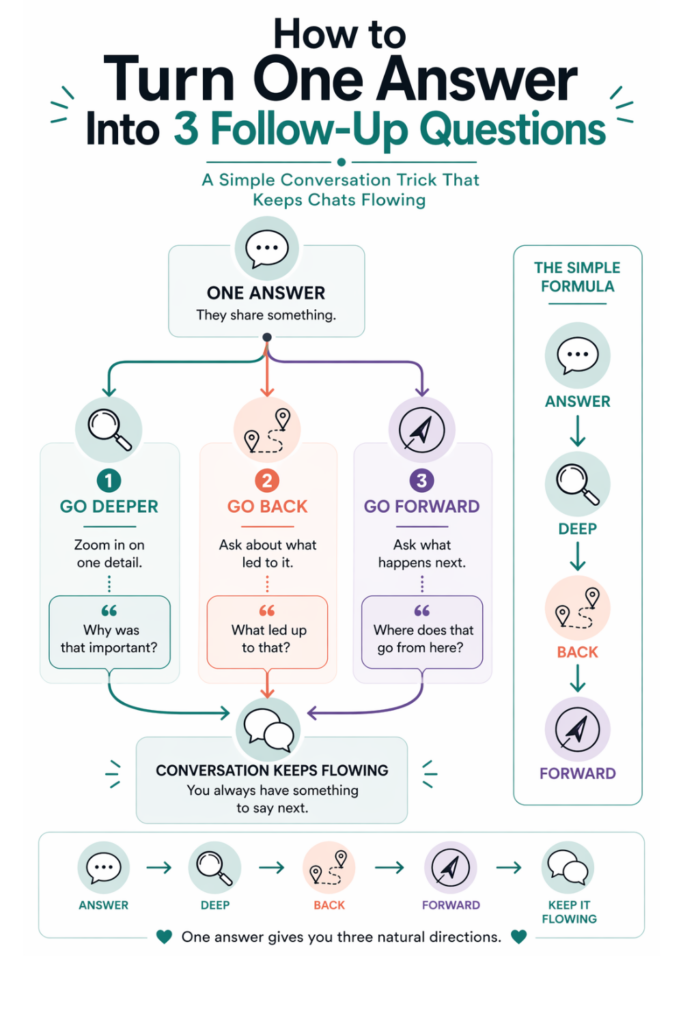
You do not need to memorize 25 questions and carry them around like a script.
If you want to get more from your life, and are looking for concrete action steps to get you there, check out our Request a Coach page. It’s a “cut the fence-sitting and take action” way to tackle your issues and actually find success. To get off the fence and start to take action, click or tap here.
In fact, that usually makes coffee chats feel worse.
When you try to hold too many prompts in your head, the conversation starts feeling like a checklist instead of an exchange. You get distracted by what you are “supposed” to ask next instead of listening to what the other person is actually saying. A better approach is to turn these prompts into a personal system.
A personal system is just a small set of question types you know how to use well.
Instead of preparing a giant list, choose a handful of prompts that feel natural to you and fit the goal of the conversation. This makes the chat easier to manage because you are working from familiar categories, not trying to improvise under pressure.
A simple system might include:
1. One opener
Something that gets the conversation started clearly.
Example: What first drew you into this kind of work?
2. Two path questions
Something that helps you understand how they got where they are.
Example: What was the turning point that led you in this direction?
3. Two reality questions
Something that helps you understand what the role is actually like.
Example: What do people usually misunderstand about this kind of work?
If you want to get more from your life, and are looking for concrete action steps to get you there, check out our Request a Coach page. It’s a “cut the fence-sitting and take action” way to tackle your issues and actually find success. To get off the fence and start to take action, click or tap here.
4. Two advice questions
Something that helps you learn without overexplaining yourself.
Example: If you were starting in this area now, what would you focus on first?
5. Two bridge questions
Something you can use if the conversation slows down.
Example: What seems to be changing most in your field right now?
That is enough.
You can also match your question set to your goal. If the conversation is mainly about career clarity, lean more on path and day-to-day questions. If you are trying to understand how to grow, lean more on skill and advice questions. If you are mostly trying to build connection, focus on follow-ups and shared observations.
This kind of system works especially well for introverts because it reduces the need for high-pressure spontaneity. You are still having a real conversation, but you are doing it with a structure that supports you.
That support matters.
When you know your opener, your follow-up patterns, your backup bridge questions, and your closing move, the whole conversation feels less like a social test and more like something you can actually navigate. That confidence is not fake. It comes from having a framework you trust.
What to do after the conversation so it actually helps your career
A coffee chat can feel good in the moment and still go nowhere afterward.
If you want to get more from your life, and are looking for concrete action steps to get you there, check out our Request a Coach page. It’s a “cut the fence-sitting and take action” way to tackle your issues and actually find success. To get off the fence and start to take action, click or tap here.
That happens all the time.
You leave thinking, “That was helpful,” but then life moves on. You forget the details, do not reflect on what stood out, and never use what you learned. For introverts especially, this can be frustrating because these conversations take real energy. If you are going to spend that energy, it helps to make the insight stick.
The first thing to do after a coffee chat is capture what you learned while it is still fresh.
Do not trust yourself to remember the useful parts later. Write down a few notes right away. They do not need to be formal. The goal is just to preserve the details that are most likely to help you think more clearly about your path.
Focus on things like:
- what surprised you
- what sounded appealing
- what sounded draining
- what skills came up repeatedly
- what advice felt especially relevant
- what next step seems most worth exploring
These notes help you move from vague inspiration to actual clarity.
The second step is follow-through. This is where a lot of career conversations quietly lose their value. You do not need to do something huge. You just need one concrete action that turns the conversation into momentum.
That might be:
If you want to get more from your life, and are looking for concrete action steps to get you there, check out our Request a Coach page. It’s a “cut the fence-sitting and take action” way to tackle your issues and actually find success. To get off the fence and start to take action, click or tap here.
- sending a short thank-you message
- looking up a resource they mentioned
- researching a role or company they referenced
- refining your own career questions
- updating how you talk about your interests
- scheduling another conversation in a related area
A simple thank-you note can go a long way too. Keep it short and specific. Mention one thing you found especially useful. That helps the message feel real instead of generic.
For example:
- Thank you again for taking the time to chat. It was especially helpful to hear how your role changed over time and what skills mattered most in the transition.
- I really appreciated your insight on what the day-to-day work actually looks like. That gave me a much clearer sense of what to explore next.
That is enough. You do not need to overdo it.
A coffee chat becomes valuable when it changes how you think, what you notice, or what you do next. The real win is not just having a good conversation. It is using that conversation to make your next career move feel a little more informed, a little more grounded, and a little less confusing.
A simpler way to walk into the next coffee chat

You do not need to become louder, smoother, or more naturally outgoing to have strong coffee chats.
That idea causes a lot of unnecessary stress.
Introverts often assume the problem is their personality, when the real problem is usually the lack of structure. If you walk into a career conversation feeling like you have to improvise everything, of course it is going to feel draining. That would be hard for anyone. But when you have better prompts, better follow-ups, and a better sense of what you are trying to learn, the whole experience changes.
That is the real point of these questions.
If you want to get more from your life, and are looking for concrete action steps to get you there, check out our Request a Coach page. It’s a “cut the fence-sitting and take action” way to tackle your issues and actually find success. To get off the fence and start to take action, click or tap here.
They are not meant to turn you into a networking machine. They are meant to give you a calmer, more thoughtful way to keep a conversation moving. A way that feels useful instead of performative. A way that helps you learn something real without getting trapped in small talk panic or awkward self-promotion.
If you remember nothing else, remember this:
- start with something easy to answer
- stay with the story instead of jumping around
- ask what the job is actually like
- get advice without over-explaining yourself
- keep a few bridge questions ready
- end with one real takeaway
That is enough to carry a very good conversation.
You do not need perfect wording. You do not need nonstop confidence. You do not need to impress the other person every five minutes. You just need to be prepared enough that you can listen well and respond with real curiosity.
That is often where introverts shine anyway.
You are already likely to notice nuance, ask thoughtful questions, and care more about substance than performance. The right prompts simply give those strengths a better place to land. Instead of trying to act like someone else, you can build a conversation style that fits how you naturally think and communicate.
So before your next coffee chat, do not ask yourself how to be more charismatic.
Ask yourself:
If you want to get more from your life, and are looking for concrete action steps to get you there, check out our Request a Coach page. It’s a “cut the fence-sitting and take action” way to tackle your issues and actually find success. To get off the fence and start to take action, click or tap here.
- What do I actually want to learn?
- What opening question feels easy for me to ask?
- What follow-up patterns can I rely on?
- What would make this conversation feel worthwhile even if nothing comes from it immediately?
Those questions will help you walk in steadier.
And steady is powerful.
****
Want to try this at home? Download your free template now!
Need some business or career guidance? Drop on by our directories choc full of business coaches and career coaches to bring your business or career to the next level. Or click here to have us match you to the best.
If you want to get more from your life, and are looking for concrete action steps to get you there, check out our Request a Coach page. It’s a “cut the fence-sitting and take action” way to tackle your issues and actually find success. To get off the fence and start to take action, click or tap here.
Read this next

Career Coaching VS Career Counseling: What’s the Difference? (And Why Should You Care)
Career coaching and career counseling sound alike. But what really sets them apart from each other?
Read More
7 Signs It’s Time to Change Careers: Signals, Tools, and a Transition Checklist
Not sure if it’s burnout, boredom, or a true career change signal? Start here before making your next move.
Read More
What is Career Coaching?
A career coach will equip you with all the techniques and career management tools you need in today’s job market.
Read More