







How to Network When You Hate Small Talk

Want to try this at home? No worries! Download a copy of our Coffee Chat Questions for Introverts.
***
Networking can feel like one long performance when you hate small talk.
You walk into a room, everyone seems to already know what to say, and suddenly the most basic questions feel impossible. “What do you do?” sounds too stiff. “How’s it going?” sounds too empty. “Have you been to one of these before?” sounds like something you are saying only because you cannot think of anything else.
If that sounds familiar, the problem may not be that you are bad at networking. It may be that the usual version of networking is not built for the way you connect.
Some people enjoy floating from person to person, keeping conversations light and quick. But if you are more depth-first, that can feel draining. You may do better when a conversation has a point, a thread, or a real reason to continue.
This is where a different networking style helps.
Instead of trying to become a more polished small talker, you can learn how to guide conversations toward something more useful. You can prepare better questions, listen for meaningful details, explain what you are looking for clearly, and exit conversations without feeling awkward.
If you want to get more from your life, and are looking for concrete action steps to get you there, check out our Request a Coach page. It’s a “cut the fence-sitting and take action” way to tackle your issues and actually find success. To get off the fence and start to take action, click or tap here.
The goal is not to meet everyone in the room. It is to make a few conversations count.
A depth-first networking style works especially well if you:
- Hate forced chatter
- Overthink what to say
- Prefer one-on-one conversations
- Want career connections but dislike “selling yourself”
- Feel awkward asking for help
- Want a more natural way to follow up
This approach gives you structure without making you sound scripted. It helps you stop relying on charm and start relying on curiosity, clarity, and simple next steps.
Need some business or career guidance? Drop on by our directories choc full of business coaches and career coaches to bring your business or career to the next level. Or click here to have us match you to the best.
1. Redefine What Networking Is Supposed To Do
Stop aiming to “work the room”: Choose one specific outcome before you show up, such as meeting two people in your field, learning how someone entered a role, finding one useful resource, or reconnecting with one person you already know.
A lot of networking advice makes the whole thing sound like a numbers game. Meet as many people as possible. Hand out cards. Add everyone on LinkedIn. Keep moving.
That is exactly why it feels awful for people who dislike small talk.
If your brain works better in deeper conversations, “working the room” is the wrong goal. It encourages shallow interactions, rushed introductions, and that uncomfortable feeling that you are always supposed to be looking past the person in front of you.
If you want to get more from your life, and are looking for concrete action steps to get you there, check out our Request a Coach page. It’s a “cut the fence-sitting and take action” way to tackle your issues and actually find success. To get off the fence and start to take action, click or tap here.
A better goal is to define what would make the experience useful.
For example, before an event, you might decide:
- “I want to learn how people move into this industry.”
- “I want to meet one person who works in product marketing.”
- “I want to practice explaining my career change clearly.”
- “I want to reconnect with someone I already know.”
- “I want to ask one person what skill helped them most.”
This gives your networking a purpose. You are not wandering around hoping something useful happens. You are entering the room with a small mission.
Trade quantity for quality: Give yourself permission to have fewer conversations that go deeper instead of trying to collect as many names, cards, or LinkedIn connections as possible.
This is where depth-first networking starts to feel different.
You might only have two good conversations at an event. That can still be a win. In fact, two thoughtful conversations are often more valuable than twelve forgettable introductions.
A good networking conversation should help at least one of these things happen:
- You understand someone’s work better.
- They understand what you are exploring.
- You learn a practical next step.
- You discover a shared interest or goal.
- You leave with a reason to follow up.
Use a connection-first mindset: Treat networking as a way to understand people’s work, problems, goals, and ideas, not as a test of how socially impressive you can be.
If you want to get more from your life, and are looking for concrete action steps to get you there, check out our Request a Coach page. It’s a “cut the fence-sitting and take action” way to tackle your issues and actually find success. To get off the fence and start to take action, click or tap here.
You do not have to impress everyone. You do not have to sound fascinating in the first five seconds.
You only need to be clear, curious, and present enough to create a real exchange.
That mindset shift takes some pressure off. Networking becomes less about proving yourself and more about finding useful overlap.
Set a realistic success marker: Decide what would make the interaction “worth it” before you begin, so you are not measuring yourself against an extrovert’s version of a good networking night.
For someone who hates small talk, success might look like staying for one hour, starting three conversations, or sending one follow-up message afterward.
That counts. That is networking.
2. Prepare a Simple Conversation Goal Before You Go
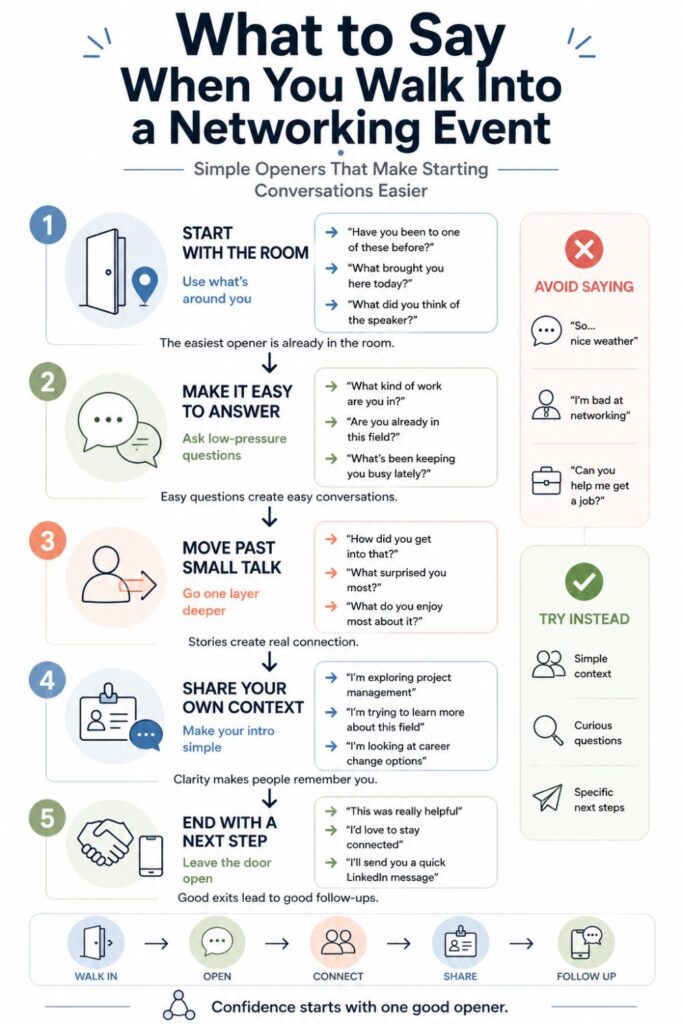
Pick your main curiosity lane: Decide what you genuinely want to learn from people, such as how they got into their role, what skills helped them grow, what they wish they knew earlier, or what trends they are noticing.
The hardest part of networking is often not the event itself. It is the blank-mind moment right before you have to speak.
If you want to get more from your life, and are looking for concrete action steps to get you there, check out our Request a Coach page. It’s a “cut the fence-sitting and take action” way to tackle your issues and actually find success. To get off the fence and start to take action, click or tap here.
You see someone standing nearby, you know you should say something, and suddenly every possible opener feels weird. This is where preparation helps.
Not over-preparation. Just enough structure that you are not inventing the entire conversation from scratch.
A “curiosity lane” is the category of information you actually care about. It gives your questions a direction.
For example, your curiosity lane might be:
- Career paths
- Industry trends
- Skill-building
- Career changes
- Leadership lessons
- Job search advice
- Freelance or business growth
- Company culture
- Tools and systems people use
Once you choose a lane, your questions get easier because they are connected to something real.
Write three anchor questions: Prepare a few questions that can work in almost any setting, so you are not trying to invent something clever while already feeling awkward.
Your anchor questions should be simple, flexible, and easy for someone else to answer.
Good examples include:
If you want to get more from your life, and are looking for concrete action steps to get you there, check out our Request a Coach page. It’s a “cut the fence-sitting and take action” way to tackle your issues and actually find success. To get off the fence and start to take action, click or tap here.
- “How did you get into the work you do now?”
- “What surprised you most about this field?”
- “What skill has helped you the most in your role?”
- “What do you wish you knew earlier in your career?”
- “What brought you to this event?”
- “What kind of projects are taking most of your attention lately?”
These are not flashy questions. That is the point.
You want questions that feel natural, not like you memorized a list from a networking handbook.
Match questions to the room: For a career event, use work-focused questions; for a casual meetup, use interest-focused questions; for LinkedIn networking, use questions that connect to the person’s actual experience.
The same question does not fit every setting.
At a conference, it makes sense to ask about someone’s work, session takeaways, or industry perspective. At a casual community meetup, it may feel better to ask what brought them there or how they first got interested in the topic.
Online, you can be more specific because you have more context. If you are messaging someone on LinkedIn, reference their role, post, company, or career path.
For example:
- “I noticed you moved from teaching into UX research. I’m exploring a similar transition and would love to ask what helped you make that shift.”
- “Your post about client onboarding stood out to me. I’m curious what made the biggest difference in your process.”
- “I saw you’ve worked in both nonprofit and tech roles. How did those experiences compare?”
Give yourself a fallback prompt: Keep one easy question ready for moments when your mind goes blank, such as “What brought you to this event?” or “What kind of work has been taking most of your attention lately?”
If you want to get more from your life, and are looking for concrete action steps to get you there, check out our Request a Coach page. It’s a “cut the fence-sitting and take action” way to tackle your issues and actually find success. To get off the fence and start to take action, click or tap here.
You do not need ten perfect questions.
You need one question that can save you when your brain freezes.
3. Start With Context Instead Of Random Chatter
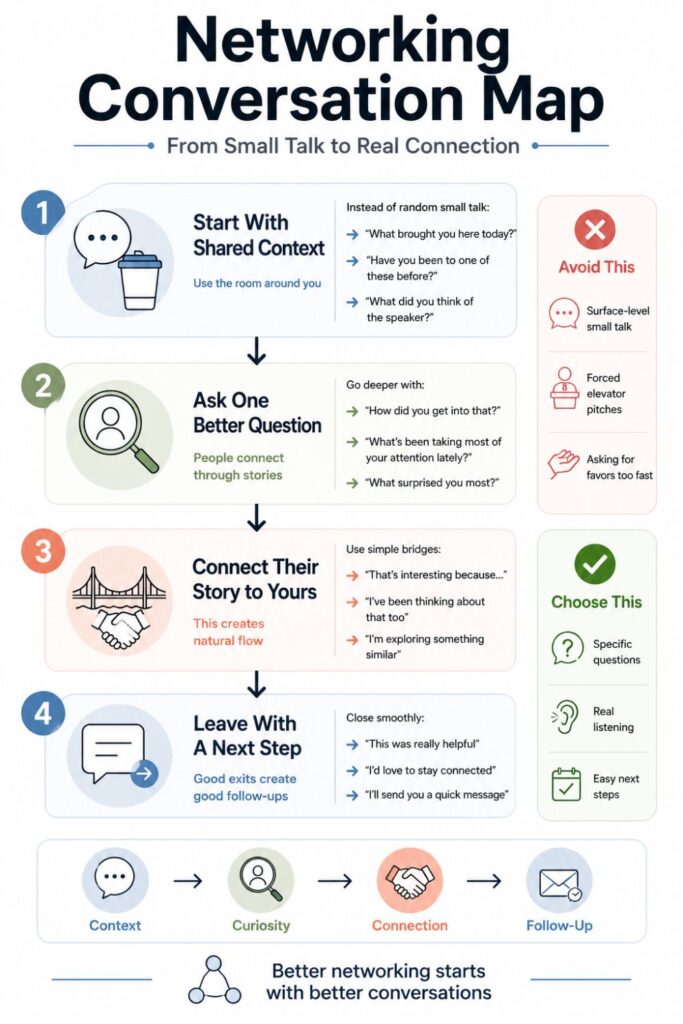
Use the shared setting as your opener: Begin with something you both already have in common, such as the event topic, speaker, workshop, industry, company, or reason people are gathered there.
Small talk often feels painful because it seems random. You are trying to create a conversation out of nothing.
Context makes that easier.
If you are at the same event, webinar, workshop, conference, coffee meetup, or online community, you already have a shared starting point. Use it.
You do not need a clever opener. You need an obvious one that gets the conversation moving.
For example:
If you want to get more from your life, and are looking for concrete action steps to get you there, check out our Request a Coach page. It’s a “cut the fence-sitting and take action” way to tackle your issues and actually find success. To get off the fence and start to take action, click or tap here.
- “Have you been to this event before?”
- “What did you think of the speaker?”
- “Are you working in this field already, or exploring it?”
- “What made you decide to come today?”
- “I’m new to this group. Have you been part of it long?”
These questions work because they are connected to the moment you are both in. They do not feel forced, and they give the other person an easy way to respond.
Make the first question easy to answer: Avoid opening with something too intense or personal; start with a low-pressure question that lets the other person choose how much they want to share.
Depth-first networking does not mean you start with deep questions immediately.
That can feel too abrupt.
The first question should open the door. The deeper question comes after there is a little trust, context, or momentum.
For example, instead of starting with:
- “What is your biggest career struggle right now?”
Start with:
- “What kind of work do you do?”
- “How did you get into that?”
- “What has that been like lately?”
The third question is where depth begins. You ease into it.
If you want to get more from your life, and are looking for concrete action steps to get you there, check out our Request a Coach page. It’s a “cut the fence-sitting and take action” way to tackle your issues and actually find success. To get off the fence and start to take action, click or tap here.
Add a small reason for asking: Make the question feel natural by attaching it to your own context, such as “I’m trying to learn more about this field, so I was curious…”
This is one of the easiest ways to make a question feel less awkward.
A reason gives the other person context. It also makes you sound more intentional.
For example:
- “I’m exploring a career change, so I’m always curious how people found their way into this field.”
- “I’m trying to get better at understanding different roles in this industry. What does your day-to-day look like?”
- “I’m new to these events, so I’m curious what usually brings people here.”
That little explanation reduces the pressure. It tells the other person why you are asking and gives them a clearer way to respond.
Move past the opener quickly: Once the conversation starts, do not stay stuck on the weather, traffic, or room logistics; use the opener as a bridge into something more useful.
The opener is only the beginning. Do not judge the whole conversation by those first few seconds.
Your job is not to make small talk magical. Your job is to use it as a doorway.
If you want to get more from your life, and are looking for concrete action steps to get you there, check out our Request a Coach page. It’s a “cut the fence-sitting and take action” way to tackle your issues and actually find success. To get off the fence and start to take action, click or tap here.
4. Use Better Questions To Go Depth-First
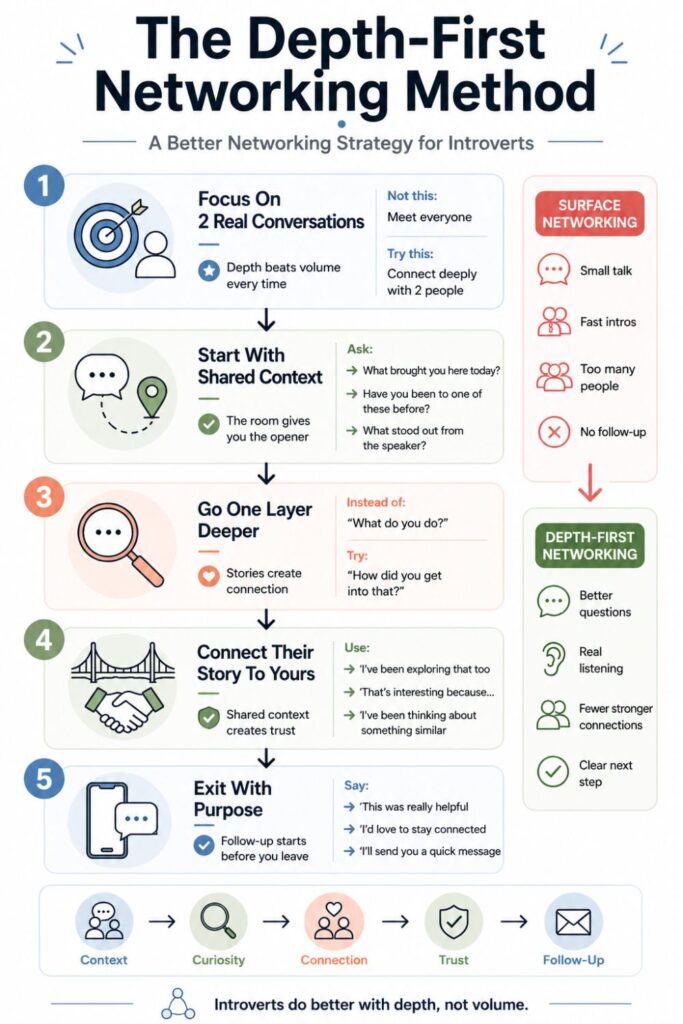
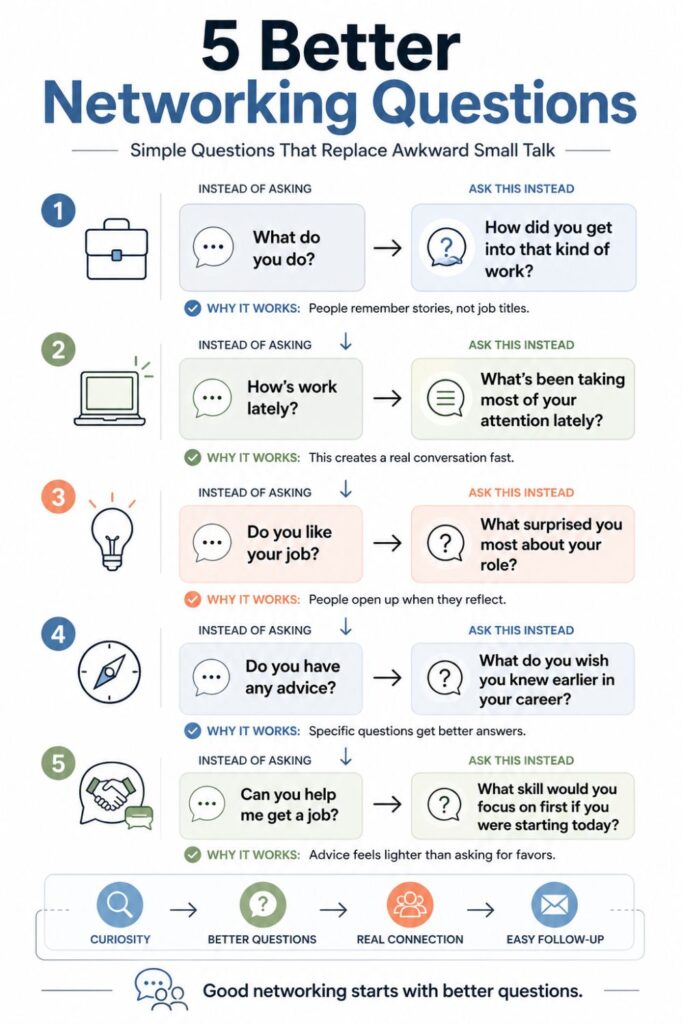
Ask for the story behind the role: Instead of only asking what someone does, ask how they ended up doing it, what surprised them about it, or what made them choose that direction.
“What do you do?” is not a bad question. It is just incomplete.
The answer usually gives you a job title, not a conversation. Someone says, “I’m a project manager,” or “I work in marketing,” and then you have to figure out where to go next.
The better move is to ask for the story behind it.
For example:
- “How did you end up in that kind of work?”
- “Was that always the plan, or did you find your way into it?”
- “What made you choose that direction?”
- “What surprised you about the role once you were actually in it?”
These questions work because most careers are not perfectly linear. People usually have a story. They made a decision, took a chance, changed direction, learned something the hard way, or followed an opportunity they did not expect.
That gives the conversation more texture.
Look for lessons, not just facts: Questions like “What do you wish you knew earlier?” or “What helped you the most when you were starting?” invite more useful answers than simple status updates.
If you want to get more from your life, and are looking for concrete action steps to get you there, check out our Request a Coach page. It’s a “cut the fence-sitting and take action” way to tackle your issues and actually find success. To get off the fence and start to take action, click or tap here.
If you only ask factual questions, the conversation can stay flat.
For example:
- “How long have you worked there?”
- “How many people are on your team?”
- “What software do you use?”
These can be useful, but they rarely create much connection on their own.
Lesson-based questions are better because they invite reflection.
Try questions like:
- “What do you wish more people understood about your work?”
- “What advice would you give someone starting in this area?”
- “What mistake do you see people make when they try to break into this field?”
- “What helped you get more confident in that role?”
- “What skill made the biggest difference for you?”
These questions are still professional, but they go deeper. They let the other person share experience, not just information.
Follow the energy in their answer: Notice which part they say with more detail, humor, frustration, or interest, then ask a follow-up about that part.
This is where active listening starts to matter.
If you want to get more from your life, and are looking for concrete action steps to get you there, check out our Request a Coach page. It’s a “cut the fence-sitting and take action” way to tackle your issues and actually find success. To get off the fence and start to take action, click or tap here.
If someone gives a short answer to one part but lights up about another, follow the energy. That is where the real conversation is.
For example, if someone says, “I started in sales, then moved into operations, which was a huge learning curve,” you might ask:
- “What made the operations shift such a learning curve?”
- “What helped you adjust?”
- “Did you know you wanted to move that direction?”
You are not forcing a new topic. You are picking up the thread they already handed you.
Avoid turning the conversation into an interview: Balance your questions with small pieces of your own context, so the exchange feels mutual instead of like you are collecting information.
After they answer, add a small bridge.
For example:
- “That makes sense. I’ve been trying to understand whether I’d enjoy that kind of work, so that’s helpful.”
- “I relate to that. I’m in a role now where I’m realizing communication matters more than I expected.”
- “That’s interesting because I’ve been thinking about making a similar shift.”
Depth-first networking is not interrogation. It is a thoughtful exchange.
5. Make Active Listening Do Most Of The Work
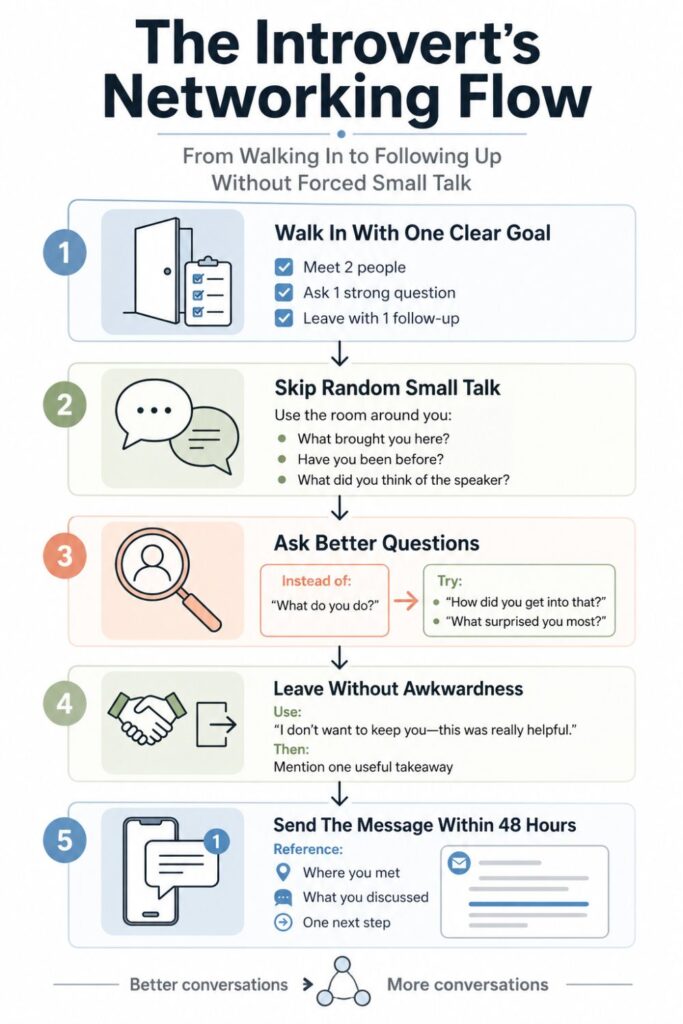
Reflect back the useful part: Repeat or lightly summarize what you heard, such as “So it sounds like the hardest part was getting that first client” or “It seems like the transition was more strategic than accidental.”
If you want to get more from your life, and are looking for concrete action steps to get you there, check out our Request a Coach page. It’s a “cut the fence-sitting and take action” way to tackle your issues and actually find success. To get off the fence and start to take action, click or tap here.
If you hate small talk, active listening is one of your biggest advantages.
You do not have to be the funniest person in the room. You do not have to carry the conversation with endless stories. You can become good at noticing what matters and helping the other person feel understood.
That alone makes you more memorable.
A simple reflection shows that you are not just waiting for your turn to talk.
For example:
- “So the biggest shift was learning how to manage stakeholders, not just the project plan.”
- “It sounds like the role became easier once you understood the company culture.”
- “So the hard part was not getting started, but knowing which opportunities to say yes to.”
This kind of response does two things. It proves you listened, and it gives the other person a chance to clarify or go deeper.
Ask one layer deeper: Use their answer to guide the next question instead of jumping to a new topic, which helps the conversation feel thoughtful and grounded.
Most people jump too quickly.
If you want to get more from your life, and are looking for concrete action steps to get you there, check out our Request a Coach page. It’s a “cut the fence-sitting and take action” way to tackle your issues and actually find success. To get off the fence and start to take action, click or tap here.
They ask what someone does, then where they live, then whether they liked the speaker, then what they do on weekends. The conversation keeps resetting.
Depth-first networking works better when you stay with one thread a little longer.
For example:
Person: “I moved into this field after realizing I wanted more creative work.”
You: “What helped you figure out that creativity was the missing piece?”
That is one layer deeper.
Person: “Honestly, I kept feeling drained in roles where I was only executing other people’s plans.”
You: “That makes sense. Did you look for a role that was more strategic, or did you find that by accident?”
If you want to get more from your life, and are looking for concrete action steps to get you there, check out our Request a Coach page. It’s a “cut the fence-sitting and take action” way to tackle your issues and actually find success. To get off the fence and start to take action, click or tap here.
Now you have a real conversation.
Notice practical clues: Pay attention to names, tools, roles, companies, books, communities, or habits they mention, because these can become follow-up points later.
Useful networking details often show up casually.
Someone might mention:
- A book that helped them
- A certification they recommend
- A community they joined
- A person who influenced them
- A tool their team uses
- A mistake they would avoid
- A company that hires beginners
- A skill they wish they had learned sooner
These are gold for follow-up.
You can later say, “You mentioned that community for new UX researchers. I looked it up and it was exactly the kind of thing I needed. Thank you.”
That is much stronger than, “Nice meeting you.”
Let pauses breathe: You do not have to fill every quiet second; a short pause can make the conversation feel more intentional and gives the other person space to say something more real.
If you want to get more from your life, and are looking for concrete action steps to get you there, check out our Request a Coach page. It’s a “cut the fence-sitting and take action” way to tackle your issues and actually find success. To get off the fence and start to take action, click or tap here.
A pause is not always a problem.
Sometimes it means someone is thinking. Sometimes it means the conversation is shifting from automatic answers to more thoughtful ones.
Let that happen.
6. Explain Yourself Clearly Without Oversharing
Create a one-sentence professional snapshot: Prepare a simple line that says who you are, what you are exploring, and why you are there, without launching into your full career history.
One reason networking feels stressful is that you know people will eventually ask about you.
“What do you do?” can feel simple until your answer is complicated. Maybe you are changing careers. Maybe you are between roles. Maybe your job title does not match what you want next. Maybe you are still figuring it out.
That is why a professional snapshot helps.
It gives you a short, clear answer you can use without rambling.
If you want to get more from your life, and are looking for concrete action steps to get you there, check out our Request a Coach page. It’s a “cut the fence-sitting and take action” way to tackle your issues and actually find success. To get off the fence and start to take action, click or tap here.
A good snapshot might sound like:
- “I’m currently in customer support, and I’m exploring project management roles because I like organizing people, timelines, and moving pieces.”
- “I work in education, but I’m starting to learn more about instructional design and corporate training.”
- “I’m a marketing coordinator, and I’m trying to grow into more strategy-focused work.”
- “I’m between roles right now and using this time to learn more about companies doing work in this space.”
The goal is not to explain everything. It is to give the other person a clear starting point.
Keep your goal understandable: If you are networking for a job, pivot, mentor, collaboration, or industry insight, say it plainly enough that the other person knows how to place you.
People cannot help you if they cannot understand what you are looking for.
This does not mean you need to ask for a job immediately. In fact, you usually should not. But you can make your direction clear.
Instead of:
- “I’m just trying to see what’s out there.”
Try:
- “I’m trying to understand what entry points make sense for someone moving from operations into customer success.”
Instead of:
If you want to get more from your life, and are looking for concrete action steps to get you there, check out our Request a Coach page. It’s a “cut the fence-sitting and take action” way to tackle your issues and actually find success. To get off the fence and start to take action, click or tap here.
- “I’m kind of interested in marketing.”
Try:
- “I’m exploring content marketing roles, especially ones where writing and strategy overlap.”
Specificity gives people something to respond to.
Use specifics instead of vague ambition: Replace “I’m just trying to figure things out” with something clearer, such as “I’m exploring project management roles in healthcare and trying to understand what skills matter most.”
You do not need to sound certain when you are not. You can be honest and still be clear.
Try phrases like:
- “I’m still narrowing it down, but I know I’m interested in…”
- “I’m exploring a few paths, especially…”
- “I’m trying to learn more before I make a move.”
- “I’m not ready to apply yet, but I’m trying to understand what the role actually looks like.”
That kind of language feels grounded. It also invites advice.
Make your ask light and appropriate: Ask for advice, direction, or a resource before asking for a referral, introduction, or favor, especially in a first conversation.
A light ask might be:
If you want to get more from your life, and are looking for concrete action steps to get you there, check out our Request a Coach page. It’s a “cut the fence-sitting and take action” way to tackle your issues and actually find success. To get off the fence and start to take action, click or tap here.
- “Is there a resource you recommend for someone learning about this?”
- “Is there a skill you would focus on first?”
- “Would it be okay if I connected with you on LinkedIn?”
- “Would you mind if I followed up with one question later?”
Small asks are easier to say yes to.
They also build trust before you ask for anything bigger.
7. Transition Without Feeling Awkward
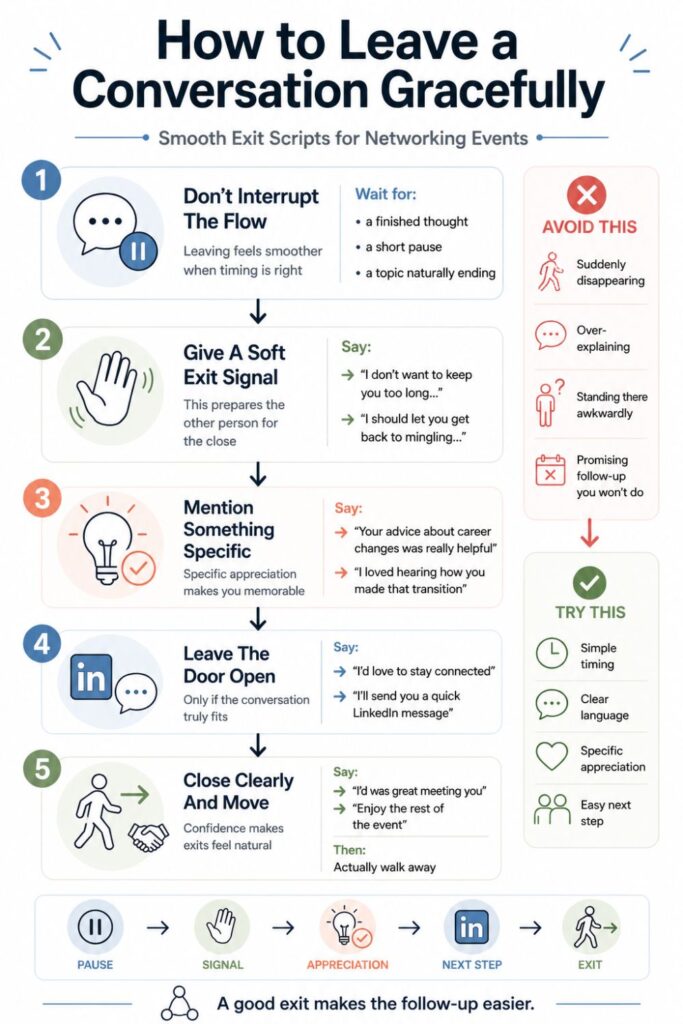
Signal the close before you leave: Use a simple transition line like “I don’t want to keep you from the rest of the event, but I really appreciated hearing about this.”
Ending a conversation can be harder than starting one.
You may worry that leaving sounds rude. So you stay too long, the conversation fades, and then the ending feels even more awkward.
The fix is to close while the conversation still has energy.
A transition line gives both people an easy exit.
Try:
If you want to get more from your life, and are looking for concrete action steps to get you there, check out our Request a Coach page. It’s a “cut the fence-sitting and take action” way to tackle your issues and actually find success. To get off the fence and start to take action, click or tap here.
- “I don’t want to take up your whole evening, but this was really helpful.”
- “I’m going to grab some water, but I’m glad we got to talk.”
- “I should say hello to a few more people, but I really appreciated this conversation.”
- “I’ll let you keep mingling, but thank you for sharing that.”
- “I’m going to step over to the next session, but I’d love to stay connected.”
These lines are polite, clear, and normal. You are not abandoning the person. You are simply closing the loop.
Name the useful takeaway: Mention one specific thing you enjoyed or learned, which makes the ending feel warm instead of abrupt.
Specificity makes an exit feel intentional.
For example:
- “Your point about building relationships before you need them was really helpful.”
- “I appreciated what you said about learning stakeholder management early.”
- “That recommendation for the community is exactly what I was looking for.”
- “It was useful to hear how you made that transition from sales into operations.”
This turns the ending into a moment of appreciation.
It also makes you easier to remember.
Ask for the next step only if it fits: If the conversation was genuinely useful, ask whether it would be okay to connect on LinkedIn or follow up with one question later.
Not every conversation needs a follow-up. That is important.
If you want to get more from your life, and are looking for concrete action steps to get you there, check out our Request a Coach page. It’s a “cut the fence-sitting and take action” way to tackle your issues and actually find success. To get off the fence and start to take action, click or tap here.
Sometimes a conversation is pleasant, but there is no real reason to continue. Let it be enough.
But if there is a clear connection, ask simply:
- “Would it be okay if I added you on LinkedIn?”
- “Could I follow up later about the resource you mentioned?”
- “Would you mind if I sent you one question after I look into that program?”
- “I’d love to stay connected if you’re open to it.”
Do not make it too heavy. You are opening a door, not asking for a commitment.
Have an exit script ready: Prepare a few polite lines in advance so you are not trapped in conversations because you cannot think of a graceful way to leave.
This is especially useful if you overthink.
You can keep two or three exit lines in your back pocket and use them whenever you need to move on.
A graceful exit is part of networking. It is not a failure.
8. Follow Up With Something Specific
Send the follow-up while the conversation is fresh: Reach out within a day or two, before the details fade and the connection goes cold.
If you want to get more from your life, and are looking for concrete action steps to get you there, check out our Request a Coach page. It’s a “cut the fence-sitting and take action” way to tackle your issues and actually find success. To get off the fence and start to take action, click or tap here.
The follow-up is where a lot of networking quietly falls apart.
You have a good conversation. You feel proud of yourself. You exchange names or connect online. Then nothing happens.
A week passes. Then two. Suddenly it feels too late, so you do nothing.
That is why it helps to follow up quickly.
You do not need to write a perfect message. You only need to send something clear while the conversation is still easy to remember.
For example:
“Hi Maya, it was great meeting you at the career panel yesterday. I really appreciated what you shared about moving from nonprofit work into program management. Your point about learning to manage timelines before managing people gave me a lot to think about.”
That is enough to reopen the connection.
If you want to get more from your life, and are looking for concrete action steps to get you there, check out our Request a Coach page. It’s a “cut the fence-sitting and take action” way to tackle your issues and actually find success. To get off the fence and start to take action, click or tap here.
Reference the exact conversation: Mention the topic, resource, advice, or story you discussed so the message does not feel generic.
A weak follow-up says:
“Great meeting you. Let’s stay in touch.”
That is fine, but forgettable.
A stronger follow-up says:
“Great meeting you at the product meetup. I appreciated your advice about building a portfolio around real business problems instead of fake case studies.”
That reminds them who you are and why the conversation mattered.
Specificity does the work.
If you want to get more from your life, and are looking for concrete action steps to get you there, check out our Request a Coach page. It’s a “cut the fence-sitting and take action” way to tackle your issues and actually find success. To get off the fence and start to take action, click or tap here.
You can reference:
- The event where you met
- A piece of advice they gave
- A role or career path they described
- A resource they mentioned
- A shared interest
- A question you discussed
- A next step you said you would take
Keep the message short: A good follow-up does not need to be impressive; it just needs to be clear, appreciative, and easy to respond to.
Do not write a giant paragraph. That can make the other person feel like they need to give an equally long reply.
Use a simple structure:
- Greeting
- Where you met
- Specific thing you appreciated
- Light next step
For example:
“Hi Daniel, I enjoyed meeting you at the networking breakfast today. Your advice about talking to people in customer success before applying was really helpful. I’m going to start there this week. I’d be glad to stay connected.”
That is warm, clear, and low-pressure.
Offer a natural next step: Depending on the connection, ask a small follow-up question, suggest a brief coffee chat, or simply say you enjoyed the conversation and would like to stay connected.
If you want to get more from your life, and are looking for concrete action steps to get you there, check out our Request a Coach page. It’s a “cut the fence-sitting and take action” way to tackle your issues and actually find success. To get off the fence and start to take action, click or tap here.
A next step might be:
- “Would it be okay if I sent one question after I look into that certification?”
- “Would you be open to a 15-minute coffee chat sometime this month?”
- “I’ll check out the book you mentioned and report back.”
- “I’d love to stay connected as I explore this field.”
The smaller and more specific the next step, the easier it is for the person to say yes.
9. Build A Repeatable Networking System
Create a simple contact tracker: Keep a basic list of who you met, where you met them, what you discussed, and any follow-up action you promised.
Networking becomes much easier when you stop relying on memory.
You do not need a complicated CRM. You just need a place to record the basics before you forget them.
This could be a spreadsheet, notes app, Notion page, paper notebook, or task manager.
Track simple details like:
- Name
- Role or company
- Where you met
- What you talked about
- Resource they mentioned
- Follow-up needed
- Date of last contact
- Possible next step
This helps you avoid that frustrating feeling of remembering someone was helpful but forgetting what they actually said.
If you want to get more from your life, and are looking for concrete action steps to get you there, check out our Request a Coach page. It’s a “cut the fence-sitting and take action” way to tackle your issues and actually find success. To get off the fence and start to take action, click or tap here.
Sort contacts by next action: Separate people into categories like follow up now, reconnect later, ask for advice, potential collaborator, or useful resource.
Not every contact needs the same treatment.
Some people are immediate follow-ups. Others are people you may reconnect with later. Some are simply useful to remember because they mentioned a resource, company, or path you want to research.
You might use categories like:
- Follow Up This Week
- Reconnect Later
- Possible Mentor
- Industry Insight
- Job Search Lead
- Collaboration Potential
- Resource Mentioned
This gives your networking structure. Instead of staring at a list of names, you know what to do next.
Schedule small networking blocks: Set aside short, recurring time for follow-ups, LinkedIn messages, coffee chat requests, and relationship maintenance.
Networking does not have to be a huge event.
In fact, it works better when it becomes a small habit.
If you want to get more from your life, and are looking for concrete action steps to get you there, check out our Request a Coach page. It’s a “cut the fence-sitting and take action” way to tackle your issues and actually find success. To get off the fence and start to take action, click or tap here.
You might schedule:
- 20 minutes every Friday to send follow-ups
- One LinkedIn message per week
- One coffee chat per month
- One event per quarter
- A monthly check-in with former coworkers
Small, consistent actions are less overwhelming than trying to suddenly network intensely when you need a job.
Review what is working: After each event or outreach session, note which questions felt natural, which openers worked, and where you got stuck.
This is how you improve.
After a networking experience, ask yourself:
- Which question got the best response?
- Where did I feel most awkward?
- What did I learn?
- Who should I follow up with?
- What would I do differently next time?
Do not use this as a way to criticize yourself. Use it as feedback.
You are building a skill.
10. How A Career Coach Can Help You Network With More Direction
Clarify your networking goal: A career coach can help you figure out whether you are networking for job leads, career clarity, industry research, confidence, referrals, or long-term relationship building.
If you want to get more from your life, and are looking for concrete action steps to get you there, check out our Request a Coach page. It’s a “cut the fence-sitting and take action” way to tackle your issues and actually find success. To get off the fence and start to take action, click or tap here.
Networking feels harder when your goal is vague.
If you are telling yourself, “I should network,” that is not specific enough to act on. It creates pressure, but no clear next step.
A coach can help you turn that vague pressure into a focused plan.
For example, you may realize you are not actually ready to ask for referrals yet. What you need first is industry research. Or you may discover that you are not lacking connections, but you are unclear about how to explain your career direction.
A coach can help you name the real issue.
That might be:
- You do not know who to reach out to.
- You are not sure what to say.
- You are afraid of seeming needy.
- You struggle to explain your value.
- You overthink follow-ups.
- You avoid networking until things feel urgent.
Once you know the actual problem, you can solve it more directly.
Practice your conversation scripts: A coach can help you refine your self-introduction, follow-up messages, and transition lines so they sound natural instead of stiff.
If you want to get more from your life, and are looking for concrete action steps to get you there, check out our Request a Coach page. It’s a “cut the fence-sitting and take action” way to tackle your issues and actually find success. To get off the fence and start to take action, click or tap here.
Scripts can be helpful, but only if they sound like you.
A coach can help you create language for:
- Introducing yourself
- Explaining a career pivot
- Asking for advice
- Requesting an informational chat
- Following up after an event
- Reconnecting with an old contact
- Ending conversations politely
The point is not to memorize every word. The point is to have a structure you trust.
That way, when nerves hit, you are not starting from zero.
Identify your overthinking patterns: If you tend to spiral before reaching out, second-guess what to say, or avoid events entirely, a coach can help turn vague fear into specific actions.
Overthinking often sounds like:
- “What if they think I’m annoying?”
- “What if I ask a stupid question?”
- “What if I have nothing to offer?”
- “What if they do not reply?”
- “What if I sound desperate?”
A coach can help you separate real strategy from fear.
For example, “I need to make a clear ask” is strategy. “Everyone will judge me” is fear.
If you want to get more from your life, and are looking for concrete action steps to get you there, check out our Request a Coach page. It’s a “cut the fence-sitting and take action” way to tackle your issues and actually find success. To get off the fence and start to take action, click or tap here.
That difference matters.
Create accountability after the event: Instead of leaving networking to mood or motivation, a coach can help you build a realistic follow-up plan and actually use it.
Many people do the hardest part, then lose the value afterward.
They attend the event, meet people, have good conversations, then never follow up.
A coach can help you turn the experience into momentum.
11. Common Mistakes That Make Networking Feel Worse
Trying to sound more impressive than you feel: Over-polishing your introduction can make you more nervous and less relatable, so aim for clear and human instead.
When you feel insecure, it is tempting to compensate by sounding more impressive.
You may over-explain your experience, use jargon, list every project you have touched, or try to make your career path sound more intentional than it was.
If you want to get more from your life, and are looking for concrete action steps to get you there, check out our Request a Coach page. It’s a “cut the fence-sitting and take action” way to tackle your issues and actually find success. To get off the fence and start to take action, click or tap here.
But that can create more pressure.
The other person does not need your full resume. They need enough context to understand who you are and what kind of conversation would be useful.
Clear usually beats impressive.
For example, this is stronger:
“I’m in operations now, and I’m exploring project management because I enjoy building systems and keeping teams organized.”
Than this:
“I have a cross-functional background with exposure to operations, communication, stakeholder alignment, process improvement, and strategic execution.”
The second one may sound polished, but the first one is easier to connect with.
If you want to get more from your life, and are looking for concrete action steps to get you there, check out our Request a Coach page. It’s a “cut the fence-sitting and take action” way to tackle your issues and actually find success. To get off the fence and start to take action, click or tap here.
Asking questions you do not care about: Generic questions lead to generic answers; choose questions that you would actually want to hear the answer to.
People can feel when a question is just filler.
If you do not care about the answer, it will be hard to follow up naturally. This is how conversations become stiff.
Choose questions that genuinely interest you.
If you are curious about career changes, ask about transitions. If you are curious about confidence, ask what helped someone feel more capable. If you are curious about leadership, ask what changed when they first started managing people.
Better questions make you a better listener.
Waiting until you need something: Networking feels more pressured when you only do it during a job search, career crisis, or urgent transition.
This is one of the biggest reasons networking feels uncomfortable.
If you want to get more from your life, and are looking for concrete action steps to get you there, check out our Request a Coach page. It’s a “cut the fence-sitting and take action” way to tackle your issues and actually find success. To get off the fence and start to take action, click or tap here.
If you only reach out when you need a referral, job lead, client, or favor, every message feels loaded.
The better approach is to build relationships before you urgently need them.
That could mean:
- Congratulating someone on a new role
- Commenting thoughtfully on a post
- Sharing a useful resource
- Checking in with a former coworker
- Asking for perspective before you apply
- Staying lightly connected over time
This makes networking feel more human and less transactional.
Treating silence as failure: Some conversations will be short, flat, or forgettable, and that does not mean you are bad at networking.
Not every interaction will turn into something.
Some people will be distracted. Some will not click with you. Some will forget to reply. Some conversations will simply end.
That is normal.
If you want to get more from your life, and are looking for concrete action steps to get you there, check out our Request a Coach page. It’s a “cut the fence-sitting and take action” way to tackle your issues and actually find success. To get off the fence and start to take action, click or tap here.
Your job is not to make every conversation meaningful. Your job is to practice creating the conditions where meaningful conversations can happen.
A Better Way To Think About Networking

You do not have to become the person who loves small talk.
You do not have to float around the room with perfect confidence. You do not have to charm strangers instantly. You do not have to collect as many contacts as possible or pretend every conversation feels natural.
You can network in a way that fits how you actually connect.
Depth-first networking is built around a different idea: better conversations beat more conversations.
Instead of forcing yourself through endless surface-level chatter, you prepare a few thoughtful questions. You listen carefully. You explain your direction clearly. You ask for small next steps when they make sense. Then you follow up in a way that feels specific and human.
That is a real networking skill.
It may not look loud from the outside. It may not look like the classic image of someone confidently shaking hands with everyone in the room. But it works because it is based on attention, clarity, and follow-through.
If you want to get more from your life, and are looking for concrete action steps to get you there, check out our Request a Coach page. It’s a “cut the fence-sitting and take action” way to tackle your issues and actually find success. To get off the fence and start to take action, click or tap here.
If networking has always made you uncomfortable, start smaller.
Choose one event. One person. One question. One follow-up.
Let that count.
Then build from there.
The goal is not to become someone else. The goal is to make career connection feel less like performance and more like a skill you can practice, repeat, and trust.
***
Want to try this at home? No worries! Download a copy of our Coffee Chat Questions for Introverts.
Need some business or career guidance? Drop on by our directories choc full of business coaches and career coaches to bring your business or career to the next level. Or click here to have us match you to the best.
If you want to get more from your life, and are looking for concrete action steps to get you there, check out our Request a Coach page. It’s a “cut the fence-sitting and take action” way to tackle your issues and actually find success. To get off the fence and start to take action, click or tap here.
If you want to get more from your life, and are looking for concrete action steps to get you there, check out our Request a Coach page. It’s a “cut the fence-sitting and take action” way to tackle your issues and actually find success. To get off the fence and start to take action, click or tap here.
Read this next

Wendy’s Interview Questions & Answers: Career Coach Guide (+ Panda, Subway, Panera and Dunkin’)
Sample questions and answers from all your favorite fast food restaurants, direct from our career coaches
Read More
13 Unexpected Layering Tricks for Casual Winter Office Looks
Winter style doesn’t have to mean hiding under heavy sweaters. The right layers can make you look effortlessly pulled together — polished but comfortable, warm without losing your shape. These […]
Read More
Don’t Count on Happily Ever After Even After you Achieve your Career Dream
Even if you actualize your dream, it won’t necessarily be sunshine, lollipops, and rainbows. This is one of the great drawbacks of the notion of the “American Dream.” Once you […]
Read More