







The 3 Coaching Business Habits That Quietly Make You More In-Demand

Three habits can make your coaching business easier to sell and easier to run: detach from needing the sale, state your value without apology, and reuse what already works.
Think of the pattern as Detach, Deliver, Duplicate. These are not vague mindset ideas. They show up in observable decisions, including what you do when a prospect hesitates, how you say your fee, and whether you rebuild the same client materials again next week.
Key Takeaways
- Detach from the outcome. A discovery call works better when your job is to assess fit and explain the next step, not make one prospect responsible for your revenue.
- State the price cleanly. Your pace, tone, and sentence ending affect how confident you sound, so practice naming your fee without rushing, apologizing, or immediately defending it.
- Standardize the repeatable parts. Intake forms, agreements, worksheets, follow-up structures, and recurring resources should not be rebuilt for every client when the underlying job is the same.
- Customize the judgment. Reuse the structure, not the coaching decision. Your questions, observations, feedback, goals, and interventions should still respond to the person in front of you.
- Turn good work into business assets. A strong exercise, framework, or resource can support client delivery, lead generation, speaking, content, courses, and digital products instead of doing one job once.
How Can Coaches Sell More Confidently and Save Time?
Coaches can sell more confidently by separating the quality of the sales conversation from the prospect’s final decision. Your job is to understand what the prospect wants, decide whether your coaching is a fit, explain the offer clearly, state the price, and give them room to choose.
You save time by separating repeatable business structure from personalized coaching. Agreements, intake questions, onboarding materials, recurring worksheets, session resources, and useful frameworks can be standardized without turning the coaching itself into a formula.
Put together, the approach is simple: Detach from needing the yes. Deliver the offer clearly. Duplicate the parts of your business that already work.
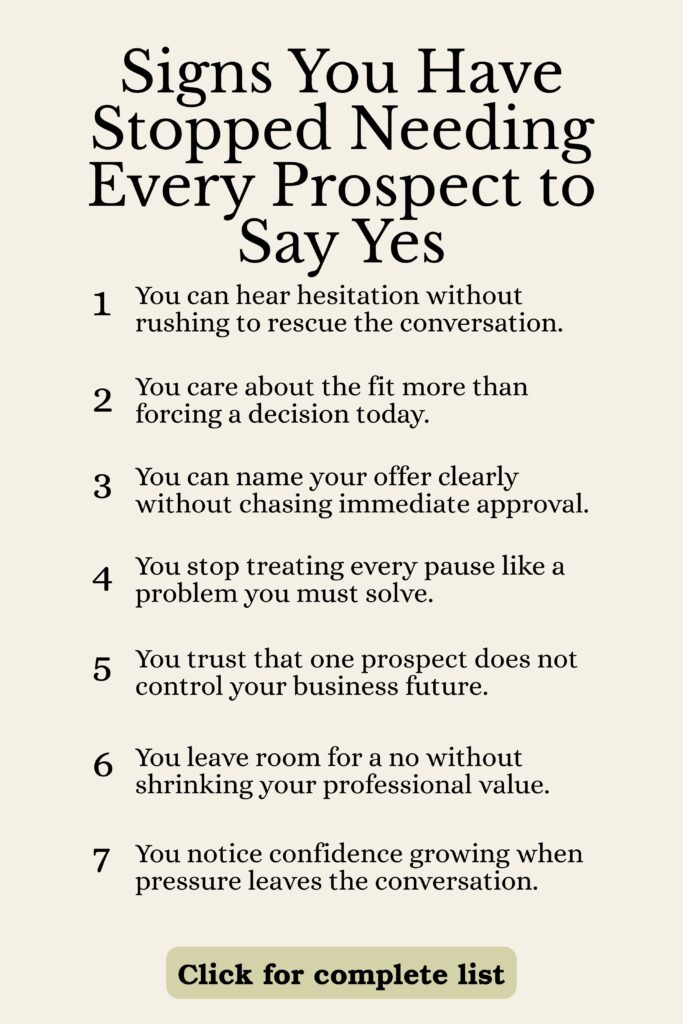
How Do You Stop Needing the Sale?
Needing clients is the fastest way to have none!
Always position yourself as not NEEDING a client.
SEE ALSO: If you’re a coach looking to streamline your administrative tasks and save time, check out our Coaching Administration Software. It’s a simple, effective solution designed to help you focus less on paperwork and more on what matters—coaching your clients. From scheduling to client management, our software gives you the tools to run your business efficiently. Ready to reclaim your time and boost productivity? Click or tap here.
Needy energy is repellent.
Change your thinking to believe that the only reason that it is important to you that they buy or work with you is because it helps them.
Why Does Sales Pressure Make Prospects Pull Away?
Sales pressure can make a prospect resist because people tend to protect their freedom to make their own decisions.
Psychologists call this psychological reactance. A 2025 meta-analysis by Zixi Li and Jingyuan Shi examined 33 studies and 146 effect sizes and found that more freedom-threatening language increased psychological reactance. Reactance-related anger and negative thoughts were also associated with weaker persuasion outcomes.
The research was not conducted specifically on coaching discovery calls, but the pattern gives coaches a useful lens. Listen for the moments when your desire for a yes starts changing your behavior.
A prospect says, “I need to think about it.”
SEE ALSO: If you’re a coach looking to streamline your administrative tasks and save time, check out our Coaching Administration Software. It’s a simple, effective solution designed to help you focus less on paperwork and more on what matters—coaching your clients. From scheduling to client management, our software gives you the tools to run your business efficiently. Ready to reclaim your time and boost productivity? Click or tap here.
A pressured coach immediately starts adding bonuses, defending the price, repeating the benefits, asking what the objection is, or offering a discount that was never part of the original conversation.
A more grounded coach might ask what the prospect still needs to consider, answer any genuine questions, clarify the next step, and then let the prospect decide.
That is the practical difference between detachment and indifference. You care whether the prospect gets the right support. You do not need to control whether they choose you.
It also becomes easier to stay detached when one conversation is not carrying the weight of your entire client pipeline. A free life coach directory listing can give you another visibility channel, while LCH Core can support lead magnets and a Public Booking Page so interested prospects have clear ways to find you and book.
The larger principle is covered in more depth in How to Master Funnels as a Coach (and Why You Need To): a healthy client-getting system gives people several sensible ways to move from awareness to conversation rather than making every discovery call a one-shot event.
How Should You Talk About Your Coaching Price?
Talking about pricing in an enrollment conversation doesn’t have to be scary.
Become masterful with your tone of voice when talking about your pricing during an enrollment conversation with a potential client.
SEE ALSO: If you’re a coach looking to streamline your administrative tasks and save time, check out our Coaching Administration Software. It’s a simple, effective solution designed to help you focus less on paperwork and more on what matters—coaching your clients. From scheduling to client management, our software gives you the tools to run your business efficiently. Ready to reclaim your time and boost productivity? Click or tap here.
Speak as if you’re just asking someone to pass the salt.
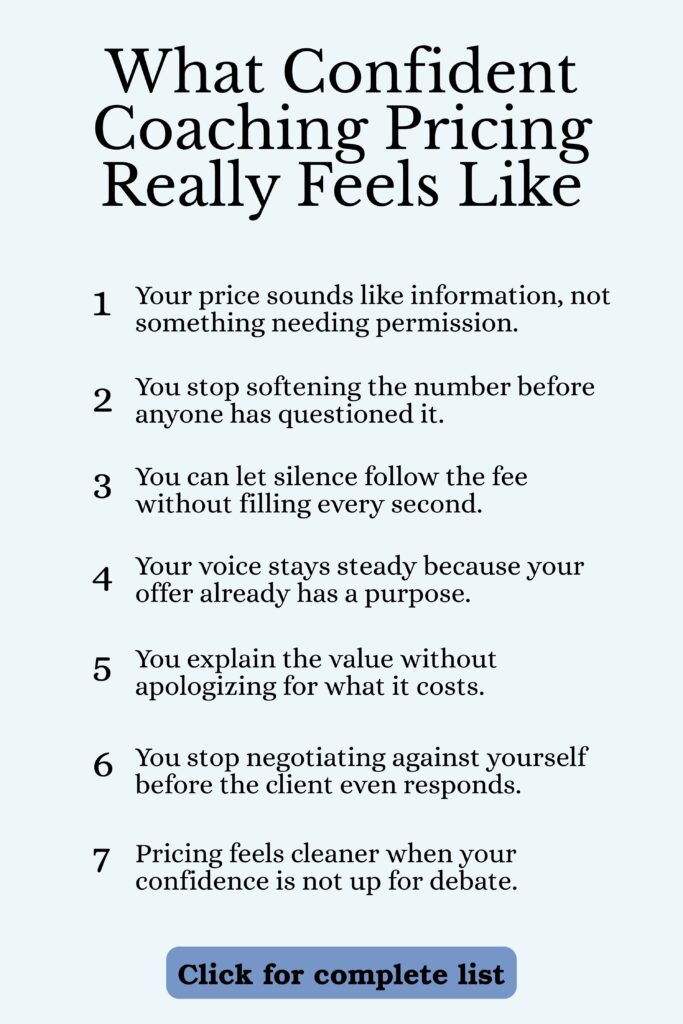
What Does Confident Pricing Actually Sound Like?
Confident pricing sounds clear, ordinary, and complete, rather than rushed, apologetic, or unfinished.
Research by Joshua Guyer, Leandre Fabrigar, and Thomas Vaughan-Johnston tested speech rate, intonation, and pitch across three experiments. Changes in those vocal qualities affected how confident speakers were perceived to be, and those perceptions could influence persuasion.
That does not mean you need to manufacture a deep voice or adopt a strange sales persona. It means uncertainty can leak into the way you say a perfectly reasonable price.
Compare what happens after you name your package.
You say, “The six-session package is $1,200.”
SEE ALSO: If you’re a coach looking to streamline your administrative tasks and save time, check out our Coaching Administration Software. It’s a simple, effective solution designed to help you focus less on paperwork and more on what matters—coaching your clients. From scheduling to client management, our software gives you the tools to run your business efficiently. Ready to reclaim your time and boost productivity? Click or tap here.
Then you stop.
That lands differently from saying the same number quickly and immediately adding, “But I can probably work something out, and there is quite a lot included, and I know it sounds like a lot.”
The second version tells the prospect that you are uncomfortable with your own price before they have even reacted to it.
Try a simple record-and-review drill. Record yourself saying the name of your coaching package, what it includes, and the price three times. Then listen specifically for four things: rushing, upward questioning intonation, apologetic wording, and unnecessary explanation after the number.
Fix what you can hear.
Your goal is not to sound aggressive. Your goal is to make the price sound like a normal fact about the offer.
SEE ALSO: If you’re a coach looking to streamline your administrative tasks and save time, check out our Coaching Administration Software. It’s a simple, effective solution designed to help you focus less on paperwork and more on what matters—coaching your clients. From scheduling to client management, our software gives you the tools to run your business efficiently. Ready to reclaim your time and boost productivity? Click or tap here.
The operational side should feel just as clear. Once a client chooses a package, a straightforward system for coaching packages, payments, and billing prevents an otherwise confident enrollment conversation from ending in a messy trail of payment instructions and manual follow-up.
How Do You Stop Reinventing the Wheel?
Stop reinventing the wheel…
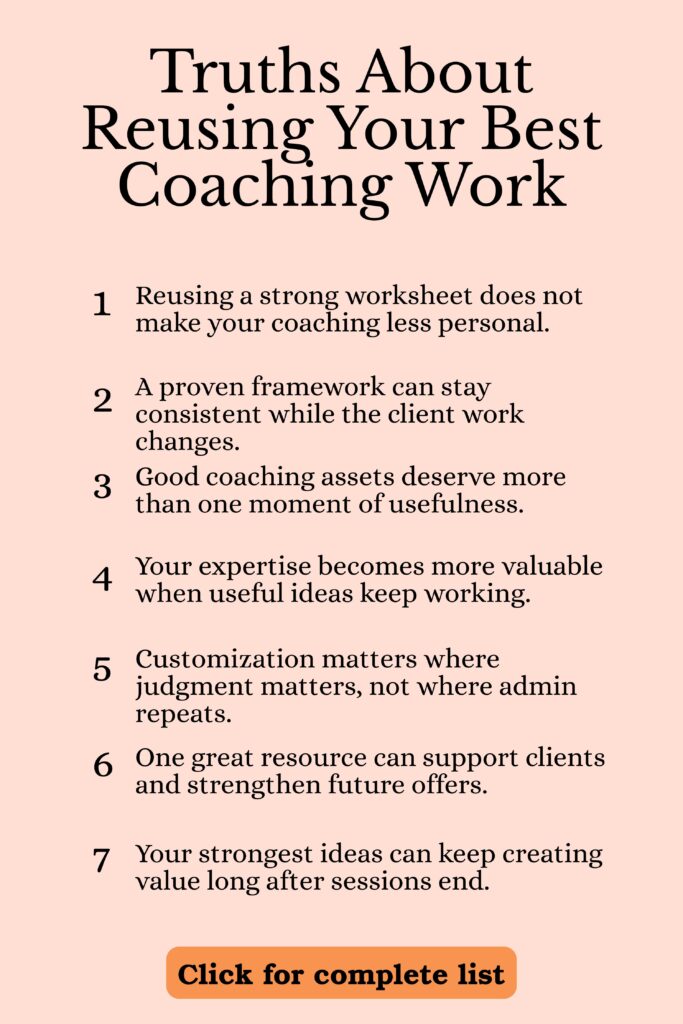
Reuse and Repurpose Everything!
Stop reinventing the wheel for every single client, talk, product, etc.,
Reuse good material over and over for maximum value.
Create once, only tweak when necessary, and use many times!
What Should Coaches Standardize First?
Coaches should standardize the parts of their business that perform the same basic job repeatedly, while keeping the coaching judgment personal.
SEE ALSO: If you’re a coach looking to streamline your administrative tasks and save time, check out our Coaching Administration Software. It’s a simple, effective solution designed to help you focus less on paperwork and more on what matters—coaching your clients. From scheduling to client management, our software gives you the tools to run your business efficiently. Ready to reclaim your time and boost productivity? Click or tap here.
A useful rule is:
Standardize the repeatable structure. Customize the coaching judgment.
Your standardizable layer might include an intake form, coaching agreement, Welcome Package, goal-setting worksheet, session preparation questions, progress review structure, or a resource you regularly send when the same issue comes up.
Imagine that you ask every new career coaching client the same 12 background questions before session one. Writing a new email with those 12 questions every time is not personalization. It is repeated administration.
The same applies if you have rebuilt essentially the same values worksheet six times because each client needed a slightly different introduction. Keep the core worksheet. Change the instructions or follow-up questions only when the client situation genuinely requires it.
The personalized layer is different. Your interpretation of the client’s answers, the question you ask next, the pattern you challenge, the goal you help them sharpen, and the action you agree on should respond to the person in front of you.
SEE ALSO: If you’re a coach looking to streamline your administrative tasks and save time, check out our Coaching Administration Software. It’s a simple, effective solution designed to help you focus less on paperwork and more on what matters—coaching your clients. From scheduling to client management, our software gives you the tools to run your business efficiently. Ready to reclaim your time and boost productivity? Click or tap here.
Tools can make the repeatable layer easier to manage. In LCH Core, journals, worksheets, goals, action items, and resources can be reusable and assigned when appropriate. The coaching tools support guide covers the available options.
The same principle applies at the beginning of the relationship. A Welcome Package can hold a welcome letter, coaching agreement with electronic signature, and forms, rather than asking you to reconstruct the same onboarding sequence for each new client. The client onboarding guide explains that workflow.
Reuse should remove repetitive work. It should never remove your judgment.
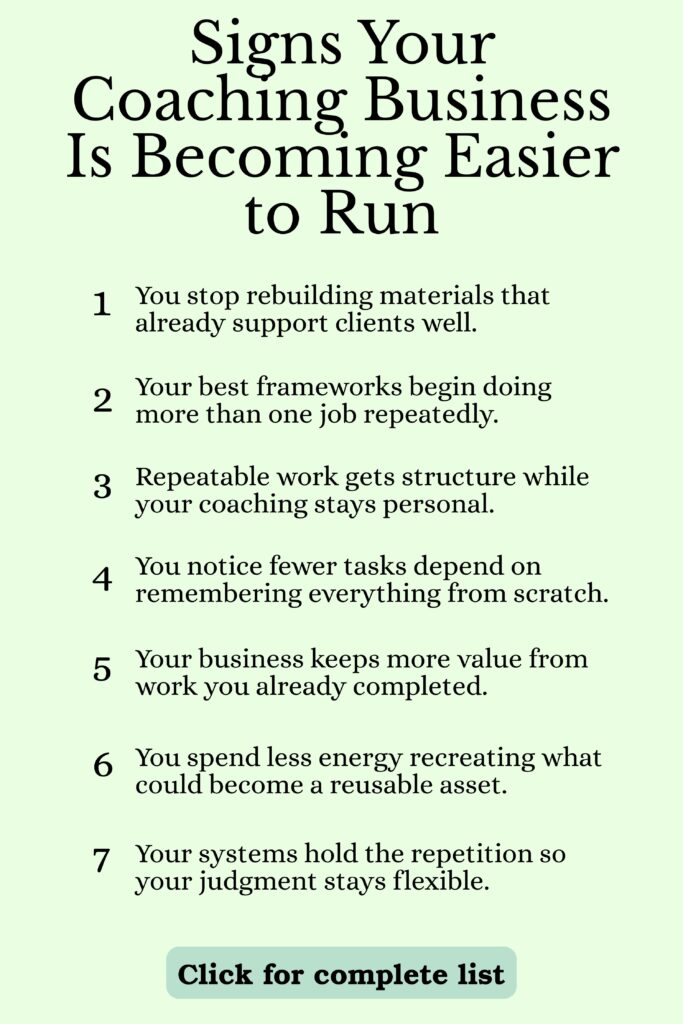
How Far Can One Good Coaching Asset Travel?
One useful coaching asset can do far more than one job when the underlying idea is strong enough to reuse.
Suppose you create a Career Decision Matrix for a client who is choosing between three job offers. It helps the client compare salary, growth, flexibility, values fit, commute, leadership opportunities, and long-term goals.
That worksheet does not need to disappear into a folder after one session.
SEE ALSO: If you’re a coach looking to streamline your administrative tasks and save time, check out our Coaching Administration Software. It’s a simple, effective solution designed to help you focus less on paperwork and more on what matters—coaching your clients. From scheduling to client management, our software gives you the tools to run your business efficiently. Ready to reclaim your time and boost productivity? Click or tap here.
You might refine it into a reusable worksheet for other career coaching clients. The decision criteria stay consistent, while each client supplies their own options, priorities, and weighting.
The same framework could become the core of a presentation called “How to Choose Between Two Good Career Opportunities.” It could generate several pieces of social content. It could become a lead magnet that introduces prospective clients to the way you think.
With enough teaching wrapped around it, the framework might become one lesson inside a course. A standalone version might also become a digital product.
This is where repurposing moves beyond saving time. You are building a library of intellectual assets that can support coaching delivery, visibility, lead generation, and scalable offers.
If you use LCH Core, the original client-facing version can stay available as a reusable resource, while courses and digital products can be offered through the Public Store.
The test is simple: whenever you create something useful, ask, “Is this truly specific to one person, or have I just created something my business could use again?”
SEE ALSO: If you’re a coach looking to streamline your administrative tasks and save time, check out our Coaching Administration Software. It’s a simple, effective solution designed to help you focus less on paperwork and more on what matters—coaching your clients. From scheduling to client management, our software gives you the tools to run your business efficiently. Ready to reclaim your time and boost productivity? Click or tap here.
How Do the Three Secrets Work Together in a Real Coaching Business?
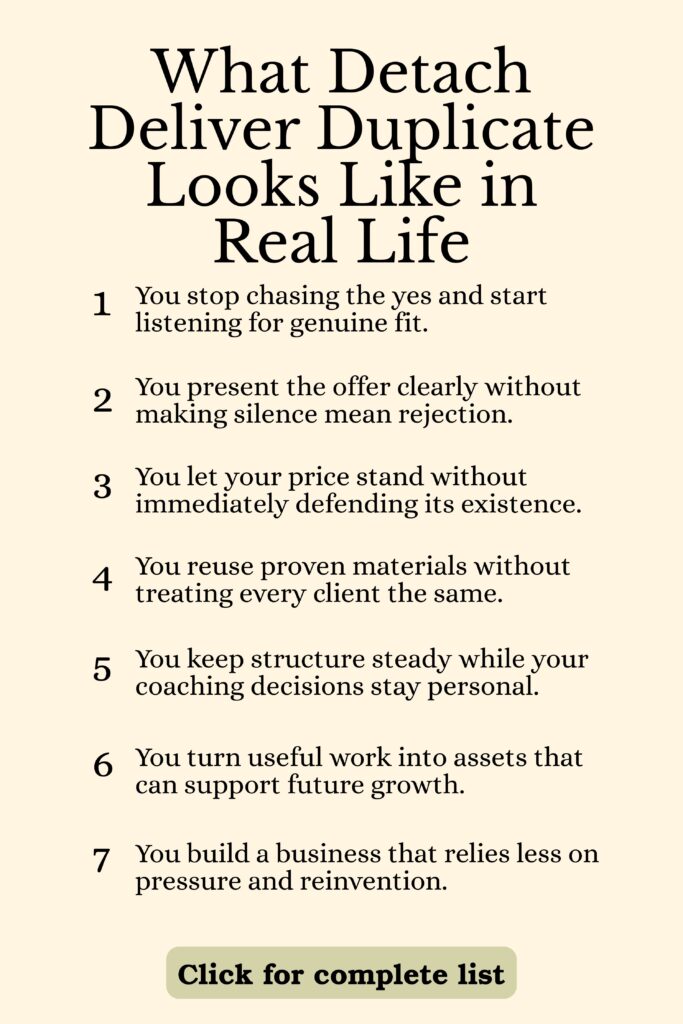
The three secrets work best as one operating loop: Detach, Deliver, Duplicate.
Picture a leadership coach speaking with a prospect who has just been promoted and is struggling to manage a former peer.
First, detach. The coach’s job during the discovery conversation is to diagnose the problem and assess fit. She does not treat every hesitation as an objection that must be defeated.
The prospect is interested, so the coach recommends a six-session package.
Next, deliver. She explains why the package fits the prospect’s situation, says what it includes, names the price clearly, and stops talking. She answers questions without immediately cutting the fee or piling on extras because the silence feels uncomfortable.
The prospect books.
SEE ALSO: If you’re a coach looking to streamline your administrative tasks and save time, check out our Coaching Administration Software. It’s a simple, effective solution designed to help you focus less on paperwork and more on what matters—coaching your clients. From scheduling to client management, our software gives you the tools to run your business efficiently. Ready to reclaim your time and boost productivity? Click or tap here.
Now the coach duplicates. She does not open a blank document and invent an onboarding process. She uses the same core agreement and intake structure she has already refined.
During the engagement, she does not invent every resource from zero either. When a proven leadership worksheet fits, she uses it. When the client situation requires different questions or a different intervention, she customizes the coaching.
A month later, she notices that the same “managing former peers” problem has come up with several clients. That is a clue.
The underlying framework might deserve a reusable worksheet, a talk, a lead magnet, or a future digital product.
This is how one coaching business becomes less dependent on improvising everything. You stay flexible where expertise matters and repeatable where repetition creates leverage.
Where LCH Core Fits
LCH Core fits the repeatable operating layer of these three habits. It cannot make you comfortable naming your price or decide whether a prospect is right for you. Those are coaching-business skills.
SEE ALSO: If you’re a coach looking to streamline your administrative tasks and save time, check out our Coaching Administration Software. It’s a simple, effective solution designed to help you focus less on paperwork and more on what matters—coaching your clients. From scheduling to client management, our software gives you the tools to run your business efficiently. Ready to reclaim your time and boost productivity? Click or tap here.
For Detach, a Public Booking Page and lead magnets can give prospects defined ways to move toward a conversation instead of making every new client depend on manual outreach.
For Deliver, coaching packages, payments, and billing can give a new client a clear commercial next step. Client management can keep client profiles, notes, and intake forms together once the relationship begins.
For Duplicate, a Welcome Package can standardize the repeatable parts of onboarding. Reusable journals, worksheets, goals, action items, and resources can support recurring client work without requiring you to remake the same material.
The Progress Stream and Engagement Report can then help you review progress and engagement across the coaching relationship. If an idea belongs beyond one-to-one work, courses and digital products can be sold through the Public Store.
For a broader look at how these functions connect across a coaching business, see Best Coaching Software for Life Coaches: What to Look For Before You Choose. If your bigger goal is getting more value from each good client relationship rather than constantly replacing clients, A Bird in the Hand: The Simple Math of Client Lifetime Value (for Coaches) goes deeper into retention, expansion, and referrals.
That is the useful role for LCH Core: giving the repeatable parts of a coaching business a clear home so your time and judgment can stay focused on the work that actually requires you.
SEE ALSO: If you’re a coach looking to streamline your administrative tasks and save time, check out our Coaching Administration Software. It’s a simple, effective solution designed to help you focus less on paperwork and more on what matters—coaching your clients. From scheduling to client management, our software gives you the tools to run your business efficiently. Ready to reclaim your time and boost productivity? Click or tap here.
Frequently Asked Questions

How do I sell coaching without sounding desperate or pushy?
Sell coaching by diagnosing the prospect’s situation, explaining the fit, and letting them make the final decision. Avoid filling every silence, arguing with hesitation, or making an unplanned discount simply because the prospect has not said yes yet.
How should a coach talk about pricing on a discovery call?
State your coaching price clearly and then give the prospect space to respond. A short pause after the number usually sounds more confident than immediately justifying the fee or adding extra benefits.
Why do I get nervous when telling prospects my coaching price?
Pricing often feels uncomfortable when you are treating the prospect’s reaction as a verdict on your value. Practice presenting the package and price as factual information about the offer, then separate their purchasing decision from your professional confidence.
Should I explain my price after I say it on a sales call?
Explain the value before or when presenting the offer, not as a nervous reaction after naming the price. If the prospect has a genuine question about what is included, answer it directly.
What parts of a coaching business should I standardize?
Standardize repeatable processes such as intake questions, agreements, onboarding materials, recurring worksheets, common resources, and progress-review structures. Keep coaching decisions and client-specific judgment personalized.
Can I use the same coaching worksheet with different clients?
Yes, you can reuse a worksheet when the framework fits multiple clients. Customize the instructions, discussion, interpretation, or follow-up when the client’s situation calls for it.
SEE ALSO: If you’re a coach looking to streamline your administrative tasks and save time, check out our Coaching Administration Software. It’s a simple, effective solution designed to help you focus less on paperwork and more on what matters—coaching your clients. From scheduling to client management, our software gives you the tools to run your business efficiently. Ready to reclaim your time and boost productivity? Click or tap here.
How can I repurpose my coaching materials?
Start by identifying the core idea rather than copying the exact format. A client worksheet might later become a lead magnet, presentation framework, social content, course lesson, or digital product if the concept is useful beyond one client.
How do I know whether something should be reused or customized?
Reuse it when the underlying task stays the same and customize it when the client’s needs change the decision or intervention. The form can repeat. Your judgment should not.
Sources
Li, Zixi, and Jingyuan Shi. “Message Effects on Psychological Reactance: Meta-Analyses.” Human Communication Research, vol. 52, no. 1, Jan. 2026, pp. 38-52. Published online 30 June 2025. Oxford Academic. View the authoritative source
Guyer, Joshua J., Leandre R. Fabrigar, and Thomas I. Vaughan-Johnston. “Speech Rate, Intonation, and Pitch: Investigating the Bias and Cue Effects of Vocal Confidence on Persuasion.” Personality and Social Psychology Bulletin, vol. 45, no. 3, Mar. 2019, pp. 389-405. doi:10.1177/0146167218787805. View the PubMed record
Read this next

13 In Demand Lead Magnet Ideas for Coaches to Get Clients Fast
Effectively market your coaching business using these 13 in demand lead magnet ideas!
Read More
5 Ways You Help Clients Even When You Think “I’m Not Perfect Yet”
How can I get clients and help others transform their lives when I haven’t cleaned up my own stuff yet?
Read More
10 Common Excuses Keeping You From Getting Paid Clients: Part 1
What is getting in the way? Ok… so we’ve established that you’re brilliant, talented, and have life experience that makes you a unique asset to others. We know you can […]
Read More