






Selling Coaching: Why Coaches Hate Selling

Coaches Hate Selling
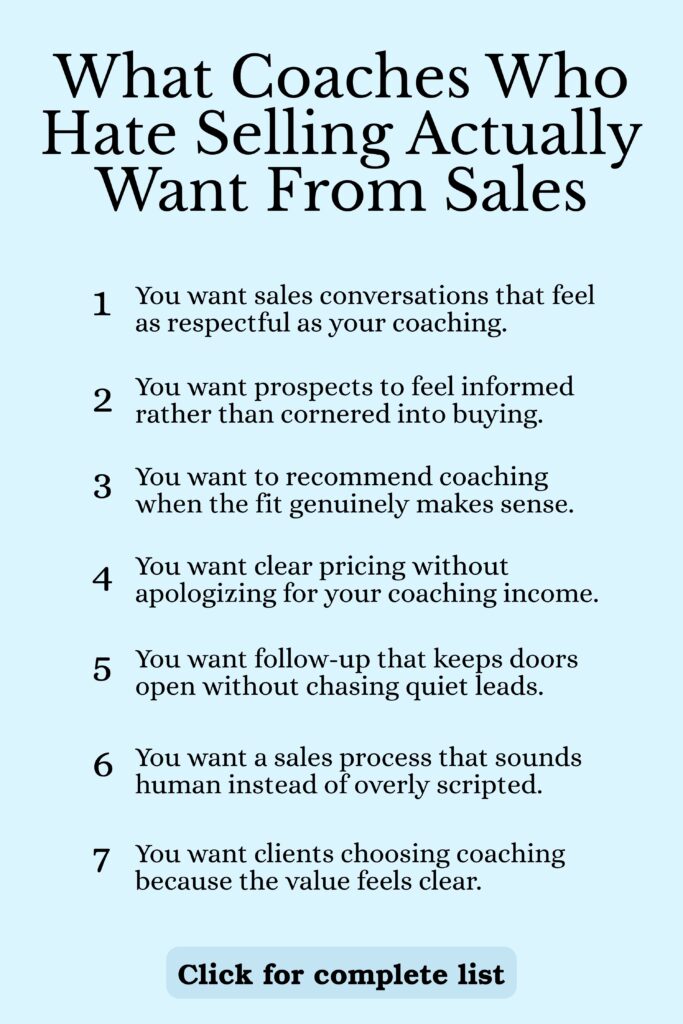
The #1 reason so many coaches hate selling or hate the thought of having to sell isn’t because they are afraid of rejection. Actually, the reason is because they don’t want to be seen as pushy or sale-sy.
Key Takeaways
- Hating pushy sales tactics does not mean you have to hate selling. You can sell coaching by helping a prospect understand their problem, desired outcome, options, and whether your offer fits.
- A sales conversation should help someone make a decision. Your job is not to manufacture a yes. It is to create enough clarity for an informed yes or no.
- Questions are more useful than a rehearsed pitch. Diagnose what the prospect wants, what is getting in the way, and what support they need before recommending your coaching.
- “I need to think about it” is not an invitation to pressure someone. Clarify what remains unresolved, agree on an appropriate next step, then give the prospect room to decide.
- A repeatable sales process makes selling simpler. A clear path from visibility to discovery call, recommendation, follow-up, payment, and onboarding means you do not have to reinvent every client conversation.
Why Do Coaches Hate Selling?
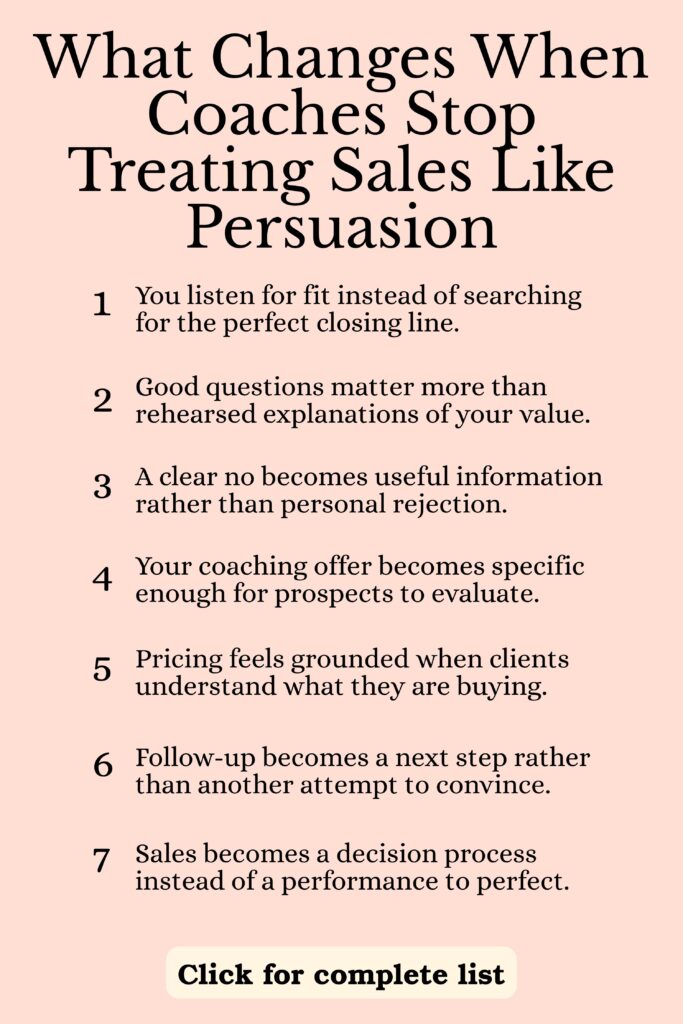
Many coaches hate selling because they associate it with pressure, manipulation, scripted persuasion, and convincing someone to buy something they may not need. That clashes with the way good coaching works, where the client has agency over their own decisions.
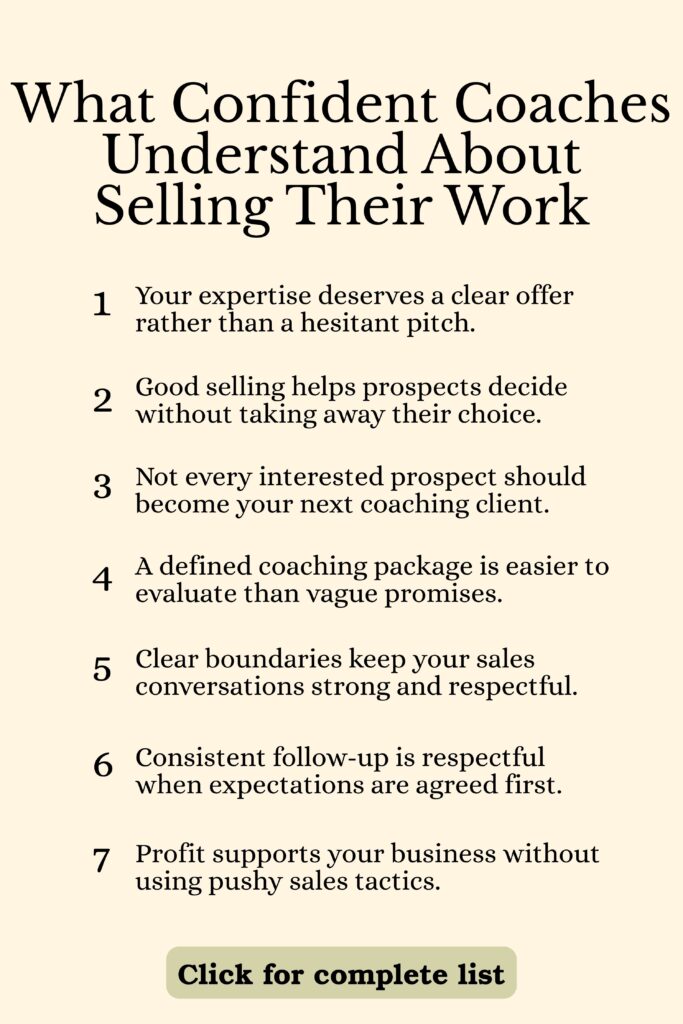
Selling coaching does not have to work that way. An ethical coaching sales conversation helps a prospect clarify what they want, understand the gap between where they are and where they want to be, consider whether coaching could help, and make their own decision about moving forward.
The goal is not to become better at pressuring people. It is to become better at helping the right people make clear decisions.
Why Do People Put Their Guard Up Around Salespeople?
We’ve been conditioned to put our guard up when salespeople approach us. Also, we’ve been taught to be wary because salespeople are always trying to sell us something. Most of the time, we tend to think of salespeople are manipulative, sleazy, dollar chasin’ creeps who don’t really care about us.
It’s true that there are those kinds of people out there in every industry on the planet, I’ve worked with them.
SEE ALSO: If you’re a coach looking to streamline your administrative tasks and save time, check out our Coaching Administration Software. It’s a simple, effective solution designed to help you focus less on paperwork and more on what matters—coaching your clients. From scheduling to client management, our software gives you the tools to run your business efficiently. Ready to reclaim your time and boost productivity? Click or tap here.
What Does Bad Selling Actually Look Like?
Even though deep down, I knew that the salesmen I’ve worked with were good people, but what came out of their mouths when talking about clients often made me cringe.
One previous coworker said to me one day, thinking it was a great teaching moment as he had just finished up with a potential customer, “In my mind I’m thinking, if you ain’t spending money with me get the hell out of my chair. NEXT…”
I was shocked that he said that to me. Didn’t he know I wasn’t like that. Guess not… He actually thought that he could train me to be that way.
As I almost threw up in my mouth, holding back my thoughts from showing up in my facial expression as the first thought flittered in my mind “Dirty! Sleazy!” I just nodded as if I understood what he meant.
As I walked back to my desk I was utterly grateful to know that I didn’t have to be like him or worry that there were others like him.
I knew that if there is one like me who knows that a selling conversation is truly a transformational conversation then there are and will be more like me. That is why I’m so passionate about this topic.
SEE ALSO: If you’re a coach looking to streamline your administrative tasks and save time, check out our Coaching Administration Software. It’s a simple, effective solution designed to help you focus less on paperwork and more on what matters—coaching your clients. From scheduling to client management, our software gives you the tools to run your business efficiently. Ready to reclaim your time and boost productivity? Click or tap here.
I’ve had my share of clients in other industries I’ve worked in say to me that so-and-so is so sleazy and they only care about making a dollar off me. But I have been blessed enough when they said “but I know you’re not like them, you’re one of the few.”
Are All Salespeople Pushy or Manipulative?
Ever heard the saying that “all men are dogs?” Is it really true. REALLY? Of course it’s not. But if you believe it, you’ll come across plenty of them in your life. PROMISE.
So is it really true that “all salespeople are sleazy, manipulate and conniving?” Of course not, but if you believe it, you’ll come across plenty of them. PROMISE.
So this is for those of you who are afraid that this stigma is how you’ll be seen.
Why Does Selling Coaching Feel So Personal?
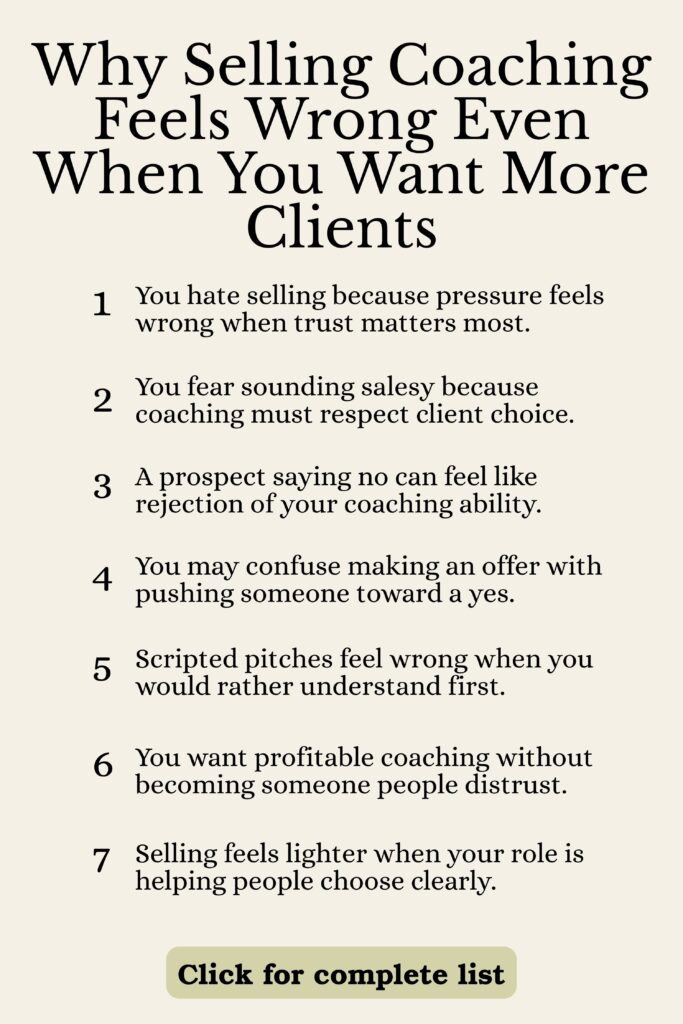
Selling coaching can feel personal because your expertise, judgment, method, and relationship with the client are part of what the prospect is considering.
That makes a no easy to misread.
SEE ALSO: If you’re a coach looking to streamline your administrative tasks and save time, check out our Coaching Administration Software. It’s a simple, effective solution designed to help you focus less on paperwork and more on what matters—coaching your clients. From scheduling to client management, our software gives you the tools to run your business efficiently. Ready to reclaim your time and boost productivity? Click or tap here.
Imagine you finish a discovery call and the prospect says, “Thanks, but I don’t think I’m ready to do this right now.” If your brain translates that into “They don’t think I’m a good coach,” the next sales conversation carries a lot more emotional weight.
But that is only one possible interpretation.
The prospect could like you and still decide:
- The timing is wrong.
- The package costs more than they can currently spend.
- The outcome still feels unclear.
- They want to compare several coaches.
- They need to discuss the expense with someone else.
- They are interested, but not ready to commit.
- Your particular coaching offer simply isn’t the right fit.
Those are decisions about an offer at a particular moment, not a verdict on your value.
There is another useful distinction here. You are not literally selling yourSELF.
You are selling a defined way of working with you. That might be six career coaching sessions designed around making a career transition, a three-month leadership coaching engagement, or a relationship coaching package with specific goals and support between sessions.
SEE ALSO: If you’re a coach looking to streamline your administrative tasks and save time, check out our Coaching Administration Software. It’s a simple, effective solution designed to help you focus less on paperwork and more on what matters—coaching your clients. From scheduling to client management, our software gives you the tools to run your business efficiently. Ready to reclaim your time and boost productivity? Click or tap here.
The more clearly you define what someone is buying, the less the decision has to feel like a referendum on you.
How Can Coaches Sell Without Feeling Pushy?
Coaches (especially my spiritual bad-asses) like to kick selling under the rug because they don’t want to be seen like this. But let’s get real for a second. You’re not just a coach… you’re a business owner and business owners make PROFIT right? If you can’t sustain yourself you can’t help many people can you? Nobody gets the transformation they’re seeking. Not you and not them.
That’s why I want to share something special with you. I want you to give yourself the gift of freedom from the fear of selling yourSELF. Let’s face it, that’s what you’re doing. You’re not selling coaching.
You’re selling yourSELF. You’re the solution to somebody’s problem. To somebody’s prayer. Don’t hold that lightly.
This isn’t about selling your soul for profit. This is about “giving” (with a generous heart) the world the gifts that come from within you. Gifts of your Spirit. Gifts of your Soul. And to be paid beautifully and WITHOUT guilt for those gifts.
What Makes a Coaching Sales Conversation Ethical?
An ethical coaching sales conversation helps the prospect make an informed decision without taking that decision away from them.
SEE ALSO: If you’re a coach looking to streamline your administrative tasks and save time, check out our Coaching Administration Software. It’s a simple, effective solution designed to help you focus less on paperwork and more on what matters—coaching your clients. From scheduling to client management, our software gives you the tools to run your business efficiently. Ready to reclaim your time and boost productivity? Click or tap here.
A simple way to structure the conversation is:
Diagnose → Clarify → Recommend → Decide
Diagnose: Understand what is actually happening. What brought this person to you? What have they tried? Where are they stuck?
Clarify: Get specific about what they want instead. What would meaningful progress look like? Why does it matter now?
Recommend: Decide whether your coaching is genuinely a sensible fit. If it is, explain what you recommend and why. If it isn’t, say so.
Decide: Give the prospect the information they need to choose. That includes what they will receive, what it costs, what commitment is involved, and what happens next.
SEE ALSO: If you’re a coach looking to streamline your administrative tasks and save time, check out our Coaching Administration Software. It’s a simple, effective solution designed to help you focus less on paperwork and more on what matters—coaching your clients. From scheduling to client management, our software gives you the tools to run your business efficiently. Ready to reclaim your time and boost productivity? Click or tap here.
That final stage matters.
Self-Determination Theory, developed by psychologists Edward Deci and Richard Ryan, distinguishes autonomy-supportive environments from controlling ones. Autonomy support involves acknowledging another person’s perspective, providing relevant information, allowing meaningful choice, and minimizing pressure and control.
That research was not developed as a coaching sales technique. But the principle translates usefully: give people the information and space required to make their own choice rather than trying to control the choice.
For example, suppose you’re a career coach and someone books a call because they hate their résumé and cannot get interviews. During the conversation, you discover they already know exactly which jobs they want and mainly need someone to rewrite their résumé.
You could force the conversation toward your 12-week career coaching program.
Or you could say, “From what you’ve told me, I don’t think a full coaching program is what you need right now. You need specialist résumé help.”
SEE ALSO: If you’re a coach looking to streamline your administrative tasks and save time, check out our Coaching Administration Software. It’s a simple, effective solution designed to help you focus less on paperwork and more on what matters—coaching your clients. From scheduling to client management, our software gives you the tools to run your business efficiently. Ready to reclaim your time and boost productivity? Click or tap here.
You lose that particular sale.
You also conduct the kind of sales conversation you probably wish more salespeople conducted.
What Questions Should You Ask Instead of Pitching?
The most useful sales questions help you determine whether there is a real problem, a meaningful desired outcome, and a genuine fit between the prospect and your coaching.
You do not need to spend 20 minutes describing your qualifications before you know why the person is there.
Start with diagnosis:
- What made you decide to look for coaching now?
- What’s happening that you want to change?
- What have you already tried?
- Where do you keep getting stuck?
Then clarify the desired outcome:
SEE ALSO: If you’re a coach looking to streamline your administrative tasks and save time, check out our Coaching Administration Software. It’s a simple, effective solution designed to help you focus less on paperwork and more on what matters—coaching your clients. From scheduling to client management, our software gives you the tools to run your business efficiently. Ready to reclaim your time and boost productivity? Click or tap here.
- What would you like to be different three or six months from now?
- What would meaningful progress look like to you?
- Why does changing this matter now?
- What happens if nothing changes?
Then explore fit:
- What kind of support do you think would help you move forward?
- Have you worked with a coach before?
- What would make coaching feel worthwhile to you?
Suppose someone tells a career coach, “I know I need to leave my job, but I’ve been saying that for two years.”
That gives you somewhere useful to go. Why haven’t they moved? Do they lack options? Are they repeatedly abandoning decisions? Do they need practical career strategy, accountability, confidence around interviews, or something entirely outside your expertise?
Only after understanding that do you explain how you work.
If you use LCH Core, you can also collect relevant information through intake forms before a prospect conversation and let prospects schedule through your Public Booking Page. The point is not to interrogate someone before they meet you. It is to arrive knowing enough context that the conversation can get to the real issue faster.
What Should You Do When a Prospect Says “I Need to Think About It”?
When a coaching prospect says “I need to think about it,” clarify what they still need to decide rather than immediately trying to overcome the objection.
SEE ALSO: If you’re a coach looking to streamline your administrative tasks and save time, check out our Coaching Administration Software. It’s a simple, effective solution designed to help you focus less on paperwork and more on what matters—coaching your clients. From scheduling to client management, our software gives you the tools to run your business efficiently. Ready to reclaim your time and boost productivity? Click or tap here.
“I need to think” can mean several things.
It can mean:
- “I’m not convinced this will help me.”
- “I want this, but I’m worried about the price.”
- “I need to talk to my partner.”
- “I’m comparing you with another coach.”
- “This isn’t a priority yet.”
- “I’m genuinely not sure.”
- Or, yes, sometimes it means, “I’m trying to say no politely.”
You don’t need to guess.
You can ask, “Absolutely. What part do you feel you need to think through?”
Then listen.
If the unanswered issue is something factual, answer it. If they need time, give them time. If they have effectively said no, respect the no.
SEE ALSO: If you’re a coach looking to streamline your administrative tasks and save time, check out our Coaching Administration Software. It’s a simple, effective solution designed to help you focus less on paperwork and more on what matters—coaching your clients. From scheduling to client management, our software gives you the tools to run your business efficiently. Ready to reclaim your time and boost productivity? Click or tap here.
You can also agree on a concrete follow-up rather than leaving both sides in limbo. For example: “Would it be useful if I checked back with you next Thursday after you’ve had time to think?”
That is very different from sending increasingly urgent messages because somebody failed to buy on the call.
It is also worth separating not ready from not interested. Someone can have a real problem and like your approach but still be months away from paying for coaching.
Instead of treating every quiet prospect as a dead lead, keep a simple record of what they were interested in and what next step was agreed. A CRM with client profiles and notes, including the client management tools in LCH Core, can make that easier without turning follow-up into a complicated marketing operation.
A prospect who said “not yet” does not need pressure. They need the freedom to decide whether “not yet” eventually becomes “yes” or stays “no.”
How Do You Build a Sales Process That Doesn’t Depend on Being “Good at Sales”?
You do not need a stereotypical sales personality when you have a clear process for moving someone from discovering you to deciding whether they want to work with you.
SEE ALSO: If you’re a coach looking to streamline your administrative tasks and save time, check out our Coaching Administration Software. It’s a simple, effective solution designed to help you focus less on paperwork and more on what matters—coaching your clients. From scheduling to client management, our software gives you the tools to run your business efficiently. Ready to reclaim your time and boost productivity? Click or tap here.
A simple coaching sales path looks like this:
Visibility → Inquiry → Discovery → Recommendation → Decision → Follow-up → Onboarding
Visibility: Someone discovers you through your website, content, referral network, social media, or another relevant source. A free life coach directory listing can also give potential clients another way to find you.
Inquiry: Give them one obvious next action. For many coaches, that will be requesting information or booking a discovery call.
Discovery: Use the conversation to diagnose and clarify rather than launching into a pitch.
Recommendation: If there is a genuine fit, explain which coaching package or service you recommend and connect it directly to what the prospect told you.
SEE ALSO: If you’re a coach looking to streamline your administrative tasks and save time, check out our Coaching Administration Software. It’s a simple, effective solution designed to help you focus less on paperwork and more on what matters—coaching your clients. From scheduling to client management, our software gives you the tools to run your business efficiently. Ready to reclaim your time and boost productivity? Click or tap here.
Decision: Explain the price, commitment, boundaries, and next step clearly. Then let them decide.
Follow-up: If they are interested but not ready, record the agreed next action rather than relying on memory.
Onboarding: Once they say yes, move cleanly from selling into coaching. Payment, agreement, intake information, and the first appointment should not become a scavenger hunt across five email threads.
This is where a system starts doing some of the heavy lifting.
A coach without a process might respond differently to every inquiry, forget which prospect asked about which package, send payment details manually, forget a follow-up, then scramble to find the right intake document when someone finally says yes.
The problem isn’t that they are “bad at sales.” There is no reliable path for the prospect to move through.
SEE ALSO: If you’re a coach looking to streamline your administrative tasks and save time, check out our Coaching Administration Software. It’s a simple, effective solution designed to help you focus less on paperwork and more on what matters—coaching your clients. From scheduling to client management, our software gives you the tools to run your business efficiently. Ready to reclaim your time and boost productivity? Click or tap here.
For a deeper look at the complete journey, see How to Master Funnels as a Coach (and Why You Need To). A funnel is useful here because it stops you treating every sales conversation as an isolated event.
Why Isn’t Selling Coaching Just About Profit?
Let’s start a movement. You and me. We’re here to change lives.
Let’s show the world selling is NOT something you do TO a person, it’s something that you do FOR a person.
Where LCH Core Fits
LCH Core fits after you have decided what your sales process should be, because the software can help you run parts of that process consistently.
For a straightforward coaching business, that might look like this:
1. Make it easy to take the first step.
A prospect can schedule through your Public Booking Page rather than exchanging messages to find a time. If useful, an intake form can collect relevant information before the conversation.
SEE ALSO: If you’re a coach looking to streamline your administrative tasks and save time, check out our Coaching Administration Software. It’s a simple, effective solution designed to help you focus less on paperwork and more on what matters—coaching your clients. From scheduling to client management, our software gives you the tools to run your business efficiently. Ready to reclaim your time and boost productivity? Click or tap here.
2. Keep prospect information organized.
Client management (CRM) gives you client profiles, notes, and intake forms so information from an inquiry does not disappear into an inbox.
3. Make the offer concrete.
Coaching packages, payments, billing, and scheduling give the prospect a defined way to work with you instead of an ambiguous “we could do some coaching together.”
4. Move from sale to client cleanly.
Once someone becomes a client, a Welcome Package can bring together a welcome letter, coaching agreement with electronic signature, and forms. That creates a clear handoff from “I’ve decided to work with you” to “here’s how we begin.”
5. Deliver what you sold.
Journals, worksheets, goals, action items, and resources can support the work between sessions. The Progress Stream and Engagement Report can help you review client activity and progress as the coaching relationship continues.
If you want to see how those pieces connect across the wider coaching business, the LCH Core coaching software overview explains the platform as a whole. You can also read Best Coaching Software for Life Coaches: What to Look For Before You Choose for a broader look at how client management, scheduling, payments, onboarding, coaching delivery, and business growth can fit together.
The technology doesn’t make the sales decision for someone.
SEE ALSO: If you’re a coach looking to streamline your administrative tasks and save time, check out our Coaching Administration Software. It’s a simple, effective solution designed to help you focus less on paperwork and more on what matters—coaching your clients. From scheduling to client management, our software gives you the tools to run your business efficiently. Ready to reclaim your time and boost productivity? Click or tap here.
It gives you a clearer system around the human conversation.
Frequently Asked Questions About Selling Coaching
How do I sell coaching without being pushy?
Sell coaching without being pushy by helping the prospect understand their situation, desired outcome, and options before recommending your service.
Ask enough questions to determine whether there is a genuine fit. Then explain what you recommend, the price, the commitment involved, and let the prospect choose.
What should I say on a coaching discovery call?
A coaching discovery call should focus on what brought the prospect to you, what they want to change, what they have already tried, and what outcome they want.
Once you understand those things, explain whether and how your coaching could help. You do not need a long scripted pitch.
How do I explain the value of coaching to a potential client?
Explain the value of coaching by connecting your offer to the specific outcome the prospect told you they want.
SEE ALSO: If you’re a coach looking to streamline your administrative tasks and save time, check out our Coaching Administration Software. It’s a simple, effective solution designed to help you focus less on paperwork and more on what matters—coaching your clients. From scheduling to client management, our software gives you the tools to run your business efficiently. Ready to reclaim your time and boost productivity? Click or tap here.
“Six sessions for $X” describes what they buy. “Six sessions focused on deciding your next career move, building your transition plan, and following through on it” makes the purpose of those sessions clearer.
What should I do when a coaching prospect says they need to think about it?
Ask what they still need to think through, answer any genuine unanswered questions, and give them room to make the decision.
If appropriate, agree on a specific follow-up date. Do not turn hesitation into a battle you need to win.
How often should I follow up with a coaching lead?
Follow up according to the next step you agreed with the prospect rather than repeatedly contacting them without context.
If someone says, “Contact me next month,” make a note and contact them next month. If someone clearly declines your offer, respect the decision.
Should coaches offer free discovery calls?
Free discovery calls can work well when both the coach and prospect need a conversation to establish fit before a larger coaching commitment.
SEE ALSO: If you’re a coach looking to streamline your administrative tasks and save time, check out our Coaching Administration Software. It’s a simple, effective solution designed to help you focus less on paperwork and more on what matters—coaching your clients. From scheduling to client management, our software gives you the tools to run your business efficiently. Ready to reclaim your time and boost productivity? Click or tap here.
They are not compulsory. If your offer can be understood and purchased without a consultation, you may choose a different sales path.
How do I turn a discovery call into a paying coaching client?
Turn a discovery call into a potential sale by diagnosing the prospect’s situation first, then recommending a clearly defined coaching offer when there is a genuine fit.
Do not make conversion the only acceptable outcome. A useful discovery process should also identify people who are not right for your coaching.
What is the difference between ethical selling and manipulating a prospect?
Ethical selling supports an informed, voluntary decision, while manipulation attempts to control the decision through pressure, distortion, or withholding relevant information.
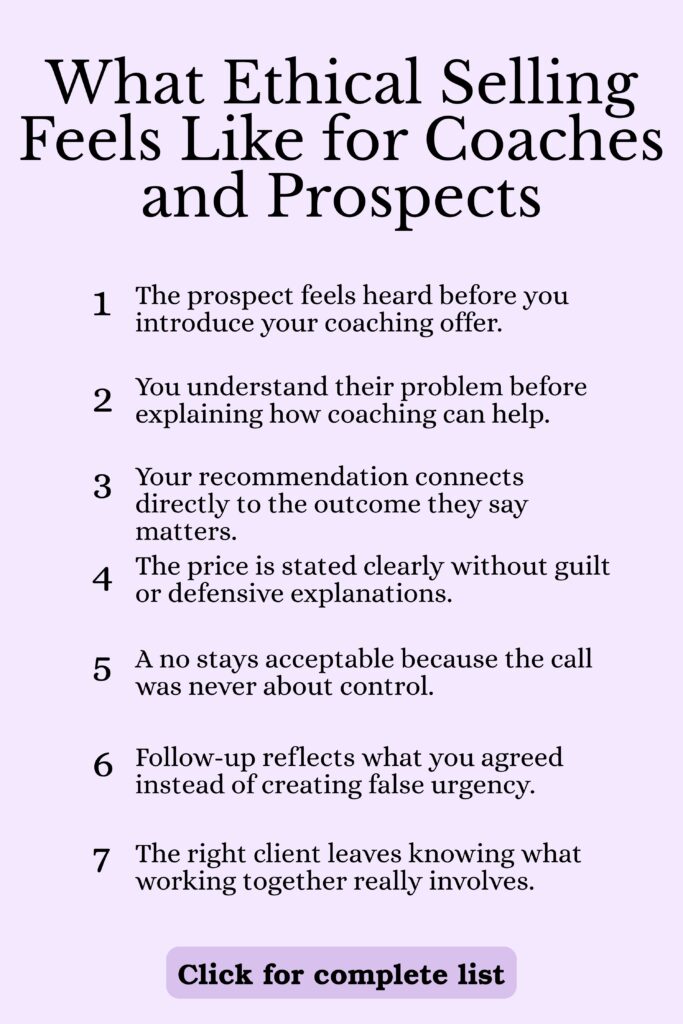
That means being clear about what you offer, what it costs, what the client can reasonably expect, and whether you believe your coaching is appropriate for their situation.
SEE ALSO: If you’re a coach looking to streamline your administrative tasks and save time, check out our Coaching Administration Software. It’s a simple, effective solution designed to help you focus less on paperwork and more on what matters—coaching your clients. From scheduling to client management, our software gives you the tools to run your business efficiently. Ready to reclaim your time and boost productivity? Click or tap here.
Want access to my FREE training to conquer your selling fears? Spiritual Selling Secrets – How to Get your First or Next Paying Clients without Feeling Pushy, Salesy or Annoying! Get all the details! <<<
Sources
Deci, Edward L., and Richard M. Ryan. “The Support of Autonomy and the Control of Behavior.” Journal of Personality and Social Psychology, vol. 53, no. 6, 1987, pp. 1024–1037. Self-Determination Theory, https://selfdeterminationtheory.org/research/autonomy-supportive-practices/.
Gagné, Marylène, and Edward L. Deci. “Self-Determination Theory and Work Motivation.” Journal of Organizational Behavior, vol. 26, no. 4, 2005, pp. 331–362. Self-Determination Theory, https://www.selfdeterminationtheory.org/SDT/documents/2005_GagneDeci_JOB_SDTtheory.pdf.

Read this next

How to Market your Life Coaching Business with the Help of Webinars: 9 Tips
Learn how to promote your coaching business with the help of webinars
Read More
13 In Demand Lead Magnet Ideas for Coaches to Get Clients Fast
Effectively market your coaching business using these 13 in demand lead magnet ideas!
Read More
5 Ways You Help Clients Even When You Think “I’m Not Perfect Yet”
How can I get clients and help others transform their lives when I haven’t cleaned up my own stuff yet?
Read More