






Be a Discussion Starter

Discussions are a great learning tool you can use to work through issues and help people learn a bit more about themselves.
Online discussions can be a great learning tool. Your group coaching clients can use discussion modules to discuss concepts, work through issues, and learn more about themselves and others. Even though these are so beneficial, it can often be difficult to get your group coaching clients to start up discussions; this means that you have to do it. You need to learn how to start conversations online that get your group coaching clients to have some quality conversations.
Key Takeaways
- Good discussions are designed, not simply posted. Use a clear Prompt → Response → Probe → Apply cycle so clients move from answering a question to examining what their answer means and deciding what to do with it.
- Specific prompts beat broad questions. Ask clients to examine a decision, experience, obstacle, comparison, or real situation rather than inviting general opinions.
- Start with lower-risk participation. Let clients describe and observe before asking them to interpret behavior, discuss difficult experiences, or challenge long-held assumptions.
- Follow-up questions create depth. Clarifying, testing, contrasting, exploring consequences, and considering alternatives can turn an ordinary first response into useful coaching work.
- Measure more than comment volume. Look for response depth, participation across the group, peer interaction, application, and follow-through to judge whether discussions are actually supporting the coaching process.
How Do You Start Meaningful Discussions in Group Coaching?
Meaningful group coaching discussions work best when you give clients a focused question, help them explore their first response, and connect what emerges to a practical next step. One useful structure is Prompt → Response → Probe → Apply.
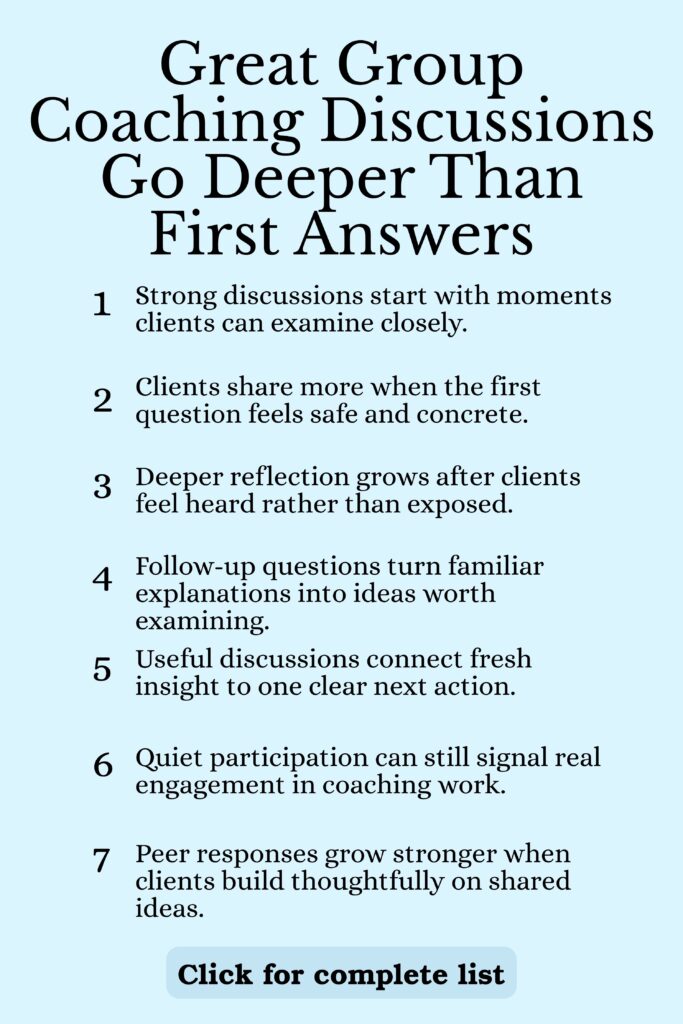
The prompt gives clients something specific to think about. Their response reveals how they currently see the issue. Your probing questions help them examine that response more closely. The application stage asks what they will do differently because of what they have discovered.
This structure also keeps an online discussion from becoming a collection of unrelated opinions. The conversation has somewhere to go.
How Can Online Discussions Strengthen Group Coaching?
There are many tools at your disposal in your life coaching practice. These tools have been designed to help you grow your coaching business, interact effectively with your clients, and efficiently lead your clients in developing strategies and techniques to help them develop and progress.
SEE ALSO: If you’re a coach looking to streamline your administrative tasks and save time, check out our Coaching Administration Software. It’s a simple, effective solution designed to help you focus less on paperwork and more on what matters—coaching your clients. From scheduling to client management, our software gives you the tools to run your business efficiently. Ready to reclaim your time and boost productivity? Click or tap here.
One such tool is that of online discussion forums which may take place in group coaching courses that you deliver. These group coaching discussions can be very powerful for your clients, but they might not be prone to take advantage of the ability to discuss with other coaching clients in a group setting. Asking your clients to use the discussion tool can help, but just because they discussing online doesn’t mean that they are using a discussion tool to its full potential.
The best way to get group coaching clients engaged and active in discussion forums is for you to participate in these discussions. As a coach, you need to be starting conversations online to get your clients involved. Starting conversations, however, is often easier said than done.
The following are some strategies and techniques that can help you kick off helpful online discussions about key concepts and important issues. These discussion starters, intriguing discussion topics, and other tips can help you to kick of conversations in your group coaching courses to get your clients more engaged so that they can reap even more benefits from the life coaching you offer.
What Makes a Coaching Discussion Prompt Actually Work?
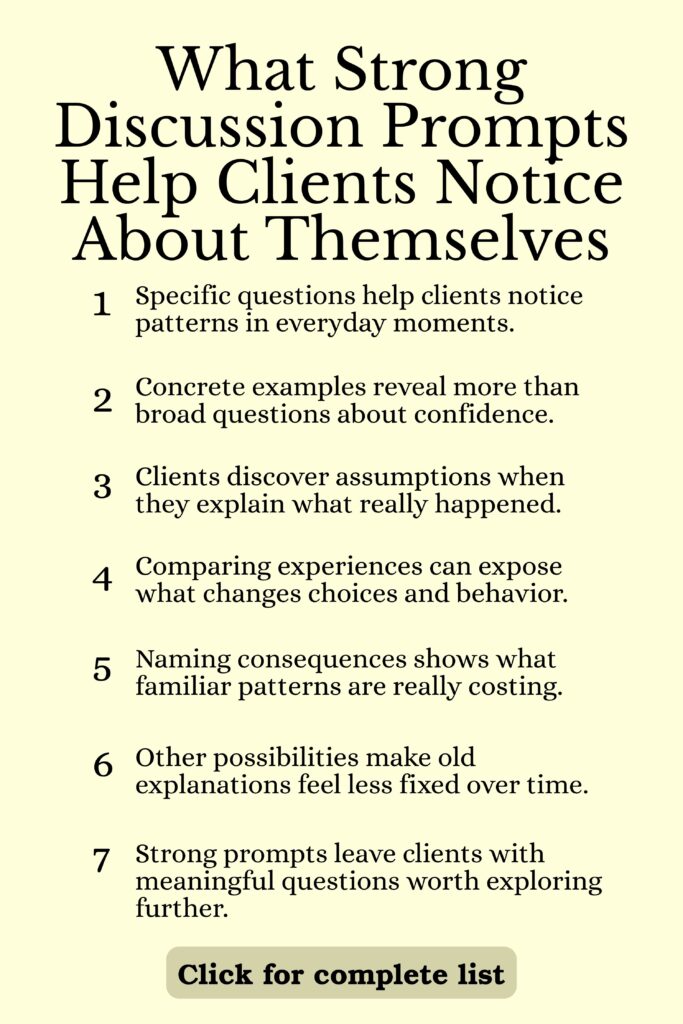
A strong coaching discussion prompt gives clients a specific piece of their experience to examine rather than asking them to discuss a huge subject.
Compare these two questions:
Broad: “What do you think about setting boundaries?”
SEE ALSO: If you’re a coach looking to streamline your administrative tasks and save time, check out our Coaching Administration Software. It’s a simple, effective solution designed to help you focus less on paperwork and more on what matters—coaching your clients. From scheduling to client management, our software gives you the tools to run your business efficiently. Ready to reclaim your time and boost productivity? Click or tap here.
Specific: “Think of one request you agreed to this week even though you wanted to say no. What made saying no difficult?”
Both questions are open-ended. Only one gives the client a concrete event to investigate.
Useful prompts often ask clients to do one of five things:
- Recall: Describe a specific situation that happened.
- Compare: Identify what was different between two experiences.
- Diagnose: Look for what keeps creating the same outcome.
- Decide: Choose between realistic options and explain why.
- Predict: Consider what is likely to happen if nothing changes.
Suppose you run a career coaching group and the week’s topic is speaking up at work. Instead of posting, “How confident are you at work?” ask clients to identify the last meeting where they had something useful to contribute but stayed quiet.
Now there is material to coach.
How Do You Build Discussion Into a Group Coaching Program?
Don’t let discussions be optional; tell your group coaching clients that online discussions are part of your life coaching approach. With each module, you will want to ask a question or offer up a discussion topic that is related to your class. Incorporate the things your clients say in these forums into your coaching; knowing you are watching make them more likely to participate.
SEE ALSO: If you’re a coach looking to streamline your administrative tasks and save time, check out our Coaching Administration Software. It’s a simple, effective solution designed to help you focus less on paperwork and more on what matters—coaching your clients. From scheduling to client management, our software gives you the tools to run your business efficiently. Ready to reclaim your time and boost productivity? Click or tap here.
How Do You Ask Coaching Questions That Get More Than One-Line Answers?
Starting conversations online can be as simple as asking an intriguing question that cannot be answered with a simple “yes” or “no” response. These questions should elicit responses by being direct, pointed, and about your client. People love to talk about themselves, so they are more likely to take the opportunity to do so.
Why Do Open-Ended Questions Sometimes Produce Weak Discussions?
Open-ended questions still produce weak discussions when they are too broad, overloaded, or emotionally demanding for the stage the group has reached.
“Tell us what success means to you” is technically open-ended. It can still produce a string of predictable answers such as “freedom,” “happiness,” and “financial security.”
Three prompt problems are especially worth watching.
The question is too broad. Narrow it to an experience or decision. Ask, “What is one thing you currently do because it looks successful from the outside, even though it no longer feels worth the tradeoff?”
The question contains too many questions. If clients have to explain what happened, why it happened, how they felt, what they learned, and what they will do next, many will answer whichever part feels easiest. Give the conversation one job at a time.
SEE ALSO: If you’re a coach looking to streamline your administrative tasks and save time, check out our Coaching Administration Software. It’s a simple, effective solution designed to help you focus less on paperwork and more on what matters—coaching your clients. From scheduling to client management, our software gives you the tools to run your business efficiently. Ready to reclaim your time and boost productivity? Click or tap here.
The question asks for vulnerability too quickly. A new group may happily discuss a common behavior but hesitate when asked to disclose an experience they consider embarrassing, painful, or private.
A powerful question at the wrong point in the relationship can be less useful than a simpler question clients are actually willing to explore.
Should Group Coaching Discussions Start With Easier Questions?
Even though most of your coaching takes place online, these discussions may be foreign to your clients. Your first discussion topics should be simpler questions that they can answer easily, like asking them about their goals. This way they can get acquainted with how the discussion tools works without having to put a lot of thought into complex ideas and concepts. Tread into more complex discussion topics over time.
How Do You Build From Easy Participation to Deeper Reflection?
The easiest way to deepen group discussion is to increase the level of reflection gradually rather than jumping immediately to the most personal question.
A useful progression is:
Observation → Example → Interpretation → Challenge → Application
SEE ALSO: If you’re a coach looking to streamline your administrative tasks and save time, check out our Coaching Administration Software. It’s a simple, effective solution designed to help you focus less on paperwork and more on what matters—coaching your clients. From scheduling to client management, our software gives you the tools to run your business efficiently. Ready to reclaim your time and boost productivity? Click or tap here.
Imagine you are coaching a group on procrastination.
You might begin with observation: “When during the day do you notice yourself postponing important work?”
Then ask for an example: “What was the last task you postponed even though you had time to do it?”
Move into interpretation: “What were you trying to avoid about that task?”
Then introduce challenge: “What assumption were you making about what would happen if you started?”
Finally, move to application: “What will you do differently the next time you notice that pattern?”
SEE ALSO: If you’re a coach looking to streamline your administrative tasks and save time, check out our Coaching Administration Software. It’s a simple, effective solution designed to help you focus less on paperwork and more on what matters—coaching your clients. From scheduling to client management, our software gives you the tools to run your business efficiently. Ready to reclaim your time and boost productivity? Click or tap here.
Clients do not have to reveal their deepest fears in the first discussion to have a useful conversation. You can earn your way toward deeper material by giving the group repeated experience of thinking, responding, and being treated thoughtfully.
How Involved Should a Coach Be in Group Discussions?
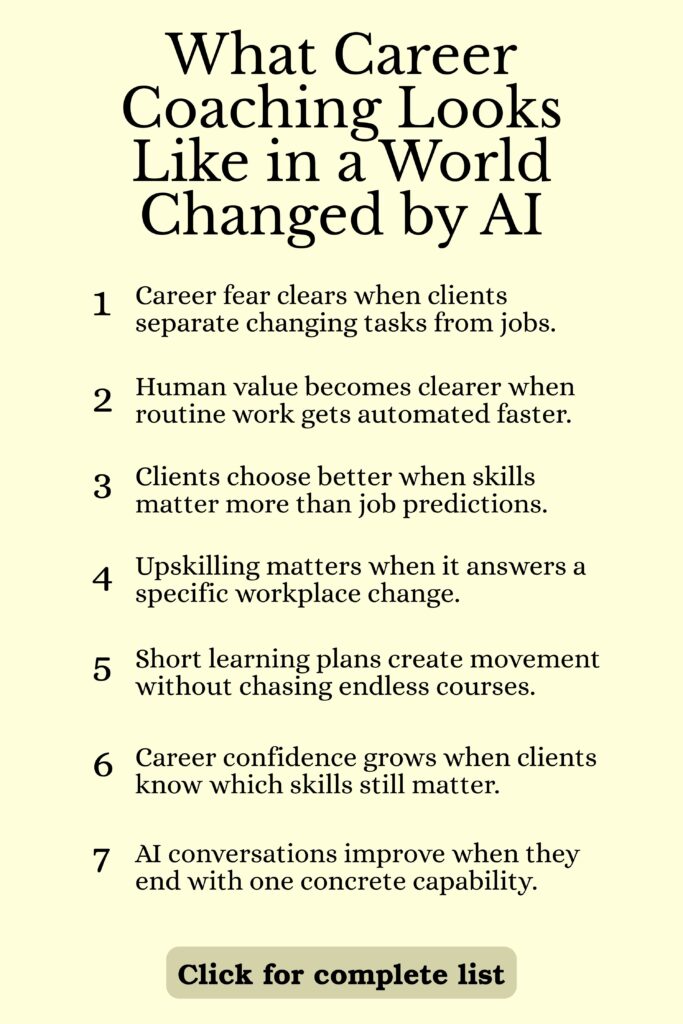
Your involvement should not end with your discussion starters. By staying engaged in discussions and responding to what your clients post, you will be leading them by example. By staying active in these discussions, you are showing your clients that you care about what they have to say, and this will make them more likely to speak up.
How Do Follow-Up Questions Turn Discussion Into Coaching?
Follow-up questions turn discussion into coaching by moving clients beyond their first explanation and helping them examine what sits underneath it.
A client might write, “I keep procrastinating because I’m bad at time management.” You could accept that answer and move on. Or you could investigate it.
Five types of follow-up questions are particularly useful:
- Clarify: “What does bad time management look like in this situation?”
- Evidence: “What makes you think time is the main problem?”
- Contrast: “When do you have the same amount of work but not procrastinate?”
- Consequence: “What happens when you keep waiting until the deadline is close?”
- Possibility: “What could you change the next time this situation appears?”
Notice what happens to the original statement. “I’m bad at time management” stops being the conclusion and becomes something to examine.
SEE ALSO: If you’re a coach looking to streamline your administrative tasks and save time, check out our Coaching Administration Software. It’s a simple, effective solution designed to help you focus less on paperwork and more on what matters—coaching your clients. From scheduling to client management, our software gives you the tools to run your business efficiently. Ready to reclaim your time and boost productivity? Click or tap here.
You also do not need to ask all five questions. One precise follow-up can be more useful than interrogating a client with a sequence of increasingly complicated prompts.
The goal is movement. Help the client get from a familiar explanation to something they can see, question, test, or change.
What Should You Do When Group Coaching Clients Don’t Participate?
If you have clients who are reluctant to say much about even your most titillating discussion topics, you need to draw them in. Be sure you comment directly on anything they say, no matter how brief, and ask them follow up questions. Praise them when they make a good point, and thank them for their thoughtfulness in their responses.
Does a Quiet Client Always Mean a Disengaged Client?
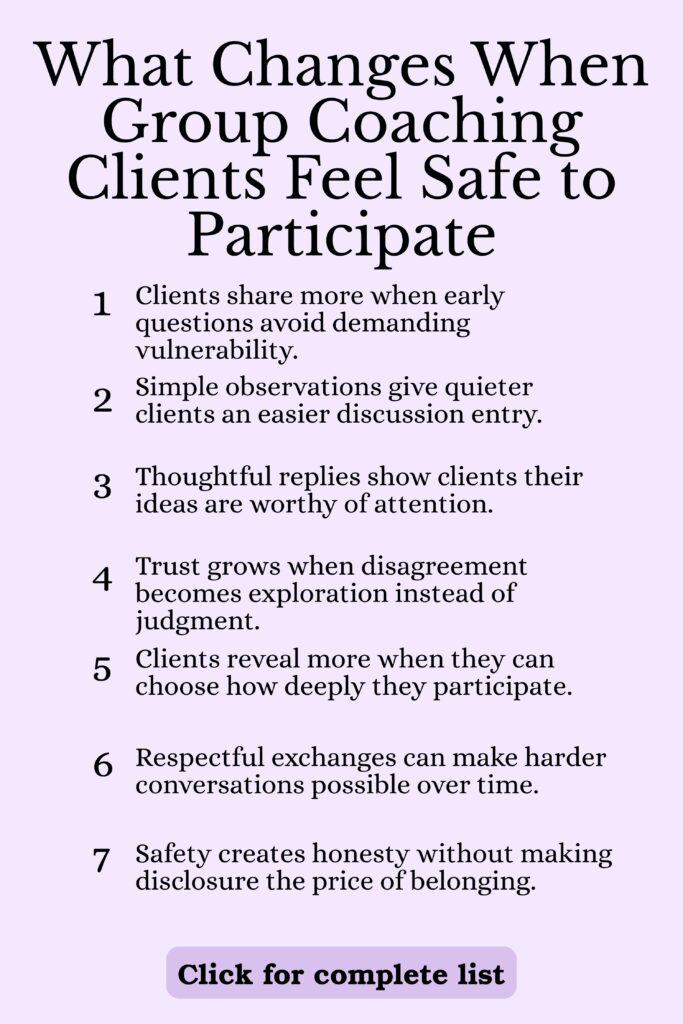
A quiet client is not automatically a disengaged client, so look at the client’s behavior across the coaching process before deciding what their silence means.
One client may read every discussion but prefer to think privately before speaking. Another may complete every worksheet and action item but rarely reply to peers. A third may have stopped participating everywhere.
Those are three different coaching situations.
SEE ALSO: If you’re a coach looking to streamline your administrative tasks and save time, check out our Coaching Administration Software. It’s a simple, effective solution designed to help you focus less on paperwork and more on what matters—coaching your clients. From scheduling to client management, our software gives you the tools to run your business efficiently. Ready to reclaim your time and boost productivity? Click or tap here.
Look for a pattern:
- Are they completing agreed actions?
- Are they attending sessions?
- Are they using assigned coaching materials?
- Has their participation changed from their normal pattern?
- Do they respond when you contact them directly?
- Is the silence limited to group discussion, or has engagement dropped more broadly?
If the client participates everywhere except the public discussion, pushing them to “speak up more” may solve a problem that does not exist. A private check-in may tell you whether they prefer observing, need more processing time, feel uncertain about the group, or simply have little to add to that particular topic.
If you use LCH Core, the Progress Stream and Engagement Report can help you look beyond one discussion thread and consider the client’s wider engagement. The point is not to turn coaching into surveillance. It is to avoid treating one visible behavior as the whole picture.
How Do You Turn a Good Discussion Into Coaching Action?
A useful coaching discussion should end with a decision, experiment, goal, or next action when the topic calls for behavior change.
That is the Apply stage of Prompt → Response → Probe → Apply.
Suppose a client realizes during a discussion that they postpone difficult conversations because they spend days trying to find the “perfect” wording. Insight matters, but the discussion becomes more useful when you ask:
SEE ALSO: If you’re a coach looking to streamline your administrative tasks and save time, check out our Coaching Administration Software. It’s a simple, effective solution designed to help you focus less on paperwork and more on what matters—coaching your clients. From scheduling to client management, our software gives you the tools to run your business efficiently. Ready to reclaim your time and boost productivity? Click or tap here.
“What conversation will you initiate this week, and what is the first sentence you are willing to use?”
Now the client has something observable to do.
Other application questions include:
- “What will you test before our next session?”
- “What will you stop doing because of what you noticed here?”
- “What is the smallest action that would give you new information?”
- “What will you do when this pattern appears again?”
- “What would we be able to observe next week if this change is working?”
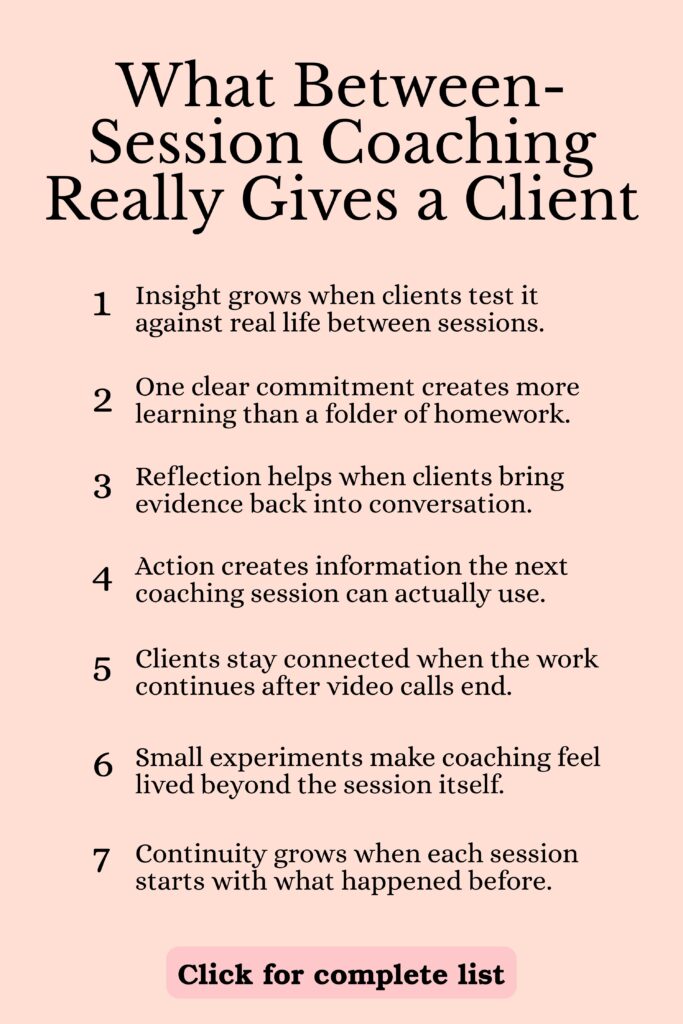
Not every discussion needs homework. Some conversations are valuable because clients understand an issue differently. But when a discussion uncovers a behavior the client wants to change, give that insight somewhere to go.
With LCH Core, coaches can carry that next step into the work between sessions using reusable and assignable journals, worksheets, goals, action items, and resources. That creates a simple bridge between what the client says in a conversation and what they actually practice afterward.
How Do You Know Whether Your Group Discussions Are Working?
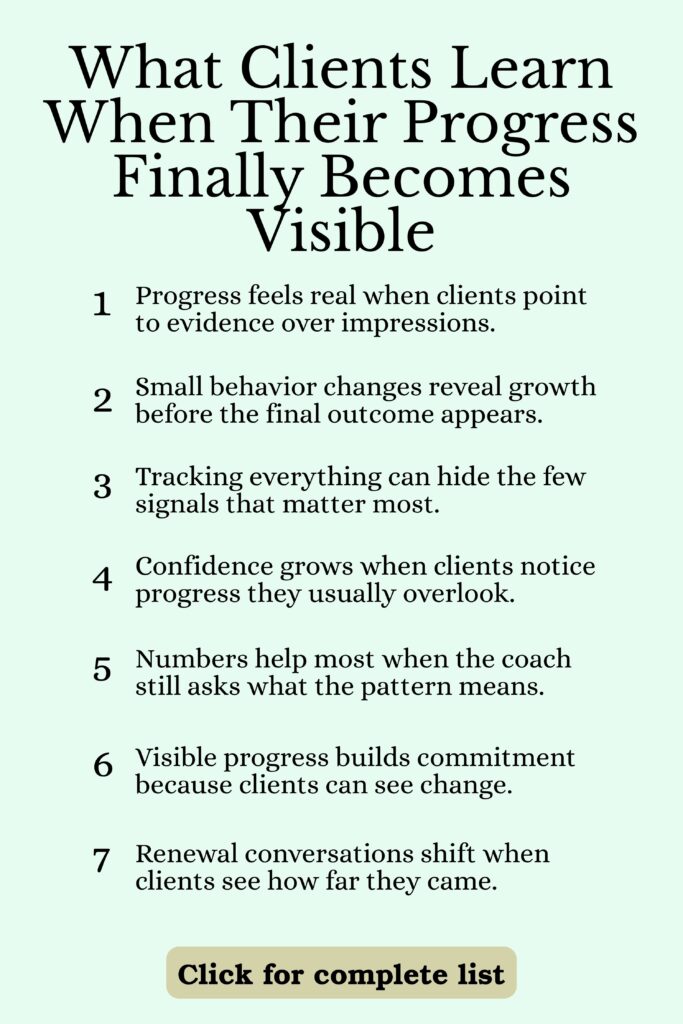
A useful group discussion creates evidence of thinking, interaction, and application, not simply a high comment count.
SEE ALSO: If you’re a coach looking to streamline your administrative tasks and save time, check out our Coaching Administration Software. It’s a simple, effective solution designed to help you focus less on paperwork and more on what matters—coaching your clients. From scheduling to client management, our software gives you the tools to run your business efficiently. Ready to reclaim your time and boost productivity? Click or tap here.
The Community of Inquiry framework developed by D. Randy Garrison, Terry Anderson, and Walter Archer offers a useful way to think about online interaction. It describes meaningful online learning through three connected elements: social presence, cognitive presence, and teaching presence.
For coaches, that distinction is useful because a busy discussion is not necessarily a productive one. Ten clients writing “Great point!” creates activity. It does not tell you whether anyone examined an assumption, learned from another client, or applied an idea.
Look at five things instead:
Participation breadth. Is discussion spread across the group, or carried by the same two or three people?
Response depth. Are clients explaining their thinking, giving examples, noticing patterns, or questioning assumptions?
Peer interaction. Are clients responding meaningfully to one another rather than communicating only with you?
SEE ALSO: If you’re a coach looking to streamline your administrative tasks and save time, check out our Coaching Administration Software. It’s a simple, effective solution designed to help you focus less on paperwork and more on what matters—coaching your clients. From scheduling to client management, our software gives you the tools to run your business efficiently. Ready to reclaim your time and boost productivity? Click or tap here.
Application. Are clients connecting the discussion to their own decisions, goals, or behavior?
Follow-through. Does anything change after the conversation?
Research reinforces the value of looking beyond simple participation. In a study of 2,159 online learners, Peter Shea and Temi Bidjerano found that learners’ reports of teaching and social presence could account for 70 percent of the variance in reported cognitive presence.
Group coaching is not the same as higher education, so that percentage should not be treated as a coaching benchmark. The useful lesson is narrower: the way you design and facilitate an online environment can matter substantially to the quality of thinking that happens inside it.
How Can You Improve Your Discussion Strategy Over Time?
These aren’t the only ways to start and foster online discussions. These discussions are beneficial for your clients in their development, and they can help you gauge their progress. As you get more comfortable with discussion starters and creating hot topics, you can start to develop your own techniques and strategies for better online discussions for your clients.
Where LCH Core Fits
LCH Core can support the work that happens around a group discussion by giving the insight, reflection, and follow-through a structured place to continue.
SEE ALSO: If you’re a coach looking to streamline your administrative tasks and save time, check out our Coaching Administration Software. It’s a simple, effective solution designed to help you focus less on paperwork and more on what matters—coaching your clients. From scheduling to client management, our software gives you the tools to run your business efficiently. Ready to reclaim your time and boost productivity? Click or tap here.
For example, a discussion might reveal that several clients understand a concept but struggle to apply it. You could follow that conversation with a reusable worksheet, schedule a journal prompt, or assign an action item that asks each client to test the idea in their own situation.
For longer-term changes, a goal can keep the bigger outcome visible while smaller action items capture what the client agrees to do next. Resources can give clients something specific to revisit instead of expecting them to remember everything that emerged in the discussion.
The Progress Stream and Engagement Report can then help you review engagement and progress beyond a single conversation. This is especially useful when a client appears quiet in one part of a program but is actively completing work elsewhere.
You can explore the broader LCH Core coaching software features if you want your discussions, client work, coaching tools, and progress tracking connected rather than scattered across separate systems.
FAQ
What are good discussion questions for group coaching?
Good group coaching discussion questions are specific enough to trigger reflection but open enough to produce different answers. Questions built around a real decision, recent experience, obstacle, comparison, or behavior usually give clients more to work with than broad questions about how they “feel” about a topic.
For example, replace “What stops you from reaching your goals?” with “Think of one goal you have repeatedly postponed. What do you usually do instead when it is time to work on it?”
SEE ALSO: If you’re a coach looking to streamline your administrative tasks and save time, check out our Coaching Administration Software. It’s a simple, effective solution designed to help you focus less on paperwork and more on what matters—coaching your clients. From scheduling to client management, our software gives you the tools to run your business efficiently. Ready to reclaim your time and boost productivity? Click or tap here.
How do you get quiet clients to participate in group coaching?
You can encourage quiet clients to participate by lowering the difficulty of the first contribution and giving them something specific to respond to. A concrete question about an observable situation is often easier to answer than a broad request for personal disclosure.
Do not assume silence means disengagement. Check whether the client is participating in other parts of the coaching process before deciding what intervention is needed.
How do you ask open-ended questions in coaching?
Ask open-ended coaching questions that require clients to describe, compare, interpret, evaluate, or decide rather than answer yes or no. The strongest questions usually focus attention on something specific enough to examine.
“What happened the last time you tried?” will often give you more usable information than “Do you struggle with this?”
How often should you post discussion prompts in an online coaching program?
Post discussion prompts when they serve the coaching objective rather than trying to hit an arbitrary frequency. One strong discussion connected to the week’s work can produce more useful coaching material than several prompts competing for attention.
A simple rhythm is to connect one main discussion to a module, session theme, or coaching objective, then deepen that conversation through follow-up questions instead of constantly starting new threads.
SEE ALSO: If you’re a coach looking to streamline your administrative tasks and save time, check out our Coaching Administration Software. It’s a simple, effective solution designed to help you focus less on paperwork and more on what matters—coaching your clients. From scheduling to client management, our software gives you the tools to run your business efficiently. Ready to reclaim your time and boost productivity? Click or tap here.
How do you keep an online group coaching discussion going?
Keep an online coaching discussion going by probing what clients have already said instead of continually introducing new topics. Ask for an example, question an assumption, invite a comparison, explore a consequence, or ask another client to contribute a different perspective.
A discussion develops when responses become material for the next question.
Should a coach respond to every client in a group discussion?
A coach does not need to give every client an equally long response in every discussion. Your job is to facilitate useful thinking and interaction, not become the only person everyone talks to.
Respond where you can clarify, deepen, connect ideas, correct a misunderstanding, or move the discussion forward. Also leave room for clients to respond meaningfully to each other.
How do you turn a group coaching discussion into accountability?
Turn a group coaching discussion into accountability by ending with a clear action, experiment, goal, or decision that can be revisited later. Ask the client what they will do, when they will do it, and what observable result will show whether the experiment helped.
If the discussion identifies a bigger goal, break it into a next action small enough to complete before the next relevant check-in.
SEE ALSO: If you’re a coach looking to streamline your administrative tasks and save time, check out our Coaching Administration Software. It’s a simple, effective solution designed to help you focus less on paperwork and more on what matters—coaching your clients. From scheduling to client management, our software gives you the tools to run your business efficiently. Ready to reclaim your time and boost productivity? Click or tap here.
Sources
Garrison, D. Randy, Terry Anderson, and Walter Archer. “Critical Inquiry in a Text-Based Environment: Computer Conferencing in Higher Education.” The Internet and Higher Education, vol. 2, nos. 2-3, 2000, pp. 87-105. Community of Inquiry, Athabasca University.
Shea, Peter, and Temi Bidjerano. “Community of Inquiry as a Theoretical Framework to Foster ‘Epistemic Engagement’ and ‘Cognitive Presence’ in Online Education.” Computers & Education, vol. 52, no. 3, Apr. 2009, pp. 543-553. ScienceDirect.

Read this next

What Smart Coaches Do Between Sessions to Keep Clients Moving
How assigning homework can help you develop a better relationship with your client
Read More
Most Coaches Skip This After a Session, and It Could Be Costing Them Their Best Insights
What if you could do one small thing once a week that could significantly improve your work?
Read More
Best Books for Life Coaches: 18 Books That Will Take your Coaching to the Next Level (2022)
Ramp up your coaching skills to expert status with these 18 books every coach needs in their library
Read More