








Career Change Checklist: 11 Low-Risk Steps to Leave Your Job Without Burning Bridges

Want to try this at home? No worries! Download a copy of our Career Change Exit Checklist.
*****
Wanting to leave your job can feel exciting, scary, and strangely urgent all at once. One bad meeting, one more unreasonable deadline, or one more Sunday night filled with dread can make resignation feel like the only way to breathe again.
But a career change does not have to begin with a dramatic exit. In fact, the safest career changes often start quietly. You test the idea, check your money, refresh your network, and build enough evidence that your next move is not just a reaction to a hard season.
That does not mean you should ignore the signs that it is time to move on. If your current job is draining you, limiting your growth, or keeping you from the work you actually want to do, it makes sense to start planning. The goal is not to stay stuck. The goal is to leave with options.
A low-risk career change plan helps you answer the questions that are easy to avoid when emotions are high:
- Can I afford to leave?
- Do I know what I want next?
- Have I tested the new direction?
- Is my resume ready?
- Have I rebuilt my network?
- Can I resign without damaging useful relationships?
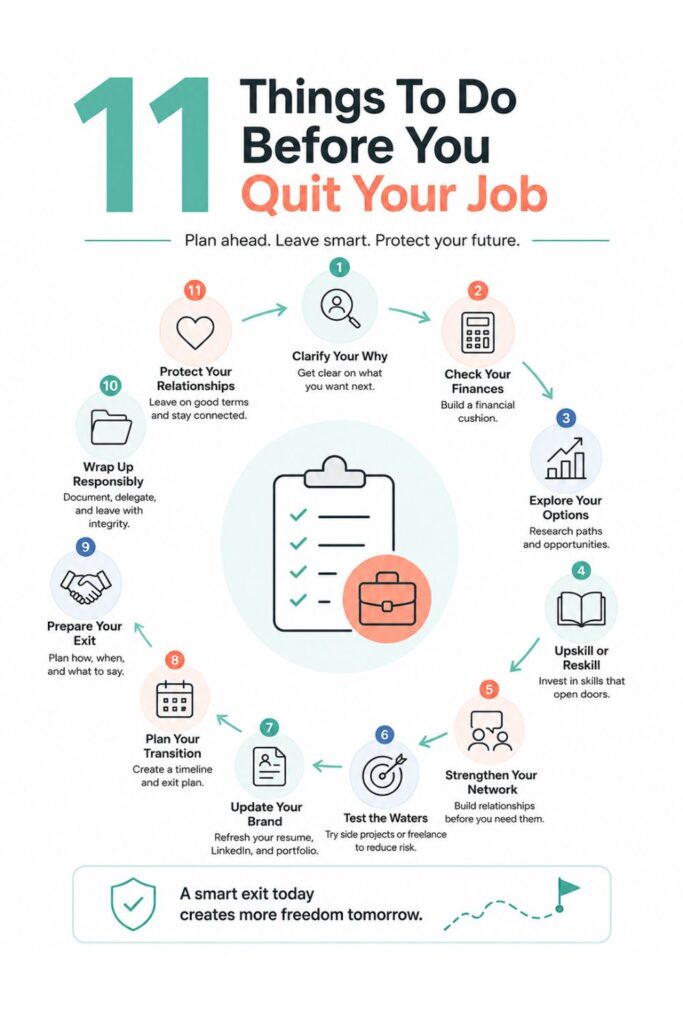
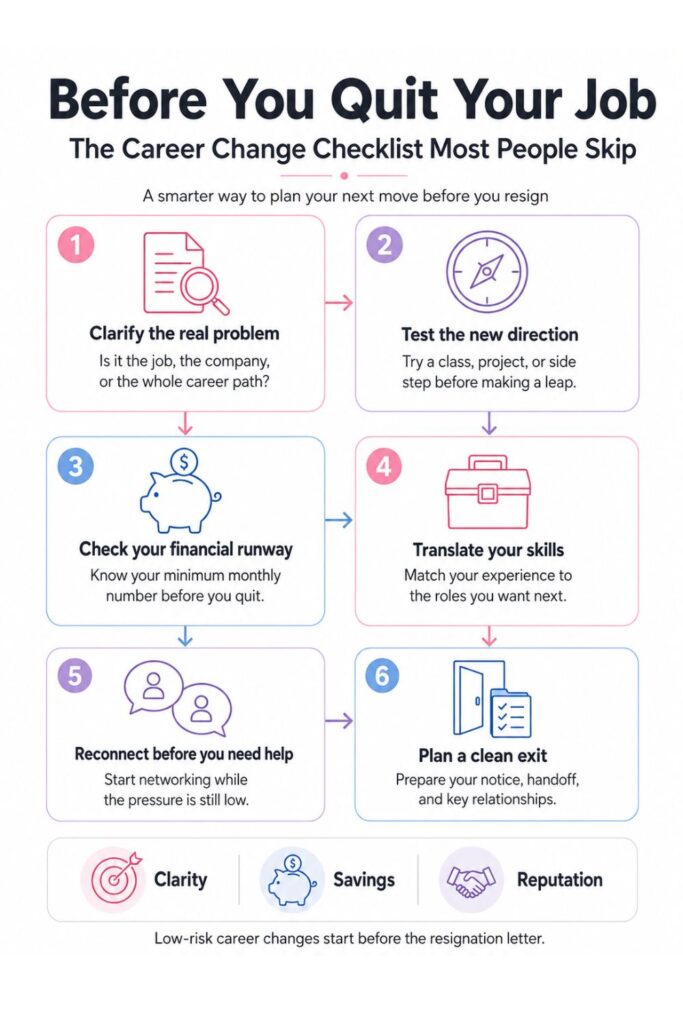
This checklist gives you 11 practical steps to take before you quit. Each one helps you lower the risk, protect your reputation, and make a cleaner decision.
You do not need to complete everything perfectly before moving forward. You just need enough clarity to know whether you are making a thoughtful move or an impulsive escape.
If you want to get more from your life, and are looking for concrete action steps to get you there, check out our Request a Coach page. It’s a “cut the fence-sitting and take action” way to tackle your issues and actually find success. To get off the fence and start to take action, click or tap here.
Think of this as your bridge between “I can’t keep doing this” and “I know what I’m doing next.”
Need some career guidance? Drop on by our directories choc full of career coaches to bring your career to the next level. Or click here to have us match you to the best.
1. Define What You Are Actually Leaving
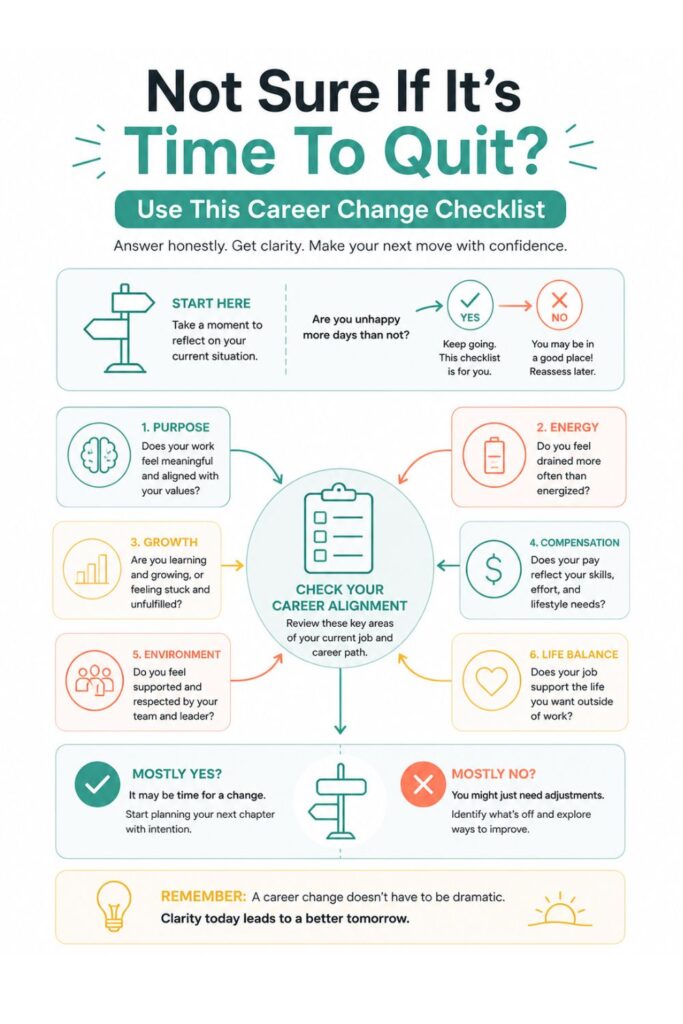
Name the real problem: Write down whether you are leaving the job, the company, the industry, the workload, the manager, the pay ceiling, or the version of yourself you have outgrown.
Before you make any major career move, get specific about what is actually not working. Many people say, “I need a career change,” when what they really need is a new manager, a better company, a healthier workload, or a role with more flexibility.
Other times, the problem really is the career path itself. You may have climbed a ladder you no longer care about. You may be good at your job but feel no interest in getting better at it. You may realize that the next promotion would only give you more of the work you already want to leave behind.
This distinction matters because it changes the size of the move you need to make.
A job change is different from a company change. A company change is different from an industry change. A true career change usually asks you to rethink your skills, story, finances, timeline, and identity.
Separate frustration from direction: List what you do not want anymore, then translate each item into what you want instead so your next move is not just an escape route.
If you want to get more from your life, and are looking for concrete action steps to get you there, check out our Request a Coach page. It’s a “cut the fence-sitting and take action” way to tackle your issues and actually find success. To get off the fence and start to take action, click or tap here.
Start by writing one honest sentence: “I want to leave because…”
Then keep going. Do not edit yourself too much at first. Write down the frustrations, the boring parts, the unfair parts, and the parts that make you feel like you are shrinking.
After that, sort your answers into clearer categories:
- Problems with the specific company
- Problems with the role
- Problems with the industry
- Problems with the schedule or lifestyle
- Problems with growth, meaning, pay, or values
Then create a second list called “What I want instead.”
For example, “I hate being in meetings all day” might become “I want more independent work time.” “I’m tired of client emergencies” might become “I want a role with more predictable demands.”
This turns your frustration into useful career data.
2. Test Your Career Change Idea Before You Announce It
Run a small experiment: Choose one low-pressure way to test the new direction before making a public or financial commitment.
It is easy to romanticize a new career from the outside. When you are exhausted by your current job, almost anything different can look better. That is why testing your idea matters so much.
If you want to get more from your life, and are looking for concrete action steps to get you there, check out our Request a Coach page. It’s a “cut the fence-sitting and take action” way to tackle your issues and actually find success. To get off the fence and start to take action, click or tap here.
A career change should not only sound good in your imagination. It should still interest you after you see the ordinary parts, the boring parts, the difficult parts, and the learning curve.
You do not need to quit your job to test a new direction. In most cases, it is smarter not to. You can gather real-world evidence while you still have income, benefits, and time to adjust your plan.
The goal is to move from “I think I want this” to “I have tested this enough to understand what I’m choosing.”
Look for real evidence: Pay attention to what energizes you, what feels harder than expected, and whether you still want the path after seeing the less glamorous parts.
Pick one small test that matches the career you are considering. Keep it simple enough that you can actually complete it.
You might:
- Take a short course or workshop
- Do a sample project
- Shadow someone in the field
- Volunteer for related work
- Freelance lightly
- Ask for an informational interview
- Read job descriptions for 10 target roles
- Join a professional community
- Watch day-in-the-life videos from people in the role
As you test, notice your reaction. Do you feel curious? Drained? Excited? Intimidated but interested? Bored once the fantasy wears off?
Also look at the practical side. What skills show up again and again? What tools do people use? What entry-level roles are realistic? What does the pay range look like? What experience gaps would you need to close?
If you want to get more from your life, and are looking for concrete action steps to get you there, check out our Request a Coach page. It’s a “cut the fence-sitting and take action” way to tackle your issues and actually find success. To get off the fence and start to take action, click or tap here.
A strong test does not have to prove that the new path is perfect. It just needs to give you better information.
At the end, ask yourself: “Would I still want this if it took 12 months to transition?”
That question can reveal whether you are chasing a real direction or just looking for the nearest exit.
3. Build a Personal Runway Number
Calculate your minimum cushion: Figure out how much money you need to cover essentials if your transition takes longer than expected.
Money is one of the biggest reasons career changes become stressful. Even when the emotional decision is clear, the financial reality can make everything feel heavier.
That does not mean you need to be wealthy before you leave. It means you need to know your numbers. A clear number is much less scary than a vague fear that you “probably can’t afford it.”
Your runway number is the amount of money that helps you make decisions without panicking. It gives you room to apply for better roles instead of grabbing the first thing available. It helps you avoid turning a career change into a financial emergency.
Start by calculating your true monthly essentials. Do not use your ideal budget. Use the amount you actually need to stay housed, fed, insured, connected, and stable.
If you want to get more from your life, and are looking for concrete action steps to get you there, check out our Request a Coach page. It’s a “cut the fence-sitting and take action” way to tackle your issues and actually find success. To get off the fence and start to take action, click or tap here.
Choose your risk level: Decide whether you need a full emergency fund, a partial runway, a bridge job, or a slower transition while still employed.
Make a list of your monthly essentials, including:
- Rent or mortgage
- Utilities
- Groceries
- Transportation
- Insurance
- Debt payments
- Childcare or family responsibilities
- Phone and internet
- Medical costs
- Minimum savings or emergency needs
Then add career change costs. These might include courses, certifications, resume help, coaching, networking events, equipment, software, portfolio tools, or unpaid time for interviews.
Now choose your comfort level. Some people need 6 months of expenses saved before resigning. Others can manage with 3 months, especially if they are moving into a strong job market or have another income source at home.
You can also create two numbers:
- Quit number: The savings amount that would make resignation feel responsible.
- Do not quit yet number: The point where leaving would create too much pressure.
If your current number is not where you want it to be, that is not failure. It is information.
You might decide to stay employed for 90 more days, reduce expenses, sell unused items, take on a temporary side project, or apply before quitting.
A runway number gives your career change a stronger foundation. It lets you move with courage and common sense at the same time.
If you want to get more from your life, and are looking for concrete action steps to get you there, check out our Request a Coach page. It’s a “cut the fence-sitting and take action” way to tackle your issues and actually find success. To get off the fence and start to take action, click or tap here.
4. Audit Your Transferable Skills
Translate your experience: Turn your current responsibilities into skills that make sense in the new field.
One of the biggest fears in a career change is feeling like you are starting from zero. Most of the time, you are not. You may be starting in a new direction, but you are bringing years of experience, judgment, communication, problem-solving, and work habits with you.
The problem is that your old job title may not clearly explain your value in the new field. That is why you need to translate your experience.
Transferable skills are the skills that can move with you. They are not always obvious until you pull them out of the context of your current role.
For example, managing difficult clients may translate into stakeholder communication. Coordinating deadlines may translate into project management. Training new employees may translate into onboarding, facilitation, or learning and development.
Match skills to real roles: Compare your experience against actual job listings so your career change story sounds grounded, not vague.
Start with your current and past roles. List what you actually do, not just what your job description says.
Include things like:
If you want to get more from your life, and are looking for concrete action steps to get you there, check out our Request a Coach page. It’s a “cut the fence-sitting and take action” way to tackle your issues and actually find success. To get off the fence and start to take action, click or tap here.
- Projects you managed
- Problems you solved
- Systems you improved
- People you supported
- Results you helped create
- Tools you used
- Decisions you made
- Processes you documented
- Customers, clients, or teams you worked with
Then translate each task into a broader skill.
For example:
- “Handled customer complaints” becomes “conflict resolution and client communication.”
- “Tracked monthly reports” becomes “data organization and performance reporting.”
- “Helped the team stay on schedule” becomes “project coordination.”
- “Explained processes to new hires” becomes “training and knowledge transfer.”
Next, pull 5 to 10 job descriptions for roles you might want. Highlight repeated words, skills, tools, and responsibilities.
Create three lists:
- Skills I already have
- Skills I can prove with examples
- Skills I still need to build
This gives you a much clearer picture of your readiness. It also helps you write a stronger resume, prepare for interviews, and explain your career change without sounding apologetic.
You are not asking someone to take a random chance on you. You are showing them how your past experience connects to their current need.
5. Quietly Refresh Your Resume and LinkedIn
Position yourself for the next chapter: Update your materials so they point toward your future role, not only your past job title.
Your resume and LinkedIn should not read like a museum of everything you have ever done. They should help people understand where you are going next.
If you want to get more from your life, and are looking for concrete action steps to get you there, check out our Request a Coach page. It’s a “cut the fence-sitting and take action” way to tackle your issues and actually find success. To get off the fence and start to take action, click or tap here.
This is especially important during a career change. If your materials only describe your old path, recruiters and hiring managers may keep seeing you as a fit for the work you are trying to leave.
You do not need to lie, exaggerate, or pretend you have experience you do not have. You simply need to frame your real experience in a way that connects to your target direction.
That means emphasizing transferable skills, relevant projects, measurable results, and language that matches the roles you want next.
Keep it discreet but ready: Make changes that prepare you for opportunities without loudly signaling to your workplace that you are leaving.
Start with your resume. Create a career-change version that is tailored to your new direction.
Update:
- Your summary
- Your key skills section
- Your recent achievements
- Your project examples
- Your job titles and descriptions
- Your education, training, or certifications
- Any volunteer, freelance, or portfolio work related to the new field
Focus on results where possible. Instead of saying you “helped with scheduling,” say you “coordinated weekly schedules for a 12-person team and reduced missed handoffs.” Specifics make your experience easier to trust.
Then review your LinkedIn profile. You may not want to make dramatic public changes if you are keeping your search quiet. That is fine.
If you want to get more from your life, and are looking for concrete action steps to get you there, check out our Request a Coach page. It’s a “cut the fence-sitting and take action” way to tackle your issues and actually find success. To get off the fence and start to take action, click or tap here.
You can still refresh your profile in subtle ways:
- Add skills related to your target role.
- Rewrite your About section to sound broader.
- Update old accomplishments.
- Follow companies or creators in your target field.
- Comment thoughtfully on industry posts.
- Save job searches privately.
- Connect with people in the new area.
Be careful with public “open to work” settings if your current employer might see them. You can use recruiter-only visibility, but even that is not always a perfect privacy guarantee.
Your goal is to be ready before the opportunity appears. When someone says, “Send me your resume,” you do not want to spend the next 48 hours panicking. You want to already have something strong enough to send.
6. Start Networking Before You Need a Favor
Reconnect while it is low-pressure: Reach out before you are desperate, so conversations feel natural instead of urgent.
Networking can feel awkward when you only do it after you need something. That is why the best time to start is before you are actively begging for leads, referrals, or introductions.
A quiet career change needs relationships. Not fake relationships. Not spammy messages. Real conversations with people who can help you understand the field, spot opportunities, and see yourself more clearly.
Many job opportunities are shaped by informal conversations long before a job post appears. Someone mentions a team is growing. Someone knows a manager who likes career changers. Someone tells you which certifications matter and which ones are a waste of money.
Those insights can save you months.
If you want to get more from your life, and are looking for concrete action steps to get you there, check out our Request a Coach page. It’s a “cut the fence-sitting and take action” way to tackle your issues and actually find success. To get off the fence and start to take action, click or tap here.
Ask for insight, not a job: Use informational chats to understand the field, refine your direction, and spot opportunities early.
Start by making a list of people you already know. Include past coworkers, classmates, former managers, clients, vendors, alumni, friends, neighbors, and people you have met at events.
Then add weak ties. These are people who know you a little but are not close friends. Weak ties can be surprisingly helpful because they often sit outside your usual circle.
Reach out with a simple message:
“I’m exploring a possible shift into [field or role] and remembered you have experience around this area. Would you be open to a quick chat? I’d love to ask a few questions and learn what the work is really like.”
Keep it short. Do not send your life story in the first message.
Before each chat, prepare a few questions:
- What does a normal week look like in this role?
- What skills matter most?
- What do people misunderstand about this field?
- What would you do first if you were starting now?
- Are there roles that suit people coming from my background?
- Is there anyone else you think I should talk to?
Afterward, send a thank-you note. Mention one specific thing they shared so it feels personal.
If you want to get more from your life, and are looking for concrete action steps to get you there, check out our Request a Coach page. It’s a “cut the fence-sitting and take action” way to tackle your issues and actually find success. To get off the fence and start to take action, click or tap here.
Track your conversations in a simple spreadsheet or notes app. Include names, dates, advice, possible referrals, and follow-up steps.
Networking is not about using people. It is about building a wider map before you make a big move.
7. Create a Bridge-Building Exit Timeline
Choose a realistic resignation window: Work backward from your finances, job search progress, notice period, and current responsibilities.
Resigning well is not only about what you say. It is also about when you say it.
Of course, not every situation gives you perfect timing. Sometimes a workplace is unhealthy. Sometimes an opportunity appears suddenly. Sometimes you have to move faster than planned.
But when you do have some control, timing can protect your reputation and reduce unnecessary conflict. A thoughtful exit timeline helps you leave without creating chaos for yourself or your team.
Start by choosing a possible resignation window, not a final date. This gives you flexibility while still creating structure.
Your window should consider your money, job search progress, emotional bandwidth, current projects, and any formal notice expectations.
If you want to get more from your life, and are looking for concrete action steps to get you there, check out our Request a Coach page. It’s a “cut the fence-sitting and take action” way to tackle your issues and actually find success. To get off the fence and start to take action, click or tap here.
Protect your reputation: Plan your timing so you do not leave during a critical handoff, messy project deadline, or preventable workplace crisis if you can avoid it.
Look at the next 1 to 6 months and map out what is happening at work.
Consider:
- Major deadlines
- Product launches
- Busy seasons
- Client renewals
- Team changes
- Performance reviews
- Bonus dates
- Vacation plans
- Contract obligations
- Training responsibilities
- Projects where you hold key knowledge
Then ask yourself what you can responsibly finish before leaving. You do not need to sacrifice your whole life for the company. But you also do not want to leave in a way that makes people remember you as careless.
Create three possible dates:
- Earliest reasonable resignation date
- Ideal resignation date
- Latest date you are willing to stay
This helps you avoid resigning impulsively after a bad day. It also keeps you from endlessly delaying because things are “not quite settled.”
Check your employee handbook, contract, or local norms around notice periods. Two weeks may be common in some places, but senior roles, project-heavy roles, or client-facing roles may require more planning.
A bridge-building exit timeline lets you leave with a steadier tone. You are not storming out. You are making a decision, preparing your handoff, and moving into your next chapter with intention.
If you want to get more from your life, and are looking for concrete action steps to get you there, check out our Request a Coach page. It’s a “cut the fence-sitting and take action” way to tackle your issues and actually find success. To get off the fence and start to take action, click or tap here.
That kind of exit is much easier to stand behind later.
8. Prepare Your Resignation Message Before Emotions Take Over
Write the clean version first: Draft a short, respectful resignation message before you are upset, exhausted, or tempted to overexplain.
A resignation conversation can bring up a lot of emotion. Even when you are ready to leave, you may feel guilty, nervous, relieved, defensive, or unexpectedly sad.
That is why you should prepare your message before the moment arrives.
The goal is not to script yourself into sounding robotic. The goal is to keep the conversation clear, respectful, and calm. When you know what you plan to say, you are less likely to ramble, apologize too much, complain, or get pulled into a debate.
A strong resignation message does three things. It states your decision, gives your final date, and offers reasonable support during the transition.
It does not need to explain every frustration that led you here.
Keep the focus forward: Thank the company, state your final date, and offer to support the transition without turning the resignation into a long debate.
If you want to get more from your life, and are looking for concrete action steps to get you there, check out our Request a Coach page. It’s a “cut the fence-sitting and take action” way to tackle your issues and actually find success. To get off the fence and start to take action, click or tap here.
Draft both an email and a verbal version.
Your verbal version might sound like:
“I wanted to let you know that I’ve made the decision to resign from my role. My final day will be [date]. I’m grateful for the experience I’ve gained here, and I’ll do what I can to help with a smooth transition.”
That is enough.
Your written version can be similarly brief:
“Thank you for the opportunity to be part of the team. I’m writing to formally resign from my position, with my final working day being [date]. I appreciate what I’ve learned here and will support the transition during my notice period.”
You can personalize it, but keep it clean.
Before the conversation, decide how you will respond to common questions:
If you want to get more from your life, and are looking for concrete action steps to get you there, check out our Request a Coach page. It’s a “cut the fence-sitting and take action” way to tackle your issues and actually find success. To get off the fence and start to take action, click or tap here.
- Where are you going?
- Why are you leaving?
- Is there anything we can do to make you stay?
- Are you unhappy here?
- Can you stay longer?
- Can we announce this today?
If you are offered a counteroffer, pause before answering. A counteroffer can feel flattering, but it does not always solve the deeper reason you wanted to leave.
You do not need to share more than you are comfortable sharing. A simple answer like, “I’ve thought carefully about this, and I feel this is the right next step for me,” can protect your boundaries.
A prepared message helps you leave with dignity, not damage.
9. Plan the Handoff Like Someone People Would Rehire
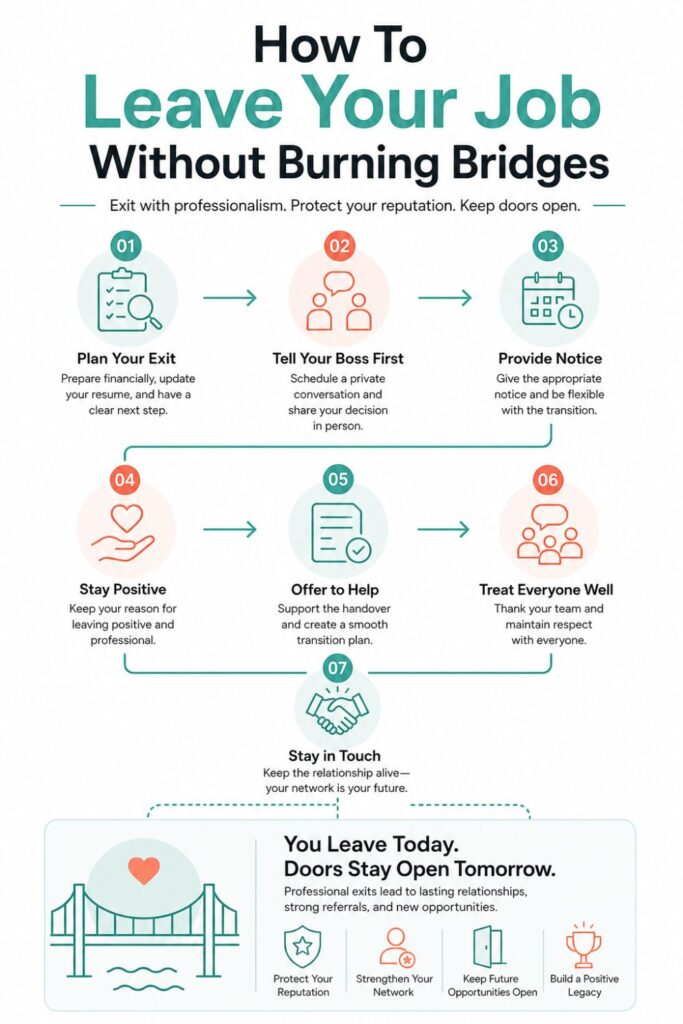
Document what only you know: Make your work easier to transfer so your exit feels organized instead of disruptive.
A good handoff is one of the most practical ways to leave without burning bridges. People may be sad, annoyed, or surprised that you are leaving, but they will usually remember whether you made the transition harder or easier.
You do not need to overfunction. You do not need to do three months of work in two weeks. You do not need to accept every last-minute request.
But you can leave useful notes, organize key information, and make it easier for the next person to pick up where you left off.
That kind of professionalism protects your reputation. It also makes it easier to ask for references, reconnect later, or even return to the company someday under better circumstances.
If you want to get more from your life, and are looking for concrete action steps to get you there, check out our Request a Coach page. It’s a “cut the fence-sitting and take action” way to tackle your issues and actually find success. To get off the fence and start to take action, click or tap here.
Leave useful breadcrumbs: Create notes, files, contacts, timelines, and next steps that help the next person succeed.
Start by listing everything you currently own or support. Include recurring tasks, active projects, key contacts, regular meetings, systems, reports, passwords or access needs, deadlines, and known issues.
Then create a simple transition document.
You might include:
- Project name
- Current status
- Next step
- Deadline
- Key contacts
- Important links
- Files or folders
- Risks or blockers
- Notes for the next owner
- Meetings that should continue
- Tasks that can be paused or reassigned
Keep it practical. The goal is not to write a novel. The goal is to reduce confusion.
For recurring tasks, include basic instructions. For example, where reports live, when they are due, who reviews them, and what common mistakes to avoid.
If your manager asks you to train someone, do what is reasonable within your notice period. You can be helpful without becoming responsible for everything after you leave.
It is also smart to clean up your files. Name documents clearly. Move important items to shared folders. Remove personal files from work devices. Save non-confidential examples of your work for your own portfolio if allowed.
If you want to get more from your life, and are looking for concrete action steps to get you there, check out our Request a Coach page. It’s a “cut the fence-sitting and take action” way to tackle your issues and actually find success. To get off the fence and start to take action, click or tap here.
A strong handoff sends a quiet message: “I am leaving, but I respect the work and the people enough to close this properly.”
That matters.
10. Protect Your References and Relationships
Identify your strongest allies: Decide who you want to keep in touch with and who may be willing to provide a reference later.
Your job may be ending, but your relationships do not have to end with it. In many career changes, former coworkers, managers, clients, and mentors become part of your future network.
They may refer you, recommend you, hire you, collaborate with you, or introduce you to someone helpful later. But those relationships are easier to preserve when you are intentional before you leave.
Do not wait until your final hour to think about this. Once your resignation is public, things can move quickly. You may have handoff tasks, exit paperwork, emotional conversations, and sudden calendar changes.
Make a list early.
Close the loop gracefully: Thank people individually, share appreciation, and make it easy for them to remember your work positively.
If you want to get more from your life, and are looking for concrete action steps to get you there, check out our Request a Coach page. It’s a “cut the fence-sitting and take action” way to tackle your issues and actually find success. To get off the fence and start to take action, click or tap here.
Write down the people you want to stay connected with. This might include:
- Direct managers
- Senior leaders who supported you
- Coworkers you enjoyed working with
- Team members you mentored
- Clients or partners
- People from cross-functional projects
- Former colleagues already outside the company
For each person, decide what kind of goodbye makes sense. Some people deserve a personal note. Others may only need a friendly LinkedIn connection.
A simple message can go a long way:
“I really appreciated working with you, especially on [specific project]. I learned a lot from the way you approached [specific thing], and I’d love to stay connected.”
Specific appreciation feels more genuine than a generic goodbye.
If you had a strong working relationship with someone, consider asking for a LinkedIn recommendation while your work is still fresh in their mind. You can make it easier by saying what you would love them to highlight, such as project leadership, communication, reliability, or client work.
Also make sure you have personal contact details for people you truly want to keep in touch with. Work email access may disappear quickly after your final day.
Most importantly, avoid exit drama. Do not turn your final days into a complaint tour. Even if your reasons for leaving are valid, gossip can travel faster than your actual work.
If you want to get more from your life, and are looking for concrete action steps to get you there, check out our Request a Coach page. It’s a “cut the fence-sitting and take action” way to tackle your issues and actually find success. To get off the fence and start to take action, click or tap here.
Leave people with a clear memory of your professionalism. That memory can help you long after this job is behind you.
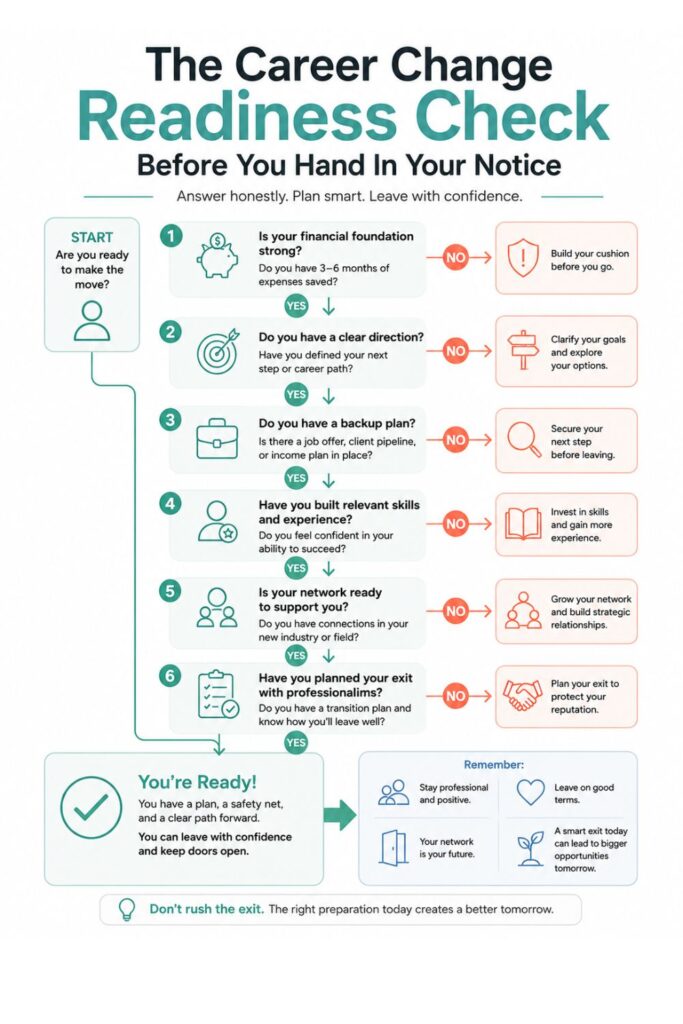
11. Decide What Must Be True Before You Resign
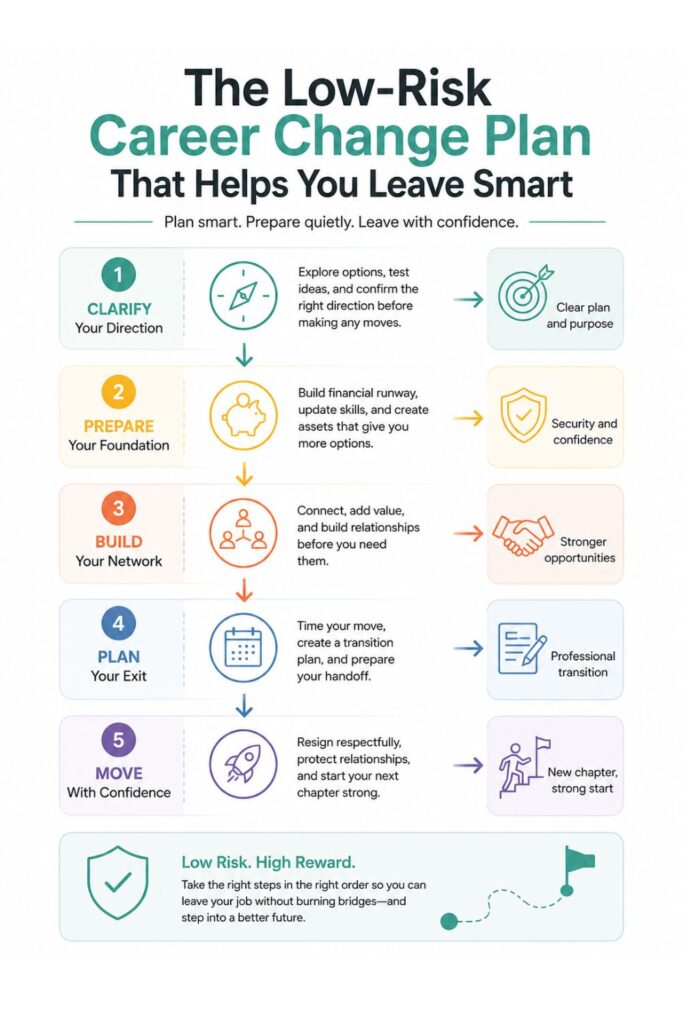
Create your final readiness checklist: Turn your fears and unknowns into concrete conditions you can check off.
At some point, planning has to become a decision. You cannot research forever, network forever, or keep telling yourself you will leave “when it feels right.”
For most people, it never feels completely risk-free. A career change usually includes some uncertainty. The goal is not to remove every possible fear. The goal is to know which fears are manageable and which ones are warning signs that you need more preparation.
That is where your final readiness checklist comes in.
Instead of asking, “Am I scared?” ask a better question: “What must be true for me to leave responsibly?”
Fear can stay vague for years. A checklist makes it visible.
Use the checklist to make a decision: Instead of asking “Am I scared?” ask “Do I have enough evidence, support, money, and next steps to leave responsibly?”
If you want to get more from your life, and are looking for concrete action steps to get you there, check out our Request a Coach page. It’s a “cut the fence-sitting and take action” way to tackle your issues and actually find success. To get off the fence and start to take action, click or tap here.
Create your own resignation criteria. Do not copy someone else’s risk tolerance. Your responsibilities, savings, family situation, health needs, job market, and personality all matter.
Your checklist might include:
- I know why I am leaving.
- I have tested my new direction.
- I understand my monthly expenses.
- I have a runway number.
- I have updated my resume.
- I have refreshed my LinkedIn.
- I have had at least 3 networking conversations.
- I know my target roles or next-step options.
- I understand my notice period.
- I have a basic handoff plan.
- I know what I will say when I resign.
- I have thought through references.
- I have a plan if the transition takes longer than expected.
Mark each item as:
- Ready
- Almost ready
- Not ready
Then look at the pattern. If most items are ready or almost ready, you may be closer than you think. If too many are not ready, choose the top 3 gaps and work on those first.
Set a review date, such as 30 days from now. This prevents “not yet” from turning into an endless waiting room.
A readiness checklist gives you something steadier than emotion. It helps you make a brave decision with your eyes open.
What to Do If You Are Not Ready to Leave Yet
Build a lower-risk transition plan: If the checklist shows you are not ready, use that information as guidance, not proof that you are stuck.
Realizing you are not ready to quit can feel disappointing. You may have wanted the checklist to give you instant permission to leave. Instead, it might show you that your money is not quite there, your next direction is still vague, or your resume is not ready for the roles you want.
If you want to get more from your life, and are looking for concrete action steps to get you there, check out our Request a Coach page. It’s a “cut the fence-sitting and take action” way to tackle your issues and actually find success. To get off the fence and start to take action, click or tap here.
That does not mean you failed. It means you found the weak spots before they turned into bigger problems.
Staying for now can be strategic. You can use your current job as a funding source, a skill-building platform, or a temporary base while you prepare your next move.
The key is to stop treating staying as passive. If you are staying, stay with a plan.
Make staying temporary and strategic: Treat your current job as a funding source, skill-building space, or transition platform while you prepare your next move.
Start by choosing the 1 to 3 biggest gaps from your checklist. Do not try to fix everything at once.
For example, your next month might focus on:
- Saving a specific amount of money
- Updating your resume
- Booking 3 networking calls
- Taking one short course
- Applying to 5 roles
- Building one portfolio sample
- Talking to someone in your target field
- Reducing expenses
- Asking for a project that builds transferable skills
Give yourself a timeline. “I’ll stay until I’m ready” is too vague. “I’ll use the next 60 days to build my runway and complete my resume” is much more useful.
You can also look for ways to make your current job more manageable while you prepare. That might mean setting better boundaries, using PTO, asking for clearer priorities, reducing unnecessary overtime, or stopping yourself from volunteering for extra tasks that do not serve your future.
If you want to get more from your life, and are looking for concrete action steps to get you there, check out our Request a Coach page. It’s a “cut the fence-sitting and take action” way to tackle your issues and actually find success. To get off the fence and start to take action, click or tap here.
If your workplace is truly harming your health or safety, your plan may need to move faster and include outside support. But if the issue is readiness, not immediate harm, a short strategic stay can be powerful.
You are not giving up on your career change. You are giving it a stronger launchpad.
How a Career Coach Can Help You Make the Move More Safely
Clarify the decision: A career coach can help you separate burnout, boredom, fear, and genuine career misalignment so you are not making the move from panic.
A career change can get messy in your own head. One day you feel certain. The next day you wonder if you are being irresponsible. Then you see someone else announce a new job online and suddenly feel behind.
That mental back-and-forth can make it hard to take practical action. A career coach can help you slow the decision down enough to understand what is really happening.
Sometimes the issue is burnout. Sometimes it is poor boundaries. Sometimes it is a bad company fit. Sometimes it is a real desire to move into a different field. A coach can help you sort through those possibilities without automatically pushing you to quit or stay.
The best coaching support is not about giving you a fantasy version of your future. It is about helping you make a clearer, more grounded plan.
Turn the transition into a plan: A coach can help you map options, test ideas, practice your career-change story, prepare for interviews, and create accountability around the steps you keep postponing.
If you want to get more from your life, and are looking for concrete action steps to get you there, check out our Request a Coach page. It’s a “cut the fence-sitting and take action” way to tackle your issues and actually find success. To get off the fence and start to take action, click or tap here.
A coach may help you:
- Identify what you want your next role to give you
- Understand why your current path no longer fits
- Name your strengths and transferable skills
- Build a realistic transition timeline
- Work through fear of starting over
- Practice explaining your career change
- Prepare for networking conversations
- Improve your resume and LinkedIn direction
- Stay accountable to weekly action steps
- Decide when you are ready to resign
This can be especially helpful if you keep cycling between overthinking and avoidance. A coach can help you turn vague worries into decisions and actions.
For example, instead of saying, “I don’t know what I want,” you might work through values, energy patterns, past wins, role options, and small experiments. Instead of saying, “I’m scared to network,” you might create a script and practice sending low-pressure messages.
A coach does not remove the risk from a career change. But the right coach can help you see the risk more clearly, prepare more carefully, and stop making the decision alone in your own head.
That kind of support can make the move feel less chaotic and more deliberate.
The Smartest Exit Is the One You Can Stand Behind

Leaving a job does not have to mean slamming a door behind you. It also does not have to mean staying until you are completely drained.
The strongest exit is usually somewhere in the middle. You tell yourself the truth, prepare what you can, protect your relationships, and make the move when you have enough evidence to trust your decision.
A career change is a big step, but it does not have to be reckless. You can test the direction first. You can calculate your money. You can refresh your resume before you need it. You can rebuild your network before you ask for help. You can plan your resignation before emotions take over.
If you want to get more from your life, and are looking for concrete action steps to get you there, check out our Request a Coach page. It’s a “cut the fence-sitting and take action” way to tackle your issues and actually find success. To get off the fence and start to take action, click or tap here.
You can also leave with kindness without betraying yourself.
That is important. Some people confuse “not burning bridges” with people-pleasing. They stay too long, overexplain their decision, or take on too much during their notice period because they do not want anyone to be disappointed.
Leaving well does not mean making everyone comfortable. It means being clear, respectful, and responsible while still honoring your own future.
Before you resign, ask yourself:
- Do I know what I am moving toward?
- Have I tested the next step?
- Can I afford the transition?
- Have I prepared my materials?
- Have I talked to people who can help me understand the path?
- Can I explain my decision calmly?
- Can I leave my work in reasonable order?
You may never feel 100 percent ready. Most meaningful changes come with some uncertainty. But there is a big difference between uncertainty with a plan and uncertainty with no preparation at all.
Use this checklist to lower the risk, not to delay forever.
Your next chapter can be bold and thoughtful at the same time. And when you finally do leave, you will know you did it in a way you can respect.
*****
If you want to get more from your life, and are looking for concrete action steps to get you there, check out our Request a Coach page. It’s a “cut the fence-sitting and take action” way to tackle your issues and actually find success. To get off the fence and start to take action, click or tap here.
Want to try this at home? No worries! Download a copy of our Career Change Exit Checklist.
Need some career guidance? Drop on by our directories choc full of career coaches to bring your career to the next level. Or click here to have us match you to the best.
If you want to get more from your life, and are looking for concrete action steps to get you there, check out our Request a Coach page. It’s a “cut the fence-sitting and take action” way to tackle your issues and actually find success. To get off the fence and start to take action, click or tap here.
Read this next

8 Tips for Writing a Killer Resume in Today’s Digital World
Follow these simple tips to get noticed by employers!
Read More
What to Say After a Networking Event: Simple Follow-Up Messages That Actually Get Replies
Most people send follow-ups that feel forgettable even when they have strong career motivation. Visit to see how to apply a simple timeline using effective communication skills, productivity tips, and career goals that lead to real replies. Save this so your career advice stays ready after every event.
Read More
Should I Wear Glasses to an Interview? (Career coaching perspective)
You never get a second chance to make a good first impression, so should you wear glasses to your interview?
Read More