


Talk to a coach about Law of Attraction coaching

Tobias Kemper
Transformation Guide - LCI/CDP
Personal Transformation / Life Balance / Spiritual Growth / Life...

Charity Archie
Several Life Coaching Certifications-Intentional Holistic Life Coach
Charity Aumora dedicated to promoting a positive clear & intentional...

Baba Tyson
Author of The Resonance of Truth and Unity: A Guide to Self-Realization and Higher Consciousness • Transformational guide who has worked with individuals and groups from diverse backgrounds around the world.
Transformational guide to transcend fear, limitations, and patterns by mastering...

Vibeke Pedersen
Certified Life Coach / ThetaHealer®
Crush 2025

Andrea and Jeremie King
Real Talk For Men - Coaching and Courses
Inner Clarity - Outer Harmony - Real Results - One...

Sarah Harkness
BA Psychology - Wake Forest University, Certified Relationship Coach
Hi! I'm Sarah, a certified dating and relationship coach with...

Kristina Day
Spiritual Life Coach | Certified Energy & Activation Life Coach
Spiritual coaching for women ready to come home to themselves...

Deborah Jackson
Bachelors in Metaphysics, B.Msc., Bachelors in Psychology, B.S., Masters in Business Leadership and Management, M.S., Certified QHHT Regression Hypnotist
Providing clients with guidance on life's challenges via spiritual law...

Visualization Techniques To Help You Succeed

What Is Visualization?
Visualization is a powerful tool for goal setting, confidence building, and generally for making your dreams come true, so long as it is properly used. Recognizing that visualization is a practice that needs to be incorporated into your constant routines is one of the ways to achieve maximum results. With constant visualization, you will be able to work on your subconscious mind to fight those thoughts that makes you break down and help you embrace positive and emphatic steps you need to be at the top of your game.
Key Takeaways
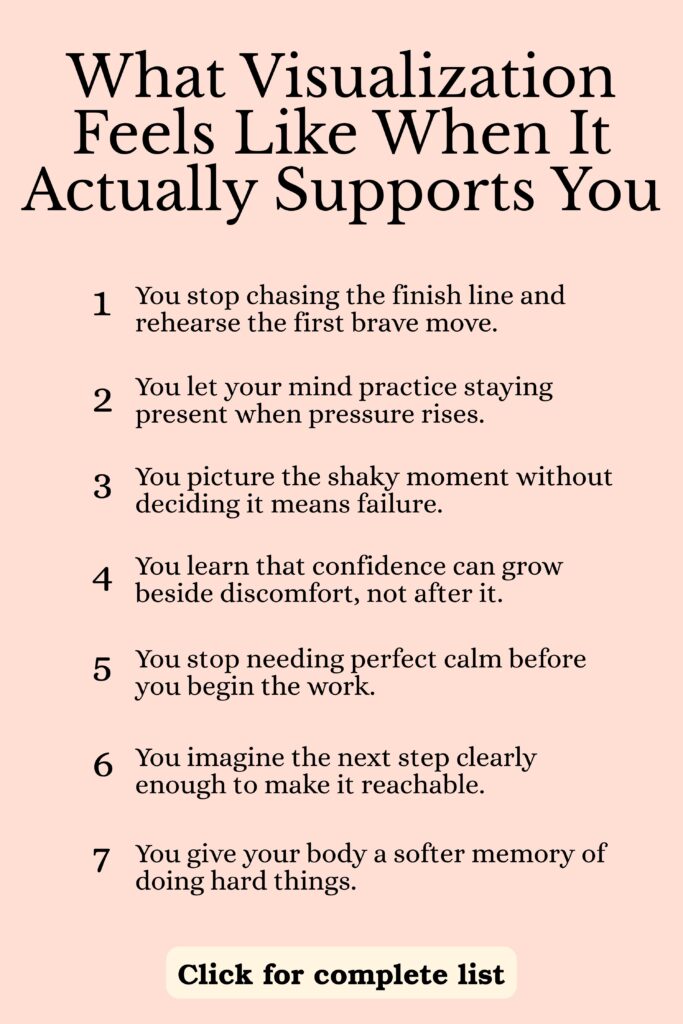
- Visualization works best as mental rehearsal. Picture the exact behaviors, decisions, and recovery moves that carry you through the difficult part, not only the rewarding finish.
- Process images are more useful than outcome fantasies. Rehearsing how you will begin, respond to nerves, and continue after a mistake gives your mind a practical path to follow.
- Obstacles belong inside the exercise. Name the internal pattern most likely to stop you, such as delay, overthinking, or avoidance, then rehearse your response.
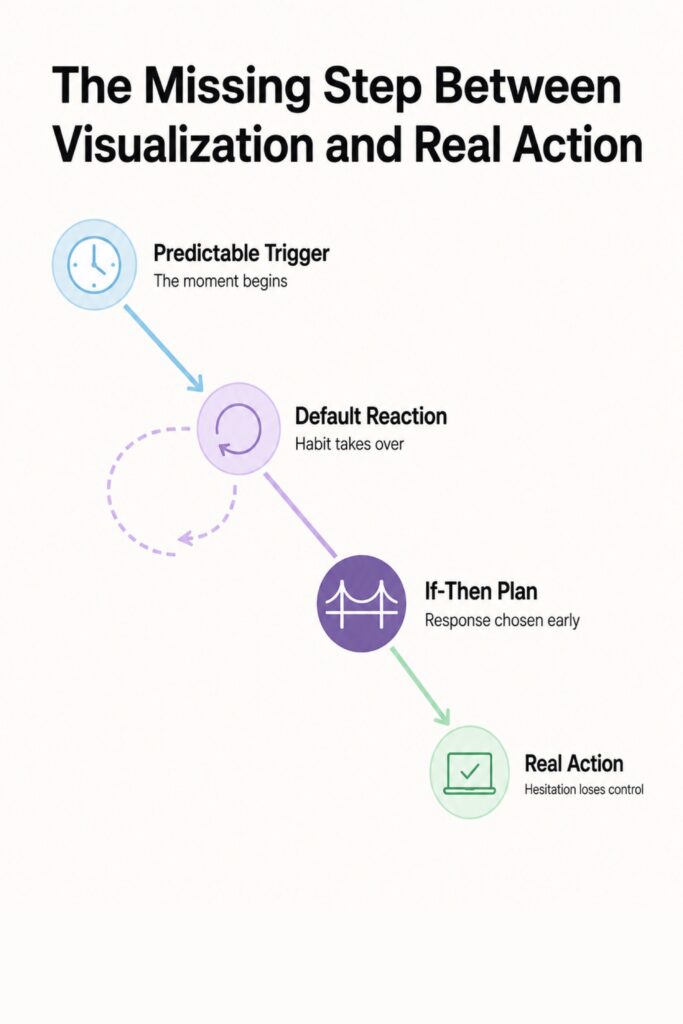
- If-then plans turn intention into action. Link a predictable trigger to one simple behavior so you know what to do before hesitation takes control.
- Credible affirmations should support immediate action. Choose statements your mind can accept, then follow them with a concrete step that creates real evidence of progress.
How Do Visualization Techniques Help You Succeed?

Visualization techniques help you succeed when they rehearse the actions required to reach a goal. Instead of picturing only the reward, mentally practice how you will start, respond to discomfort, recover from mistakes, and continue through the difficult part.
The strongest approach combines a clear goal with process rehearsal, a realistic obstacle, and a planned response. WOOP and if-then planning make visualization more useful by connecting the future you want to the behavior you will take when a predictable obstacle appears.
How Can Visualization Help You Overcome Obstacles?
One way to do this with quicker and effective results is to imagine yourself taking the steps you need in smaller chunks and walking through the process until you achieve that part of the exercise, and then simply repeat this for other areas you want to achieve.
For instance, if you need to do a presentation at work or make a business proposal to your partners. Imagine yourself actually standing up and doing the presentation. Feel the sensation of standing up, truly imagine it and honestly, you will find it easier to take that step. Otherwise, whenever people are anxious or afraid of certain tasks, they may feel insecure, broken, or powerless, which will only invite all things negative. Don’t let your negative emotions trample over you. If you do not apply conscious effort to overcome a difficult situation, you will never succeed.
Repeat the visualization process as often as you can until you actually begin to write your script or material. By focusing intently on visualization exercises, you begin to forget your anxieties and fears. It keeps you distracted enough that you may not even realize that a difficult situation has hit you, which you mostly don’t need to focus your energy on. All you need to do is apply this process to whatever it is you need to achieve. The focus you gain from this process definitely moves you closer to taking the actual steps with more ease and greater mental and physical stimulation. Just take it one step at a time, and when you achieve that stage, celebrate it. Feel the sensation success brings and imagine you winning at the end of it all.

What Makes Visualization More Effective?
Why Should You Keep Your Goals in Mind?
- What is your vision?
- Why do you have to get productive in the first place?
- What is your end goal?
Knowing exactly what you want and why you want it will always be a motivation for you to to continue striving. This will only help you focus more.
So, always be clear with your goals and why you want it. This will help you remain focused and push through the tough and tedious parts. Don’t forget that difficult situations test your focus, commitment and determination. It’s up to you to decide how easy or difficult it is for you to complete certain steps.
If you want to get more from your life, and are looking for concrete action steps to get you there, check out our Request a Coach page. It’s a “cut the fence-sitting and take action” way to tackle your issues and actually find success. To get off the fence and start to take action, click or tap here.
Don’t allow worry to take you over, instead, try silencing those unwanted thoughts and focus on getting something done (anything!). Once you do that, you’ll see that all your thoughts will be about finishing your task and achieving your goal.
How Much Detail Should You Use in Visualization?

Begin visualization by establishing a highly specific goal. Whilst visualizing, imagine the future where you have already achieved your goal. Hold a mental ‘picture’ of it as if it were occurring to you right at that moment. Imagine the scene in as much detail as possible. Engage as many of the five senses as you can in your visualization.
- See who are you with.
- Feel the emotions of the moment, as if it was the real situation.
- Be clear on what you are wearing and hear your conversation.
- Smell the air and feel the environment.
- Sit with a straight spine and ensure to practice night and day (just before/after sleep).
- Eliminate any doubts, if they come to you and repeat this practice often.
How Should You Add Affirmations?
Combine your visualization practice with affirmations, as this will give your visualizations, greater grounding. Affirmation is a declaration of something, and in your case, it should be a declaration of what you want to achieve. However, make sure that your affirmations are said in the present. For example…
- I am healthy
- I am successful
- I am full of joy, wealth and harmony
Repeat affirmations many times during the day before and after visualisation, and before long, both techniques will become rooted in your subconscious. You will begin to see the manifestation in your life. Practice needs to be consistent and consciously done, for about three to four months, for the changes to be seen.
How Do You Practice Visualization?
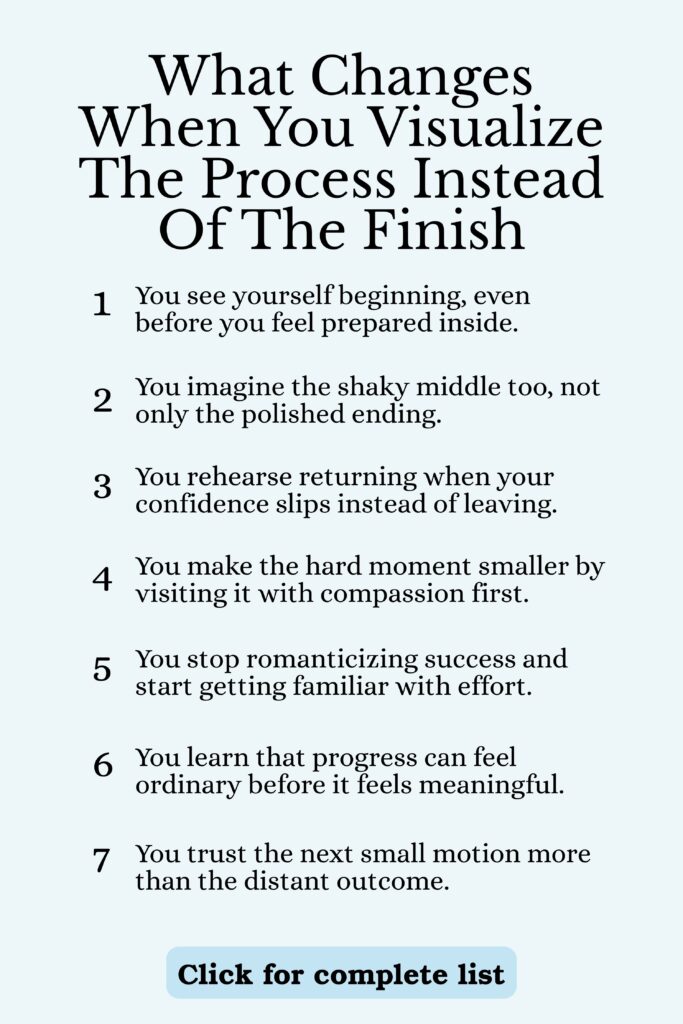
If you are wondering how to go about visualisation, here is a simple demonstration of what to do:
Sit with a straight spine, and keep your focus on track while you do this. Remember, this is a conscious effort at attracting what you want. Practice early in the morning, just about after waking up or when your nerves are relaxed and just about to sleep at night and make sure you believe in what you see.
To achieve maximum results, just follow the three tips above.
Why Visualizing the Finish Line Is Not Enough

Seeing the outcome can give you a quick lift. You picture the applause after the presentation, the signed contract, the finished workout, the calm conversation.
If you want to get more from your life, and are looking for concrete action steps to get you there, check out our Request a Coach page. It’s a “cut the fence-sitting and take action” way to tackle your issues and actually find success. To get off the fence and start to take action, click or tap here.
That part feels good because your brain likes a clear reward. The problem is that reward can arrive too early.
If all you rehearse is the success moment, you can end up feeling oddly satisfied before you have done the hard part. You feel ready. Then 9:00 a.m. comes, your slides still need work, and your stomach drops.
A better approach is to visualize the process, not just the result.
Research by Shelley Taylor and colleagues found that process-focused mental simulation supported progress toward goals, while simply imagining successful completion did not.
Picture yourself:
- opening the laptop instead of pacing the room
- reading the first line of your talk out loud
- clicking to the next slide after your voice shakes a little
- pausing to breathe when you lose your place
- finishing the meeting even if it is not perfect
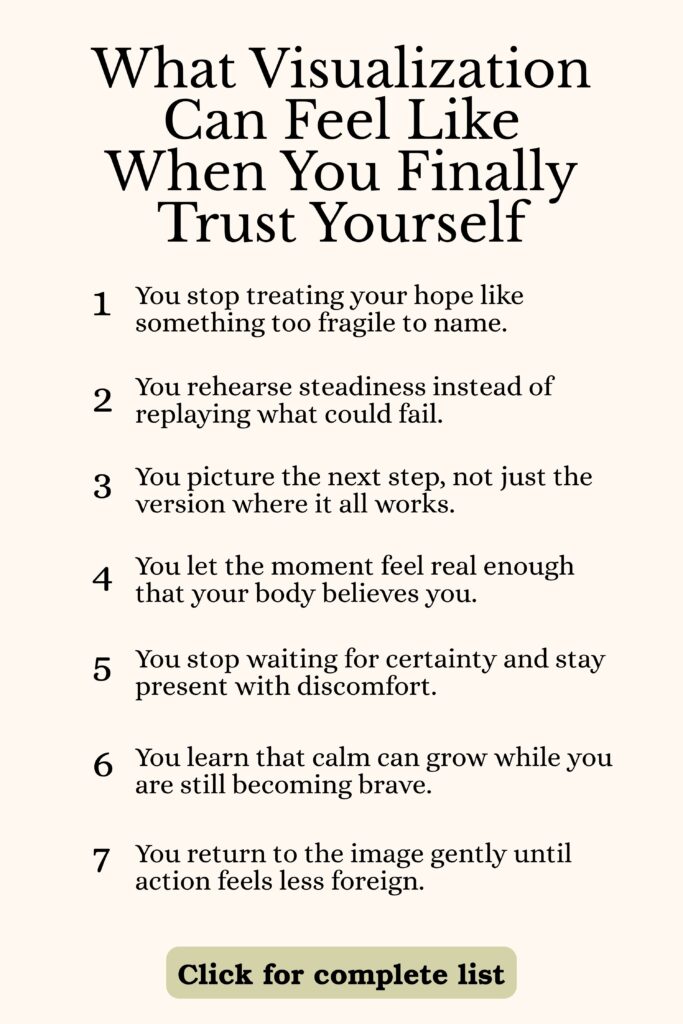
That is what actually moves you forward.
A career coach might use this kind of rehearsal before a job interview or keynote. Not by asking you to imagine being successful in a vague way, but by walking you through the exact first 60 seconds, the likely stress point, and the recovery move.
How Can You Use WOOP When Motivation Is Not Enough?
A simple way to make visualization useful is the WOOP method.
If you want to get more from your life, and are looking for concrete action steps to get you there, check out our Request a Coach page. It’s a “cut the fence-sitting and take action” way to tackle your issues and actually find success. To get off the fence and start to take action, click or tap here.
WOOP draws on mental contrasting, a self-regulation strategy developed through Gabriele Oettingen’s research on connecting a desired future with the obstacle in present reality.
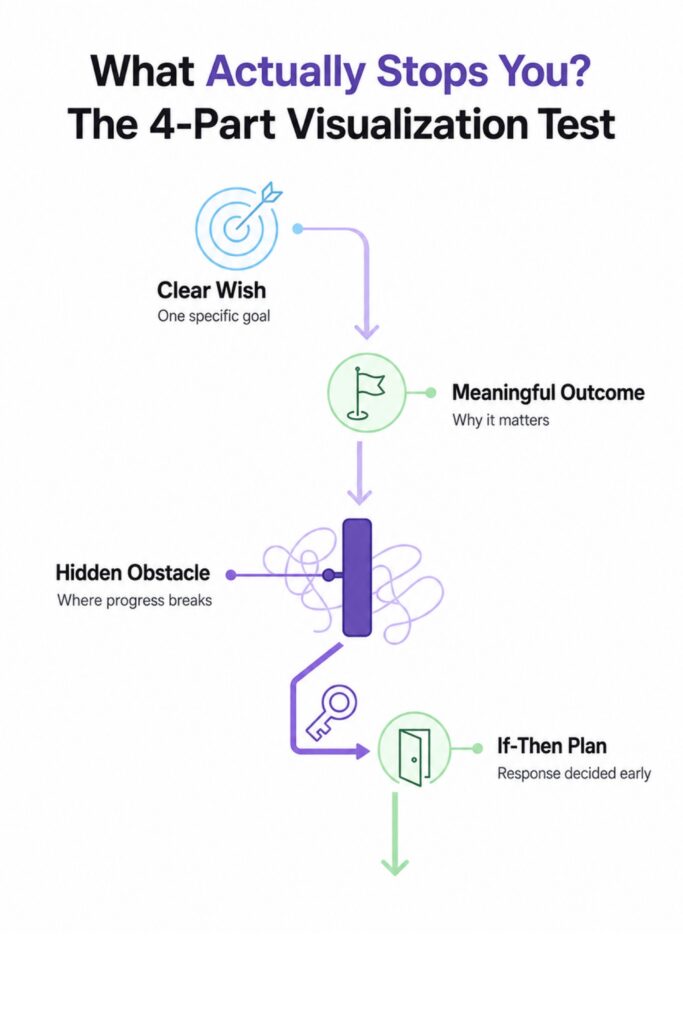
WOOP stands for:
- Wish
- Outcome
- Obstacle
- Plan
Start with the wish. One clear target. Not ten.
If your goal is to pitch a business proposal to a partner this week, your WOOP could look like this:
- Wish: Deliver the proposal by Thursday
- Outcome: I feel clear, prepared, and credible in the room
- Obstacle: I keep putting off the draft because I do not want it judged too early
- Plan: If I catch myself delaying, then I will open the document and write the first ugly version for 15 minutes
That works better than repeating “I am confident” while avoiding the task.
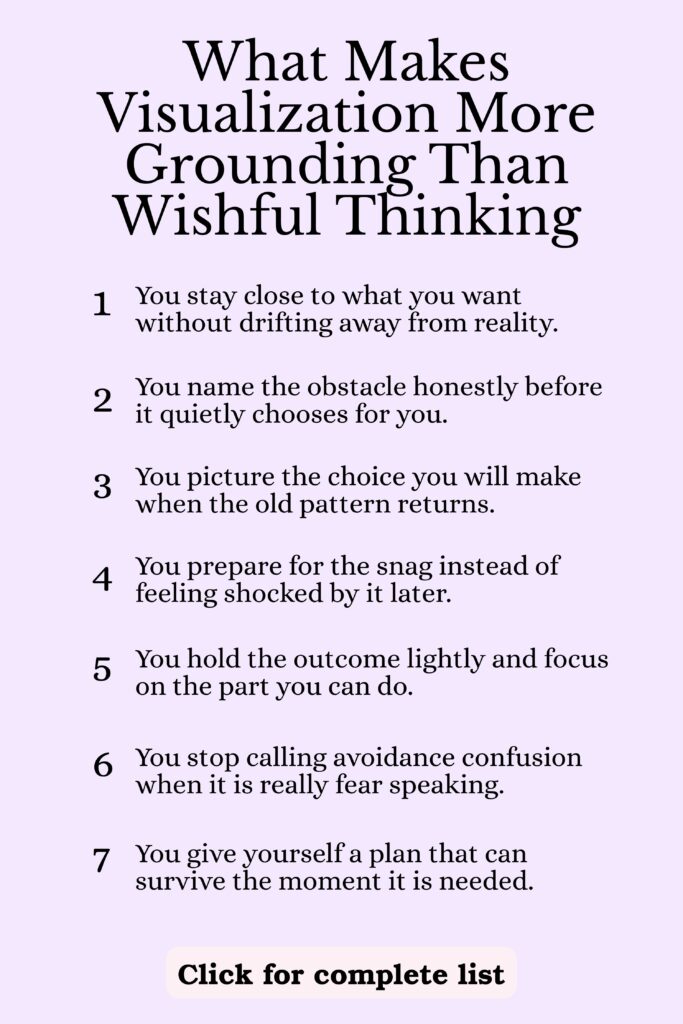
The obstacle matters because it is usually not the event itself that stops you. It is the pattern right before the event. The delay. The overthinking. The disappearing into low-value tasks.
If you work with a coach on performance, business, or public speaking, this is often where the real work happens. Not on the dream. On the snag.
How Do You Build an If-Then Plan for the Moment You Usually Slip?
Most people know the goal. They do not know the moment they go off track.
If you want to get more from your life, and are looking for concrete action steps to get you there, check out our Request a Coach page. It’s a “cut the fence-sitting and take action” way to tackle your issues and actually find success. To get off the fence and start to take action, click or tap here.
That is where an if-then plan helps.
Research by Peter Gollwitzer and colleagues describes these implementation intentions as cue-response plans that can improve goal attainment and protect goal pursuit from distraction.
You name the trigger. Then you decide the response before it happens.
Examples:
- If I start scrolling instead of writing, then I will set a 10-minute timer and draft one paragraph badly.
- If I feel myself freezing before I speak, then I will exhale once and read my first line slowly.
- If I want to cancel the workout because I feel tired, then I will put on my shoes and do the warm-up only.
- If I hear myself thinking “I need more time,” then I will ask what still needs to be decided and finish that first.
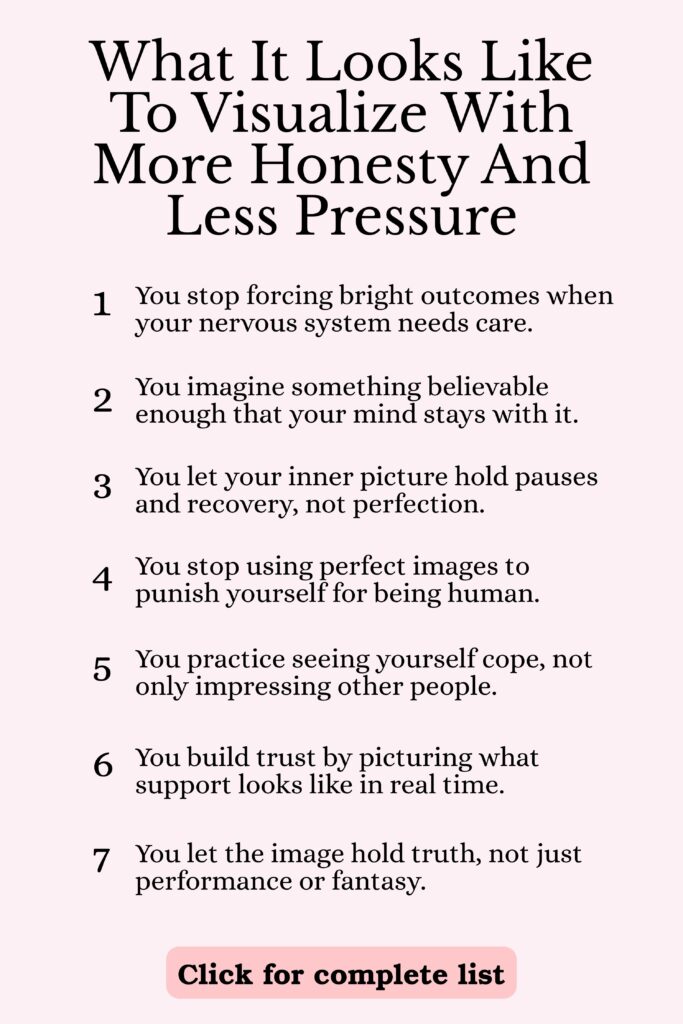
This works because hesitation is fast. You usually do not have time for a deep pep talk in the moment.
You need a response that is already loaded.
That is why athletes, speakers, and good coaches rehearse recovery as much as performance. They do not assume nerves will disappear. They decide what to do when nerves show up.
Make Affirmations Credible Enough to Use

Affirmations work better when they support action instead of pretending doubt does not exist.
If you want to get more from your life, and are looking for concrete action steps to get you there, check out our Request a Coach page. It’s a “cut the fence-sitting and take action” way to tackle your issues and actually find success. To get off the fence and start to take action, click or tap here.
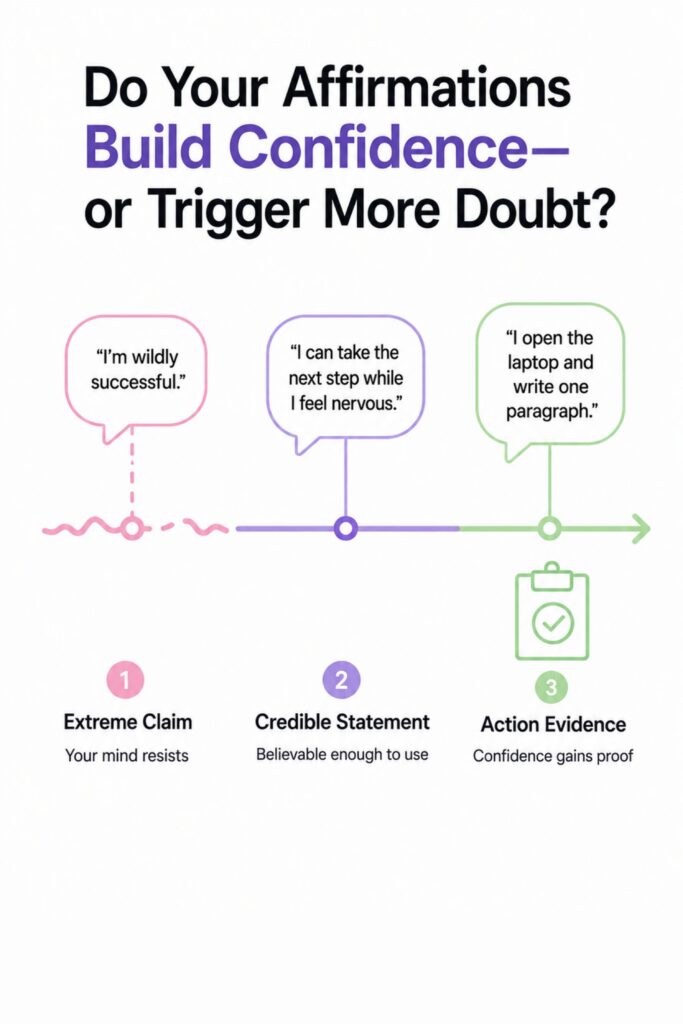
Joanne Wood and colleagues found that highly positive self-statements could make some participants with low self-esteem feel worse, which supports using statements that feel credible rather than extreme.
“I am wildly successful” may sound strong, but if you are sitting in front of a half-finished proposal and avoiding email, your brain will reject it.
Use statements your mind can work with.
For example:
- I can do the next step even while I feel nervous
- I know how to begin before I know how to finish
- I can handle feedback without shutting down
- I am getting better at staying with discomfort
- I can prepare well and speak clearly
These statements have traction because they match behavior.
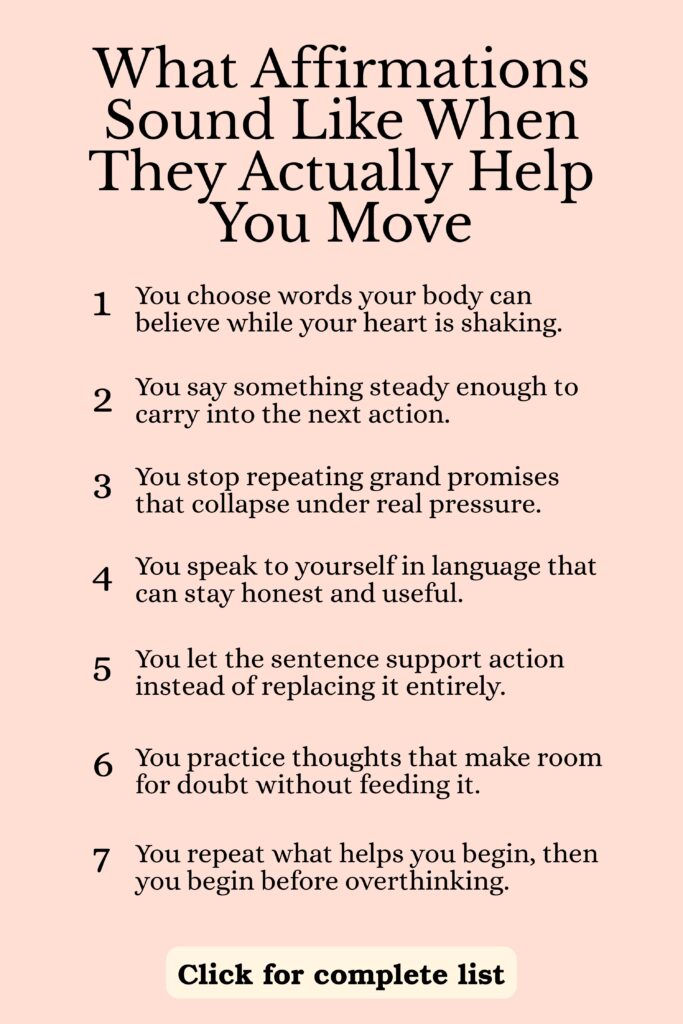
Say them before visualization. Say them again right before the action itself. Then back them up fast.
If you are about to make a sales call, say the line that steadies you and dial. If you are about to have a hard conversation, say it and send the message asking for the meeting.
Confidence grows faster from evidence than repetition alone.
If you want to get more from your life, and are looking for concrete action steps to get you there, check out our Request a Coach page. It’s a “cut the fence-sitting and take action” way to tackle your issues and actually find success. To get off the fence and start to take action, click or tap here.
A coach focused on confidence or leadership will often help clients rewrite affirmations this way. Less fantasy. More statements that can survive contact with real life.

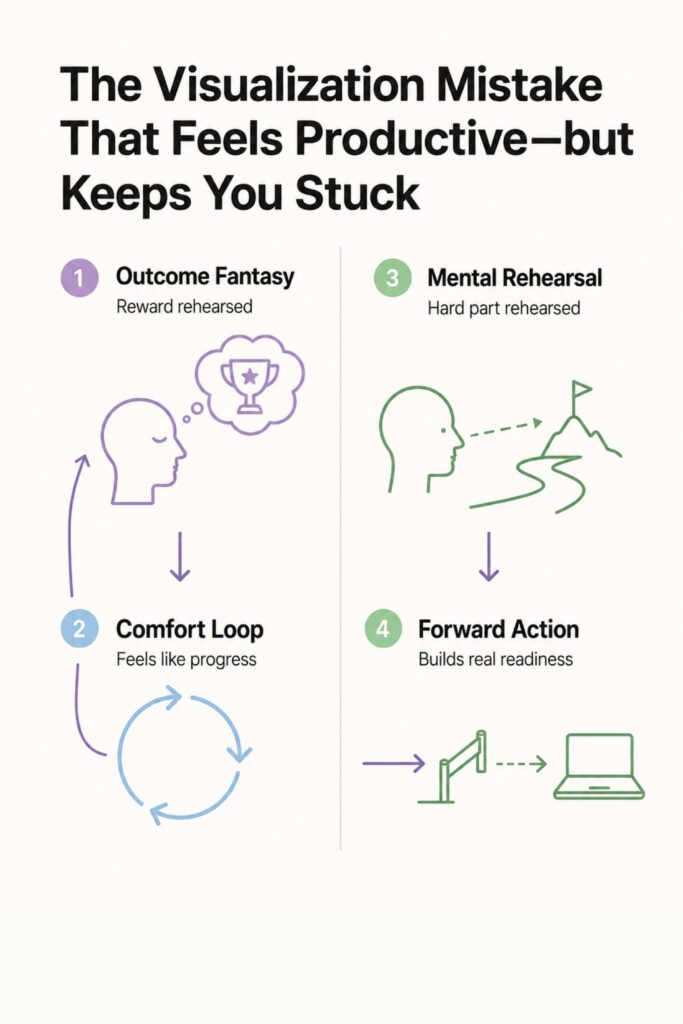
What Is the Difference Between Outcome Fantasy and Mental Rehearsal?
There is a big difference between imagining success and rehearsing the steps that create it.
Imagining the applause after a speech may feel good. Imagining yourself opening the laptop, reviewing your notes, standing up, losing your place, pausing, and continuing is more useful.
That is mental rehearsal.
You are not just picturing the reward. You are practicing the behavior before the pressure arrives.
For example, if you have a job interview coming up, do not only imagine hearing, “We’d love to offer you the role.”
Picture the first 90 seconds:
walking into the room
If you want to get more from your life, and are looking for concrete action steps to get you there, check out our Request a Coach page. It’s a “cut the fence-sitting and take action” way to tackle your issues and actually find success. To get off the fence and start to take action, click or tap here.
sitting down before you feel fully ready
answering the first question clearly
noticing your hands feel tense
slowing your voice instead of rushing
asking for a moment when you need to think
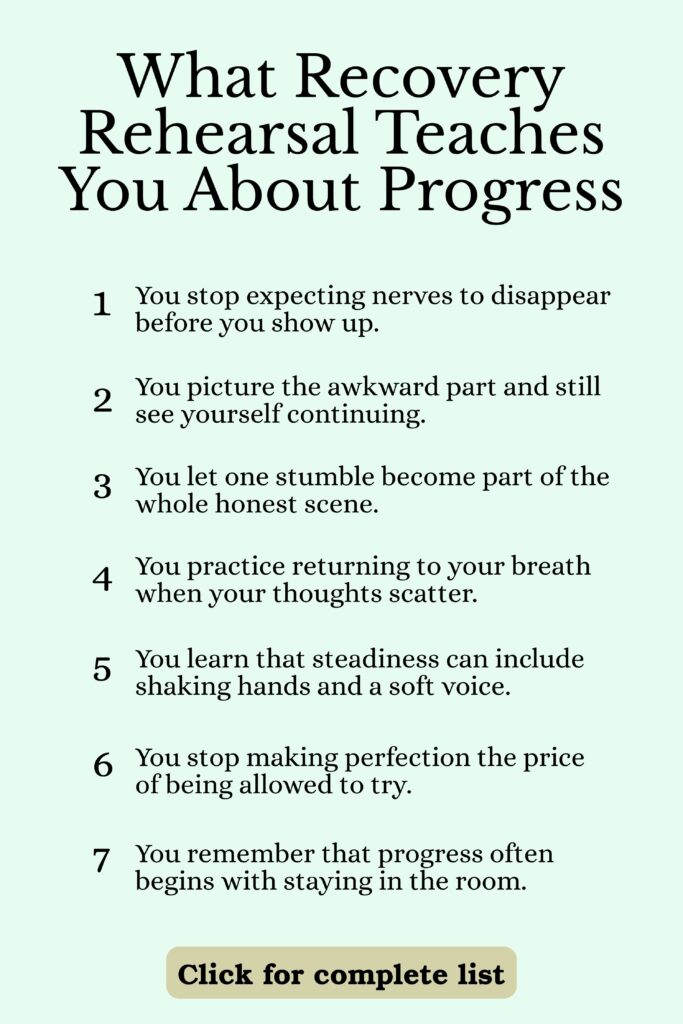
That is the part your brain needs to practice.
The same applies to a sales call, a difficult conversation, a workout, or a proposal you keep avoiding. Visualize the actual moment where you usually hesitate.
Not just the win.
If you want to get more from your life, and are looking for concrete action steps to get you there, check out our Request a Coach page. It’s a “cut the fence-sitting and take action” way to tackle your issues and actually find success. To get off the fence and start to take action, click or tap here.
The move that gets you there.
A career coach or performance coach might work through this with you before an interview or presentation. Not by giving you a vague confidence speech, but by helping you rehearse the exact opening, the likely stress point, and what you will do when your nerves show up.
How Do You Build a Visualization Script You Can Actually Use?
A useful visualization script does not need to be long.
It just needs to be specific enough that your mind knows what to practice.
Use this simple structure:
Scene: Where are you?
Action: What are you doing first?
Obstacle: What is likely to interrupt you?
If you want to get more from your life, and are looking for concrete action steps to get you there, check out our Request a Coach page. It’s a “cut the fence-sitting and take action” way to tackle your issues and actually find success. To get off the fence and start to take action, click or tap here.
Recovery: What will you do next?
Next step: How do you keep moving?
So if your goal is to write a proposal, your script might look like this:
You sit at your desk at 9:00 a.m. You open the proposal document before checking email. You feel the urge to rewrite the title five times because the draft looks rough. You notice the urge, set a 15-minute timer, and write the messy version anyway. When the timer ends, you highlight the parts that need evidence instead of deleting the whole thing.
That is a real rehearsal.
Not “I am successful.”
Not “I attract amazing opportunities.”
You are practicing the behavior that gets the proposal out of your head and onto the page.
If you want to get more from your life, and are looking for concrete action steps to get you there, check out our Request a Coach page. It’s a “cut the fence-sitting and take action” way to tackle your issues and actually find success. To get off the fence and start to take action, click or tap here.
For a difficult conversation, the script might be:
You ask to speak after lunch. You say the first sentence slowly. The other person looks defensive. You feel the urge to soften the whole point. Instead, you say, “I want to be clear because this matters.” Then you state the issue without adding five extra explanations.
That is visualization with a spine.
How Do You Identify the Real Obstacle?
The most useful part of WOOP is often the obstacle.
Not because obstacles are negative, but because they reveal the exact place where your pattern takes over.
The obvious obstacle is usually external.
“I do not have enough time.”
“I have too much going on.”
If you want to get more from your life, and are looking for concrete action steps to get you there, check out our Request a Coach page. It’s a “cut the fence-sitting and take action” way to tackle your issues and actually find success. To get off the fence and start to take action, click or tap here.
“The task is hard.”
The real obstacle is often closer to the moment you slip.
You open your email before the proposal because email feels safer.
You keep researching because a rough draft feels too exposed.
You delay the conversation because you do not want to see the other person’s reaction.
You skip the workout because changing clothes feels like the point of no return.
That is where the work is.
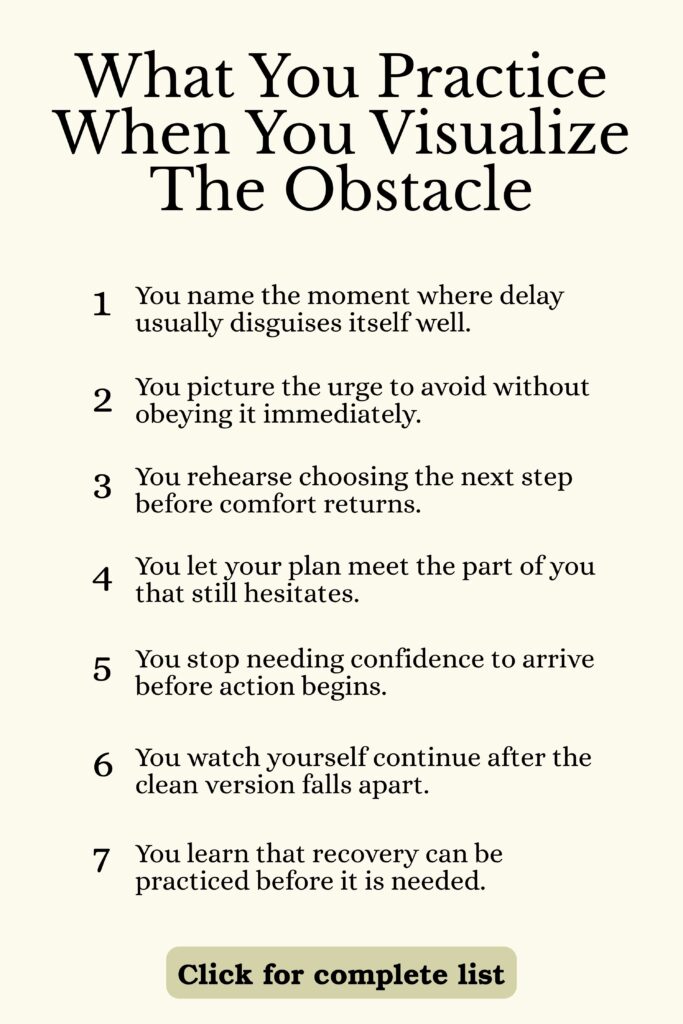
If your wish is to deliver a business proposal by Thursday, the obstacle may not be the proposal. It may be the first ugly draft.
If you want to get more from your life, and are looking for concrete action steps to get you there, check out our Request a Coach page. It’s a “cut the fence-sitting and take action” way to tackle your issues and actually find success. To get off the fence and start to take action, click or tap here.
If your wish is to speak more confidently in meetings, the obstacle may not be confidence. It may be the first three seconds after someone says, “What do you think?”
If your wish is to start exercising again, the obstacle may not be discipline. It may be the moment you sit down after work and tell yourself you will decide later.
A coach can be useful here because patterns are easier to spot from the outside. An accountability coach, business coach, or leadership coach can help you identify the exact repeat moment where you go off track and build a response that fits the situation.
Not a giant life overhaul.
A better move at the point of friction.
How Do You Match If-Then Plans to Your Goal?
If-then plans work best when they match the situation you are likely to face.
A presentation problem needs a different plan than a workout problem. A hard conversation needs a different plan than a writing problem.
For a performance goal, plan for the moment your body reacts.
If you want to get more from your life, and are looking for concrete action steps to get you there, check out our Request a Coach page. It’s a “cut the fence-sitting and take action” way to tackle your issues and actually find success. To get off the fence and start to take action, click or tap here.
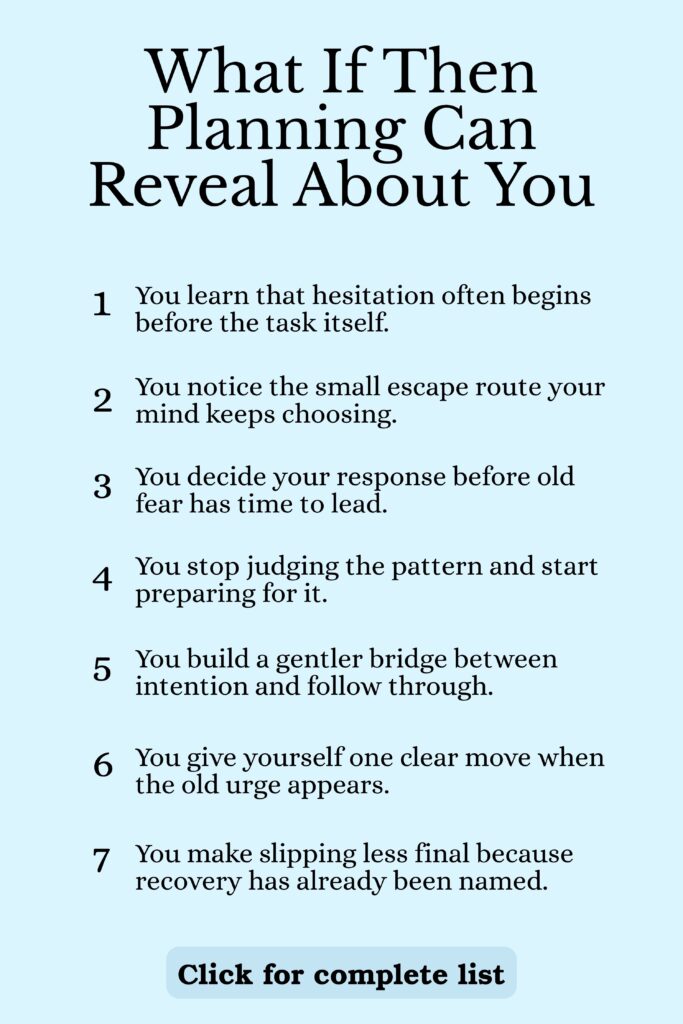
If my voice shakes, then I will pause, exhale, and read the next line slowly.
If I lose my place, then I will look at my notes and say, “Let me pick that back up here.”
If I rush, then I will put both feet flat on the floor and slow the next sentence.
For a work goal, plan for avoidance.
If I open a new tab instead of writing, then I will close it and write one rough paragraph.
If I think, “I need more research,” then I will list the missing facts and keep drafting around them.
If I start editing the first sentence again, then I will move to the next section.
For a health goal, plan for the transition.
If you want to get more from your life, and are looking for concrete action steps to get you there, check out our Request a Coach page. It’s a “cut the fence-sitting and take action” way to tackle your issues and actually find success. To get off the fence and start to take action, click or tap here.
If I feel tired after work, then I will put on my shoes and do the warm-up only.
If I want to skip meal prep, then I will prepare one protein and one simple side.
If I miss one day, then I will restart at the next planned time instead of waiting until Monday.
For a relationship goal, plan for the emotional spike.
If I feel myself getting defensive, then I will ask one clarifying question before responding.
If I start overexplaining, then I will stop and repeat the main point once.
If the conversation gets tense, then I will suggest a 10-minute break instead of walking away angry.
The power is in deciding before the moment arrives.
If you want to get more from your life, and are looking for concrete action steps to get you there, check out our Request a Coach page. It’s a “cut the fence-sitting and take action” way to tackle your issues and actually find success. To get off the fence and start to take action, click or tap here.
Hesitation moves fast.
Your plan needs to be faster.
Why Should You Rehearse Recovery Instead of Perfection?
A lot of people visualize as if the goal is to remove nerves completely.
That can backfire.
If you only picture a perfect version of yourself, the first sign of nervousness can feel like failure. Your voice shakes, your mind blanks, your heart beats faster, and suddenly you think the whole thing is going wrong.
But nerves are not proof that you are unprepared.
They are part of the scene.
So include them.
If you want to get more from your life, and are looking for concrete action steps to get you there, check out our Request a Coach page. It’s a “cut the fence-sitting and take action” way to tackle your issues and actually find success. To get off the fence and start to take action, click or tap here.
If you are preparing for a presentation, picture yourself stumbling over one sentence. Then picture yourself pausing, looking down at your notes, and continuing.
If you are preparing for a sales call, picture the other person asking a question you did not expect. Then picture yourself saying, “That is a good question. Let me think for a second.”
If you are preparing for a hard conversation, picture the other person disagreeing. Then picture yourself staying with the point instead of abandoning it to keep things comfortable.
This is where visualization becomes practical.
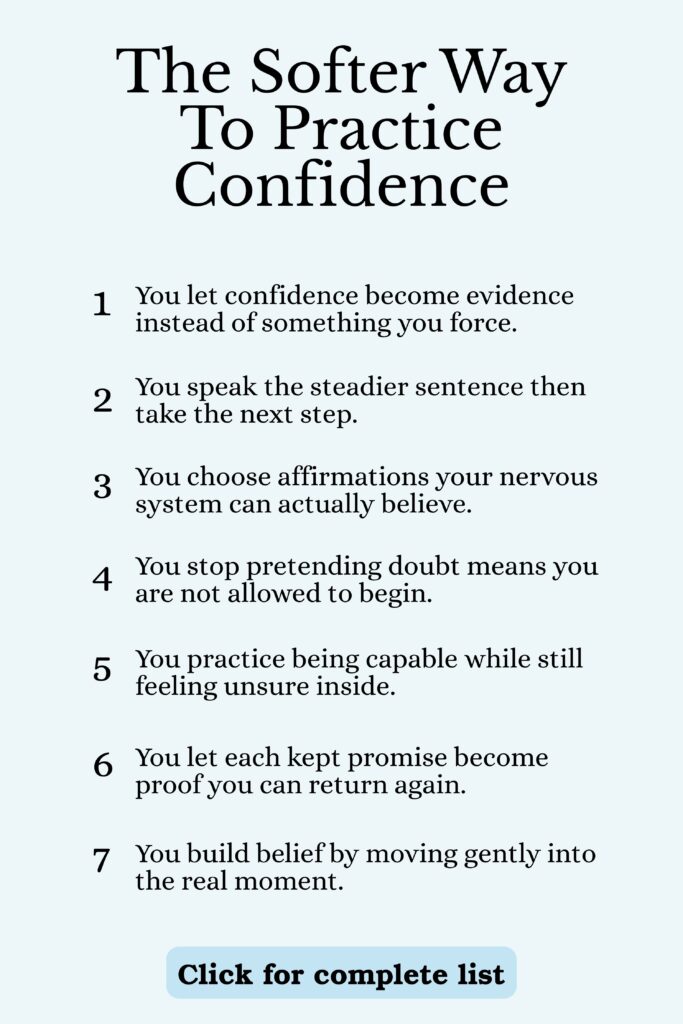
You are not training yourself to feel nothing.
You are training yourself to recover.
A communication coach or leadership coach might role-play this with you. They may interrupt you, challenge your answer, or ask the awkward question on purpose so you can practice staying steady in the real moment.
That kind of rehearsal builds confidence because it gives you evidence.
If you want to get more from your life, and are looking for concrete action steps to get you there, check out our Request a Coach page. It’s a “cut the fence-sitting and take action” way to tackle your issues and actually find success. To get off the fence and start to take action, click or tap here.
You have already practiced what to do when the clean version falls apart.
Frequently Asked Questions About Visualization Techniques

What is visualization?
Visualization is the deliberate mental rehearsal of a future situation. It can include the actions you will take, what you may feel, the obstacles that could appear, and how you will respond.
Does visualization really work?
Visualization can support performance and goal pursuit when it focuses on the process, coping actions, and the behavior required to move forward. Simply imagining the successful outcome is less useful than rehearsing how you will reach it.
Should you visualize the outcome or the process?
You should visualize both, but spend more time rehearsing the process. Picture how you will begin, handle the difficult point, recover from mistakes, and complete the next step.
How often should you practice visualization?
Practice visualization briefly and consistently, particularly before the action or situation you are preparing for. A specific five-minute rehearsal can be more useful than repeatedly imagining a vague future success.
What is the WOOP visualization method?
WOOP is a structured mental strategy built around Wish, Outcome, Obstacle, and Plan. It connects a desired future with the internal obstacle that may interfere and a practical response you can use.
How do if-then plans improve visualization?
If-then plans improve visualization by giving you a preselected response to a predictable trigger. Instead of deciding what to do while anxious, distracted, or tempted to stop, you rehearse the response in advance.
Can affirmations be used with visualization?
Affirmations can be used with visualization when they are credible and connected to behavior. Statements such as “I can take the next step while nervous” are more workable than extreme claims your mind immediately rejects.
If you want to get more from your life, and are looking for concrete action steps to get you there, check out our Request a Coach page. It’s a “cut the fence-sitting and take action” way to tackle your issues and actually find success. To get off the fence and start to take action, click or tap here.
Can visualization replace action?
Visualization cannot replace action. It prepares you for the behavior, decisions, and recovery moves that make progress possible, but you must still perform the next real step.
Sources
Achtziger, Anja, Peter M. Gollwitzer, and Paschal Sheeran. “Implementation Intentions and Shielding Goal Striving from Unwanted Thoughts and Feelings.” Personality and Social Psychology Bulletin, vol. 34, no. 3, 2008, pp. 381–393. SAGE Journals, https://doi.org/10.1177/0146167207311201/.
Oettingen, Gabriele, and Klaus Michael Reininger. “The Power of Prospection: Mental Contrasting and Behavior Change.” Social and Personality Psychology Compass, vol. 10, no. 11, 2016, pp. 591–604. Wiley Online Library, https://doi.org/10.1111/spc3.12271/.
Taylor, Shelley E., et al. “Harnessing the Imagination: Mental Simulation, Self-Regulation, and Coping.” American Psychologist, vol. 53, no. 4, 1998, pp. 429–439. PubMed, https://pubmed.ncbi.nlm.nih.gov/9572006/.
Wood, Joanne V., W. Q. Elaine Perunovic, and John W. Lee. “Positive Self-Statements: Power for Some, Peril for Others.” Psychological Science, vol. 20, no. 7, 2009, pp. 860–866. PubMed, https://pubmed.ncbi.nlm.nih.gov/19493324/.
If you want to get more from your life, and are looking for concrete action steps to get you there, check out our Request a Coach page. It’s a “cut the fence-sitting and take action” way to tackle your issues and actually find success. To get off the fence and start to take action, click or tap here.
Read this next

The Law of Attraction: The Key to Automatic Happiness
Do you know how to use the Law of Attraction to automatically become happy?
Read More
3 Easy Steps To Overcome and Reverse Negative Thinking Patterns (From A Coach)
It’s easier said than done, but with a little bit of practice, you can learn how to control your thoughts and create a more positive trajectory for your future. Life […]
Read More
How to Use the Law of Attraction: 3 Steps to Attracting What You Want
Follow these three simple steps to bring what you want into your life by learning how to use the law of attraction.
Read More