


Talk to a coach about Stress management coaching

Dr Soraya Sawicki, DSW, CPC, RMT
DSW, CPC, CSC, RMT
Personalized wellness coaching for stress relief, energy, and inner harmony.

Robert Bradley Singleton
Certified Master Spiritual Life Coach, Neuropsychologist, and Existential Therapist
Train with the best to be the best you! Don't...

Crystal Faulk
ACC
I help overwhelmed women in transition gain clarity, confidence, and...

Dr. Kate Watson
B.A Psychology, M.Ed. Psychological Counseling, Dr.PH in Public Health, Certified Health Coach, Certified Life Coach, Certified Mind and Body Specialist, Certified Women's Empowerment Coach, Certified Neurodiversity Coach
Dr. Kate Watson helps people with boundaries, coping strategies, and...

A. Nya ~ Savvy Soul Life
CPC, MSLC
Life, wellness, creativity, mindfulness & spiritual coaching for personal strengthening...

Stephanie Peers
Somatic Coach | Midlife Transitions, Self-Trust & Personal Growth --> (Download my free Body-Led Clarity Guide in My Store!)
Body-led coaching for midlife women ready to trust themselves, set...

Menna Jones
Certified Health & Wellness Coach (Real Balance Global Wellness)
Health & Wellness Coaching For Women Going Through Menopause

Claudia Silver
HDIP CBH - Cognitive Behavioural Hypnotherapist (UK Higher Diploma)
Certified Hypnotherapist for evidence-based help with stress, specific fears and...


Before You Share Your Problems, Ask These 4 Questions

There is a saying, “A problem shared is a problem halved.” Sharing a problem may not solve it, or even halve it, but saying it out loud can put it into perspective.
The right conversation can help you separate what happened from what you fear might happen. It can also reveal a choice that was difficult to see while the problem was circling inside your head.
But is sharing your problems with others always the answer?
Key Takeaways
- Share with a purpose. Decide whether you want someone to listen, offer perspective, help you make a decision or support a specific next step before starting the conversation.
- Choose for suitability, not just closeness. A caring friend may still be too involved, reactive or personally affected to give you the kind of support you need.
- Ask clearly for the response you want. Telling someone whether you need listening, thoughtful questions or practical help reduces unwanted advice and crossed expectations.
- Watch for circular problem talk. Repeating the same story without gaining information, making a decision or taking action can reinforce anger, fear and helplessness.
- Use writing to organize the problem. Separating observable facts from interpretations, needs and possible next steps can make a later conversation more focused and constructive.
Is It Good to Share Your Problems With Someone?

Sharing your problems with someone can be helpful when the conversation gives you perspective, emotional support, useful information or a clearer next step. It is less helpful when the listener is personally involved, cannot keep the information private or pushes you toward a decision that reflects their values rather than yours.
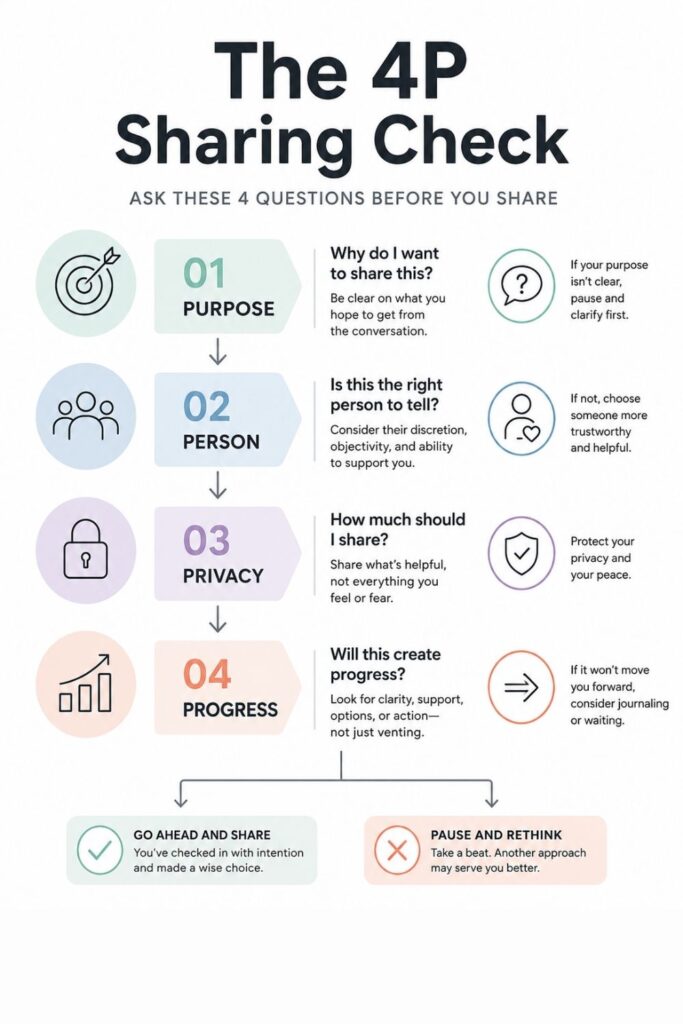
Before sharing, consider four things: your purpose, the person you are telling, the level of privacy the situation requires and whether the conversation is likely to help you make progress. You do not have to keep every problem to yourself, but you also do not have to tell the whole story to everyone who asks.
What Do You Want From Sharing the Problem?
The conversation is more likely to help when you know what you want from it.
People often begin talking because they feel upset, then become frustrated when the listener responds in the wrong way. You wanted sympathy. They produced a five-step action plan. You wanted help making a decision. They simply agreed that the situation was terrible.
If you want to get more from your life, and are looking for concrete action steps to get you there, check out our Request a Coach page. It’s a “cut the fence-sitting and take action” way to tackle your issues and actually find success. To get off the fence and start to take action, click or tap here.
Before you begin, identify the purpose of the conversation:
- To be heard: You need space to say what happened without immediately solving it.
- To gain perspective: You want questions or observations that may help you see the situation differently.
- To make a decision: You need to compare choices, risks and likely consequences.
- To take action: You want practical help planning or completing a specific next step.
For example, after a difficult meeting with your manager, you may need ten minutes to explain what happened before deciding whether to respond. Advice about resigning would be premature if you have not yet reviewed the facts or clarified what outcome you want.
A communication or career coach might help you define that outcome, test your assumptions and practice the conversation you intend to have.
When Does Sharing Your Problems Help?
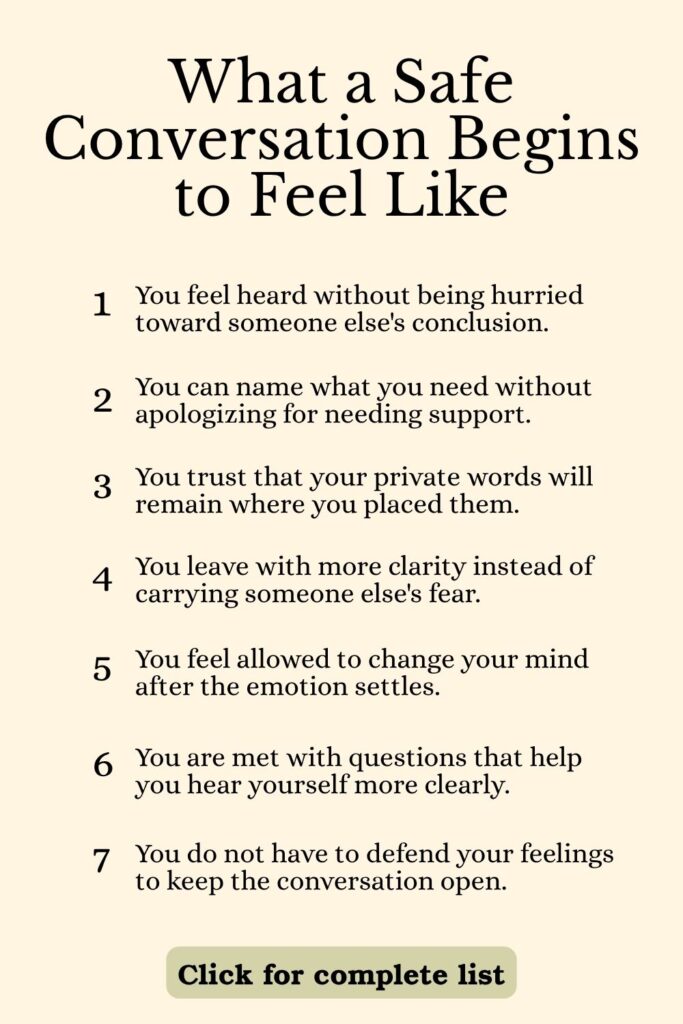
Sharing helps when the listener can give you the kind of support the situation actually requires.
You probably have at least one friend or family member whom you consider a great listener. They know your history, care about what happens to you and may notice patterns that you miss.
One of the reasons many people become coaches, counselors or other helping professionals is that people have regularly come to them for advice or to talk through their worries.
The risk in sharing with friends and family is that they may be too close to you, or too close to the situation, to remain objective. They may also be affected by what you reveal or by the decision you eventually make.
For example, imagine listening sympathetically while a friend complains about something their partner has done. Your friend is clearly hurt, so you feel protective and perhaps angry with the partner.
If you want to get more from your life, and are looking for concrete action steps to get you there, check out our Request a Coach page. It’s a “cut the fence-sitting and take action” way to tackle your issues and actually find success. To get off the fence and start to take action, click or tap here.
You offer sympathy and give your opinion. Your friend and their partner later resolve the disagreement, but you still remember every detail that was shared in the heat of the moment.
Your friend has moved forward. You may find it much harder to relate to the partner as you did before, and that change can affect the wider friendship.
How Do You Choose the Right Person to Tell?
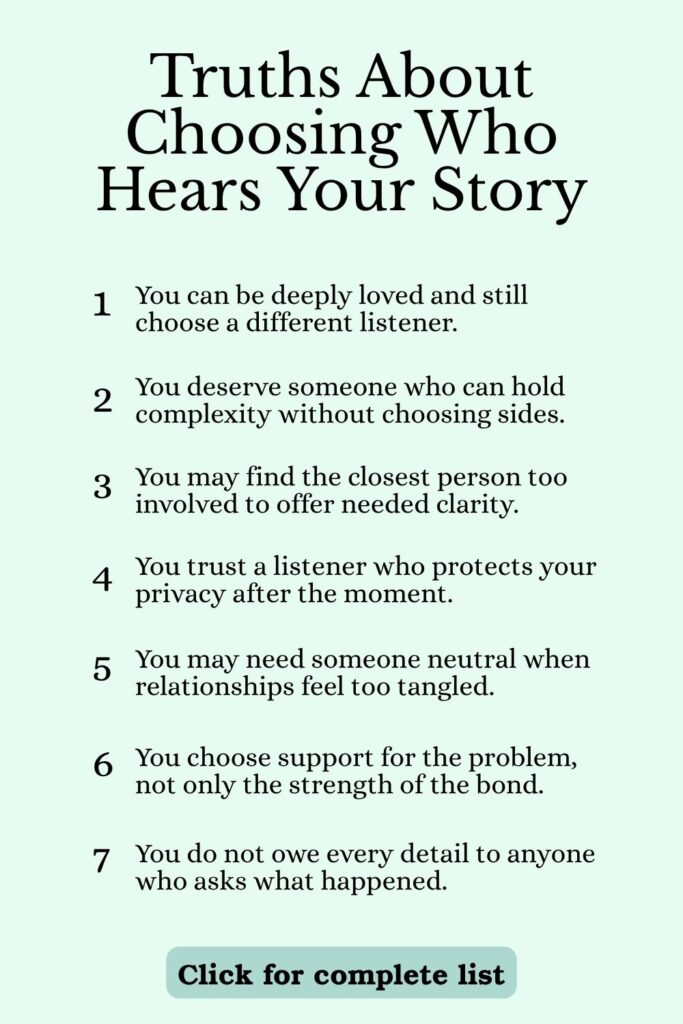
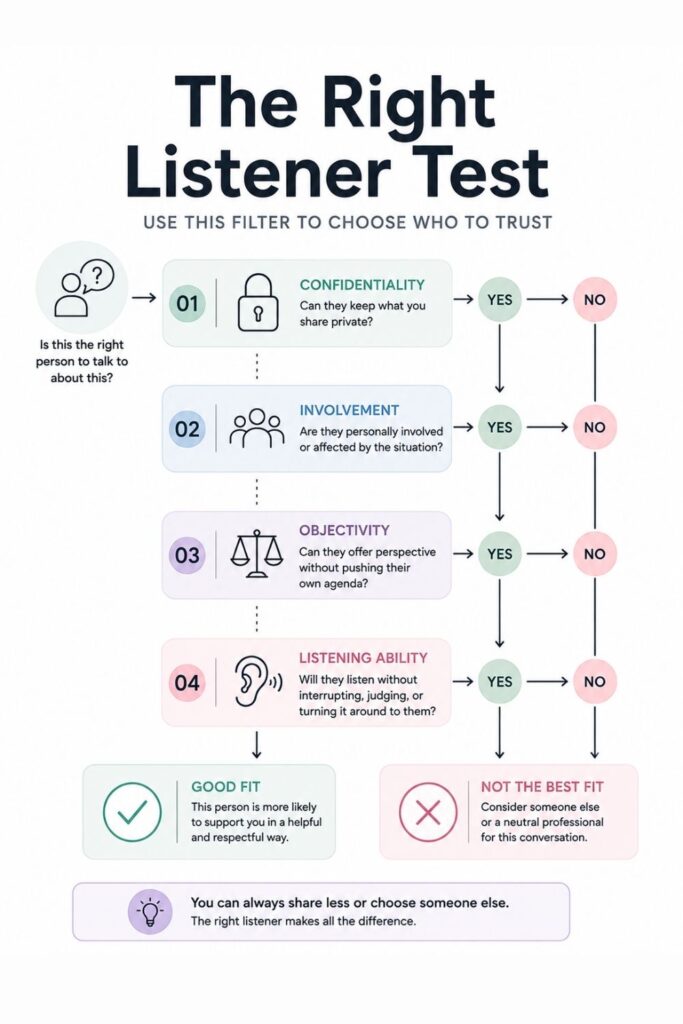
The right listener is someone who can handle the information responsibly and respond to the problem you actually have.
Closeness matters, but it is not the only test. A person can love you deeply and still be the wrong person for a particular conversation.
Use this simple Listener Fit Matrix before sharing:
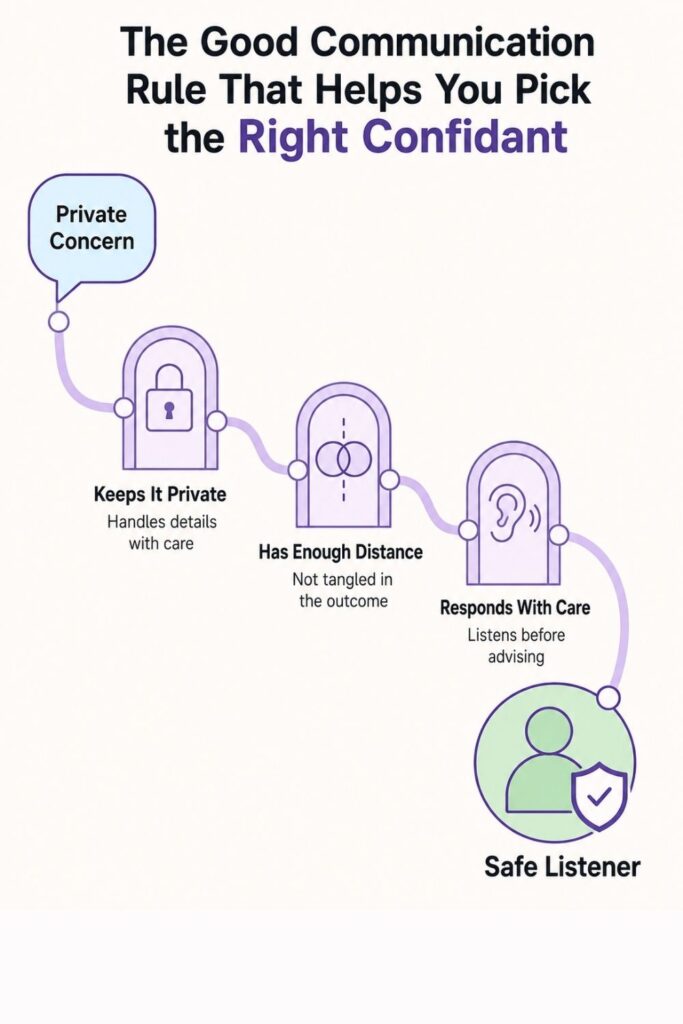
- Confidentiality: Can this person keep private information private?
- Involvement: Are they personally connected to anyone involved in the problem?
- Listening ability: Can they listen without interrupting, taking over or turning the conversation toward themselves?
- Relevant perspective: Do they understand enough about the situation to offer useful questions or information?
A sibling may be an excellent person to call when you have had a discouraging day at work. That same sibling may be a poor choice for discussing a family dispute in which they have already taken sides.
A colleague may understand your workplace structure, but sharing confidential details with them could create professional consequences. A trusted friend outside the organization may be safer, even if you need to explain more of the context.
Choose the person based on the job the conversation needs to do.
If you want to get more from your life, and are looking for concrete action steps to get you there, check out our Request a Coach page. It’s a “cut the fence-sitting and take action” way to tackle your issues and actually find success. To get off the fence and start to take action, click or tap here.
When Might Sharing With Friends and Family Backfire?
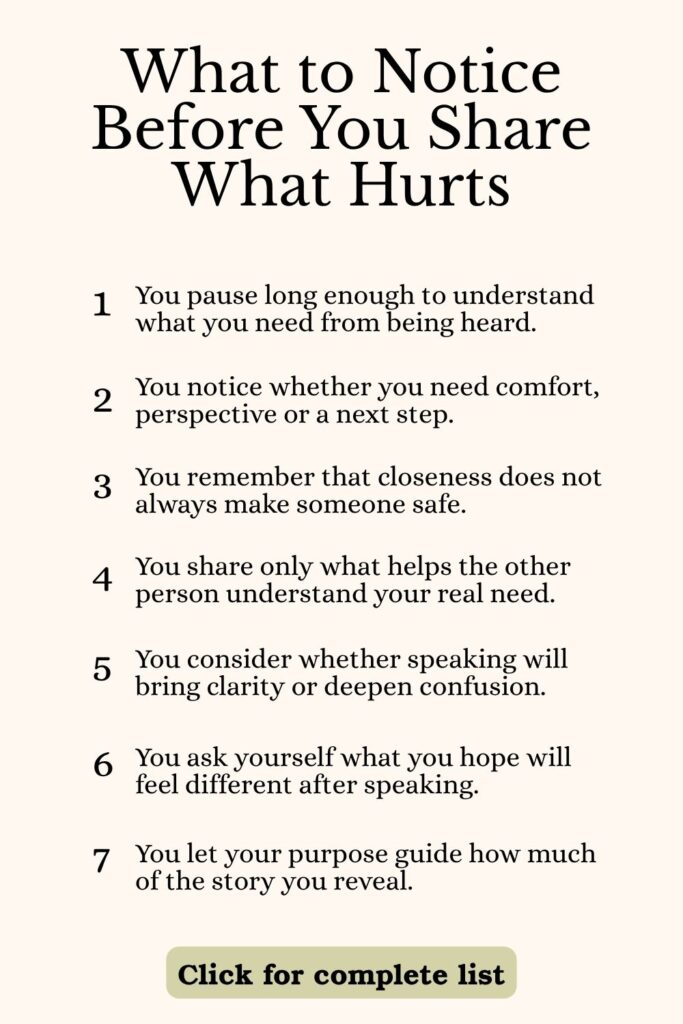
Sharing with friends and family can backfire when loyalty, personal history or strong opinions make it difficult for them to respond objectively.
Your support network can still be valuable. The goal is not to stop speaking to people close to you. It is to consider how the information might affect the relationship after the immediate problem has passed.
Someone who cares about you will naturally dislike seeing you hurt. They may rush to protect you, confront someone on your behalf or encourage you to leave a situation before you have decided what you want.
Their advice will also be shaped by their own beliefs, experiences and fears.
A friend who regretted staying in a difficult job may tell you to resign immediately. A parent who values financial security may tell you to stay, even when the role is damaging your health or limiting your future.
Neither response necessarily tells you what is right for you.
Before acting on advice, ask:
- What assumptions is this advice based on?
- Does the person understand the consequences I would face?
- Does the recommendation fit my priorities?
- What information might the listener be missing?
- Would I make the same choice after the emotion of this conversation has settled?
Advice can give you another perspective. It should not replace your own decision-making.
If you want to get more from your life, and are looking for concrete action steps to get you there, check out our Request a Coach page. It’s a “cut the fence-sitting and take action” way to tackle your issues and actually find success. To get off the fence and start to take action, click or tap here.
How Much Should You Share?
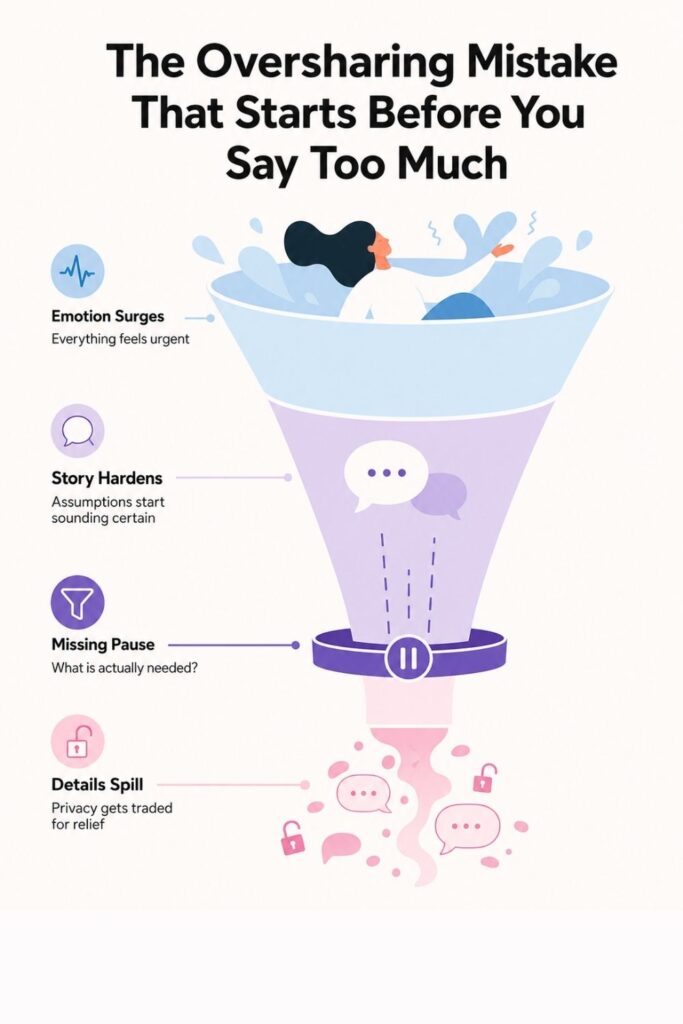
Share enough information for the listener to understand the problem, but not every detail you possess.
A useful rule is minimum necessary disclosure. Ask yourself what the person needs to know to provide the kind of support you are requesting.
You might need to explain the pattern of a disagreement and how it affected you. You may not need to reveal private medical, financial or sexual information about someone else.
Before sharing a detail, consider:
- Does this fact help explain the problem?
- Does it belong only to me, or am I revealing someone else’s private information?
- Could sharing it permanently alter the listener’s relationship with another person?
- Am I disclosing it because it is relevant, or because I am angry right now?
- Would I be comfortable knowing this detail had been repeated?
You can also begin with a limited version of the situation.
For example, you might say, “My partner and I disagree about how we handle money, and I need help preparing for a productive conversation,” rather than giving a friend a complete account of your partner’s income, debts and past mistakes.
You can always share more when it becomes necessary. You cannot reliably take private information back once it has been disclosed.
How Do You Ask for the Support You Actually Need?
Ask directly for the response you want before explaining the whole problem.
If you want to get more from your life, and are looking for concrete action steps to get you there, check out our Request a Coach page. It’s a “cut the fence-sitting and take action” way to tackle your issues and actually find success. To get off the fence and start to take action, click or tap here.
A simple request gives the listener a role. It also reduces the chance that you will feel dismissed, controlled or misunderstood.
Three requests cover many situations:
- Listen: “I need to say this out loud. I am not ready for advice yet.”
- Think: “Can you ask me questions and help me see what I might be missing?”
- Act: “Can you help me work out what to do next?”
You can combine them in sequence.
After a career setback, you might say, “Could you listen for ten minutes first? After that, I would like your help comparing my options.”
This is more useful than expecting the other person to guess when you want comfort and when you want solutions.
The listener may not be able to give you what you request. Someone might say, “I care about you, but I am too close to this situation to be objective.”
That is useful information. It allows you to choose another person rather than forcing an unsuitable conversation.
A communication coach may use role-play to help you make the request clearly, especially when the listener tends to interrupt, advise or become defensive.
If you want to get more from your life, and are looking for concrete action steps to get you there, check out our Request a Coach page. It’s a “cut the fence-sitting and take action” way to tackle your issues and actually find success. To get off the fence and start to take action, click or tap here.
When Is a Neutral Professional the Better Listener?
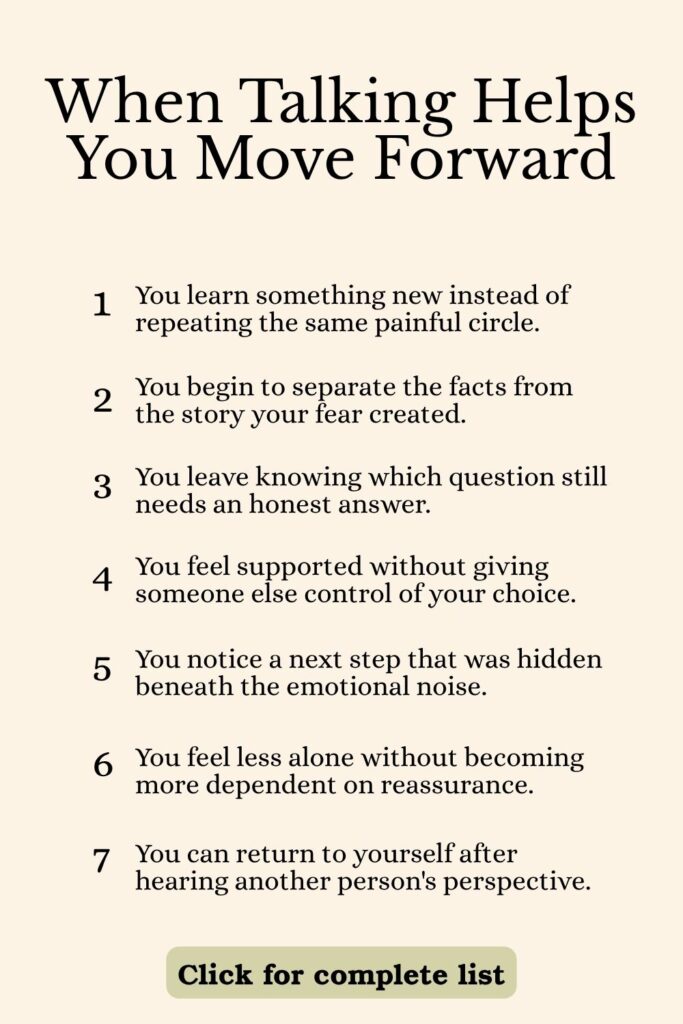
A neutral professional is often the better choice when privacy, objectivity or the seriousness of the issue makes a personal relationship unsuitable.
A friend may understand your personality but struggle to challenge your version of events. A professional has a different role. They can focus on your experience without needing to defend a relative, protect a friendship or live with the consequences of your disclosure.
The type of support should match the problem.
If you need assessment or treatment for a mental health condition, seek an appropriately qualified mental health professional. If you are working through a decision, preparing for a conversation, changing a behavior or building accountability around a goal, a coach may be a suitable option.
A relationship coach, for example, might help you practice stating a boundary without attacking the other person. A career coach might help you assess a job problem, prepare questions for your manager and follow through on an agreed plan.
Professionals should not make every decision for you. Their role is often to help you examine the situation, notice assumptions and choose a response that fits your circumstances.
Not everyone feels comfortable talking to a stranger, and professional support may not always be affordable or immediately available. Educational resources, support groups, structured exercises and journaling can sometimes help you organize the problem while you decide what additional support you need.
When Does Talking About a Problem Stop Helping?
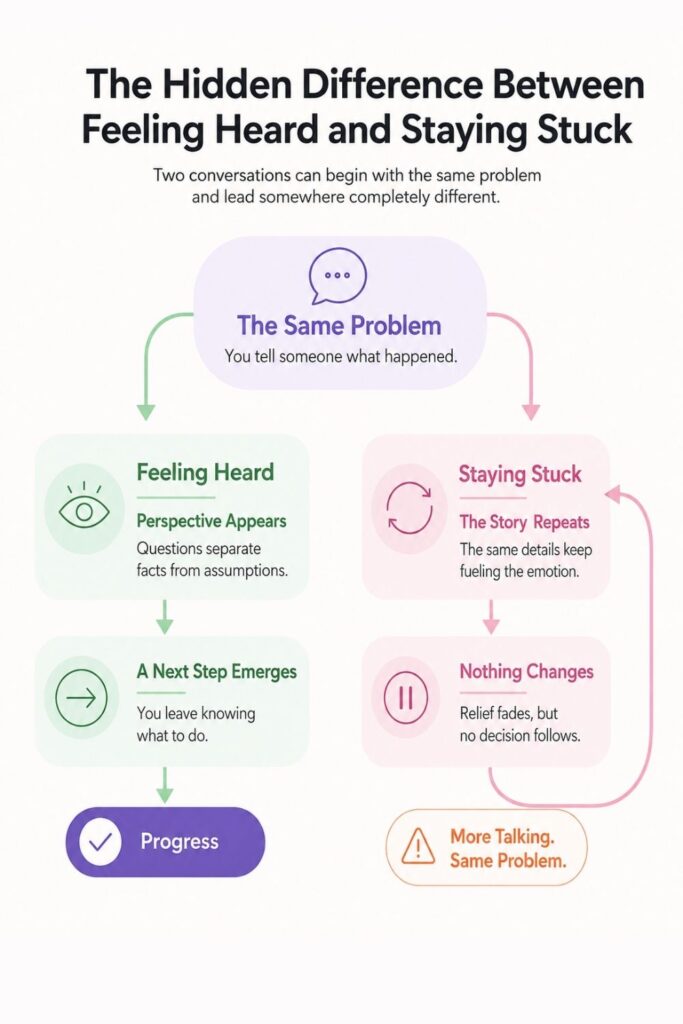
Talking stops helping when the conversation repeatedly circles the problem without producing perspective, information, a decision or a constructive next step.
If you want to get more from your life, and are looking for concrete action steps to get you there, check out our Request a Coach page. It’s a “cut the fence-sitting and take action” way to tackle your issues and actually find success. To get off the fence and start to take action, click or tap here.
Psychologists use the term co-rumination for repeated, extensive discussion of problems and negative feelings within a relationship. A systematic review and meta-analysis by Jason Spendelow, Laura Simonds and Rachel Avery found a modest but significant association between co-rumination and internalizing problems such as anxiety and depression. The research shows an association, not proof that talking about problems causes these conditions.
Look for observable signs:
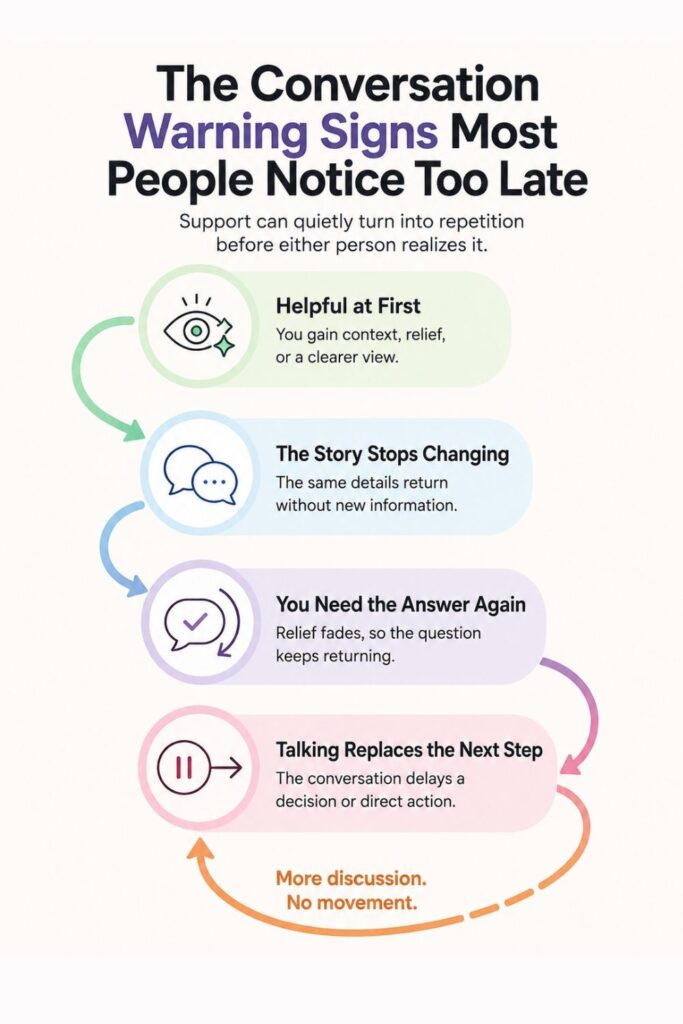
- You tell the same story to several people but gain no new information.
- Each conversation leaves you more angry, frightened or certain of the worst outcome.
- You repeatedly ask for reassurance but cannot accept the answer.
- You and the listener analyze another person’s motives without checking the facts.
- The conversation becomes a way of recruiting allies.
- You avoid the decision or direct conversation that could change the situation.
Suppose you have a conflict with a colleague. You discuss it with three coworkers, replay each sentence and speculate about what the colleague “really meant.”
The conversations may make your interpretation feel more certain, but they do not tell you whether it is accurate. Meanwhile, the direct conversation becomes harder because other people are now involved.
Use the Progress part of the 4P Sharing Check:
- What became clearer?
- What new information did I gain?
- What decision now needs to be made?
- What action will I take?
- Do I need a different kind of support?
Sometimes the next useful step is not another conversation. It may be writing down the facts, asking a direct question, setting a boundary or pausing until your emotional response settles.
How Can Journaling Help You Work Through a Problem?
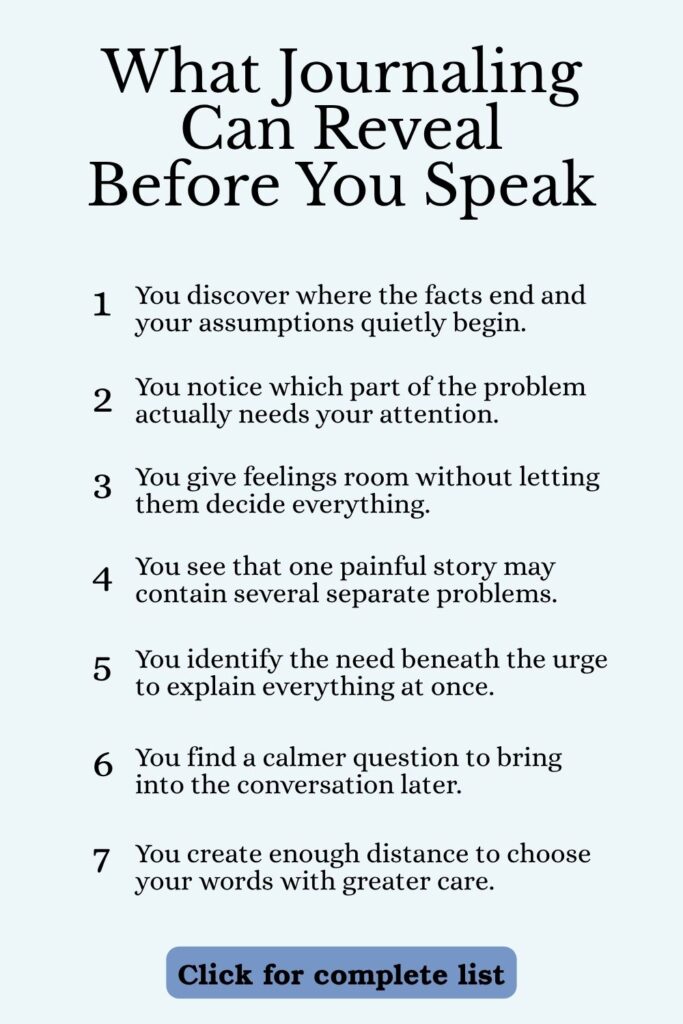
Journaling can help you organize a problem by moving it from a stream of thoughts into words you can examine.
Problems, arguments, feelings and unanswered questions can feel tangled when you repeatedly rehearse them in your mind. On paper, you can separate events, interpretations and possible responses.
If you want to get more from your life, and are looking for concrete action steps to get you there, check out our Request a Coach page. It’s a “cut the fence-sitting and take action” way to tackle your issues and actually find success. To get off the fence and start to take action, click or tap here.
This does not mean journaling reliably produces broad health improvements. A meta-analysis by Carolin Mogk, Sebastian Otte, Bettina Reinhold-Hurley and Birgit Kröner-Herwig found minor or no overall effects of expressive writing on psychological or physical health across the studies they examined.
Something that feels frightening in your mind may become more specific on the page. “Everything is going wrong” might turn into three separate issues: a missed deadline, a difficult conversation and uncertainty about next month’s income.
Those problems may require three different responses.
Writing can also help before important events such as an exam, a meeting or a house move. The aim is not simply to release emotion. It is to identify what needs attention and what can be left alone for now.
You do not need a dramatic crisis before trying it. A short, regular entry can help you notice repeated concerns, unfinished decisions and conversations you keep postponing.
How Can You Journal Before Sharing a Problem?
Use four headings to turn an emotional account into a clearer conversation plan: Facts, Interpretation, Need and Next Step.
Facts
Write only what could have been observed, recorded or confirmed.
“My friend did not reply for two days” is a fact.
If you want to get more from your life, and are looking for concrete action steps to get you there, check out our Request a Coach page. It’s a “cut the fence-sitting and take action” way to tackle your issues and actually find success. To get off the fence and start to take action, click or tap here.
“She no longer cares about me” is not a fact. It is one possible explanation.
Interpretation
Write down the meaning you are assigning to the facts.
You might write:
- She is angry with me.
- I said something wrong.
- She is avoiding me.
- Our friendship is changing.
Seeing several possible interpretations can loosen your grip on the first one that entered your mind.
Need
Identify what remains unresolved.
Do you need information, reassurance, an apology, a decision, a boundary or time to process what happened?
“I need to know whether we are still meeting on Friday” requires a different conversation from “I need to discuss why our friendship feels one-sided.”
Next Step
Choose one action that fits the facts and the need.
If you want to get more from your life, and are looking for concrete action steps to get you there, check out our Request a Coach page. It’s a “cut the fence-sitting and take action” way to tackle your issues and actually find success. To get off the fence and start to take action, click or tap here.
You might send a brief message, prepare a direct question or decide to wait until you have more information.
A completed entry could look like this:
- Fact: My manager canceled our progress meeting twice.
- Interpretation: I am assuming my work is no longer a priority.
- Need: I need feedback and clarity about the project.
- Next step: I will request a new meeting and include the three decisions I need from her.
The exercise does not tell you what the other person thinks. It helps you enter the conversation knowing what you know, what you are assuming and what you need to ask.
Frequently Asked Questions About Sharing Your Problems

Is it healthy to share your problems with other people?
Yes, sharing can be healthy when it provides support, perspective or a constructive next step. It becomes less useful when the conversation repeatedly intensifies distress without adding clarity or movement.
Who should you talk to about personal problems?
Talk to someone who can keep the information private, listen without taking control and remain reasonably separate from the situation. The closest person to you is not automatically the most suitable listener.
Can sharing your problems make you feel worse?
Yes, sharing can make you feel worse when the listener dismisses you, becomes alarmed, spreads the information or encourages circular problem talk. Pay attention to how you feel and what becomes clearer after the conversation.
Why do I regret telling people my problems?
You may regret sharing because you disclosed more than the conversation required or chose someone who could not handle the information responsibly. Regret can also appear after the emotional urgency passes and you realize the listener now knows something highly private.
How do you know when you are oversharing?
You may be oversharing when the details do not help the listener understand your request, belong to someone else’s private life or could create consequences you have not considered. Use minimum necessary disclosure and add information only when it serves a clear purpose.
If you want to get more from your life, and are looking for concrete action steps to get you there, check out our Request a Coach page. It’s a “cut the fence-sitting and take action” way to tackle your issues and actually find success. To get off the fence and start to take action, click or tap here.
How do you ask someone to listen without giving advice?
State the request before telling the story. You could say, “I need to talk this through, but I am not ready for advice yet. Could you listen and ask questions if something is unclear?”
Is journaling as helpful as talking to someone?
Journaling and talking perform different jobs. Writing can help you organize facts, assumptions and questions, while a conversation can provide another person’s perspective, information and emotional response.
What can you do when you have no one you trust to talk to?
Start by writing down the facts, your interpretation, what you need and the next practical step. You can then consider a qualified professional, a reputable support service or a structured group where confidentiality and boundaries are clearly explained.
What Should You Do Next?
Use the 4P Sharing Check before your next conversation:
- Purpose: What do I want from sharing?
- Person: Is this listener suitable?
- Privacy: What do they genuinely need to know?
- Progress: What should become clearer or happen next?
You do not have to solve the entire problem before speaking. You only need enough clarity to choose a conversation that is more likely to help than complicate the situation.
Sometimes that means calling a trusted friend. Sometimes it means speaking to a professional. Sometimes it means opening a notebook first and working out what you are actually trying to say.
Sources
Mogk, Carolin, Sebastian Otte, Bettina Reinhold-Hurley, and Birgit Kröner-Herwig. “Health Effects of Expressive Writing on Stressful or Traumatic Experiences: A Meta-Analysis.” Psycho-Social Medicine, vol. 3, 2006, Doc06. Read the full study through PubMed Central.
Spendelow, Jason S., Laura M. Simonds, and Rachel E. Avery. “The Relationship Between Co-Rumination and Internalizing Problems: A Systematic Review and Meta-Analysis.” Clinical Psychology & Psychotherapy, vol. 24, no. 2, 2017, pp. 512–527. View the study record and abstract on PubMed.
If you want to get more from your life, and are looking for concrete action steps to get you there, check out our Request a Coach page. It’s a “cut the fence-sitting and take action” way to tackle your issues and actually find success. To get off the fence and start to take action, click or tap here.
If you want to get more from your life, and are looking for concrete action steps to get you there, check out our Request a Coach page. It’s a “cut the fence-sitting and take action” way to tackle your issues and actually find success. To get off the fence and start to take action, click or tap here.
Read this next

How to Transform Anger Into Passion: Four Steps
Transforming anger into passion Before we move into explaining how anger can be transformed into passion, we need to understand the differences among… They are all different and by creating […]
Read More
How to Set Priorities in Life
Sometimes we experience difficulty prioritizing or we make everything a priority so that nothing is a priority. Sometimes we allow distractions to throw us off. In this video we explore […]
Read More
How to Avoid Negative Thoughts: The Power of “Pause”
The power of “pause” is a great tool to help you quickly change your negative thoughts.
Read More