


Talk to a coach about Career coaching

Dr Soraya Sawicki, DSW, CPC, RMT
DSW, CPC, CSC, RMT
Personalized wellness coaching for stress relief, energy, and inner harmony.

Robert Bradley Singleton
Certified Master Spiritual Life Coach, Neuropsychologist, and Existential Therapist
Train with the best to be the best you! Don't...

Crystal Faulk
ACC
I help overwhelmed women in transition gain clarity, confidence, and...

Sqa Coach QA
test test
test test

Shauntice Wood MS, MPA
Certified Life & Resilience Coach
Certified life coach focused on resilience, purpose development, and structured...

Charity Archie
Several Life Coaching Certifications-Intentional Holistic Life Coach
Charity Aumora dedicated to promoting a positive clear & intentional...

Vibeke Pedersen
Certified Life Coach / ThetaHealer®
Crush 2025
Candice Crosgrove
MA
Resilience coach helping individuals recover, rebuild, and reignite their purpose...


What to Say After a Networking Event: Simple Follow-Up Messages That Actually Get Replies

Want to try this at home? Download your free template now!
*****
Going to a networking event is the part people think will be hard. Then the event ends, you get home, and a different problem shows up. You are staring at your screen wondering what to say, how soon to say it, and whether sending anything at all will make you sound awkward.
That is where most good opportunities quietly die. Not because the conversation went badly, but because there was no follow-up while the interaction was still fresh. A decent conversation at an event can turn into a recruiter reply, a peer connection, a future introduction, or a useful professional relationship. But only if you make the next move.
The good news is that follow-up does not need to be creative or complicated. It just needs to be clear, personal enough to feel real, and easy for the other person to respond to. Most people are not ignoring follow-ups because they hate networking. They are ignoring them because the message feels vague, generic, or like it is immediately leading to a favor.
This article is built to make that easier. Instead of giving abstract advice like “be authentic” or “add value,” it will walk you through what to send after a networking event depending on who you met and what kind of connection you want to build.
You will learn how to:
- follow up while the conversation still feels current
- write different messages for recruiters, peers, and weak ties
- make your messages sound warm without sounding overly familiar
- give people an easy reason to respond
- avoid the common mistakes that make messages feel stiff or transactional
If networking often leaves you with a handful of names and no idea what to do next, this is the part that matters most. The event opened the door. The follow-up is what decides whether anything actually happens after that.
If you want to get more from your life, and are looking for concrete action steps to get you there, check out our Request a Coach page. It’s a “cut the fence-sitting and take action” way to tackle your issues and actually find success. To get off the fence and start to take action, click or tap here.
Need some business or career guidance? Drop on by our directories choc full of business coaches and career coaches to bring your business or career to the next level. Or click here to have us match you to the best.
Send your message while the interaction is still fresh
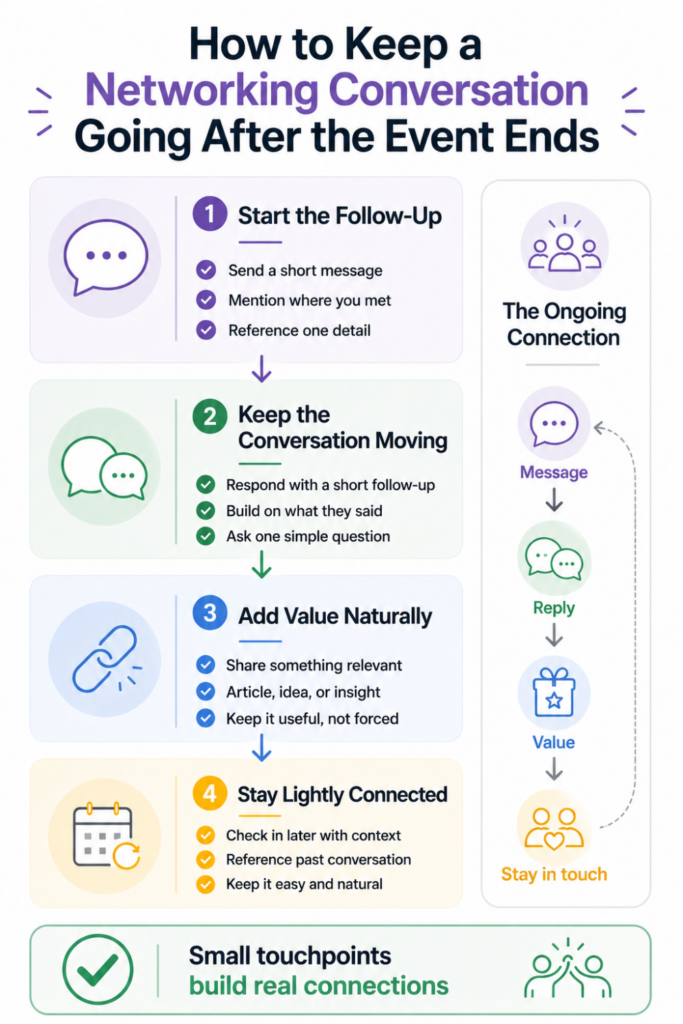
Timing matters more than people think. A strong follow-up sent within a day or two feels thoughtful and natural. A message sent two weeks later often feels like you either forgot, got around to it reluctantly, or are only reaching out now because you want something.
That does not mean you need to message people the second you get into your car. It means you should aim to follow up while the event is still easy for both of you to remember. In most cases, that sweet spot is later the same day, the next morning, or within 48 hours.
The goal of your first message is simple. You want the other person to remember who you are and feel glad you reached out. That is why the best follow-ups usually start with a quick memory trigger instead of a big introduction.
Good memory triggers include:
- where you met
- what you talked about
- a detail they shared
- a moment from the event that stood out
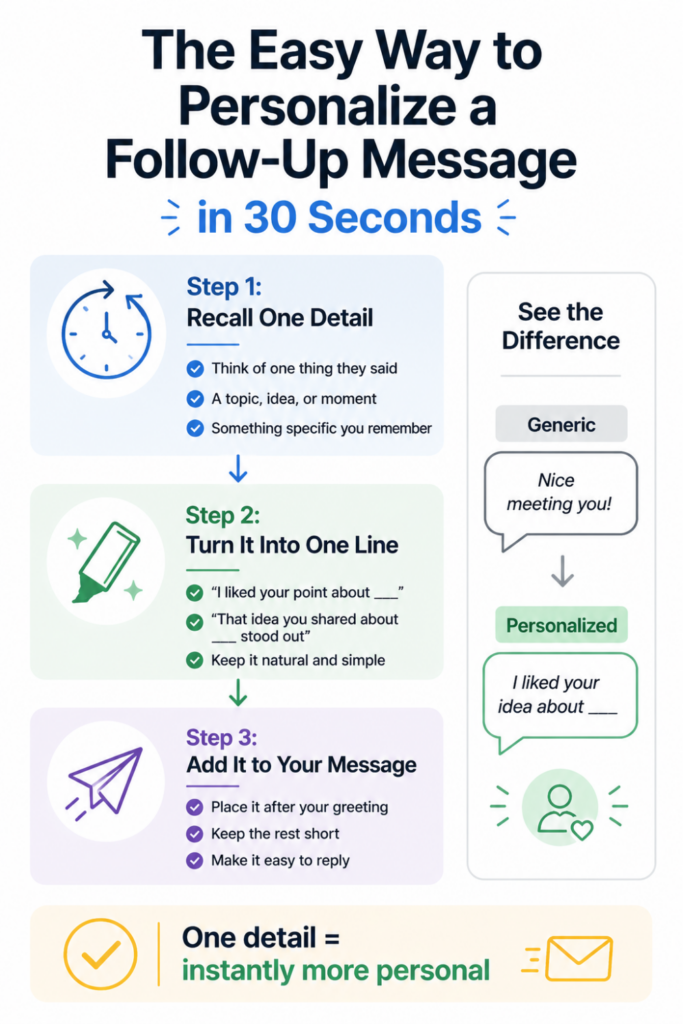
For example, instead of saying, “Hi, it was nice meeting you,” you could say, “Hi Maya, it was great meeting you at Thursday’s marketing panel. I really liked your point about making career pivots without waiting for perfect timing.”
That one extra sentence does a lot of work. It proves the message is not copied and pasted. It helps them place you faster. It also gives the message a warmer tone without adding extra fluff.
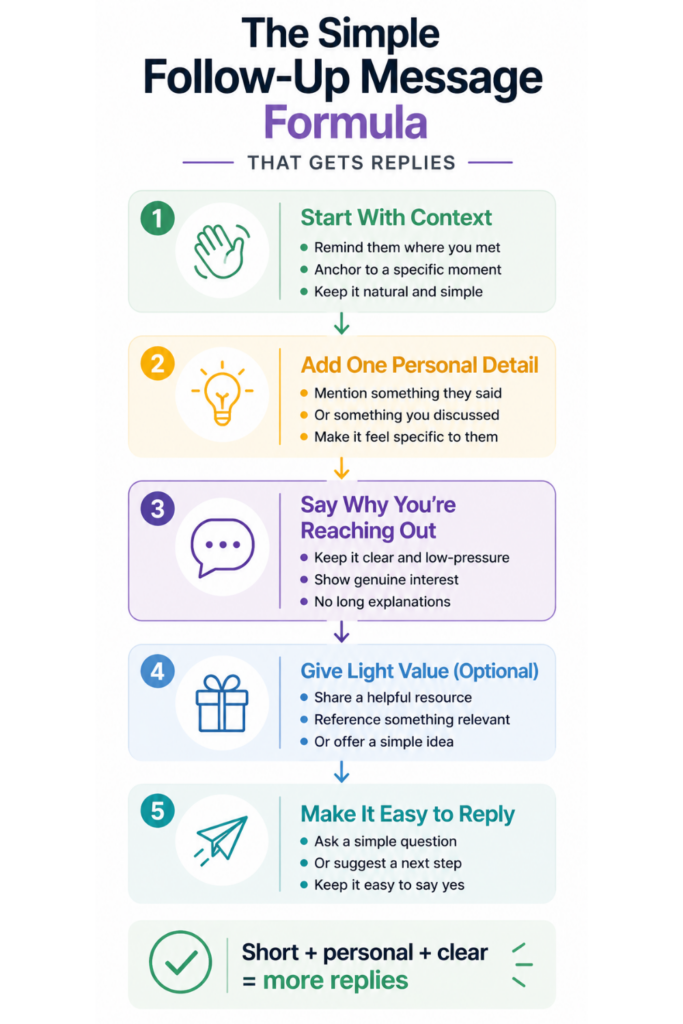
A simple structure works well for almost every first follow-up:
If you want to get more from your life, and are looking for concrete action steps to get you there, check out our Request a Coach page. It’s a “cut the fence-sitting and take action” way to tackle your issues and actually find success. To get off the fence and start to take action, click or tap here.
- greeting with their name
- reminder of where you met
- one specific reference from the conversation
- brief appreciation or interest
- a light next step, if appropriate
Keep the message short. Four to six sentences is plenty. Most people do not need your full background in the first follow-up. They just need enough context to remember you and enough warmth to want to continue the connection.
If you only remember one thing from this section, make it this: send the message while the conversation still has energy. You are not trying to be memorable weeks later. You are trying to keep good momentum from going cold.
Match the message to the type of contact
Not every networking follow-up should sound the same. The message you send to a recruiter should feel different from the one you send to a peer. A weak tie, such as someone you spoke to briefly or someone you know through a mutual connection, also needs a different tone.
This is where many people get stuck. They find one networking template online and try to use it for everyone. The result is usually a message that feels too formal for a peer, too casual for a recruiter, or too intense for someone they barely know.
Start by asking one question: what kind of relationship is this? Once you know that, the tone gets easier.
A recruiter follow-up should usually feel:
- clear
- professional
- concise
- interested, but not pushy
A peer follow-up can be a little more relaxed. You are often reinforcing shared interests, industry common ground, or a conversation that could lead to mutual support later. The tone can sound warmer and more conversational because the relationship is more equal.
A weak-tie follow-up should stay light. Do not write as though you are continuing a deep conversation if you only spoke for three minutes. The safest approach is to acknowledge the brief interaction, mention the point of connection, and open the door without forcing it.
If you want to get more from your life, and are looking for concrete action steps to get you there, check out our Request a Coach page. It’s a “cut the fence-sitting and take action” way to tackle your issues and actually find success. To get off the fence and start to take action, click or tap here.
Think about the difference here:
Recruiter message: “I enjoyed hearing more about your team’s hiring priorities and would love to stay in touch regarding future roles.”
Peer message: “I liked talking with you about how your team handles cross-functional projects. Would be great to stay connected.”
Weak tie message: “We only chatted briefly after the panel, but I appreciated your advice about transitioning into product work.”
The purpose also shifts depending on the contact. With recruiters, you may want to reinforce fit and interest. With peers, you may want to build a professional relationship. With weak ties, you may simply want to keep the connection alive long enough for it to become more useful later.
This is why “nice meeting you” is not enough by itself. It does not tell the reader why you are following up or what kind of connection you are trying to build.
When you match the message to the relationship, your outreach feels more natural. It also makes people more likely to reply because the message sounds like it belongs to the actual interaction you had, not to some generic networking script pulled from a blog post.
Use copy-ready templates that sound human
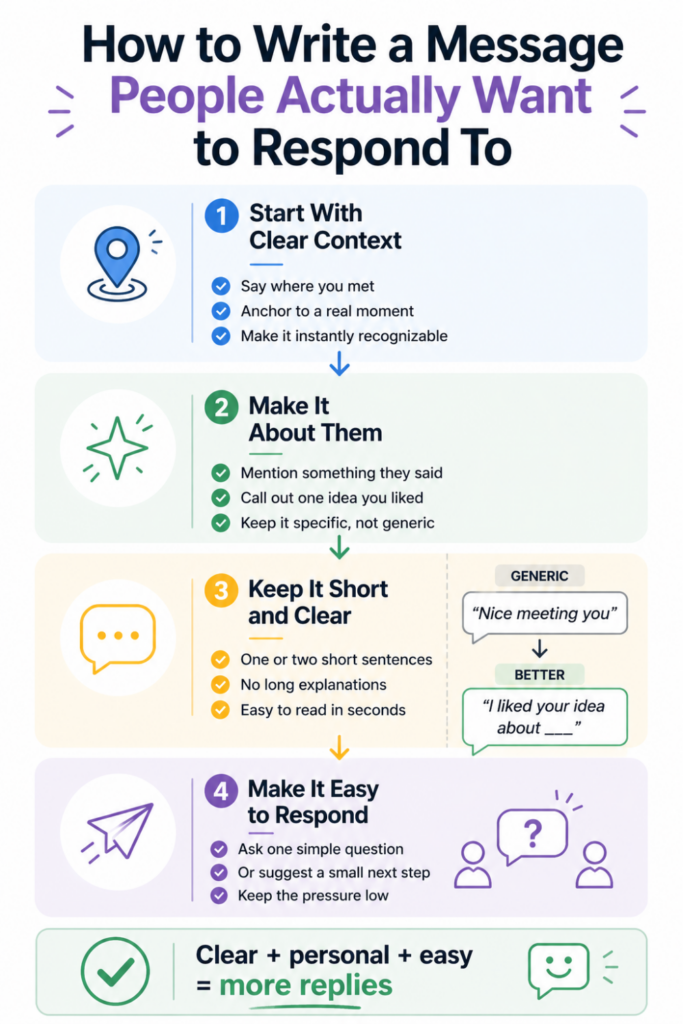
Templates are useful because they remove hesitation. They become a problem when they sound so polished and predictable that the other person can practically hear the copy and paste. The solution is not to avoid templates. It is to use short, flexible ones that leave room for a real detail.
If you want to get more from your life, and are looking for concrete action steps to get you there, check out our Request a Coach page. It’s a “cut the fence-sitting and take action” way to tackle your issues and actually find success. To get off the fence and start to take action, click or tap here.
Here are three practical templates you can adapt after a networking event.
Recruiter follow-up template:
Hi [Name], it was great meeting you at [event]. I enjoyed hearing about [specific detail about their team, role, or company]. Our conversation made me even more interested in [relevant role area or field], and I would love to stay in touch. Thanks again for taking the time to chat.
Why it works: it is direct, professional, and specific. It shows interest without rushing into a request.
Peer follow-up template:
Hi [Name], it was great meeting you at [event]. I really liked our conversation about [shared topic]. It is always refreshing to meet someone thinking about [topic] in such a practical way. Would be great to stay connected and keep in touch.
Why it works: it sounds human and collegial. It leaves the door open without turning the message into a pitch.
Weak-tie follow-up template:
Hi [Name], we spoke briefly at [event] after [panel, talk, session, etc.], and I wanted to say I appreciated your point about [specific detail]. It gave me a lot to think about. Glad we crossed paths, and I hope we can stay connected.
Why it works: it does not pretend the relationship is deeper than it is. It uses a brief connection well.
When you customize a template, focus on these pieces first:
If you want to get more from your life, and are looking for concrete action steps to get you there, check out our Request a Coach page. It’s a “cut the fence-sitting and take action” way to tackle your issues and actually find success. To get off the fence and start to take action, click or tap here.
- where you met
- one specific thing they said
- what made the conversation useful or interesting
- a small, natural next step
You do not need dramatic personalization. One good detail is usually enough.
You can also swap the closing based on your goal:
- “Would love to stay in touch.”
- “Glad to connect.”
- “Would be great to keep in touch.”
- “I hope our paths cross again.”
- “Thanks again for the conversation.”
The biggest mistake with templates is overloading them. A short message with one specific detail feels far more personal than a long message stuffed with formal language. The right template should not make you sound impressive. It should make it easy for someone to remember you and respond.
Make it easy for the other person to reply
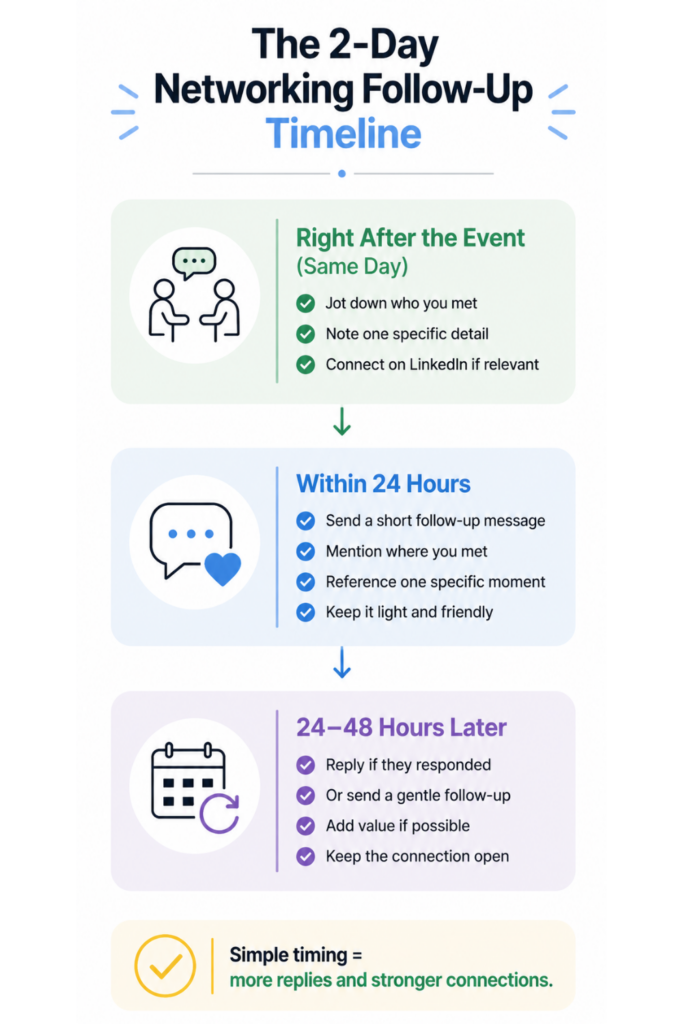
A good follow-up message does not just sound polite. It makes replying feel easy. This is one of the biggest differences between outreach that gets ignored and outreach that starts a conversation.
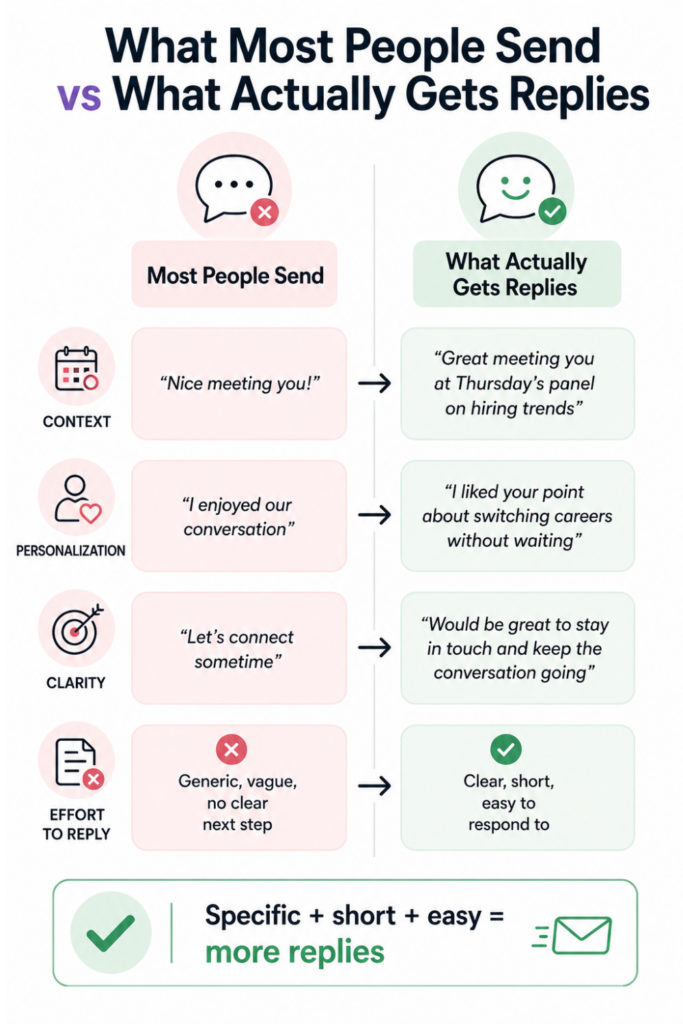
People are much more likely to reply when they know what to do with your message. If your note ends in a vague, floating line like “Let’s connect sometime,” the other person has to decide what that means. Should they offer a meeting? Accept the sentiment? Ignore it unless they want something specific? That uncertainty creates friction.
A better approach is to end with a light, clear next step. Not a huge ask. Just something that gives the conversation shape.
Low-pressure closers include:
- “Would be great to stay connected.”
- “If it is helpful, I would be glad to send over that article I mentioned.”
- “I would love to hear how your team is thinking about this space over the coming months.”
- “Hope we can keep in touch.”
- “If you are open to it, I would love to continue the conversation sometime.”
These work because they are specific enough to guide a response, but not so heavy that the other person feels cornered.
If you want to get more from your life, and are looking for concrete action steps to get you there, check out our Request a Coach page. It’s a “cut the fence-sitting and take action” way to tackle your issues and actually find success. To get off the fence and start to take action, click or tap here.
When people go wrong here, they often jump too quickly. They meet someone once and immediately ask for a referral, a coffee chat, a job lead, or an introduction to someone else. That can work in rare cases, but only when the conversation was unusually strong and the context clearly supports it.
Most of the time, your first goal is not to secure something big. It is to build enough comfort that a second interaction feels normal.
Ask yourself before sending a message:
- Is the next step clear?
- Is it easy to say yes to?
- Does it match how well we actually know each other?
- Does it sound like a conversation, not a demand?
You can also make replies easier by keeping your message visually light. A short message gets read faster. A short message also feels easier to answer. Busy professionals are not usually rejecting people. They are often just responding to what feels simple in the moment.
That is why a short, thoughtful message beats a long, impressive one. If the person can understand who you are, why you are reaching out, and what kind of reply makes sense within a few seconds, you have done your job well.
The easier you make it to respond, the less likely your message is to become one more thing they intend to answer later and never do.
Avoid the mistakes that make people ignore networking follow-ups
Most ignored follow-up messages are not offensive. They are just forgettable, confusing, or slightly uncomfortable. That is why it helps to know the common mistakes before you hit send.
One of the biggest mistakes is sounding generic. If your message could be sent to any person from any event, it probably will not stand out. People can tell when a note was written for “someone” rather than for them.
If you want to get more from your life, and are looking for concrete action steps to get you there, check out our Request a Coach page. It’s a “cut the fence-sitting and take action” way to tackle your issues and actually find success. To get off the fence and start to take action, click or tap here.
Generic lines often sound like this:
- “It was great connecting.”
- “I enjoyed learning about your journey.”
- “Would love to keep in touch.”
- “Looking forward to future opportunities together.”
None of those are terrible. They are just weak when there is no specific detail around them.
Another common mistake is writing too much. People often think that a longer message sounds more thoughtful. In reality, it usually creates more work for the reader. A wall of text can make even a friendly message feel like an obligation.
You also want to avoid overfamiliarity. This happens when the message acts as though you built a close bond after one short conversation. Phrases that are too warm, too intimate, or too enthusiastic can feel off if the connection is new.
Watch out for things like:
- excessive flattery
- language that suggests instant closeness
- emotional oversharing
- acting as though a brief chat was deeply transformative
Another mistake is leading too quickly with need. If the first follow-up immediately asks for a referral, favor, or meeting, it can make the interaction feel transactional. Even if you do want help eventually, the first message usually works better when it focuses on the connection first.
Before sending, check for these red flags:
- no specific reference to the conversation
- message is too long
- tone is too stiff or too familiar
- ask is too big for the stage of the relationship
- message sounds copied and pasted
A useful test is to read the message out loud. If it sounds like a person you know would actually say it, you are probably in good shape. If it sounds like a networking robot trying to seem professional, revise it.
If you want to get more from your life, and are looking for concrete action steps to get you there, check out our Request a Coach page. It’s a “cut the fence-sitting and take action” way to tackle your issues and actually find success. To get off the fence and start to take action, click or tap here.
Good follow-up does not require perfect wording. It just requires enough clarity, warmth, and relevance that the other person feels like replying would be easy and worthwhile.
Turn one message into an ongoing professional relationship
The first follow-up matters, but it is not the whole story. A lot of networking advice makes it sound like everything depends on one perfect message. In reality, relationships are usually built through a few small interactions over time, not one excellent note sent after an event.
That is good news because it takes pressure off. Your first message does not need to secure a job lead, book a call, or create instant rapport. It just needs to keep the connection alive long enough for a second touchpoint to make sense.
This is where many people stop too soon. They send one message, maybe get a polite reply, and then do nothing else. The conversation fades, and a potentially useful contact becomes another name sitting in LinkedIn or your inbox.
A better approach is to think in gentle follow-up layers.
After the first message, a second touchpoint might be:
- replying thoughtfully if they respond
- sending a useful article related to your conversation
- congratulating them on a role change or achievement
- reaching out later when something relevant comes up
- checking in after a few weeks with context
For example, if you talked about career pivots at an event and later see an article on that topic, you could send a short note: “This made me think of our conversation at last month’s event. Thought you might find it interesting.”
That kind of message works well because it feels natural. It builds familiarity without forcing anything. It also shows that your follow-up is not only about immediate gain.
If you want to get more from your life, and are looking for concrete action steps to get you there, check out our Request a Coach page. It’s a “cut the fence-sitting and take action” way to tackle your issues and actually find success. To get off the fence and start to take action, click or tap here.
Consistency matters more than intensity here. One occasional, thoughtful touchpoint is far more effective than an overly eager burst of messages right after the event. You want to create the feeling that staying connected with you is easy and useful, not draining.
Keep your expectations realistic. Not every contact will turn into something meaningful. Some replies will be brief. Some people will not respond at all. That does not mean your follow-up failed. It just means not every connection is meant to develop.
The goal is not to turn every event into a dozen relationships. The goal is to identify the few conversations worth building on and stay present enough that those connections have room to grow. Networking gets much easier when you stop treating follow-up as a single task and start treating it as the beginning of a professional rhythm.
Use a simple tracking system so good contacts do not disappear
A lot of networking problems are really organization problems. People think they are bad at follow-up when the real issue is that they do not have a simple way to remember who they met, what they talked about, or when to reach out again.
You do not need a fancy CRM for this. A spreadsheet, notes app, or simple document is enough. What matters is that you capture useful information quickly, before it fades.
Right after an event, try writing down:
- the person’s name
- where you met
- their role or company
- what you talked about
- any specific detail that stood out
- whether you followed up yet
- a possible next touchpoint
This only takes a few minutes, but it changes everything. Instead of relying on memory, you are creating a small system that makes future follow-up much easier.
You can also group contacts by type. That helps you decide what kind of next step makes sense.
If you want to get more from your life, and are looking for concrete action steps to get you there, check out our Request a Coach page. It’s a “cut the fence-sitting and take action” way to tackle your issues and actually find success. To get off the fence and start to take action, click or tap here.
Simple categories might include:
- recruiters
- peers in your field
- mentors or senior professionals
- weak ties worth keeping warm
- people to reconnect with later
This matters because not every contact needs the same amount of attention. Some people deserve a quick thank-you and a connection request. Others are worth a longer-term effort because the conversation had real relevance.
Setting a reminder also helps. If someone replies warmly but there is no immediate next step, make a note to reach out again in a month or two when you have context. That is often enough to keep momentum going without making the relationship feel forced.
A good tracking system should feel light, not like homework. If it is too complicated, you will stop using it. Keep it simple enough that you can update it after every event in under ten minutes.
This also gives you an advantage over most people. Many attendees leave a networking event with business cards, LinkedIn requests, and vague intentions. Very few have a reliable way to turn those into real follow-up. When you track the basics, you make it much more likely that the right people stay visible long enough for the connection to matter.
A career coach can help you sound confident without sounding fake
Networking advice often assumes that the only problem is information. As if once you know the right template, everything else becomes easy. But for many people, the real challenge is not a lack of information. It is hesitation, second-guessing, and the fear of sounding awkward.
That is where a career coach can help. Not because they will hand you a magical script, but because they can help you build a follow-up style that feels natural for you. That matters more than people realize. Messages get easier when you stop trying to sound like an ideal version of a polished networker and start sounding like a clear, grounded professional.
A coach can help in a few practical ways.
If you want to get more from your life, and are looking for concrete action steps to get you there, check out our Request a Coach page. It’s a “cut the fence-sitting and take action” way to tackle your issues and actually find success. To get off the fence and start to take action, click or tap here.
They can help you:
- figure out what kind of networking conversations are actually worth pursuing
- refine your message tone so it feels warm but professional
- practice common follow-up situations out loud
- create a repeatable post-event routine
- connect your networking efforts to bigger career goals
That last part matters. A lot of people approach networking as random outreach. They go to events, meet people, collect names, and hope something useful happens. A coach can help you become more intentional about it.
For example, they might help you ask:
- Am I trying to build visibility in a new field?
- Am I looking for recruiter relationships?
- Do I need stronger peer connections in my industry?
- Am I following up with the right people, or just anyone I met?
They can also help with accountability. Follow-up is one of those tasks people mean to do, then quietly avoid. Having someone help you create a simple system can make it easier to act while the interaction is still fresh.
This does not mean you need coaching to network well. Plenty of people build strong professional relationships on their own. But if networking repeatedly stalls at the same point, especially after the event when you are left staring at a blank message box, support can make the process feel far less draining.
Sometimes confidence comes less from having the perfect words and more from having a repeatable process. A coach can help you build that process so follow-up stops feeling like a social test and starts feeling like a skill you know how to use.
Start with one message, not a perfect strategy
A good networking follow-up is not about saying something brilliant. It is about making the next step easy. You are reminding the other person where you met, giving them one real detail to hold onto, and opening the door in a way that feels natural.
That is why simple usually wins. A short message with a specific reference will outperform a long, polished message that tries too hard to impress. People respond to relevance, clarity, and ease.
If you want to get more from your life, and are looking for concrete action steps to get you there, check out our Request a Coach page. It’s a “cut the fence-sitting and take action” way to tackle your issues and actually find success. To get off the fence and start to take action, click or tap here.
If you want to make follow-up easier from now on, keep these ideas in mind:
- send the message while the event is still fresh
- match the tone to the kind of contact
- use templates, but personalize one part well
- make the reply feel easy
- avoid sounding generic or transactional
- treat networking as a series of small touchpoints, not one big moment
- keep a simple system so promising contacts do not vanish
You do not need to use every tactic at once. You do not need a perfect spreadsheet, a flawless template library, or a fully developed networking system by tonight. You just need one useful next move.
Think about the last event you attended. There is probably at least one person you meant to message but never did. Start there. Pull up their name, write one line that reminds them where you met, add one specific detail from your conversation, and send a short note.
That one message is often the difference between “I should follow up sometime” and an actual professional connection.
Networking events create possibilities. Follow-up is what turns those possibilities into something real.
*****
Want to try this at home? Download your free template now!
Need some business or career guidance? Drop on by our directories choc full of business coaches and career coaches to bring your business or career to the next level. Or click here to have us match you to the best.
If you want to get more from your life, and are looking for concrete action steps to get you there, check out our Request a Coach page. It’s a “cut the fence-sitting and take action” way to tackle your issues and actually find success. To get off the fence and start to take action, click or tap here.
If you want to get more from your life, and are looking for concrete action steps to get you there, check out our Request a Coach page. It’s a “cut the fence-sitting and take action” way to tackle your issues and actually find success. To get off the fence and start to take action, click or tap here.
Read this next

10 Crucial Job Search Mistakes and How to Avoid Them
Looking for a job? Make sure you aren’t guilty of making any of these crucial job search mistakes.
Read More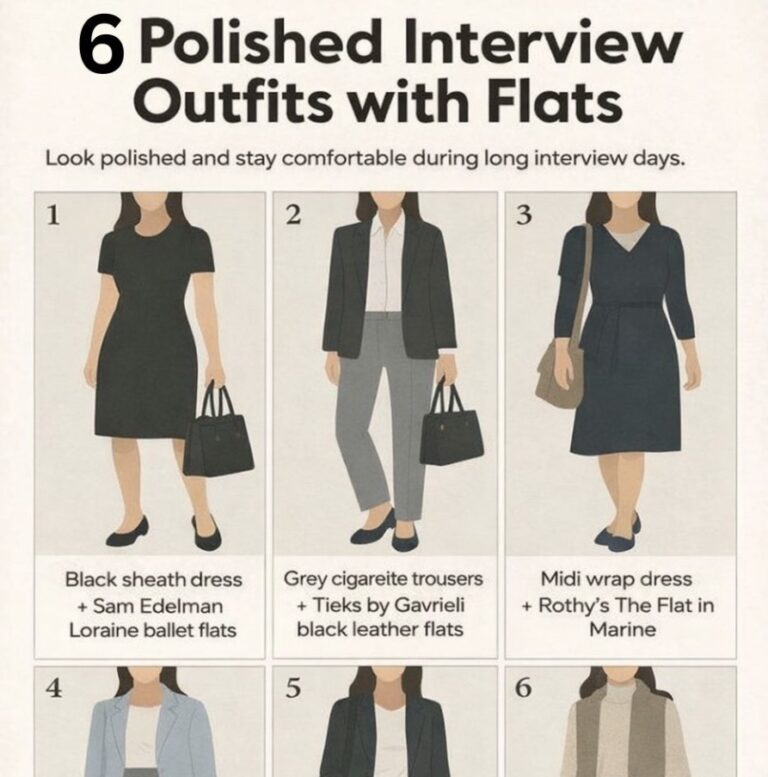
The Best Interview Outfits With Flats When You Need to Walk All Day: 8 Comfy, Polished Looks That Still Mean Business
You want to look sharp at your interview, but you also need shoes that can handle a long walk or hours on your feet. Flats can give you both style […]
Read More
Definitive Coaching Interview Questions Guide (with Do’s and Don’ts from a Life Coach)
How do you impress an interviewer? Knowing good interview questions to ask is key.
Read More