


Four Reasons Why You Should Become a Certified Life Coach
Never discount the impossible while you are trying to become a life coach.
Life coaching is a growth industry. It’s a nice job—you help people identify and overcome their problems. Better still there’s no barrier to entry, it’s perfectly legal to call yourself a life coach and then start selling your services. You can set your own fees and your own working hours, as long as you can win clients. Given that certification is not mandatory for the profession, why should you become a certified life coach?
Key Takeaways
- Certification is not the same as a license. A training certificate, a professional credential such as an ICF credential, and a government-issued professional license represent different things.
- Credentials can strengthen buyer trust. Clients and organizations increasingly look for evidence that a coach has completed serious training and works to recognized professional standards.
- Good training changes how you coach. Observation, feedback, mentor coaching, ethics training, and competency assessment can expose habits and blind spots that experience alone may not reveal.
- Professionalism goes beyond letters after your name. Clear agreements, appropriate boundaries, organized client records, reliable onboarding, and ethical handling of client information also shape how professional your practice feels.
- Certification has the most value when it matches your market. The stronger the credential matters to the clients, organizations, or coaching work you want to pursue, the easier it is to justify the investment.
Do You Need to Be Certified to Be a Life Coach?
You do not automatically need a coaching certification simply to offer life coaching, but certification requirements and legal boundaries depend on where you practice and the services you provide. A life coach certification is also not the same thing as a government-issued professional license.
That does not make certification irrelevant. For a coach building a serious practice, formal training can strengthen coaching skill, provide an ethical framework, and give prospective clients or organizations a recognizable signal that you have invested in learning your profession.
The commercial case is becoming stronger too. According to the 2025 ICF Global Coaching Study, 73% of coaches agreed that clients and organizations increasingly expect coaches to hold credentials and pursue professional development.
What Is the Difference Between Certification, a Credential, and a License?
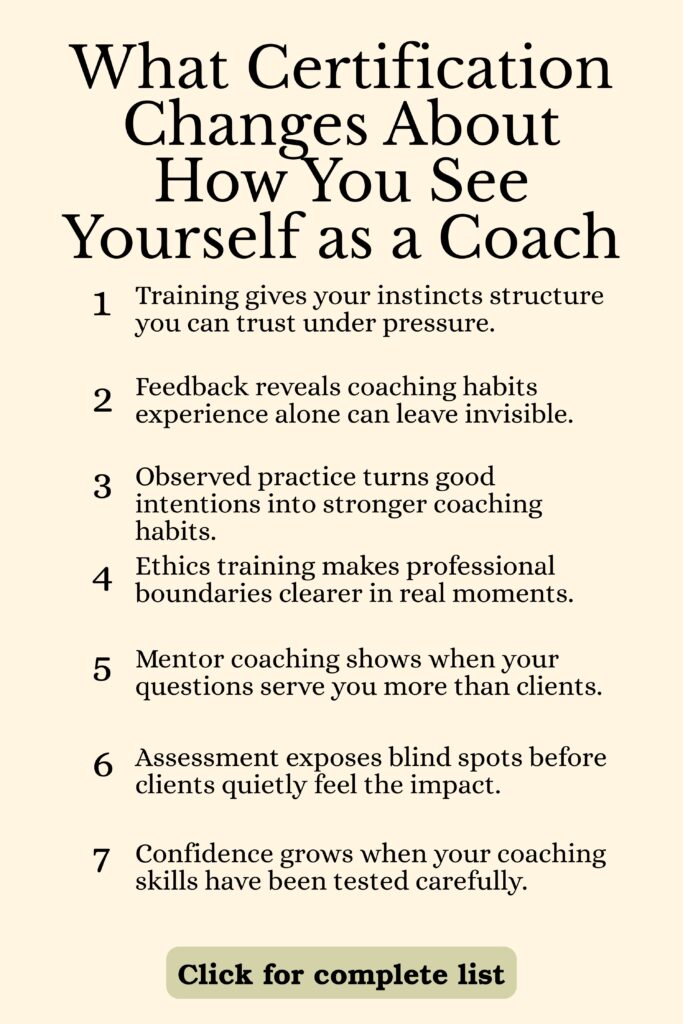
A certification, professional credential, and professional license prove different things, so coaches should not use the terms interchangeably.
SEE ALSO: If you’re a coach looking to streamline your administrative tasks and save time, check out our Coaching Administration Software. It’s a simple, effective solution designed to help you focus less on paperwork and more on what matters—coaching your clients. From scheduling to client management, our software gives you the tools to run your business efficiently. Ready to reclaim your time and boost productivity? Click or tap here.
A training certificate or certification usually shows that you completed the requirements of a particular coach-training program. What that involved can vary substantially between providers.
A professional credential, such as the ICF’s ACC, PCC, or MCC, involves requirements set by an external professional body. The ICF ACC pathway, for example, requires coaching education, client coaching experience, mentor coaching, a performance evaluation, and an examination.
A professional license is different again. It is authorization from a government or regulatory body to practice a regulated profession within its legal scope.
That distinction matters in real life. Completing coach training does not turn a coach into a licensed psychologist, counselor, physician, or other regulated professional. If a client’s needs move outside the coach’s competence or legal scope, a certificate does not remove that boundary.
For a coaching business, use precise language on your website, directory profiles, proposals, and discovery calls. Say what credential or training you actually hold rather than using a broader title that could imply qualifications you do not have.
How Does Certification Build Credibility?
Whilst it’s true that many great coaches have never taken an exam, particularly as life coaches have existed for far longer than certification programs, it’s also true that it’s a competitive profession now. With a huge number of new coaches starting out each year, you want to be considered credible by your clients.
SEE ALSO: If you’re a coach looking to streamline your administrative tasks and save time, check out our Coaching Administration Software. It’s a simple, effective solution designed to help you focus less on paperwork and more on what matters—coaching your clients. From scheduling to client management, our software gives you the tools to run your business efficiently. Ready to reclaim your time and boost productivity? Click or tap here.
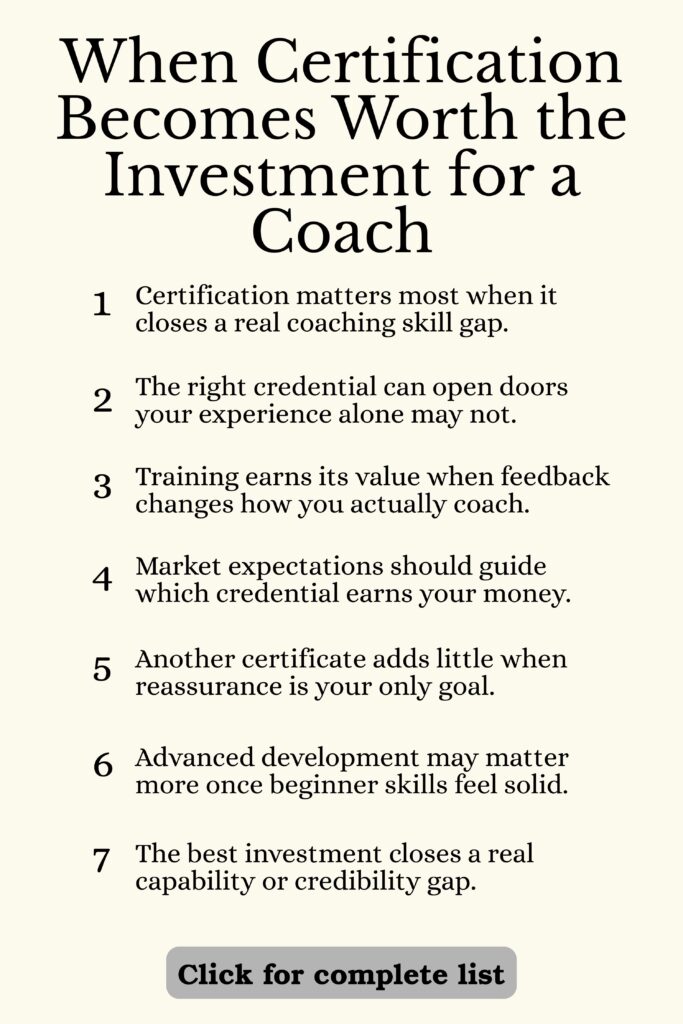
One of the easiest ways to deliver that credibility is to become a certified professional. It shows potential customers that you care enough about your profession to study it in depth, and that someone else (from an academic institution) thinks that you are a professional.
What Does a Coaching Credential Actually Prove?
A reputable coaching credential proves that you have met defined professional requirements, but it does not prove that you are automatically the right coach for every client.
Take the ICF Associate Certified Coach credential as a concrete example. Current ACC requirements include at least 60 hours of coaching education, 100 hours of coaching experience, 10 hours of mentor coaching over at least three months, a performance evaluation, and the ACC examination.
That is much more informative than simply saying a coach “took a course.”
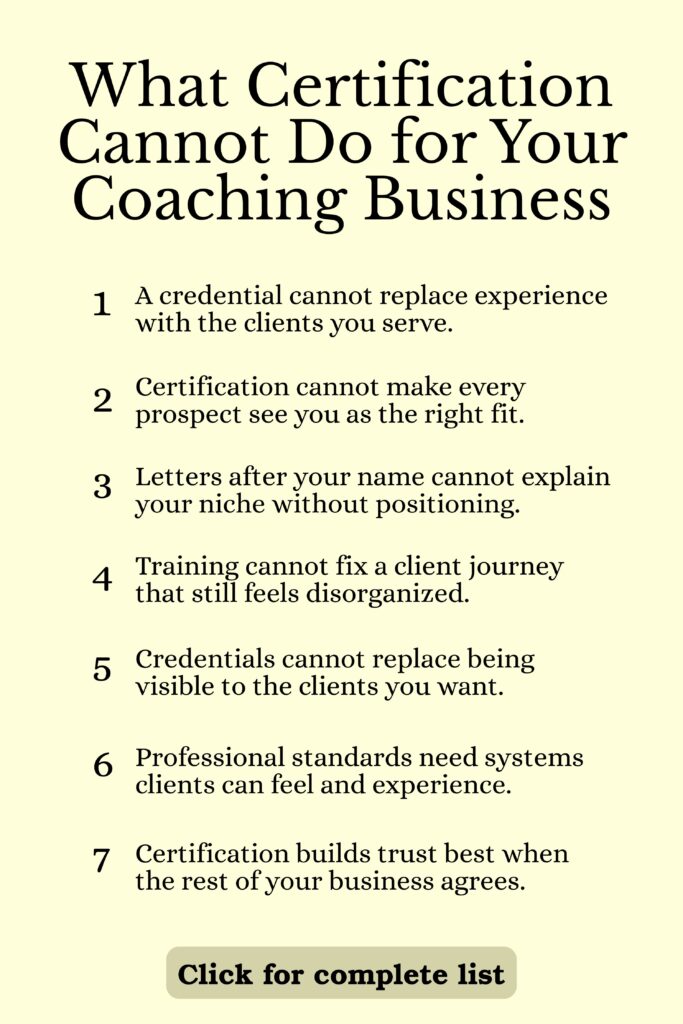
It still does not prove everything a prospective client needs to know. A credential does not automatically establish expertise in career transitions, ADHD coaching, executive leadership, relationships, grief, entrepreneurship, or any other niche.
Imagine two credentialed coaches speaking with a founder who needs help navigating a leadership transition. One has coached founders through 40 similar transitions. The other has never worked with a founder. Both may meet a professional coaching standard, but their fit for this specific client is not identical.
SEE ALSO: If you’re a coach looking to streamline your administrative tasks and save time, check out our Coaching Administration Software. It’s a simple, effective solution designed to help you focus less on paperwork and more on what matters—coaching your clients. From scheduling to client management, our software gives you the tools to run your business efficiently. Ready to reclaim your time and boost productivity? Click or tap here.
Think of a credential as a professional baseline, not a complete buying decision. Your niche experience, coaching approach, boundaries, client fit, and track record still matter.
How Does Certification Improve Your Coaching Skills?
No-one instinctively knows all there is to know about any form of coaching. Life coaching is a huge responsibility; someone is entrusting you to help them through their pressing issues to make a better life for themselves.
One of the big benefits of a certification program is the training that goes along with it.
It helps you understand different methodologies of coaching (when our own preferred techniques don’t work).
It enables you to work with a wider range of clients by understanding the issues they face more deeply.
All professionals need developing, there’s no shame in that – it’s why we have universities and colleges, and why we aren’t all licensed to practice brain surgery too.
What Does Certification Training Actually Require?
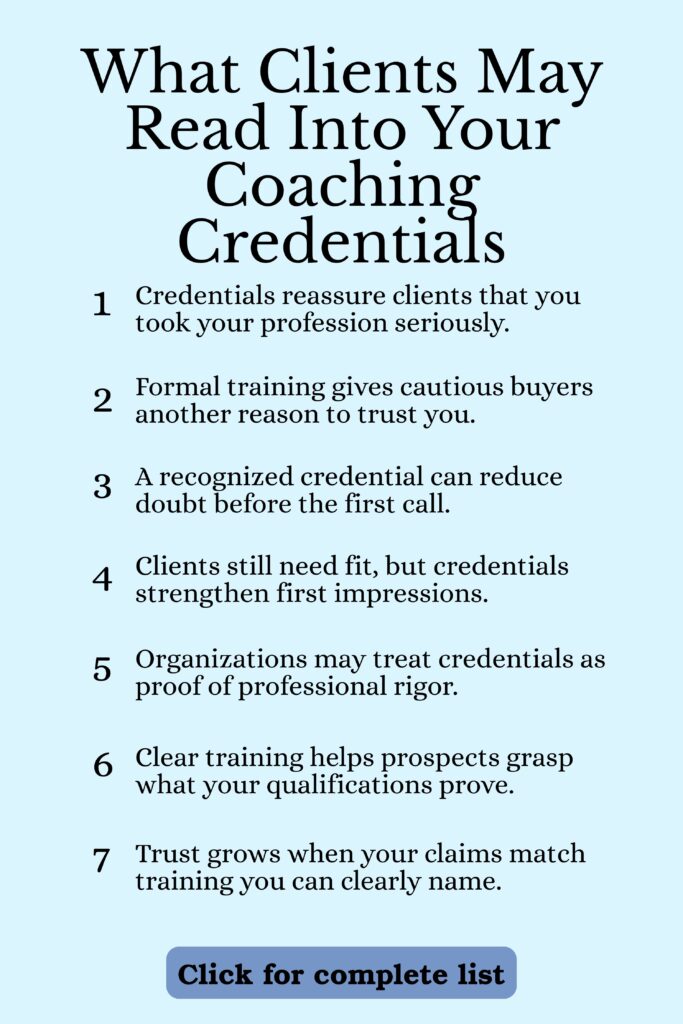
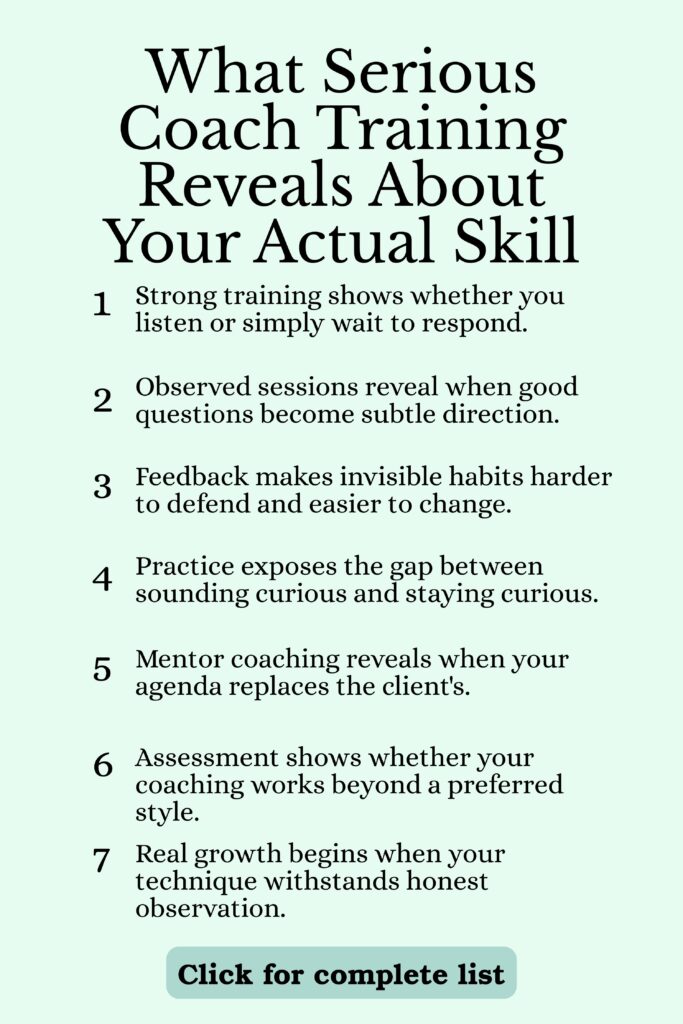
Serious coach training involves practicing coaching and receiving feedback, not simply watching lessons and passing a multiple-choice test.
For example, an ICF-accredited Level 1 education program must provide 60 to 124 coach-specific learning hours. ICF also requires observation and written feedback on five coaching sessions, 10 hours of mentor coaching over at least three months, and a final performance evaluation at the ACC skill level.
SEE ALSO: If you’re a coach looking to streamline your administrative tasks and save time, check out our Coaching Administration Software. It’s a simple, effective solution designed to help you focus less on paperwork and more on what matters—coaching your clients. From scheduling to client management, our software gives you the tools to run your business efficiently. Ready to reclaim your time and boost productivity? Click or tap here.
That feedback loop is one of the most useful parts of structured training.
A new coach may believe they ask powerful questions, then hear a recording and discover that they regularly interrupt the client, steer toward their own solution, or ask three questions at once. Those habits are difficult to correct if nobody skilled is observing the coaching.
Mentor coaching adds another layer. Instead of discussing how to market your practice or organize your week, the focus is your actual coaching behavior. What did you ask? Why did you ask it? Did you follow the client’s agenda or your own? What happened when you stayed curious rather than jumping in with advice?
That is development you can apply in the very next client conversation.
Why Does Your Own Development Matter as a Coach?
A coach helps other people develop. In fact that’s almost certainly part of your sales pitch for your life coaching, “I will help you grow so that you can overcome your problems.” (Or some variant on the theme).
If you know that your mission is to develop others, shouldn’t you be focused on developing yourself as well?
SEE ALSO: If you’re a coach looking to streamline your administrative tasks and save time, check out our Coaching Administration Software. It’s a simple, effective solution designed to help you focus less on paperwork and more on what matters—coaching your clients. From scheduling to client management, our software gives you the tools to run your business efficiently. Ready to reclaim your time and boost productivity? Click or tap here.
That’s congruence—it allows us to walk the walk, as well as talk the talk. Nobody likes to hear; “Do what I say, not what I do!” So your approach needs to be congruent in order to gain your clients’ full trust.
What Ethical Boundaries Should Professional Coaches Know?
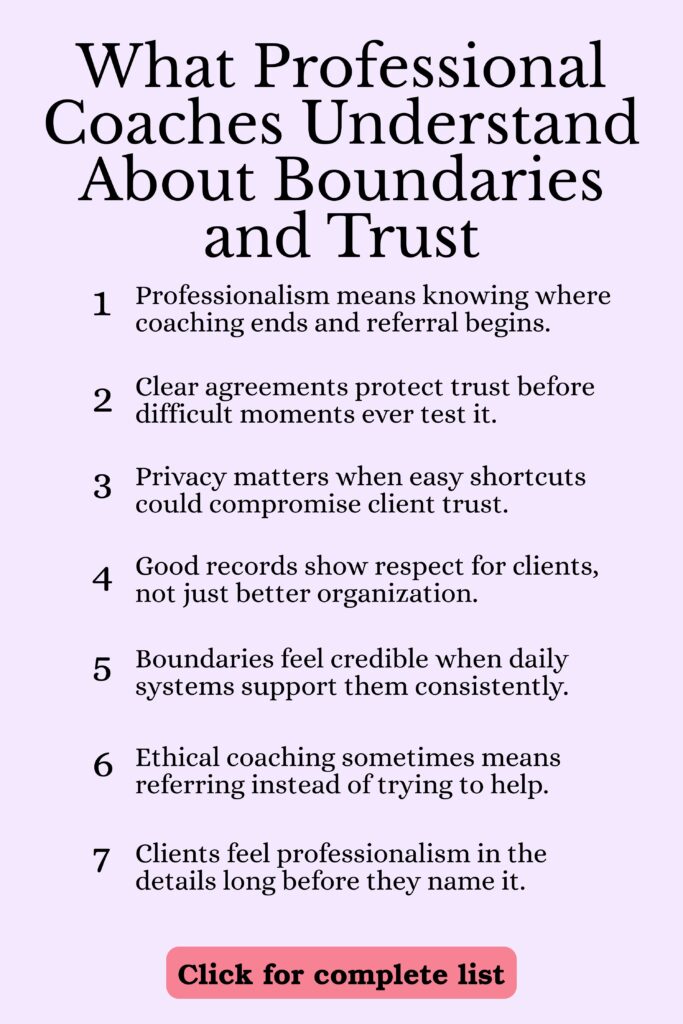
Professional coaches need clear boundaries around agreements, confidentiality, records, conflicts of interest, and the limits of the coaching role.
The current ICF Code of Ethics, effective April 1, 2025, requires ICF professionals to establish coaching agreements, address confidentiality, manage records appropriately, disclose conflicts, and comply with applicable laws and regulations.
These standards become concrete quickly.
Suppose a client starts working with you on career confidence. Several sessions later, the conversation shifts into issues that require a type of clinical assessment or treatment you are not qualified to provide. Professionalism means recognizing that change and staying within your role, not stretching the definition of coaching because the client already trusts you.
The same principle applies to the business side of coaching. Before work begins, the client should know what the coaching relationship covers, what they are paying for, how information will be handled, and what each person is responsible for.
SEE ALSO: If you’re a coach looking to streamline your administrative tasks and save time, check out our Coaching Administration Software. It’s a simple, effective solution designed to help you focus less on paperwork and more on what matters—coaching your clients. From scheduling to client management, our software gives you the tools to run your business efficiently. Ready to reclaim your time and boost productivity? Click or tap here.
A system such as LCH Core can support that operational side after you have decided what your professional policies actually are. Client management keeps client profiles, notes, and intake information organized, while a Welcome Package can include a welcome letter, coaching agreement with electronic signature, and forms. The practical mechanics are covered in the LCH Core Welcome Package guide.
Software cannot decide your ethical boundaries for you. It can make the boundaries and processes you have chosen easier to apply consistently.
How Does Certification Signal Professionalism?
You wouldn’t visit a doctor without certification would you? You wouldn’t want an unqualified builder building your home either. Certification helps us separate the wheat from the chaff in a professional sense.
It’s not that someone without medical training can’t help us with our medical issues, but we’d rather see someone with a degree all the same. We know that when people put in the hard work to certify their abilities, they are more likely to deliver on their promises.
Life coaching is a real profession, it helps many thousands of people every day. In order to be take seriously as professionals, we must get certified.
When Is Life Coach Certification Worth the Time and Cost?
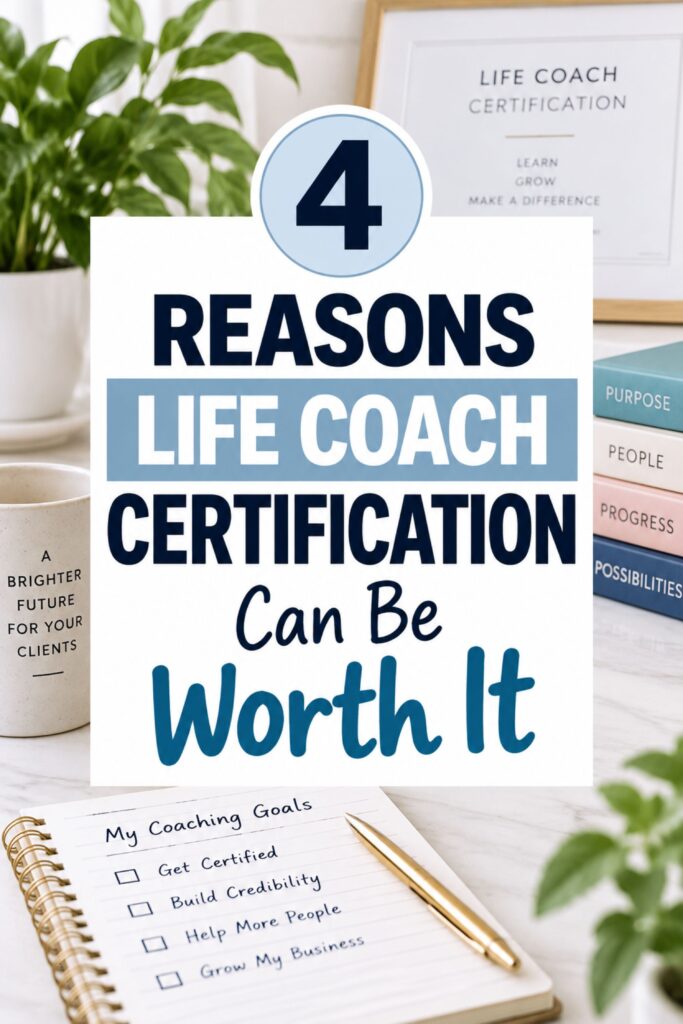
Life coach certification is most worth the investment when it closes a real skills gap, strengthens your credibility with the market you want to serve, or opens access to work that expects formal credentials.
SEE ALSO: If you’re a coach looking to streamline your administrative tasks and save time, check out our Coaching Administration Software. It’s a simple, effective solution designed to help you focus less on paperwork and more on what matters—coaching your clients. From scheduling to client management, our software gives you the tools to run your business efficiently. Ready to reclaim your time and boost productivity? Click or tap here.
A simple way to decide is to test the investment against four questions.
1. Do you need structured coaching skill development?
If you are new to coaching, formal training can give you a framework for listening, questioning, contracting, ethics, feedback, and session practice.
A marketing consultant who has spent 15 years advising businesses, for example, may know a great deal about business. That does not automatically mean they know how to coach without turning every session into consulting.
2. Does your target market care about credentials?
The answer may change according to whom you want to coach.
An individual hiring a coach based on a personal referral may focus heavily on connection, niche experience, and results. An organization assembling a leadership coaching panel may have formal requirements around coaching education or professional credentials.
If the clients you want routinely ask about credentials, the business case becomes much clearer.
SEE ALSO: If you’re a coach looking to streamline your administrative tasks and save time, check out our Coaching Administration Software. It’s a simple, effective solution designed to help you focus less on paperwork and more on what matters—coaching your clients. From scheduling to client management, our software gives you the tools to run your business efficiently. Ready to reclaim your time and boost productivity? Click or tap here.
3. Will the program make you demonstrably better at the work?
Look beyond the certificate itself.
Ask how much observed coaching you will do, who gives feedback, what competencies are assessed, how ethics are taught, and whether mentor coaching is included. A program that forces you to examine your real coaching behavior has a different value from one that mainly gives you content to consume.
4. Are you buying skill or buying reassurance?
A certification can be valuable, but collecting qualifications can become a substitute for actually coaching.
An established coach with strong training and hundreds of client hours may not need another beginner program simply because they feel nervous about raising their fees. Their next development step might be advanced training, supervision, a stronger specialization, or a higher-level credential instead.
The useful question is not, “Will another certificate make me legitimate?”
It is, “What capability, credibility, or opportunity will this specific training add to my coaching business?”
SEE ALSO: If you’re a coach looking to streamline your administrative tasks and save time, check out our Coaching Administration Software. It’s a simple, effective solution designed to help you focus less on paperwork and more on what matters—coaching your clients. From scheduling to client management, our software gives you the tools to run your business efficiently. Ready to reclaim your time and boost productivity? Click or tap here.
How Do You Turn a Coaching Credential Into Client Trust?
A coaching credential builds trust only when prospective clients can see it, understand it, and connect it to the reason they are considering you.
Start with the places where a prospective client is already deciding whether you are credible:
- Your website bio and About page
- Your coach directory profile
- Your discovery-call or booking page
- Proposals for corporate or organizational coaching
- Your email signature and professional profiles
Do not simply add an acronym and assume every prospect knows what it means.
“Jane Smith, PCC” is accurate, but a prospect unfamiliar with coaching credentials may not know why PCC matters. A short explanation such as “ICF Professional Certified Coach” gives them useful context without turning your biography into a credentialing lecture.
Your credential also needs to sit beside evidence of fit. A career coach might pair their credential with the type of career transitions they specialize in. An executive coach might state the leadership levels or organizational situations they regularly coach.
Visibility matters here too. A credential cannot strengthen trust if potential clients never find you. Life Coach Hub offers a free life coach directory listing where you can present your coaching focus and professional background to people looking for coaches.
SEE ALSO: If you’re a coach looking to streamline your administrative tasks and save time, check out our Coaching Administration Software. It’s a simple, effective solution designed to help you focus less on paperwork and more on what matters—coaching your clients. From scheduling to client management, our software gives you the tools to run your business efficiently. Ready to reclaim your time and boost productivity? Click or tap here.
Once someone discovers you, give them a clear next step rather than making them hunt through your site. That principle is part of a wider coaching funnel: visibility creates the introduction, trust gives the prospect a reason to continue, and a clear action moves the relationship forward.
Your credential is strongest when it supports that trust process rather than trying to replace it.
Where LCH Core Fits
Certification helps establish how you coach professionally. Your business systems determine whether clients experience that professionalism consistently.
A coach can have excellent credentials and still send agreements through scattered email threads, lose intake information, forget where session notes live, or make prospects exchange six emails to find a meeting time.
That is a separate problem from training.
Once you have decided how you want your client journey to work, LCH Core can help you run the operational pieces. Client management keeps client profiles, notes, and intake forms together. A Welcome Package can deliver your welcome letter, coaching agreement with electronic signature, and forms. A Public Booking Page gives prospects a direct way to schedule the sessions you make publicly available.
SEE ALSO: If you’re a coach looking to streamline your administrative tasks and save time, check out our Coaching Administration Software. It’s a simple, effective solution designed to help you focus less on paperwork and more on what matters—coaching your clients. From scheduling to client management, our software gives you the tools to run your business efficiently. Ready to reclaim your time and boost productivity? Click or tap here.
If booking is part of your client-getting process, the Public Booking Page setup guide walks through the configuration. The LCH Core tutorial library also covers setup and onboarding workflows.
As coaching progresses, journals, worksheets, goals, action items, and reusable resources can support work between sessions. The Progress Stream and Engagement Report can then help you review client activity and progress instead of relying only on memory from individual calls.
That is also why choosing software should come after deciding what professional client experience you want to create. The guide to choosing coaching software for life coaches goes deeper into the systems a growing coaching practice may need.
Your certification develops the coach. Your processes support the practice. LCH Core is one way to keep those client-facing processes organized once the professional standards behind them are clear.
Frequently Asked Questions About Life Coach Certification
Do you need a certification to become a life coach?
No universal coaching certificate automatically determines whether someone can call themselves a life coach. Legal rules vary by jurisdiction and by the services you provide, so coaches still need to understand the boundaries that apply where they practice.
Certification can nevertheless be valuable for skill development, professional credibility, and markets where clients or organizations expect formal training.
SEE ALSO: If you’re a coach looking to streamline your administrative tasks and save time, check out our Coaching Administration Software. It’s a simple, effective solution designed to help you focus less on paperwork and more on what matters—coaching your clients. From scheduling to client management, our software gives you the tools to run your business efficiently. Ready to reclaim your time and boost productivity? Click or tap here.
Is life coaching regulated or licensed?
Life coaching is not the same as a licensed profession such as psychology, medicine, or certain counseling professions. A life coach certification therefore should not be presented as though it grants a clinical or government-issued professional license.
Coaches should check the laws that apply in their own jurisdiction and avoid offering regulated services for which they are not qualified.
What is the difference between life coach certification and an ICF credential?
A life coach certification usually shows that you completed a particular training provider’s program, while an ICF credential verifies that you met ICF’s separate requirements for education, coaching experience, mentor coaching, assessment, and examination.
The exact value of a training certificate therefore depends heavily on the program behind it.
Is ICF certification worth it for life coaches?
An ICF credential can be worth pursuing when you want a widely recognized professional standard, stronger external validation of your coaching skills, or access to clients and organizations that value formal credentials.
Technically, ICF awards professional credentials such as ACC, PCC, and MCC rather than simply certifying attendance at a training course.
SEE ALSO: If you’re a coach looking to streamline your administrative tasks and save time, check out our Coaching Administration Software. It’s a simple, effective solution designed to help you focus less on paperwork and more on what matters—coaching your clients. From scheduling to client management, our software gives you the tools to run your business efficiently. Ready to reclaim your time and boost productivity? Click or tap here.
How long does it take to become a certified life coach?
The time required depends on the program and the credential you are pursuing. Completing coach education may take months, while earning a professional credential can take longer because experience, mentor coaching, assessment, and examination requirements also have to be completed.
For example, an ICF ACC requires both education and 100 hours of coaching experience.
What should you look for in a life coach certification program?
Look for substantial coaching practice, observed sessions, qualified feedback, ethics training, mentor coaching, clear competency standards, and transparent assessment requirements.
Do not choose solely by course length, price, or how impressive the certificate looks. Ask what you will actually have demonstrated by graduation.
Can you get coaching clients without being certified?
Yes, coaches can attract clients through specialization, referrals, experience, visibility, trust, and a strong fit with the client’s needs.
Certification adds another trust signal. It should strengthen your positioning, not substitute for becoming findable, explaining whom you help, and demonstrating relevant expertise.
SEE ALSO: If you’re a coach looking to streamline your administrative tasks and save time, check out our Coaching Administration Software. It’s a simple, effective solution designed to help you focus less on paperwork and more on what matters—coaching your clients. From scheduling to client management, our software gives you the tools to run your business efficiently. Ready to reclaim your time and boost productivity? Click or tap here.
What are ACC, PCC, and MCC coaching credentials?
ACC, PCC, and MCC are the International Coaching Federation’s Associate Certified Coach, Professional Certified Coach, and Master Certified Coach credentials.
They represent progressively higher requirements for coaching education and experience. Coaches should check ICF’s current requirements directly because credentialing rules and application procedures can change.
Want to Understand the ICF Credential Path?
The current ICF education system centers on Level 1, Level 2, and Level 3 accredited education, while older terms such as ACTP and ACSTH now describe legacy education routes that some coaches may still have in their training history.
For a deeper explanation of how those terms fit together, see How to Get ICF Certification: Level 1, 2, ACSTH, ACTP, CCE, Making Sense of it All. Because ICF requirements continue to evolve, compare any credentialing guidance with ICF’s current official requirements before making a training decision.
Interested in ICF Training?
Check out our comprehensive guide, How to Get ICF Certification: Level 1, 2, ACSTH, ACTP, CCE, Making Sense of it All
Sources
International Coaching Federation. “2025 ICF Global Coaching Study Executive Summary.” International Coaching Federation, 2025. Accessed 15 Sept. 2026. 2025 ICF Global Coaching Study Executive Summary.
SEE ALSO: If you’re a coach looking to streamline your administrative tasks and save time, check out our Coaching Administration Software. It’s a simple, effective solution designed to help you focus less on paperwork and more on what matters—coaching your clients. From scheduling to client management, our software gives you the tools to run your business efficiently. Ready to reclaim your time and boost productivity? Click or tap here.
International Coaching Federation. “Associate Certified Coach (ACC).” International Coaching Federation. Accessed 15 Sept. 2026. Associate Certified Coach credential requirements.
International Coaching Federation. “Coach Education Accreditation: Level 1 Accreditation.” International Coaching Federation. Accessed 15 Sept. 2026. ICF Level 1 accreditation requirements.
International Coaching Federation. “ICF Code of Ethics.” International Coaching Federation, effective 1 Apr. 2025. Accessed 15 Sept. 2026. ICF Code of Ethics.
Read this next

How to Become a Certified Life Coach
Want to be a life coach? Find out how you can easily choose the right program without becoming overwhelmed.
Read More
How is Christian Life Coach Training Any DIfferent?
Is Christian Life Coach Training really any different than your typical Life Coach Training?
Read More
What Becoming an ICF Certified Life Coach Means
What does it mean to become certified by the International Coach Federation (ICF)?
Read More