







Good Listening Habits to Develop as a Coach

Become a more effective listener by strengthening three core habits: positioning, summarizing, and thoughtful mirroring. These simple techniques help you stay focused on the words, tone, patterns, and shifts that can tell you far more than simply hearing what a client says.
Good listening is not about sitting silently until it is your turn to speak. It is about understanding enough of what your client means that your next response moves the conversation somewhere useful.
Key Takeaways
- Effective listening goes beyond hearing words. Strong coaches pay attention to language, emotion, tone, behavior, energy shifts, and recurring patterns before deciding what to ask next.
- Your physical setup affects your attention. Reducing distractions and giving the client your visible attention makes it easier to stay with difficult, detailed, or emotionally significant conversations.
- Summaries should test your understanding. A useful summary gives the client a chance to confirm, correct, or add to what you think you heard rather than simply repeating their words.
- Mirroring should feel like attunement, not imitation. Adjusting naturally to a client’s pace and communication style can support connection, but obvious copying can become distracting or uncomfortable.
- Deep listening should lead to better questions and client-owned action. Listen first, reflect what matters, clarify anything uncertain, then ask the question that helps the client think further.
What Are Good Listening Habits for Coaches?
Good listening habits for coaches include removing distractions, listening for both words and nonverbal information, reflecting or summarizing what the client has communicated, checking your interpretation, noticing recurring patterns, and responding with questions that follow the client’s thinking rather than your own agenda.
The International Coaching Federation’s 2025 Core Competencies describes active listening as focusing on both what the client says and what they do not say. It specifically includes reflecting or summarizing, noticing emotions and energy shifts, considering nonverbal cues, integrating words with tone and body language, and recognizing patterns across sessions.
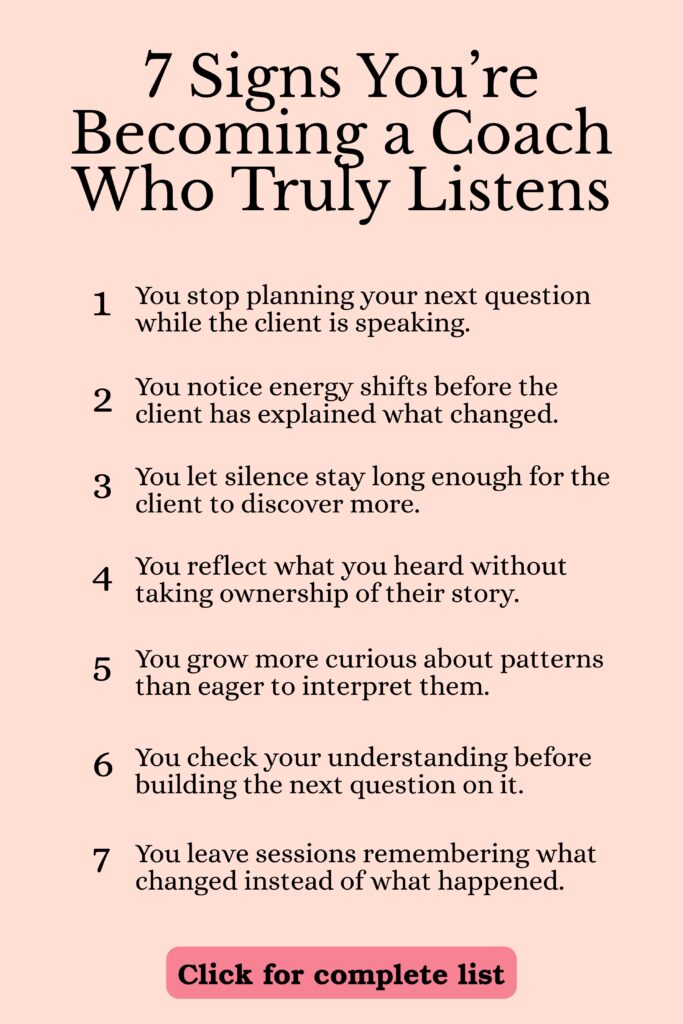
In practice, that means good listening follows a simple sequence: listen, reflect, clarify, then respond. You do not need to analyze every gesture or turn every statement into a technique. You need to stay close enough to the client’s experience that your response grows from what is actually happening in the conversation.
How Should You Position Yourself to Listen Better?
Your physical setup should make it easier for you to give the client your full attention, not force you into a particular coaching pose.
SEE ALSO: If you’re a coach looking to streamline your administrative tasks and save time, check out our Coaching Administration Software. It’s a simple, effective solution designed to help you focus less on paperwork and more on what matters—coaching your clients. From scheduling to client management, our software gives you the tools to run your business efficiently. Ready to reclaim your time and boost productivity? Click or tap here.
Sit where you can see and hear your client comfortably. In an in-person session, avoid putting unnecessary physical barriers between you if they make the conversation feel formal or distant. In an online session, position the camera and screen so you are not constantly looking away to find notes, windows, or controls.
Comfort matters too. If you are too hot, uncomfortable, distracted by notifications, or shifting constantly in your seat, part of your attention is being spent somewhere other than the conversation.
The brain can shoot off in any direction surprisingly quickly. That becomes particularly noticeable when a client is explaining something complicated or sharing something that has taken effort to say.
You do not need to sit completely still. You do need to create conditions where you can stay present.
A useful test is simple: Can you remain with the client’s train of thought for several minutes without needing to mentally reconstruct what they just told you?
If not, remove something from the environment before trying to add another listening technique.
SEE ALSO: If you’re a coach looking to streamline your administrative tasks and save time, check out our Coaching Administration Software. It’s a simple, effective solution designed to help you focus less on paperwork and more on what matters—coaching your clients. From scheduling to client management, our software gives you the tools to run your business efficiently. Ready to reclaim your time and boost productivity? Click or tap here.
What Should You Listen for Beyond the Client’s Words?
Listen on three levels at once: content, emotion, and pattern.
The first level is content. What actually happened? Who was involved? What decision does the client face? What facts or assumptions are shaping the situation?
The second level is emotion and energy. Notice changes rather than trying to diagnose them. A client may begin speaking faster when discussing one possibility, go quiet when another option comes up, laugh while describing something that does not sound funny, or repeatedly soften a statement with “I don’t know.”
You do not need to decide what that behavior means. You can notice it and ask.
For example:
“You slowed down when you started talking about leaving the role. What came up for you just then?”
SEE ALSO: If you’re a coach looking to streamline your administrative tasks and save time, check out our Coaching Administration Software. It’s a simple, effective solution designed to help you focus less on paperwork and more on what matters—coaching your clients. From scheduling to client management, our software gives you the tools to run your business efficiently. Ready to reclaim your time and boost productivity? Click or tap here.
That is very different from:
“You’re obviously afraid to leave.”
The first gives the observation back to the client. The second turns your interpretation into a conclusion.
The third level is pattern. Listen for words, conflicts, values, or situations that keep returning.
Imagine a leadership coach whose client repeatedly says she wants more authority at work. Over three sessions, however, she also describes avoiding difficult conversations, postponing decisions, and asking her manager to approve choices that are already within her remit.
The pattern may be more useful than any single statement.
SEE ALSO: If you’re a coach looking to streamline your administrative tasks and save time, check out our Coaching Administration Software. It’s a simple, effective solution designed to help you focus less on paperwork and more on what matters—coaching your clients. From scheduling to client management, our software gives you the tools to run your business efficiently. Ready to reclaim your time and boost productivity? Click or tap here.
You might say:
“I’ve heard you talk several times about wanting more authority. I’ve also noticed that when a decision carries some risk, you tend to move it back to your manager. What do you make of that?”
Now the client has something concrete to examine.
This closely matches the ICF approach to active listening, which includes recognizing emotion and energy shifts, integrating words with tone and body language, and noticing recurring behaviors across sessions.
How Do You Summarize Without Sounding Like a Parrot?
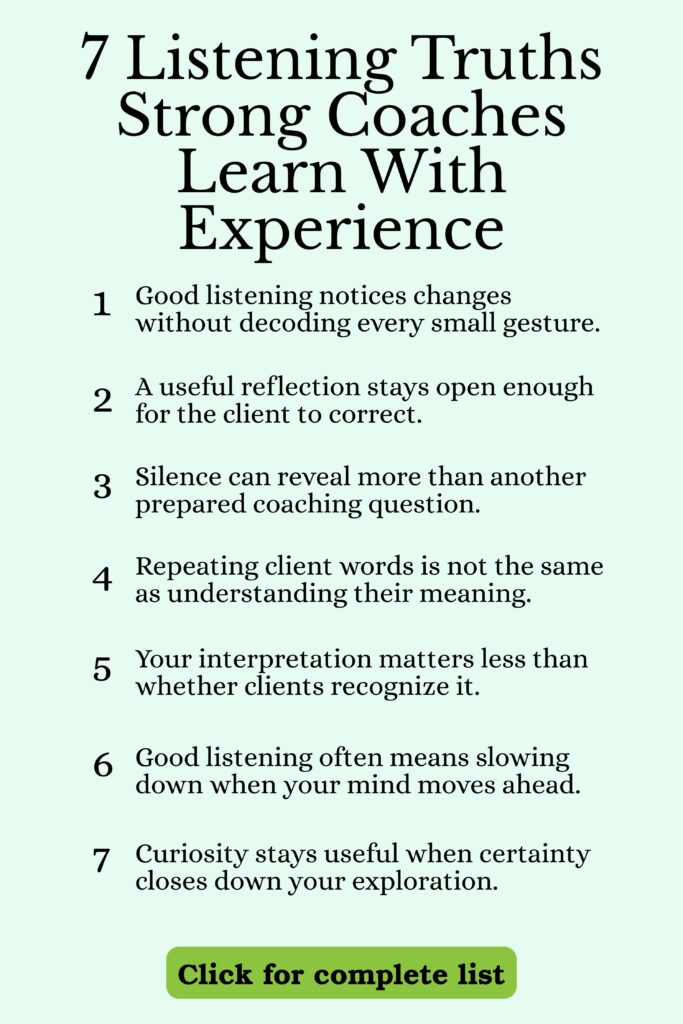
A good summary captures meaning, not just wording.
At comfortable intervals, pull together what you believe the client has said and offer it back in simpler language. Then leave enough space for them to correct you.
SEE ALSO: If you’re a coach looking to streamline your administrative tasks and save time, check out our Coaching Administration Software. It’s a simple, effective solution designed to help you focus less on paperwork and more on what matters—coaching your clients. From scheduling to client management, our software gives you the tools to run your business efficiently. Ready to reclaim your time and boost productivity? Click or tap here.
For example:
“So you don’t dislike the job itself. What is wearing you down is feeling responsible for the team’s results without having the authority to make the decisions that affect them. Have I got that right?”
That sounds very different from repeating several of the client’s sentences almost word for word.
Speak slowly enough that the client can interrupt, amend, or add something.
That pause is useful for you too. It gives you a moment to organize what you have heard without mentally leaving the conversation to plan your next brilliant question.
Summarizing was something I did not consciously think about until I took my counseling course. Watching the tutor use the strategy at first looked rather like watching someone repeat things parrot fashion.
SEE ALSO: If you’re a coach looking to streamline your administrative tasks and save time, check out our Coaching Administration Software. It’s a simple, effective solution designed to help you focus less on paperwork and more on what matters—coaching your clients. From scheduling to client management, our software gives you the tools to run your business efficiently. Ready to reclaim your time and boost productivity? Click or tap here.
With practice, the distinction became much clearer. A strong summary does not merely prove that you remember the conversation. It helps both people see the shape of the conversation.
Sometimes the client will say, “Yes, exactly.”
Sometimes they will say, “Almost, but that’s not quite it.”
The second response is just as useful.
You have discovered where your understanding and the client’s meaning separated, which gives you something worth clarifying before you go any further.
What’s the Difference Between Summarizing, Paraphrasing, and Reflecting?
Paraphrasing captures one idea, summarizing connects several ideas, and reflecting brings attention to the emotion or significance that may sit underneath them.
SEE ALSO: If you’re a coach looking to streamline your administrative tasks and save time, check out our Coaching Administration Software. It’s a simple, effective solution designed to help you focus less on paperwork and more on what matters—coaching your clients. From scheduling to client management, our software gives you the tools to run your business efficiently. Ready to reclaim your time and boost productivity? Click or tap here.
Suppose a client says:
“I was offered the promotion, which is what I’ve been working toward for two years. But now that it’s here, all I can think about is how much more responsibility I’ll have. Everyone keeps congratulating me, so I feel ridiculous even questioning it.”
A paraphrase might be:
“You finally got the promotion you wanted, but now you’re unsure whether you actually want what comes with it.”
A summary might be:
“You spent two years working toward this promotion. Now that you have the opportunity, you’re weighing the achievement against the extra responsibility, while also feeling pressure to be pleased because everyone around you sees it as good news.”
SEE ALSO: If you’re a coach looking to streamline your administrative tasks and save time, check out our Coaching Administration Software. It’s a simple, effective solution designed to help you focus less on paperwork and more on what matters—coaching your clients. From scheduling to client management, our software gives you the tools to run your business efficiently. Ready to reclaim your time and boost productivity? Click or tap here.
A reflection might be:
“It sounds as though part of you feels you are not allowed to be uncertain about something you worked so hard to get.”
Each does a different job.
The paraphrase checks the central meaning. The summary organizes several strands. The reflection puts possible significance on the table for the client to accept, reject, or refine.
The goal is never to prove how perceptive you are. The goal is accuracy.
When a phrase, concern, or recurring pattern is likely to matter later, it can also help to record it rather than expecting yourself to remember it across a full client load. In LCH Core, client profiles and notes can keep those details connected to the client record. The support guide to taking and sending coaching notes shows how notes can be used around individual sessions.
SEE ALSO: If you’re a coach looking to streamline your administrative tasks and save time, check out our Coaching Administration Software. It’s a simple, effective solution designed to help you focus less on paperwork and more on what matters—coaching your clients. From scheduling to client management, our software gives you the tools to run your business efficiently. Ready to reclaim your time and boost productivity? Click or tap here.
Should Coaches Mirror and Match Their Clients?
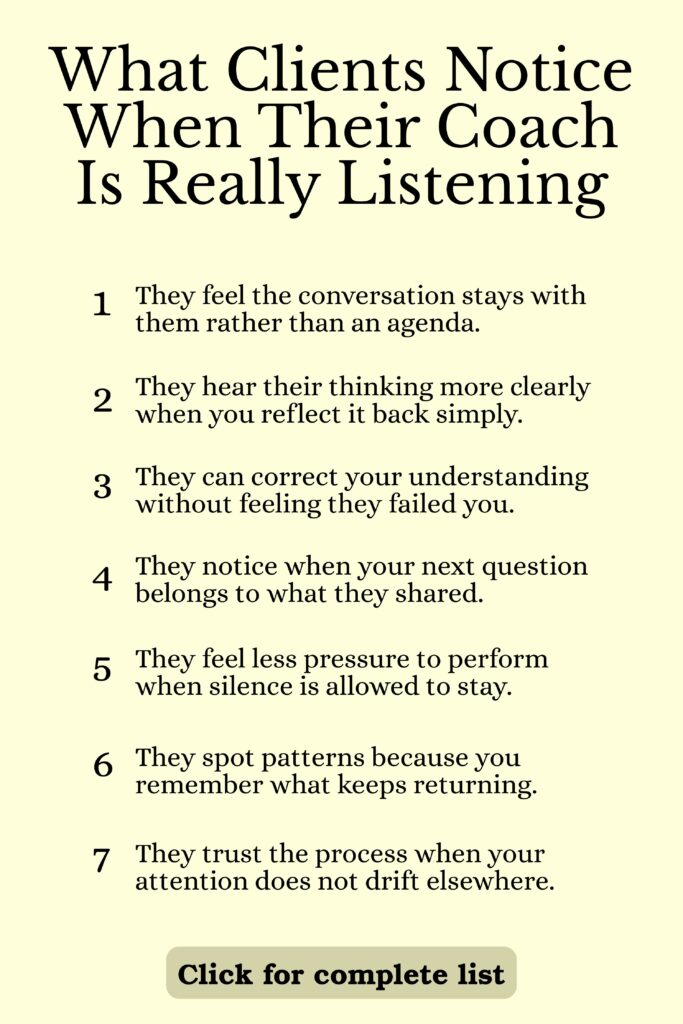
Coaches can adjust naturally to a client’s communication style, but mirroring should never become obvious imitation.
Mirroring and matching are often discussed in NLP as ways of building rapport through posture, behavior, pace, tone, or language. The useful part of that idea is attentiveness. When you are genuinely engaged with another person, some adjustment often happens naturally.
Someone speaking slowly and thoughtfully may find a rapid barrage of questions jarring. Someone who is animated and thinking out loud may find an extremely slow interaction equally unnatural.
You can respond to that without copying them.
Matching pace might mean leaving more silence for a reflective client.
Matching language might mean using the client’s own important words instead of immediately translating everything into your vocabulary.
SEE ALSO: If you’re a coach looking to streamline your administrative tasks and save time, check out our Coaching Administration Software. It’s a simple, effective solution designed to help you focus less on paperwork and more on what matters—coaching your clients. From scheduling to client management, our software gives you the tools to run your business efficiently. Ready to reclaim your time and boost productivity? Click or tap here.
Matching energy might mean recognizing that a normally enthusiastic client has become unusually flat and asking what has changed.
That is different from crossing your legs because they crossed theirs or deliberately touching your face because they touched theirs.
The aim is connection, not choreography.
When Does Mirroring Help, and When Can It Backfire?
Mirroring is most useful when it means subtle attunement to how the client is communicating, and least useful when it turns into a technique the client can feel being performed on them.
A coach who becomes so focused on matching posture, breathing, vocabulary, or gestures can stop doing the one thing the technique was supposed to improve: listening.
It can also create false certainty.
SEE ALSO: If you’re a coach looking to streamline your administrative tasks and save time, check out our Coaching Administration Software. It’s a simple, effective solution designed to help you focus less on paperwork and more on what matters—coaching your clients. From scheduling to client management, our software gives you the tools to run your business efficiently. Ready to reclaim your time and boost productivity? Click or tap here.
You might notice that a client folded their arms just as a particular subject came up. That is an observation. It does not automatically mean they became defensive.
Maybe they were cold.
Maybe the chair was uncomfortable.
Maybe that is simply how they sit.
Instead of interpreting the movement for them, connect it with the conversation only when there is a useful reason to ask.
“I noticed you became much quieter when we moved onto that subject. Is there something happening there that would be useful to stay with?”
SEE ALSO: If you’re a coach looking to streamline your administrative tasks and save time, check out our Coaching Administration Software. It’s a simple, effective solution designed to help you focus less on paperwork and more on what matters—coaching your clients. From scheduling to client management, our software gives you the tools to run your business efficiently. Ready to reclaim your time and boost productivity? Click or tap here.
That preserves curiosity.
It is also worth separating useful listening practices from bigger claims sometimes made about NLP. A systematic review by Jackie Sturt and colleagues examined experimental research on NLP and health-related outcomes. The researchers concluded that there was little evidence of improved health outcomes and that the quantity and quality of the available research were limited. The review did not specifically test ordinary coaching mirroring, but it is a good reason not to present broad NLP claims as settled science.
Use the part that survives the common-sense test: pay close attention, notice how the client communicates, adapt enough to make the conversation easier to enter, and remain curious about what your observations actually mean.
What Should You Do When You Miss or Misunderstand Something?
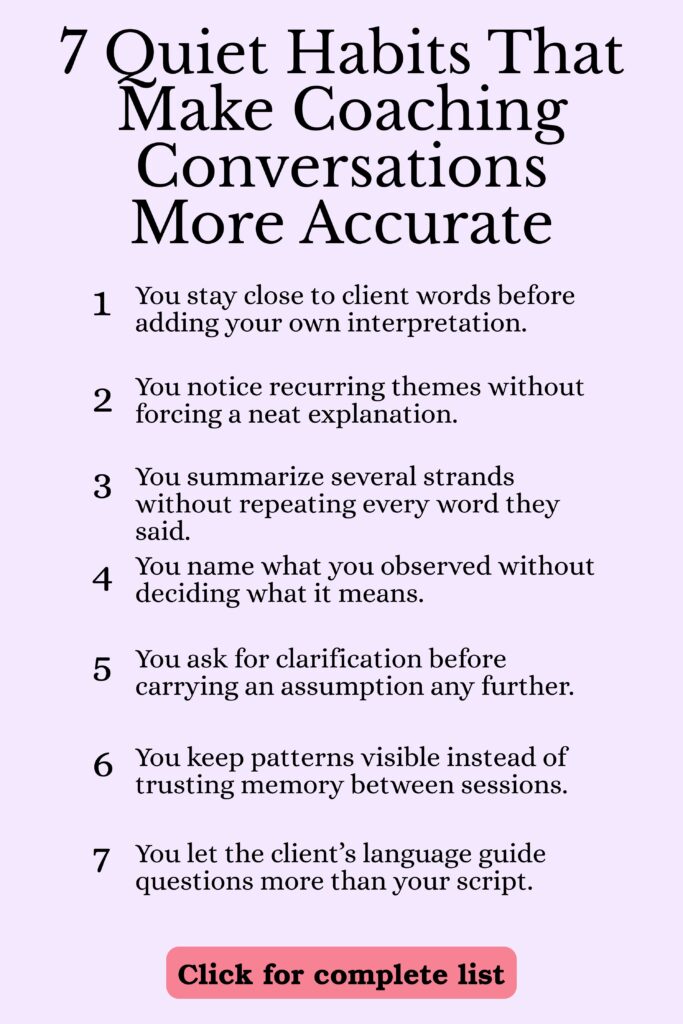
Repair the misunderstanding quickly, simply, and without pretending you understood something you did not.
Every coach will occasionally lose the thread, mishear a phrase, or interpret a client’s meaning incorrectly. The problem is not needing clarification. The bigger problem is carrying an incorrect assumption through the next twenty minutes of the session.
Use a four-step repair:
SEE ALSO: If you’re a coach looking to streamline your administrative tasks and save time, check out our Coaching Administration Software. It’s a simple, effective solution designed to help you focus less on paperwork and more on what matters—coaching your clients. From scheduling to client management, our software gives you the tools to run your business efficiently. Ready to reclaim your time and boost productivity? Click or tap here.
Acknowledge it.
“I think I may have misunderstood that.”
Check the specific point.
“When you said you were ready to leave, did you mean leave the company or leave your current position?”
Let the client correct you.
Do not rush to fill the silence or explain why you misunderstood.
Continue from the corrected meaning.
“Got it. So the company still feels right, but this particular role doesn’t.”
This becomes even more important when the subject is difficult for the client.
If they have just said something significant and you genuinely missed part of it, avoid a vague “Can you repeat all that?”
SEE ALSO: If you’re a coach looking to streamline your administrative tasks and save time, check out our Coaching Administration Software. It’s a simple, effective solution designed to help you focus less on paperwork and more on what matters—coaching your clients. From scheduling to client management, our software gives you the tools to run your business efficiently. Ready to reclaim your time and boost productivity? Click or tap here.
Tell them what you did understand and identify the piece you lost.
“I heard that the conversation with your partner changed how you’re thinking about the move. I missed the last part about what they said. Would you give me that piece again?”
That shows the client you were listening, even though you lost one detail.
The same approach works when the problem is interpretation rather than hearing.
“I may be putting more frustration into that than you intended. How would you describe what you’re feeling?”
Good listening does not require pretending to be infallible. It requires being willing to correct your understanding before building on it.
SEE ALSO: If you’re a coach looking to streamline your administrative tasks and save time, check out our Coaching Administration Software. It’s a simple, effective solution designed to help you focus less on paperwork and more on what matters—coaching your clients. From scheduling to client management, our software gives you the tools to run your business efficiently. Ready to reclaim your time and boost productivity? Click or tap here.
How Do You Turn Deep Listening Into the Right Coaching Question?
The strongest next question usually comes from something the client has already said, not from a list of questions you planned before the session.
Use a simple sequence:
Listen.
Take in the client’s words, tone, pauses, shifts, and repeated themes.
Reflect.
Give back the part that appears most significant.
Clarify.
Check that your interpretation is accurate.
Ask.
Only then move the conversation forward.
SEE ALSO: If you’re a coach looking to streamline your administrative tasks and save time, check out our Coaching Administration Software. It’s a simple, effective solution designed to help you focus less on paperwork and more on what matters—coaching your clients. From scheduling to client management, our software gives you the tools to run your business efficiently. Ready to reclaim your time and boost productivity? Click or tap here.
Imagine a client tells you:
“I keep saying I want to grow the business, but every time someone asks me to speak at an event I find a reason not to do it. I tell myself the event isn’t quite right, or I don’t have enough time to prepare.”
A generic question would be:
“What could you do to grow your business?”
The client has already told you that.
Listening gives you somewhere better to go.
SEE ALSO: If you’re a coach looking to streamline your administrative tasks and save time, check out our Coaching Administration Software. It’s a simple, effective solution designed to help you focus less on paperwork and more on what matters—coaching your clients. From scheduling to client management, our software gives you the tools to run your business efficiently. Ready to reclaim your time and boost productivity? Click or tap here.
“You’ve said visibility matters to the business, but you’ve also described repeatedly turning down opportunities that would make you more visible. What do you think you are protecting yourself from when you say no?”
That question belongs to this client and this conversation.
Once the client arrives at an action they genuinely own, make the next step precise. “Be more visible” is vague. “Reply to the conference organizer by Friday and ask for the speaker brief” is observable.
If you use coaching software, this is the point where the tool should follow the coaching rather than lead it. A goal or action item can capture the commitment after the insight has emerged. Life Coach Hub’s support guide to using action items with coaching clients explains how action items can be used to carry a specific coaching commitment forward.
Where LCH Core Fits
Software cannot listen to your client for you. Its useful role is making sure the context, commitments, and progress you heard do not disappear between sessions.
A simple workflow is enough.
SEE ALSO: If you’re a coach looking to streamline your administrative tasks and save time, check out our Coaching Administration Software. It’s a simple, effective solution designed to help you focus less on paperwork and more on what matters—coaching your clients. From scheduling to client management, our software gives you the tools to run your business efficiently. Ready to reclaim your time and boost productivity? Click or tap here.
Use client profiles, notes, and intake forms to keep important context together. Record the decisions, phrases, patterns, or concerns that are likely to matter when you meet again.
When reflection needs to continue outside the session, journals and worksheets can give the client somewhere to develop the thinking further. When a client chooses a concrete direction, goals and action items can make the next step visible and specific.
Resources can also be useful when the same framework, explanation, or exercise supports several clients. Rather than explaining it from scratch every time, you can reuse and assign the material when it actually fits the conversation.
The Progress Stream then gives you a way to review client activity and progress over time instead of treating each session as an isolated conversation. The Progress Stream support guide explains how it brings sessions, notes, and coaching-tool activity together for review.
That longer view matters because a comment that seems small in one session may become significant after it appears for the fourth time.
For a broader look at how client records, coaching tools, progress tracking, scheduling, and the rest of the practice can fit together, see Life Coach Hub’s guide to coaching software for life coaches. The connection between visible progress and longer coaching relationships is also explored in A Bird in the Hand: The Simple Math of Client Lifetime Value for Coaches.
SEE ALSO: If you’re a coach looking to streamline your administrative tasks and save time, check out our Coaching Administration Software. It’s a simple, effective solution designed to help you focus less on paperwork and more on what matters—coaching your clients. From scheduling to client management, our software gives you the tools to run your business efficiently. Ready to reclaim your time and boost productivity? Click or tap here.
Used this way, LCH Core supports what happens after good listening: preserving context, assigning client-owned next steps, and making progress easier to review.

Frequently Asked Questions About Listening as a Coach
What are the most important listening skills for a coach?
The most important listening skills are sustained attention, accurate paraphrasing, summarizing, noticing emotional and nonverbal shifts, recognizing recurring patterns, and checking your interpretation before responding. Strong listening keeps your questions connected to what the client is actually exploring.
What is active listening in coaching?
Active listening in coaching means deliberately focusing on both what the client communicates and how they communicate it. That includes words, pauses, tone, energy, repeated phrases, contradictions, and meaningful changes in behavior during the conversation.
How do you summarize what a coaching client says without sounding repetitive?
Summarize the meaning rather than repeating the client’s exact wording. Pull together the main ideas in simpler language, then ask whether you understood correctly so the client can confirm or amend your summary.
What is the difference between paraphrasing and reflecting in coaching?
Paraphrasing restates the meaning of what the client said, while reflecting brings attention to possible emotion, significance, or tension within it. A reflection should remain tentative enough for the client to reject or correct it.
Should coaches mirror a client’s body language?
Coaches should focus on natural attunement rather than deliberately copying body language. Adjusting your pace, allowing appropriate silence, and using the client’s meaningful language can support rapport without turning the interaction into imitation.
SEE ALSO: If you’re a coach looking to streamline your administrative tasks and save time, check out our Coaching Administration Software. It’s a simple, effective solution designed to help you focus less on paperwork and more on what matters—coaching your clients. From scheduling to client management, our software gives you the tools to run your business efficiently. Ready to reclaim your time and boost productivity? Click or tap here.
How do you listen for what a coaching client is not saying?
Look for gaps between the client’s words and the rest of their communication. Repeated avoidance, sudden changes in pace, unusual hesitation, contradictions, or recurring topics can be worth exploring, but they should prompt a question rather than an assumption.
What should a coach do after misunderstanding a client?
A coach should acknowledge the misunderstanding, identify the specific point that needs clarification, let the client correct it, and continue from the corrected meaning. A clean repair is more useful than pretending the misunderstanding did not happen.
How can coaches improve their listening skills between sessions?
Review the client’s previous themes, commitments, and progress without scripting the next conversation in advance. The goal is to arrive with useful context while remaining open to whatever the client brings into the next session.
More Articles on NLP Techniques
- The Art of Rapport
- How to Quickly Build Rapport with Anyone
- The Five Best NLP Techniques for Self-Improvement
Sources
International Coaching Federation. “2025 ICF Core Competencies.” International Coaching Federation, 2025. 2025 ICF Core Competencies. Accessed 16 Sept. 2026.
Sturt, Jackie, et al. “Neurolinguistic Programming: A Systematic Review of the Effects on Health Outcomes.” British Journal of General Practice, vol. 62, no. 604, Nov. 2012, pp. e757-e764. PubMed. Neurolinguistic Programming: A Systematic Review of the Effects on Health Outcomes.
Read this next

9 Steps to Help You Coach Your Employees More Effectively
Learn how you can be a better leader with these simple steps
Read More
Telephone Coaching Strategies: The Five Minute Window to Make a Successful Connection
Discover the two most important strategies for building a connection with your client, even when you can’t see them
Read More
The Simple Assessment System That Shows Clients How Far They’ve Come
Assessments should be a vital part of your coaching business as they are highly beneficial and can be eye-opening.
Read More