







What Smart Coaches Do Between Sessions to Keep Clients Moving

What Is Coaching, and What Is It Not?
- Coaching is not therapy
- It is not counseling
- For the most part, it is also not about giving advice.
Coaching is actually the powerful process in which the coach and client(s) form a partnership to formulate, implement, and achieve a desired outcome or a goal in a specific valued life area.
Key Takeaways
- Effective homework extends coaching into real life. A useful assignment gives the client something specific to practice, observe, decide, or complete before the next session, so insight has somewhere to go.
- Co-created actions protect client ownership. The coach can sharpen the assignment, but the client should understand why it matters and agree that the action fits the goal, capacity, and circumstances.
- Specific plans improve follow-through. Turning “work on confidence” into a defined action with a clear cue, place, or deadline makes it easier for the client to know exactly what to do.
- Incomplete homework is useful coaching data. A missed assignment can reveal poor timing, an unrealistic task, competing priorities, weak commitment, or a barrier that deserves attention.
- Review closes the accountability loop. The next session should examine what happened, what the client learned, and what needs to change before choosing the next action.
How Do You Assign Effective Homework in Coaching?
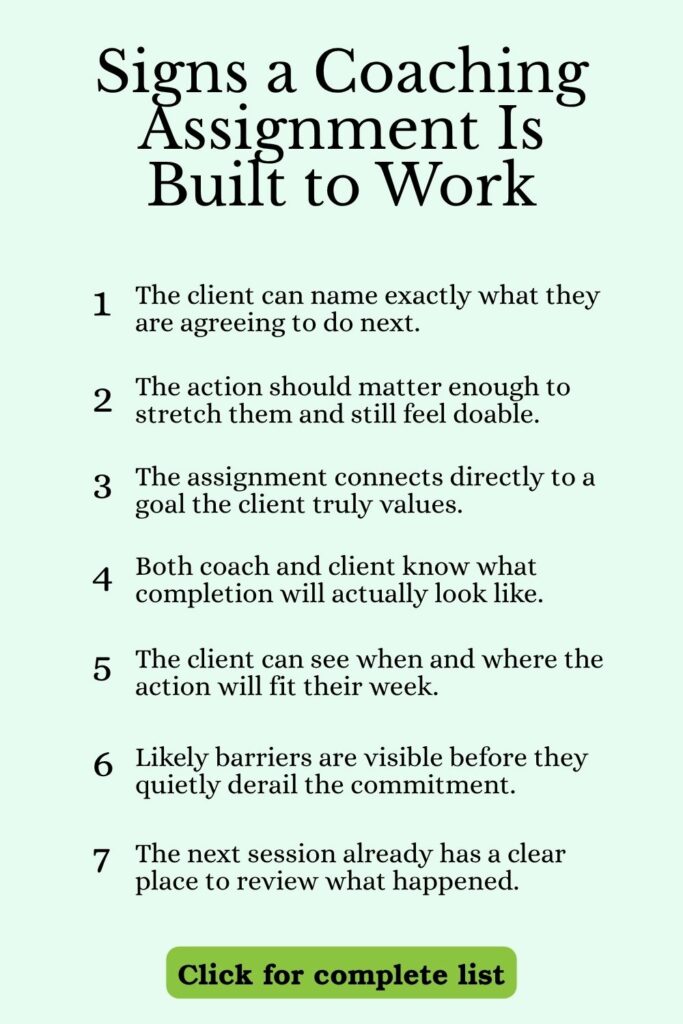
Effective coaching homework turns an insight from the session into a specific action, observation, reflection, or experiment that the client agrees to carry out between sessions. The assignment should connect directly to the client’s goal and be clear enough that both coach and client know what completion looks like.
The client should have meaningful ownership of the assignment. Your role is to help sharpen the action, test whether it is realistic, identify likely barriers, and agree on how the learning will be reviewed later.
This approach fits the International Coaching Federation’s 2025 Core Competencies, which describes client growth as a partnership that turns learning into action while supporting client autonomy in goals, actions, and accountability.
What Makes a Coaching Homework Assignment Effective?
An effective coaching assignment is specific, relevant to the client’s goal, realistic within the client’s actual week, and designed to produce either action or useful information.
“Work on being more confident” gives the client very little to act on. “In Wednesday’s leadership meeting, contribute one opinion before someone asks what you think, then note what you expected to happen and what actually happened” creates something observable.
SEE ALSO: If you’re a coach looking to streamline your administrative tasks and save time, check out our Coaching Administration Software. It’s a simple, effective solution designed to help you focus less on paperwork and more on what matters—coaching your clients. From scheduling to client management, our software gives you the tools to run your business efficiently. Ready to reclaim your time and boost productivity? Click or tap here.
A strong assignment usually answers five questions:
- What is the client going to do or notice?
- Why does this action matter to the coaching goal?
- When or where will it happen?
- What could get in the way?
- What will you review together afterward?
The task also needs the right size. If a client has agreed to start networking again, “make 30 new contacts this week” may turn a useful experiment into another abandoned obligation. Contacting two former colleagues might give you much better coaching material.
Once you know what the assignment needs to accomplish, a system can reduce the administration around it. LCH Core supports reusable, assignable, and schedulable journals, worksheets, goals, action items, and resources. The coaching tools support guide explains how those tools can be used with clients.
What Is the Coach’s Role?
As a coach, you should do the following:
- Ask evocative questions
- Provide information
- Give appropriate feedback that will help your client(s) develop and clarify their goals and establish appropriate action plans
- Support clients in tapping into their own resources and strengths, make their own choices, develop new skills, and with the coach’s support, make progress towards achieving their goals.
What Does the Coaching Process Involve?
This may involve the following tasks:
- Conducting questionnaires
- Assigning relevant homework assignments
- Identifying personal resources (experiences, values, strengths, competencies, knowledge, and so forth)
- Creating strategies to successfully identify and remove obstacles to achieving desired goals
- Enhancing self-awareness
- Developing emotional competence
- Creating a personal life-vision based on the clients’ values and dreams
Another integral aspect of the coaching relationship is the development of accountability between the coach and the client(s). It is important to be able to create appropriate action plans and strategies that facilitate the client’s movement toward the attainment of their valued goals and the overall enhancement of the quality of life.
SEE ALSO: If you’re a coach looking to streamline your administrative tasks and save time, check out our Coaching Administration Software. It’s a simple, effective solution designed to help you focus less on paperwork and more on what matters—coaching your clients. From scheduling to client management, our software gives you the tools to run your business efficiently. Ready to reclaim your time and boost productivity? Click or tap here.
Through the coaching process, a client(s) is able to assess aspects of their life. This should help them determine what he or she values and wishes to enhance or change. With the help of the coach, you can intentionally construct and live a more satisfying, happier life. I believe that giving homework is the core to a successful coaching relationship.
Why Assign Homework Between Coaching Sessions?
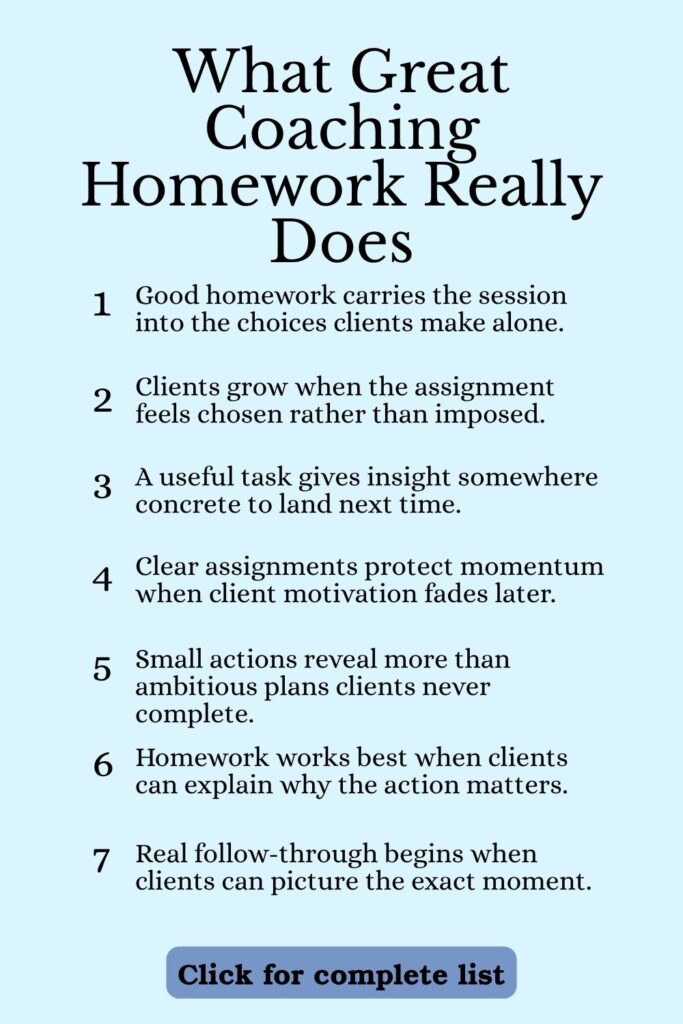
I have found that assigning tasks and homework has helped both me and my client ensure that the best of the session has been absorbed and understood. This format allows the coach to have a better idea of exactly how well the coaching session has made an impact. It will also give the coach some perspective on how their guidance will be applied to the client’s daily life.
To be an effective coach, it is important to ensure that the information presented at the coaching session is well received. You want your client to use it in the desired way, which is why assigning homework is helpful. The coach will be able to view the effectiveness of the coaching sessions and make improvements or adjustments, should there be a need for it.
Homework also provides a good platform for the audience to put all the information they gathered at the session in a more committed form. More than that, the assignments can help the client develop a more independent use of the information learnt.
It will also allow the audience to display some level of independence in how the information is to be incorporated into their lives based on their own perspective and understanding.
Should the use of the information learnt be displayed in a manner that is contrary to its original presentation, the coach will be able to address this as it would show up in the task or homework done.
SEE ALSO: If you’re a coach looking to streamline your administrative tasks and save time, check out our Coaching Administration Software. It’s a simple, effective solution designed to help you focus less on paperwork and more on what matters—coaching your clients. From scheduling to client management, our software gives you the tools to run your business efficiently. Ready to reclaim your time and boost productivity? Click or tap here.
Overall, taking the time to assign homework has helped me have a 100 percent success rate with my clients for the past seven years!
What Makes a Coaching Homework Assignment Effective?
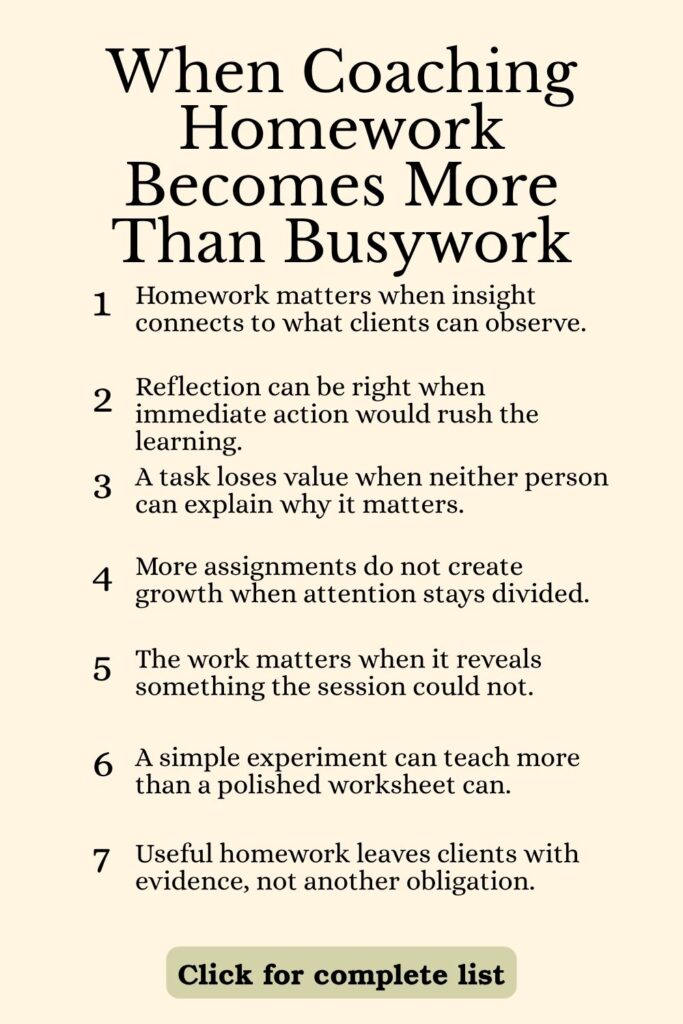
An effective coaching assignment is specific, relevant to the client’s goal, realistic within the client’s actual week, and designed to produce either action or useful information.
“Work on being more confident” gives the client very little to act on. “In Wednesday’s leadership meeting, contribute one opinion before someone asks what you think, then note what you expected to happen and what actually happened” creates something observable.
A strong assignment usually answers five questions:
- What is the client going to do or notice?
- Why does this action matter to the coaching goal?
- When or where will it happen?
- What could get in the way?
- What will you review together afterward?
The task also needs the right size. If a client has agreed to start networking again, “make 30 new contacts this week” may turn a useful experiment into another abandoned obligation. Contacting two former colleagues might give you much better coaching material.
Once you know what the assignment needs to accomplish, a system can reduce the administration around it. LCH Core supports reusable, assignable, and schedulable journals, worksheets, goals, action items, and resources. The coaching tools support guide explains how those tools can be used with clients.
SEE ALSO: If you’re a coach looking to streamline your administrative tasks and save time, check out our Coaching Administration Software. It’s a simple, effective solution designed to help you focus less on paperwork and more on what matters—coaching your clients. From scheduling to client management, our software gives you the tools to run your business efficiently. Ready to reclaim your time and boost productivity? Click or tap here.
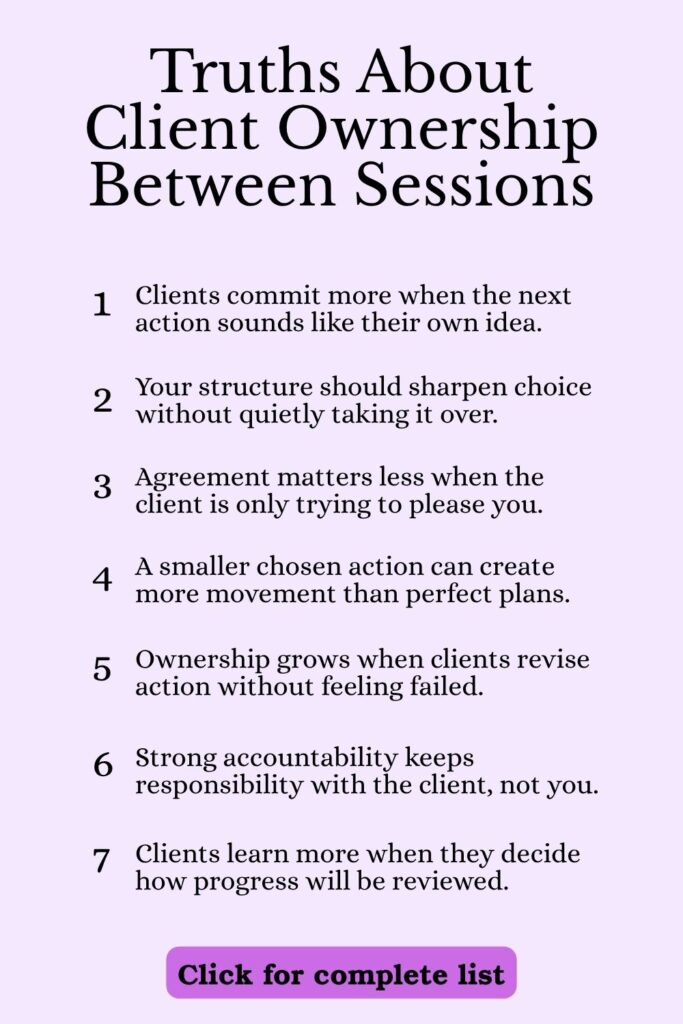
How Do You Co-Create Homework Without Telling the Client What to Do?
Coaching homework works best when the client helps design the action rather than simply receiving an instruction from the coach.
That distinction matters. “I want you to contact five people this week” puts the coach in charge of the solution. “What would be a useful way to test your belief that reaching out to people will feel pushy?” keeps the client thinking and choosing.
A career coaching client might decide to reconnect with one former colleague rather than send five messages. A leadership client might choose to ask one direct question in a difficult meeting rather than follow a communication exercise you selected in advance.
You can still challenge vague commitments. If the client says, “I’ll try to speak up more,” ask what speaking up would actually look like, where the opportunity is likely to occur, and what would tell them they followed through.
ICF’s 2025 Core Competencies makes this partnership explicit. Competency 8 calls for coaches to partner with clients in designing goals, actions, and accountability measures while supporting the client’s autonomy in deciding how that accountability will work.
The coach provides structure. The client retains ownership.
SEE ALSO: If you’re a coach looking to streamline your administrative tasks and save time, check out our Coaching Administration Software. It’s a simple, effective solution designed to help you focus less on paperwork and more on what matters—coaching your clients. From scheduling to client management, our software gives you the tools to run your business efficiently. Ready to reclaim your time and boost productivity? Click or tap here.
How Can You Turn a Vague Coaching Goal Into an Action the Client Will Actually Do?
A vague intention becomes more actionable when the client connects a specific situation with a specific response.
Behavior researchers call this an implementation intention. The basic structure is simple:
If X happens, then I will do Y.
Instead of:
“I’m going to challenge my negative self-talk.”
The client might choose:
SEE ALSO: If you’re a coach looking to streamline your administrative tasks and save time, check out our Coaching Administration Software. It’s a simple, effective solution designed to help you focus less on paperwork and more on what matters—coaching your clients. From scheduling to client management, our software gives you the tools to run your business efficiently. Ready to reclaim your time and boost productivity? Click or tap here.
“If I notice myself thinking that I am going to embarrass myself before Thursday’s presentation, then I will write down one piece of evidence that challenges that prediction.”
Instead of:
“I need to follow up with more prospects.”
A business coaching client might choose:
“If I finish my Tuesday morning client call, then I will spend 15 minutes following up with the three people already on my contact list.”
This is more than tidy wording. Peter Gollwitzer and Paschal Sheeran analyzed 94 independent tests of implementation intentions and reported a medium-to-large effect on goal attainment, with an effect size of d = .65. Their research concerned goal pursuit broadly, not coaching outcomes specifically, but it gives coaches a useful evidence-based mechanism for turning intentions into more concrete plans.
SEE ALSO: If you’re a coach looking to streamline your administrative tasks and save time, check out our Coaching Administration Software. It’s a simple, effective solution designed to help you focus less on paperwork and more on what matters—coaching your clients. From scheduling to client management, our software gives you the tools to run your business efficiently. Ready to reclaim your time and boost productivity? Click or tap here.
You do not need to force every assignment into an if-then sentence. Use the structure when the main problem is not knowing exactly when or how the client will act.
When Should You Not Assign Homework?
Do not assign homework simply because every coaching session is expected to end with a task.
Sometimes the most useful between-session work is observation rather than action. A client who has just recognized that they automatically agree to requests from colleagues may learn more by noticing when, where, and with whom that pattern appears than by immediately trying to change it.
You should also reconsider an assignment when:
- The client cannot explain why the task matters.
- The action was largely chosen by you rather than the client.
- The task is too large for the time available.
- The client is agreeing mainly to please you.
- The assignment has drifted away from the coaching goal.
- The work crosses from coaching into an area that requires an appropriately qualified clinical or other professional.
Homework is a tool, not a ritual.
Sometimes “notice what happens and bring back what you learn” is the right assignment. Sometimes there should be no assignment at all.
SEE ALSO: If you’re a coach looking to streamline your administrative tasks and save time, check out our Coaching Administration Software. It’s a simple, effective solution designed to help you focus less on paperwork and more on what matters—coaching your clients. From scheduling to client management, our software gives you the tools to run your business efficiently. Ready to reclaim your time and boost productivity? Click or tap here.
What Do You Do When a Client Doesn’t Complete Their Homework?
When a client does not complete an assignment, treat the missed action as coaching information before treating it as an accountability problem.
Start with what actually happened.
A useful sequence is:
- Was the action clear? Could the client describe exactly what they had agreed to do?
- Was it realistically sized? Did a 10-minute task quietly become a two-hour project?
- Did the client genuinely choose it? Or did they agree because it sounded like the answer you wanted?
- What happened at the moment of action? Look for a concrete barrier, competing commitment, assumption, emotion, or decision.
- Does the assignment still matter? New information may have changed the goal or the next step.
Suppose a client repeatedly fails to complete a 20-minute evening journal. Asking them to “be more disciplined” gives you very little.
A better review might reveal that evenings are when they handle dinner, children, and unfinished work. The client may decide that a three-minute voice note in the car before entering the house is a more realistic reflection practice.
The missed assignment has now improved the coaching plan. That is very different from simply marking the client as noncompliant.
SEE ALSO: If you’re a coach looking to streamline your administrative tasks and save time, check out our Coaching Administration Software. It’s a simple, effective solution designed to help you focus less on paperwork and more on what matters—coaching your clients. From scheduling to client management, our software gives you the tools to run your business efficiently. Ready to reclaim your time and boost productivity? Click or tap here.
How Should You Review Homework in the Next Coaching Session?
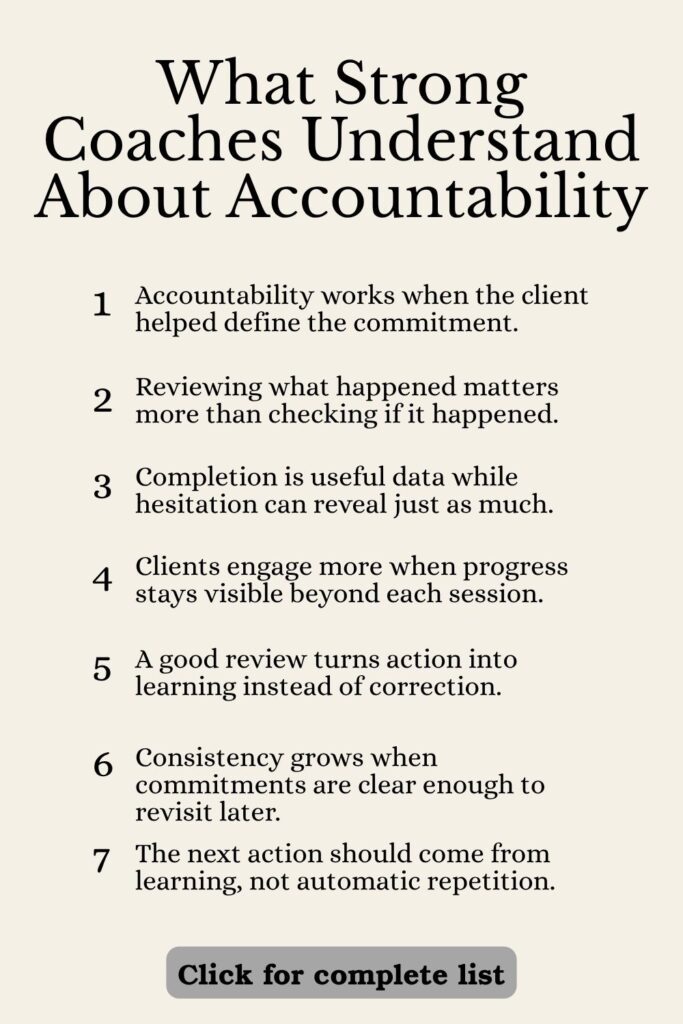
Reviewing the assignment turns activity into learning, so homework should not disappear the moment the client says they completed it.
A simple four-question loop works well:
- What happened? Establish the facts rather than jumping directly to interpretation.
- What did you notice? Look at thoughts, choices, reactions, patterns, and unexpected outcomes.
- What did you learn? Connect the experience back to the goal or insight from the previous session.
- What will you do differently or repeat next? Convert the learning into the next experiment.
Completion is not the only useful outcome.
A client may carry out the agreed action and discover it had no effect. Another may only complete half of it and uncover the exact obstacle that has been blocking the larger goal. Both experiences can produce valuable coaching material.
For a coach running a growing practice, this review also creates a clearer record of value. When progress, decisions, experiments, and milestones are visible over several weeks, renewal conversations can be grounded in what has actually changed rather than relying on a vague memory of good sessions. That principle also matters when thinking about client lifetime value for coaches.
How Do You Track Between-Session Action Without Creating More Admin?
The simplest tracking system gives every assignment one home, one owner, and one review point.
SEE ALSO: If you’re a coach looking to streamline your administrative tasks and save time, check out our Coaching Administration Software. It’s a simple, effective solution designed to help you focus less on paperwork and more on what matters—coaching your clients. From scheduling to client management, our software gives you the tools to run your business efficiently. Ready to reclaim your time and boost productivity? Click or tap here.
One home means the client knows where the assignment lives. Avoid putting one worksheet in email, another goal in a spreadsheet, journal prompts in text messages, and action steps in handwritten notes.
One owner means the client owns the action. Your job is to maintain the coaching process, not chase the client through the week.
One review point means both of you know when the assignment will come back into the coaching conversation. Usually that is the next session, unless the coaching arrangement calls for an earlier check-in.
For example, if a client agrees to have a difficult conversation with their manager, capture that commitment as one clear action. At the next session, review whether the conversation happened, what the client noticed, and what the experience changed.
With LCH Core, the Progress Stream can provide a central view of client activity and progress alongside assigned coaching tools. The related support guide on how to keep track of client data, session notes, and progress is useful if your current process is scattered across several places.
The goal is not more tracking. It is enough structure that useful client work does not vanish between sessions.
SEE ALSO: If you’re a coach looking to streamline your administrative tasks and save time, check out our Coaching Administration Software. It’s a simple, effective solution designed to help you focus less on paperwork and more on what matters—coaching your clients. From scheduling to client management, our software gives you the tools to run your business efficiently. Ready to reclaim your time and boost productivity? Click or tap here.
What Does a Coaching Homework Assignment Look Like?
Here is an example of an assignment that I use with my clients:
The Key Concept I’d like you to practice this week is the concept of Self-Talk.
Here’s the definition we’ll use for Self-Talk: “The skill and practice of replacing old, harmful ‘mental programs’ with new programs that create a healthier, long-term sense of self, fulfillment, and personal well-being.”
First, we will review the perceptions of Self-Talk that you have right now. All you have to do is answer each of these questions:
1. Do you consciously practice Self-Talk techniques now – and in what way?
________________________________________________________________________
SEE ALSO: If you’re a coach looking to streamline your administrative tasks and save time, check out our Coaching Administration Software. It’s a simple, effective solution designed to help you focus less on paperwork and more on what matters—coaching your clients. From scheduling to client management, our software gives you the tools to run your business efficiently. Ready to reclaim your time and boost productivity? Click or tap here.
2. How important do you think your personal Self-Talk is to your success and happiness as an individual?
________________________________________________________________________
3. Do you typically listen to professional Self-Talk tapes? If so, for how long, and how do you use them?
________________________________________________________________________
4. If you could change any of your old programs, which programs would you change?
________________________________________________________________________
SEE ALSO: If you’re a coach looking to streamline your administrative tasks and save time, check out our Coaching Administration Software. It’s a simple, effective solution designed to help you focus less on paperwork and more on what matters—coaching your clients. From scheduling to client management, our software gives you the tools to run your business efficiently. Ready to reclaim your time and boost productivity? Click or tap here.
5. What areas of your own Self-Talk would you like to work on first?
________________________________________________________________________
6. Would you be willing to listen to some Self-Talk each day, if doing that would help you reach your goals? _____ Why?
________________________________________________________________________
VII. YOUR SELF-TALK
This week I’d like you to listen to____________________________________________
SEE ALSO: If you’re a coach looking to streamline your administrative tasks and save time, check out our Coaching Administration Software. It’s a simple, effective solution designed to help you focus less on paperwork and more on what matters—coaching your clients. From scheduling to client management, our software gives you the tools to run your business efficiently. Ready to reclaim your time and boost productivity? Click or tap here.
________________________________________________________________________
VIII. CLOSING
On the same scale of 1 – 10, how do you choose to make this week work for you? _____
What will you do to make that happen?
________________________________________________________________________
________________________________________________________________________
SEE ALSO: If you’re a coach looking to streamline your administrative tasks and save time, check out our Coaching Administration Software. It’s a simple, effective solution designed to help you focus less on paperwork and more on what matters—coaching your clients. From scheduling to client management, our software gives you the tools to run your business efficiently. Ready to reclaim your time and boost productivity? Click or tap here.
You can do it! I believe in you, ______________. I’ll talk to you next week.
Where LCH Core Fits

LCH Core fits after you have decided what the client needs to practice, reflect on, or complete, because the coaching decision should come before the software decision.
You might finish a session with one action item, use a worksheet when structured reflection would help, assign a journal prompt when the client needs to observe a recurring pattern, or use a goal when the work needs to be tracked over a longer period. Those tools can then be reused, assigned, and scheduled rather than recreated for each client.
The Progress Stream gives you a way to review client activity and progress before the next conversation. That makes it easier to reconnect the new session to what happened outside the previous one instead of treating every call as a fresh start.
If action items are central to the way you coach, the LCH support guide to coaching action items gives a practical explanation of their use. There is also an LCH Core video walkthrough if you want to see how the wider client workflow fits together.
The point is not to give clients more work. It is to make the work you have already agreed on easier to assign, find, revisit, and connect to the next coaching conversation. That is where LCH Core fits naturally.
SEE ALSO: If you’re a coach looking to streamline your administrative tasks and save time, check out our Coaching Administration Software. It’s a simple, effective solution designed to help you focus less on paperwork and more on what matters—coaching your clients. From scheduling to client management, our software gives you the tools to run your business efficiently. Ready to reclaim your time and boost productivity? Click or tap here.
Frequently Asked Questions About Coaching Homework
Should life coaches give clients homework?
Yes, life coaches can use between-session assignments when the work supports an agreed coaching goal. The strongest assignments help clients apply, observe, or test something from the session rather than giving them unrelated tasks to stay busy.
What kind of homework can a life coach assign?
Coaching homework can include action steps, reflection prompts, journals, worksheets, observations, goal-related experiments, conversations, or practical decisions. The format should match what the client is trying to learn or change.
How much homework should a coaching client get between sessions?
One clear, meaningful assignment is often more useful than a long list of tasks. The client should be able to explain what they are doing, why they are doing it, and when it can realistically happen.
How do you hold coaching clients accountable without being controlling?
Hold clients accountable by reviewing the commitments they chose and exploring what happened without taking ownership of the action away from them. Accountability works best when the client helps decide both the action and how progress will be reviewed.
What should a coach do when a client doesn’t complete their homework?
A coach should explore the reason for noncompletion before deciding what happens next. An unclear task, poor timing, an unexpected barrier, weak commitment, or new information about the goal can all make redesigning the assignment more useful than simply repeating it.
How should coaching homework be reviewed?
Coaching homework should be reviewed by examining what happened, what the client noticed, what they learned, and what they want to do next. This turns the assignment into part of an ongoing learning cycle rather than a pass-or-fail exercise.
SEE ALSO: If you’re a coach looking to streamline your administrative tasks and save time, check out our Coaching Administration Software. It’s a simple, effective solution designed to help you focus less on paperwork and more on what matters—coaching your clients. From scheduling to client management, our software gives you the tools to run your business efficiently. Ready to reclaim your time and boost productivity? Click or tap here.
What is the difference between coaching homework and therapy homework?
Coaching homework should stay within the agreed coaching goals and the coach’s professional scope. Therapy homework may be part of assessment or clinical treatment delivered by an appropriately qualified mental health professional, which is a different professional relationship and purpose.
Sources
International Coaching Federation. 2025 ICF Core Competencies. International Coaching Federation, 2025. 2025 ICF Core Competencies
Gollwitzer, Peter M., and Paschal Sheeran. “Implementation Intentions and Goal Achievement: A Meta-Analysis of Effects and Processes.” Advances in Experimental Social Psychology, vol. 38, 2006, pp. 69-119. Elsevier. Implementation Intentions and Goal Achievement
Read this next

Best Books for Life Coaches: 18 Books That Will Take your Coaching to the Next Level (2022)
Ramp up your coaching skills to expert status with these 18 books every coach needs in their library
Read More
The Simple Assessment System That Shows Clients How Far They’ve Come
Assessments should be a vital part of your coaching business as they are highly beneficial and can be eye-opening.
Read More
Coach like a Pro: Coaching Conversation Script, Samples and Template
Use a sound coaching conversation script for your client to visualize their path and realize their goals!
Read More