








Should You Change Careers or Stay Put? A Decision Framework for Burnout, Boredom, and Misfit

Want to try this at home? No worries! Download a copy of our Career Change Exit Checklist.
*****
There is a particular kind of career confusion that can make every workday feel heavier than it should.
You might wake up already tired. You might stare at your calendar and wonder how this became your life. You might feel guilty because the job looks good on paper, pays the bills, or took years to build, but something inside you keeps asking, “Is this still right for me?”
That question can be scary because it feels like it could change everything.
But before you decide you need a whole new career, it helps to slow down and name what is actually happening. Burnout, boredom, and misfit can feel very similar from the inside. They can all make you dread Monday. They can all make you fantasize about quitting. They can all make you scroll job listings late at night, hoping one title will suddenly make your future clear.
The problem is that they do not require the same solution.
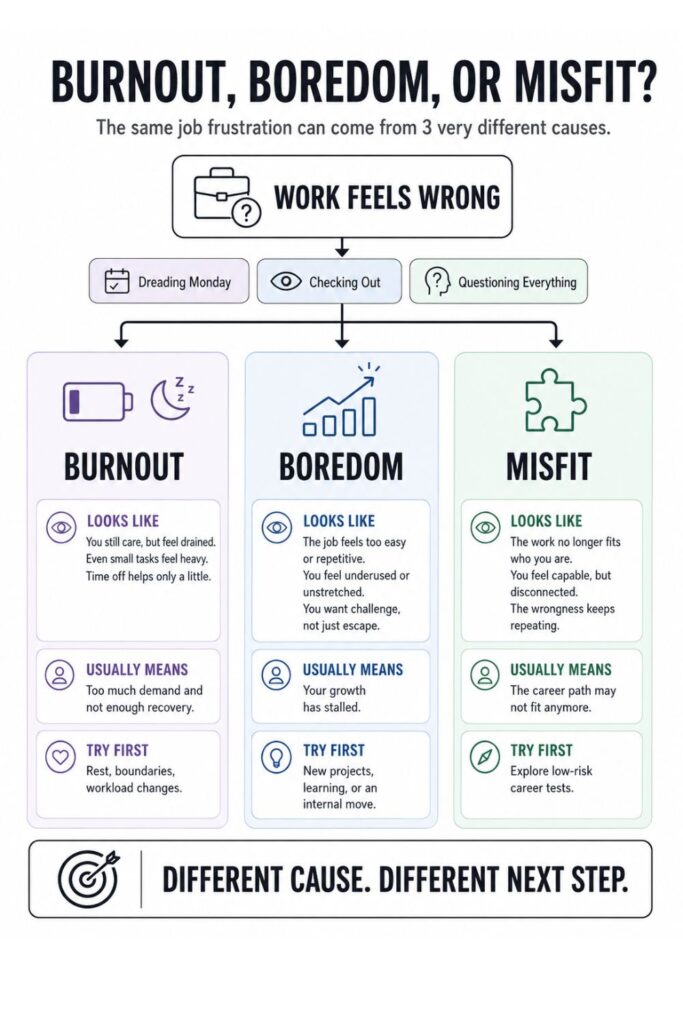
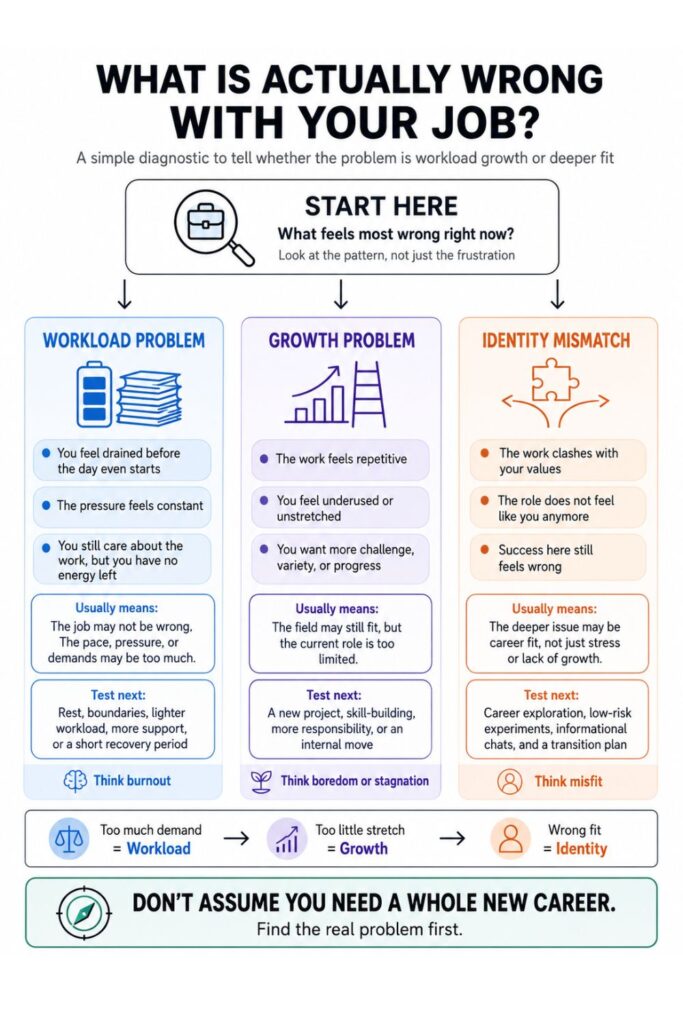
Burnout may mean you need rest, boundaries, workload changes, or a healthier role. Boredom may mean you need more challenge, variety, learning, or responsibility. Misfit may mean your current career path no longer matches your values, strengths, personality, or long-term direction.
If you want to get more from your life, and are looking for concrete action steps to get you there, check out our Request a Coach page. It’s a “cut the fence-sitting and take action” way to tackle your issues and actually find success. To get off the fence and start to take action, click or tap here.
The goal is not to force yourself to stay. It is also not to rush yourself into leaving.
The goal is to make the right move, not just the fastest one.
In this article, you will walk through a practical decision framework that helps you separate a fixable bad season from a true career mismatch. You will look at what is draining you, what still feels possible, what keeps repeating, and what kind of change would actually solve the problem.
By the end, you should have a clearer sense of whether you need to fix your current situation, adjust your role, or start planning a more intentional career change.
Need some career guidance? Drop on by our directories choc full of career coaches to bring your career to the next level. Or click here to have us match you to the best.
1. Start With the Three-Part Career Check: Burnout, Boredom, or Misfit?
When work feels wrong, it is tempting to treat every bad feeling as proof that you need to leave. But “I hate this” is not always a complete diagnosis. It is a starting point.
The first step is to sort your experience into three possible categories: burnout, boredom, or misfit. You may have more than one happening at once, but usually one is leading the others.
Burnout often feels like depletion. You may still care about the work, but you have no energy left for it. You feel used up, resentful, foggy, or unable to recover between workdays.
If you want to get more from your life, and are looking for concrete action steps to get you there, check out our Request a Coach page. It’s a “cut the fence-sitting and take action” way to tackle your issues and actually find success. To get off the fence and start to take action, click or tap here.
Boredom often feels like restlessness. You are not necessarily overwhelmed. You may simply feel underused, unstretched, or tired of repeating the same tasks with no real growth.
Misfit often feels like a deeper wrongness. The work may not align with your values, strengths, lifestyle, personality, or the kind of future you want to build.
Use these steps to begin sorting it out:
- Name the strongest pattern: Ask yourself whether the biggest feeling is exhaustion, restlessness, resentment, confusion, or a sense that you are pretending to be someone you are not.
- Separate the symptom from the source: Dreading work is the symptom, but the source could be too much demand, too little challenge, or work that does not fit you anymore.
- Look for where it shows up: Notice whether the feeling is tied to your current manager, current workload, current company, or the actual nature of the career itself.
- Write one honest sentence: Finish this prompt: “The thing that feels most wrong about my work right now is…”
That sentence matters because it gives your confusion shape. “I am tired” is different from “I am bored” or “I do not believe in this work anymore.”
Once you know which problem you are solving, your options become clearer. You are no longer asking, “Should I blow up my career?” You are asking, “What kind of change would actually fix this?”
That is a much more useful question.
2. Test for Burnout Before You Decide You Need a New Career
Burnout can make even a good career feel unbearable. It can distort your view of your job, your skills, your future, and yourself. When you are burned out, every option can feel too hard. Staying feels impossible, but changing careers also feels exhausting.
That is why burnout needs to be tested before you treat your entire career as the problem.
If you want to get more from your life, and are looking for concrete action steps to get you there, check out our Request a Coach page. It’s a “cut the fence-sitting and take action” way to tackle your issues and actually find success. To get off the fence and start to take action, click or tap here.
Start by looking at your energy. Are you only tired during certain projects or busy seasons, or do you feel drained all the time? Do you still enjoy parts of your work when the pressure drops, or does everything feel flat and heavy?
Burnout often shows up outside work too. You may stop doing things that usually help you feel like yourself. You may avoid friends, struggle to focus, lose patience quickly, or spend your evenings recovering from the day instead of actually living your life.
Use these steps to test whether burnout is driving the career crisis:
- Check your recovery pattern: Notice whether weekends, days off, or slower weeks actually restore you, or whether you still feel depleted after time away.
- Identify the pressure points: Look for the exact sources of strain, such as workload, unclear expectations, constant availability, emotional labor, meetings, conflict, or lack of control.
- Try one recovery experiment: Before making a major decision, test a real change for two to four weeks, such as firmer work hours, fewer commitments, more sleep, PTO, or a workload conversation.
- Avoid deciding at your lowest point: If your brain is saying “everything is impossible,” focus first on creating enough space to think clearly.
This does not mean burnout is not serious. It is serious. It also does not mean you should tolerate a workplace that keeps harming your health or well-being.
It means the first decision may not be “new career or no new career.” The first decision may be, “How do I reduce the pressure enough to see clearly?”
If you recover and the work starts to feel meaningful again, your career may not be the issue. If you recover and still feel deeply mismatched, you have stronger evidence that the problem goes beyond burnout.
That evidence is worth getting before you make a life-changing move.
3. Look for Boredom Disguised as a Career Crisis
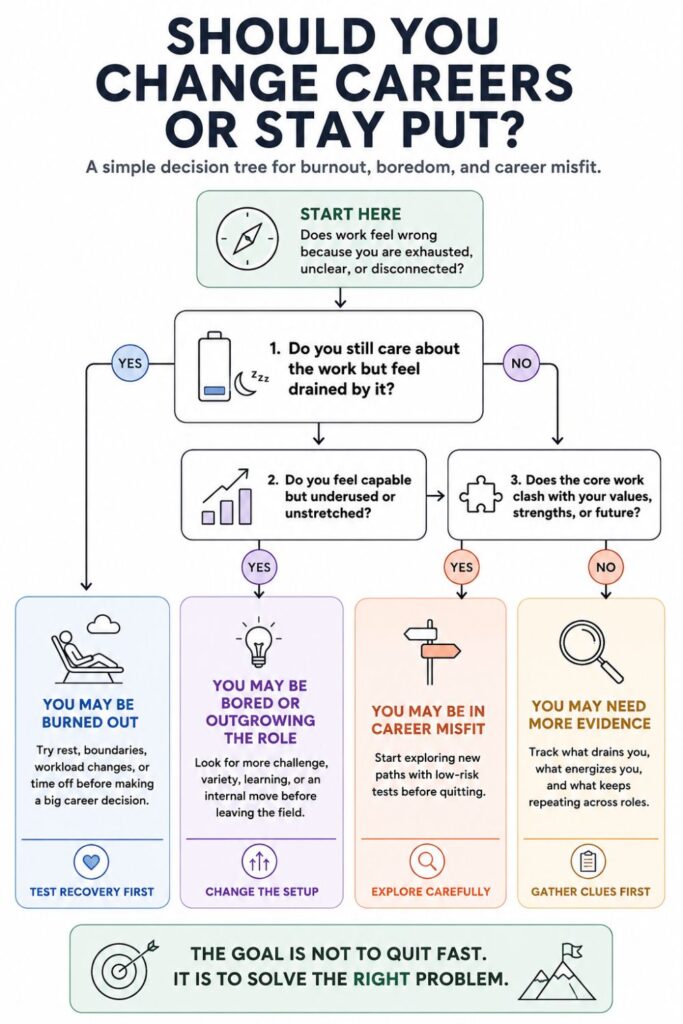
Boredom can be sneaky because it does not always feel like boredom. Sometimes it feels like irritability, procrastination, low motivation, or a constant urge to start over.
If you want to get more from your life, and are looking for concrete action steps to get you there, check out our Request a Coach page. It’s a “cut the fence-sitting and take action” way to tackle your issues and actually find success. To get off the fence and start to take action, click or tap here.
You may tell yourself you are lazy, ungrateful, or impossible to satisfy. But sometimes the real issue is that you have stopped growing.
This is especially common if you once loved your work. The role may have challenged you at first, then slowly became too familiar. You learned the systems, solved the interesting problems, and reached a level where the work now feels repetitive.
That does not always mean the career is wrong. It may mean the current version of the career is too small.
Use these steps to find out:
- Audit your growth level: Ask whether you are learning anything new, building meaningful skills, solving interesting problems, or moving toward a next stage.
- Find the missing challenge: Identify what is absent, such as leadership, creativity, strategy, autonomy, mentorship, technical depth, client work, or variety.
- Test variety before leaving: Look for ways to change your responsibilities, join a new project, mentor someone, learn a tool, shift teams, or move into an adjacent role.
- Watch for novelty cravings: A new job can feel exciting at first, but if you do not address the need for growth, the same restlessness may return.
Boredom often becomes more painful when you feel trapped by success. Maybe you are good at what you do, but being good at it has turned into a cage. People keep giving you the same work because you are reliable, even though that work no longer stretches you.
In that case, the question is not only “Should I leave?” It is also “What would make this work feel alive again?”
A career change might be right. But before you assume that, see whether the issue is the entire field or just the lack of progression inside your current setup.
Sometimes you do not need to abandon the path. You need a harder, richer, more interesting version of it.
If you want to get more from your life, and are looking for concrete action steps to get you there, check out our Request a Coach page. It’s a “cut the fence-sitting and take action” way to tackle your issues and actually find success. To get off the fence and start to take action, click or tap here.
4. Identify True Career Misfit Without Overreacting to a Bad Season
Career misfit is different from having a bad boss, a heavy season, or a role that has gone stale. Misfit runs deeper. It is the feeling that the work asks you to operate in ways that consistently clash with who you are, what you value, or how you do your best work.
A true misfit may look like success from the outside. You may perform well, earn praise, or have a respectable title. But inside, you feel like you are constantly forcing yourself into a shape that does not fit.
This is why misfit can be so confusing. The external signs may say, “This is working.” Your inner life may say, “This is costing me too much.”
Use these steps to spot a deeper mismatch:
- Compare the work to your values: Ask whether your daily tasks, company culture, industry norms, or measures of success conflict with what matters most to you.
- Track what drains and energizes you: Make two lists: tasks that leave you depleted and tasks that make you feel useful, capable, interested, or alive.
- Study the parts you keep resisting: Notice whether you dislike the temporary problems around the work or the core work itself.
- Look for patterns over time: If the same mismatch has followed you across roles, companies, or managers, the issue may be the career path, not one bad job.
For example, someone might think they hate their job because their company is stressful. But after moving companies, they may realize they still dislike the core tasks. Another person might assume they need a new career, then discover they love the work when they are in a healthier environment.
That distinction matters.
Misfit is not always dramatic. It can be quiet. It can sound like, “I can do this, but I do not want to keep doing this.” Or, “I am capable here, but I do not feel connected to the work.” Or, “This career rewards things I do not want to keep prioritizing.”
If that pattern keeps showing up after rest, role changes, and honest reflection, it may be time to explore a more meaningful shift.
If you want to get more from your life, and are looking for concrete action steps to get you there, check out our Request a Coach page. It’s a “cut the fence-sitting and take action” way to tackle your issues and actually find success. To get off the fence and start to take action, click or tap here.
Not because you failed. Because you are finally telling the truth about what fits.
5. Use the “Fix, Adjust, or Leave” Decision Filter
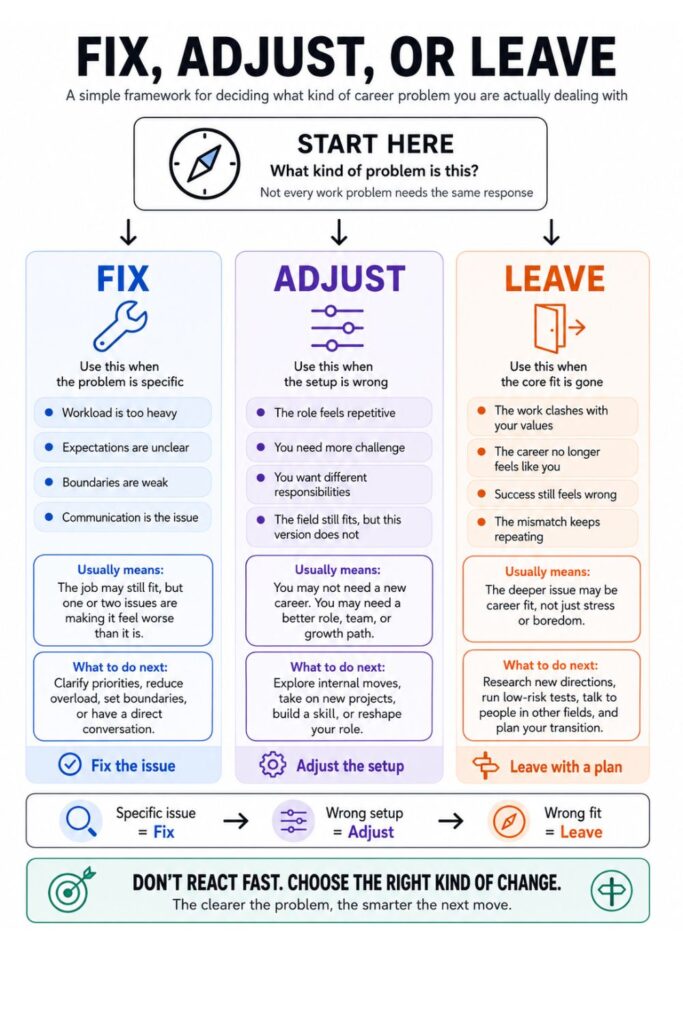
Once you have looked at burnout, boredom, and misfit, the next step is to turn your insight into a decision. That is where the “fix, adjust, or leave” filter helps.
This filter keeps you from treating every work problem like it needs the same solution. Some problems need a conversation. Some need a role change. Some need a careful exit plan.
The goal is to choose the smallest honest move that matches the size of the problem.
Use these steps:
- Choose fix when the problem is specific: If one or two issues are causing most of the pain, such as workload, unclear expectations, meeting overload, or communication problems, start by addressing those directly.
- Choose adjust when the career still fits but the setup does not: If you still like the field but not your role, team, company, schedule, or growth path, look for a better configuration.
- Choose leave when the core mismatch is clear: If the work itself conflicts with your values, strengths, or long-term direction, begin planning a career change.
- Give each option a concrete action: Turn the decision into one practical next step instead of staying stuck in analysis.
For a fix, your next step might be asking your manager to clarify priorities, renegotiating deadlines, setting availability boundaries, or requesting support on a difficult project.
For an adjustment, your next step might be exploring an internal transfer, shifting your responsibilities, applying for a related role, or building a skill that opens a better lane in the same field.
For leaving, your next step might be researching new paths, mapping transferable skills, setting a financial runway, or talking to people already doing the kind of work you are considering.
If you want to get more from your life, and are looking for concrete action steps to get you there, check out our Request a Coach page. It’s a “cut the fence-sitting and take action” way to tackle your issues and actually find success. To get off the fence and start to take action, click or tap here.
The filter works because it reduces panic. You do not have to decide your entire future in one afternoon. You only need to decide which category your next move belongs to.
If the problem is fixable, fix it. If the setup is wrong, adjust it. If the career no longer fits, plan your way out with care.
That is how you move forward without confusing urgency with clarity.
6. Build a Low-Risk Career Change Test Before You Quit
If you suspect you need a career change, it can feel exciting and terrifying at the same time. A new field may look like freedom from the outside. But before you leap, you need to know whether the new path works in real life, not just in your imagination.
A low-risk test helps you gather evidence before making a major move. It gives you a way to explore without immediately quitting, enrolling in an expensive program, or announcing a dramatic reinvention before you understand the path.
This is not about talking yourself out of change. It is about making the change stronger.
Use these steps:
- Pick one possible direction: Choose a role, field, industry, or work style that feels realistic enough to investigate, not just something that sounds good because it is different.
- Run a small evidence-gathering experiment: Talk to someone in the field, take a short course, volunteer, shadow, freelance a small project, or review real job descriptions.
- Compare fantasy to daily reality: Look at the tasks, pace, pay range, entry requirements, stress points, growth path, and lifestyle tradeoffs.
- Create a decision checkpoint: Decide what evidence would make you keep exploring, pause, or rule out that option.
For example, if you think you want to become a project manager, do not only read inspiring career-change stories. Study real job postings. Talk to project managers about their daily work. Ask what they love, what they find draining, and what surprised them about the role.
If you want to get more from your life, and are looking for concrete action steps to get you there, check out our Request a Coach page. It’s a “cut the fence-sitting and take action” way to tackle your issues and actually find success. To get off the fence and start to take action, click or tap here.
If you think you want to move into coaching, writing, design, tech, teaching, operations, or entrepreneurship, test the work in a small way. See what the daily tasks require. Notice whether you enjoy the process, not just the identity attached to it.
This matters because escape fantasies are often vague. Real career direction is more specific.
A good test can confirm that you are on the right track. It can also save you from jumping into a new version of the same problem.
The best career changes are not built on panic. They are built on evidence, timing, and honest self-knowledge.
7. Check the Practical Side: Money, Timing, and Risk
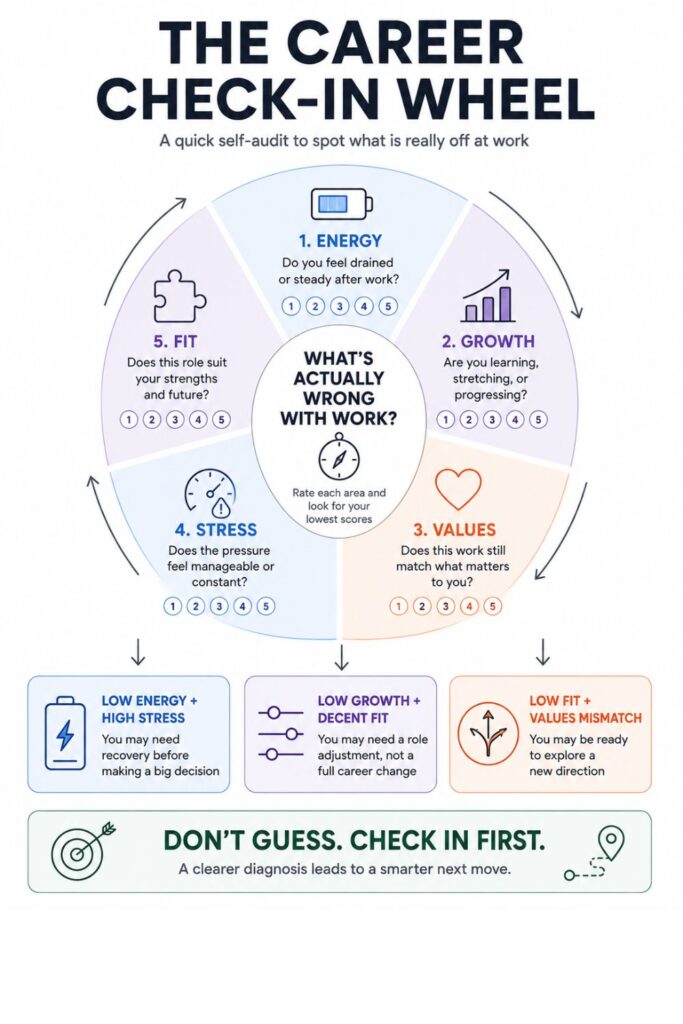
Career decisions are emotional, but they are also practical. You may know you want a change, but that does not automatically mean quitting tomorrow is the wisest move.
This is where money, timing, and risk come in. Not to scare you. To protect you.
A thoughtful plan gives you more freedom, not less. When you understand your runway and options, you can make a career move from a place of steadiness instead of desperation.
Use these steps:
If you want to get more from your life, and are looking for concrete action steps to get you there, check out our Request a Coach page. It’s a “cut the fence-sitting and take action” way to tackle your issues and actually find success. To get off the fence and start to take action, click or tap here.
- Calculate your runway: Review your savings, monthly expenses, debt, benefits, dependents, and how long you could manage reduced or unstable income.
- Choose your transition style: Decide whether you need a slow pivot, internal transfer, part-time study, side project, freelance bridge, or full exit.
- Protect your current stability: Avoid burning bridges, quitting without a plan, or making the transition harder than it needs to be.
- Set a responsible timeline: Map out research, skill-building, networking, applications, interviews, and financial preparation.
This step can feel frustrating if you are eager to leave. But practical planning does not mean you are stuck. It means you are taking your desire for change seriously enough to support it.
For some people, the best move is a slow pivot. They keep their current role while testing new directions, saving money, or building skills. For others, the current environment is damaging enough that leaving sooner may be necessary. Even then, a basic plan can reduce the fallout.
Think about what you need to feel grounded during the transition. Do you need three months of savings? A certification? Ten informational interviews? A lower-cost lifestyle? A bridge job? A clear deadline for when you will reassess?
A career change does not become less brave because it is planned. It often becomes more possible.
The point is not to remove every risk. That rarely happens. The point is to understand the risks you are taking and decide how to carry them wisely.
That is how you protect both your future and your nervous system while you move toward something better.
8. How a Career Coach Can Help You Make the Decision More Clearly
When you are deep inside career confusion, it can be hard to see the pattern. Your thoughts may loop between “I should be grateful,” “I cannot keep doing this,” “Maybe I am just tired,” and “What if I make the wrong move?”
A career coach can help you slow that loop down and sort the pieces.
If you want to get more from your life, and are looking for concrete action steps to get you there, check out our Request a Coach page. It’s a “cut the fence-sitting and take action” way to tackle your issues and actually find success. To get off the fence and start to take action, click or tap here.
This does not mean a coach tells you what to do. A good coach helps you hear yourself more clearly, test your assumptions, and make decisions based on evidence instead of panic, guilt, or fear.
Use these steps to understand where coaching can help:
- Clarify the actual problem: A coach can help you separate burnout, boredom, and misfit so you do not solve the wrong issue.
- Turn vague frustration into patterns: Coaching can help you identify recurring drains, strengths, values, work preferences, and decision habits.
- Build a decision framework: A coach can help you compare staying, adjusting, and leaving without getting lost in all-or-nothing thinking.
- Create an action plan: Instead of endlessly thinking about change, you can set milestones, test options, prepare conversations, and move forward step by step.
This can be especially helpful if you are someone who overthinks decisions or feels responsible for everyone else’s comfort. You may know you need change, but keep talking yourself out of it. Or you may be so exhausted that every option feels equally impossible.
A coach can also help you prepare for practical moments, such as talking to your manager, naming transferable skills, rebuilding confidence, updating your direction, or deciding what kind of role would fit you better.
Career confusion often gets worse when it stays abstract. Coaching makes it more concrete.
Instead of “What am I doing with my life?” the conversation becomes, “What evidence do I have? What options are realistic? What do I want to test first? What would make this decision feel more grounded?”
That shift matters.
You do not need a coach to make a good career decision. But if you feel stuck, scattered, or unable to trust your own read on the situation, support can help you move from emotional fog to practical clarity.
If you want to get more from your life, and are looking for concrete action steps to get you there, check out our Request a Coach page. It’s a “cut the fence-sitting and take action” way to tackle your issues and actually find success. To get off the fence and start to take action, click or tap here.
9. Questions to Ask Before You Make a Final Decision
Before you decide whether to stay, adjust, or leave, give yourself a better set of questions. The quality of your questions affects the quality of your decision.
Many people ask, “Should I quit?” too early. That question can create pressure because it sounds like there are only two choices: leave everything or tolerate everything.
A better question is, “What problem am I actually trying to solve?”
From there, you can ask questions that reveal whether the situation is repairable, adjustable, or truly wrong for you.
Use these prompts:
- Ask what would need to change for staying to feel possible: This shows whether the current role could become workable with clearer boundaries, better support, more growth, or a different structure.
- Ask what keeps repeating across roles: If the same frustration has followed you through multiple jobs, the pattern deserves attention.
- Ask what you are afraid will happen if you leave: Fear may reveal practical issues that need planning, or beliefs that are keeping you smaller than you need to be.
- Ask what future version of you would thank you for: This helps you think beyond immediate relief and consider long-term alignment.
You can also ask yourself:
- What parts of my work do I still want more of?
- What parts do I never want to build a life around again?
- Am I running toward something specific or away from something painful?
- What would I try if I knew I could change slowly?
- What evidence would help me feel more certain?
- What am I tolerating because it is familiar?
- What am I dismissing because it feels scary?
Write your answers down. Career confusion tends to spin in your head, but it becomes easier to understand on paper.
Do not pressure yourself to produce perfect clarity immediately. The goal is to notice what your answers keep pointing toward.
If you want to get more from your life, and are looking for concrete action steps to get you there, check out our Request a Coach page. It’s a “cut the fence-sitting and take action” way to tackle your issues and actually find success. To get off the fence and start to take action, click or tap here.
If every answer is about needing rest, start there. If every answer is about needing growth, explore that. If every answer is about a deeper mismatch, honor that signal.
Your next move does not have to be dramatic to be meaningful. It just has to be honest.
10. Red Flags That You’re Rushing the Decision
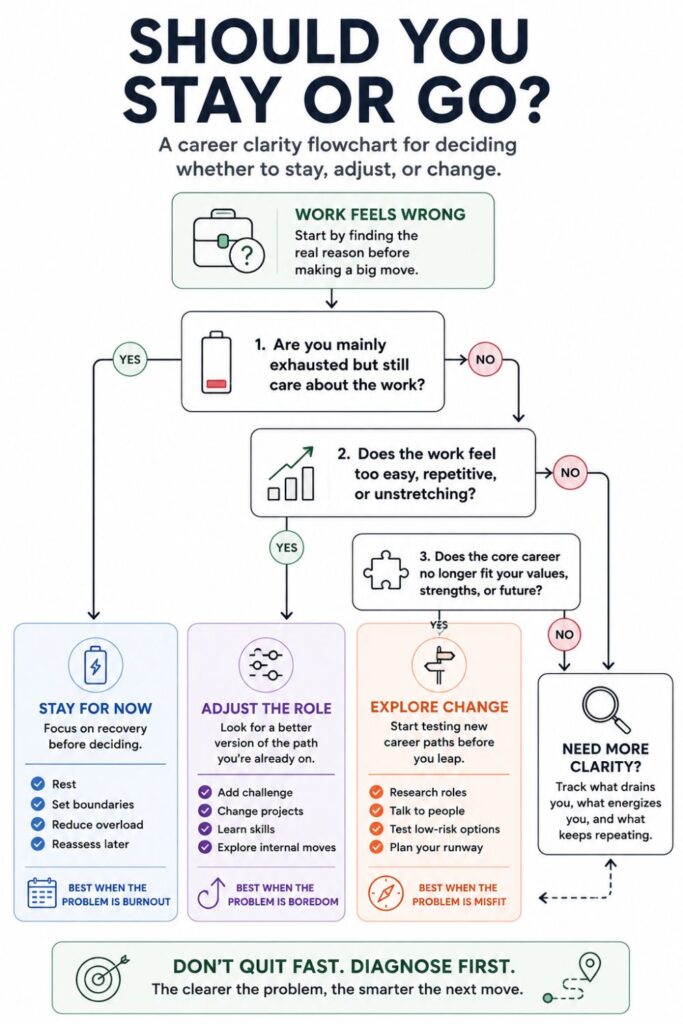
Sometimes you really do need to leave. But it is still worth checking whether you are making a clear decision or a rushed one.
Rushed decisions often happen when discomfort becomes unbearable. You want relief, and quitting starts to look like the only door out. That instinct is understandable, especially if you have been unhappy for a long time.
But relief is not the same as direction.
Use these steps to check whether you are rushing:
- Notice all-or-nothing thinking: If your only options feel like “quit immediately” or “stay forever,” slow down and create more middle options.
- Watch for revenge quitting fantasies: Wanting to leave because you are angry may be valid, but anger alone is not a complete plan.
- Check whether you have tested anything yet: If you have not tried a boundary, role adjustment, recovery period, manager conversation, or career experiment, you may still be missing useful evidence.
- Avoid mistaking relief for alignment: Leaving a bad situation may feel good at first, but your next step still needs to be chosen with care.
Other red flags include applying to random jobs just because they are different, romanticizing an industry you have not researched, ignoring financial realities, or assuming one bad season means your entire professional identity is wrong.
Again, this does not mean you should stay somewhere harmful. If your workplace is unsafe, abusive, or damaging your health, you may need to prioritize getting out. But even then, a simple plan can help you leave with more protection.
If you want to get more from your life, and are looking for concrete action steps to get you there, check out our Request a Coach page. It’s a “cut the fence-sitting and take action” way to tackle your issues and actually find success. To get off the fence and start to take action, click or tap here.
The key is to create a pause between the feeling and the decision.
That pause might be one weekend of honest reflection. It might be a week of tracking what drains you. It might be one conversation with a trusted person. It might be a month of testing a possible new path while you prepare financially.
A rushed decision says, “I need out.” A clear decision says, “I know what problem I am solving, and I know my next step.”
That difference can save you from trading one confusing situation for another.
The Clearer Move Is Usually the Better Move

Changing careers is not a failure. Staying is not automatically settling. Adjusting your role is not avoidance.
The right move depends on the problem you are actually solving.
If you are burned out, you may need recovery, boundaries, support, or a healthier work environment before you can think clearly. If you are bored, you may need growth, challenge, variety, or a role that uses more of your abilities. If you are in a true misfit, you may need to begin planning a career change that reflects who you are now, not who you were when you chose the path.
The mistake is treating all three problems the same.
If you want to get more from your life, and are looking for concrete action steps to get you there, check out our Request a Coach page. It’s a “cut the fence-sitting and take action” way to tackle your issues and actually find success. To get off the fence and start to take action, click or tap here.
Use these final steps to move forward:
- Name the problem honestly: Decide whether burnout, boredom, or misfit is the strongest pattern right now.
- Choose the matching response: Fix a specific issue, adjust the setup, or begin a thoughtful exit plan.
- Take one evidence-based step: Have the conversation, test the new direction, research the role, review your finances, or write down what you need next.
- Set a reassessment date: Give yourself a clear point to review what changed and what still feels true.
You do not need to solve your entire career in one decision. Most meaningful changes happen through a series of honest next steps.
The important thing is to stop making career decisions from fog.
When you know whether you are dealing with burnout, boredom, or misfit, you stop asking vague, frightening questions like “What if my whole life is wrong?” You start asking better ones.
What can be repaired? What needs to change? What no longer fits? What evidence do I need? What would a steady next step look like?
That is where clarity begins.
Not with panic. Not with forcing yourself to stay. Not with quitting just to feel free for a moment.
With the courage to understand what is really wrong, and the patience to choose the move that actually helps.
If you want to get more from your life, and are looking for concrete action steps to get you there, check out our Request a Coach page. It’s a “cut the fence-sitting and take action” way to tackle your issues and actually find success. To get off the fence and start to take action, click or tap here.
*****
Want to try this at home? No worries! Download a copy of our Career Change Exit Checklist.
Need some career guidance? Drop on by our directories choc full of career coaches to bring your career to the next level. Or click here to have us match you to the best.
If you want to get more from your life, and are looking for concrete action steps to get you there, check out our Request a Coach page. It’s a “cut the fence-sitting and take action” way to tackle your issues and actually find success. To get off the fence and start to take action, click or tap here.
Read this next

Is Executive Career Management Worth It?
More firms are marketing themselves as executive career management services. Are they worth the cost?
Read More
Unlock the Style Secrets of Career Elite and Level Up Your Look
Why Career Elites Rely on Outfit Formulas, Not Guesswork Career elites don’t spend their mornings wondering what to wear. Not because they love fashion more than everyone else—but because they […]
Read More
Decide Your Interview Outfit in Seconds with These Psychological Tricks for Stress-Free Success
Choosing what to wear for a job interview can feel overwhelming, especially when you want to make a strong first impression. Your outfit does more than cover you up—it shapes […]
Read More