





Networking Event Scripts for Introverts: What to Say When You Walk In, Join a Group, and Leave Gracefully

Want to try this at home? No worries! Download a copy of our Coffee Chat Questions for Introverts.
***
Networking events can feel like they were designed for people who already know exactly what to say.
You walk into a room full of strangers. Everyone seems busy, paired off, or already comfortable. You are trying to look normal while your brain is asking practical but terrifying questions like: Where do I stand? Who do I talk to? How do I leave without being rude?
The good news is that networking does not have to be improvised.
For introverts, the hardest part is often not the conversation itself. It is the blank space before the conversation starts. When you do not have a plan, every tiny moment can feel like a test.
This article gives you scripts for the three moments that usually feel the hardest:
- What to say when you walk in
- What to say when you join a group
- What to say when you want to leave gracefully
You do not need to become louder, more outgoing, or more polished overnight. You just need a few reliable lines that help you move through the room with less panic.
If you want to get more from your life, and are looking for concrete action steps to get you there, check out our Request a Coach page. It’s a “cut the fence-sitting and take action” way to tackle your issues and actually find success. To get off the fence and start to take action, click or tap here.
Think of these scripts as social handrails. They give you something to hold onto while you get oriented.
The goal is not to meet everyone. It is not to collect the most business cards or sound like a perfect professional. The goal is to make a few useful, genuine connections without draining yourself completely.
A good networking event can be simple. You walk in with a plan. You start one or two conversations. You ask a few thoughtful questions. You leave when you have done enough.
That is a real win.
Need some business or career guidance? Drop on by our directories choc full of business coaches and career coaches to bring your business or career to the next level. Or click here to have us match you to the best.
1. Script Your First 60 Seconds Before You Walk In
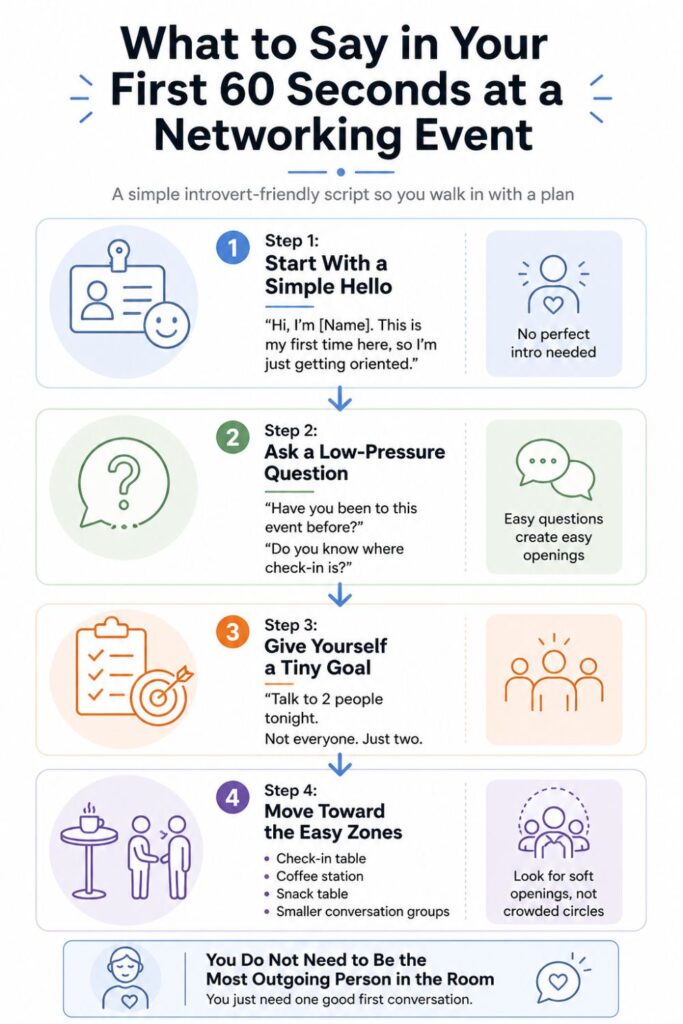
The first minute of a networking event matters because it sets the tone for everything that follows. If you walk in with no plan, the room can feel bigger than it is. If you walk in with one simple script, you give your brain something useful to do.
You do not need a dramatic entrance. You just need a starting point.
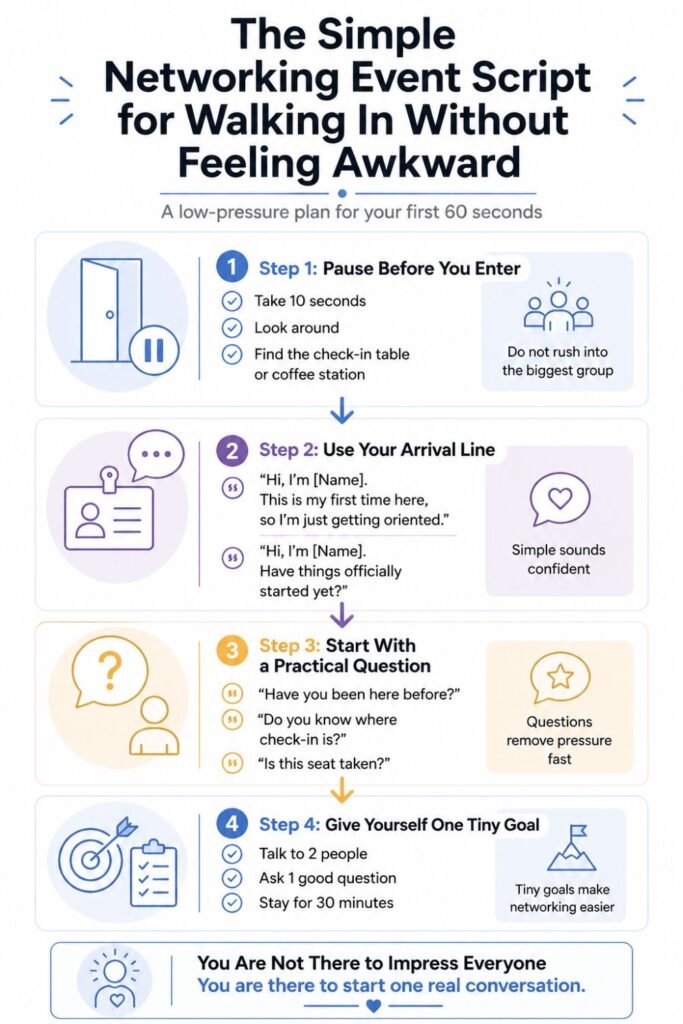
Choose your arrival line: Pick one simple sentence you can say to the host, check-in person, or first friendly face, such as, “Hi, I’m [Name]. This is my first time at one of these, so I’m just getting oriented.”
If you want to get more from your life, and are looking for concrete action steps to get you there, check out our Request a Coach page. It’s a “cut the fence-sitting and take action” way to tackle your issues and actually find success. To get off the fence and start to take action, click or tap here.
That one line does a lot. It explains why you might look a little unsure, gives the other person an easy way to respond, and helps you avoid pretending you know exactly what you are doing.
Other arrival lines you can use:
- “Hi, I’m [Name]. Is this where check-in starts?”
- “Hi, I’m [Name]. Have things officially started yet?”
- “Hi, I’m [Name]. I’m just getting settled in.”
Give yourself a tiny mission: Choose one realistic goal before you enter, such as meeting two people, finding someone in your field, or asking one useful question.
A tiny mission keeps the event from turning into a vague pressure cloud. “Network better” is too big. “Talk to two people before I leave” is much easier to act on.
Use the room before the room uses you: Step to the side for a moment, notice where people are gathering, and look for natural conversation zones like the check-in table, coffee station, snack table, or seating area.
You do not have to walk straight into the busiest group. Look for people who are also arriving, standing alone, or scanning the room. They may be just as relieved to have someone start the conversation.
Make your first move low-pressure: Start with a practical question instead of trying to launch into an impressive introduction.
Try:
If you want to get more from your life, and are looking for concrete action steps to get you there, check out our Request a Coach page. It’s a “cut the fence-sitting and take action” way to tackle your issues and actually find success. To get off the fence and start to take action, click or tap here.
- “Have you been to this event before?”
- “Do you know if there’s a schedule tonight?”
- “Is this seat taken?”
- “How did you hear about this event?”
Keep your body language simple: Face the room, keep your shoulders relaxed, and avoid hiding in your phone for too long.
A quick phone check is fine. A long phone scroll can accidentally make you look unavailable. Give yourself a minute, then re-enter the room with your tiny mission in mind.
2. Use a Simple Introduction That Does Not Sound Like a Pitch
One reason networking feels awkward is that people think they need a perfect elevator pitch. That can make your introduction sound stiff, rehearsed, or too salesy.
At most events, a better introduction sounds like a normal person explaining who they are and why they are there.
Start with your name and context: Use a short line like, “I’m [Name], I work in [field], and I came because I’m trying to meet more people in [area].”
This gives people enough information to place you, without turning the conversation into a presentation.
For example:
- “I’m Maya. I work in nonprofit communications, and I came because I’m trying to meet more people in the local marketing space.”
- “I’m Daniel. I’m in project management, and I’m exploring what’s happening in tech operations right now.”
- “I’m Priya. I’m a recent grad, and I’m here to learn more about career paths in product.”
Avoid explaining your whole career history: Keep your first answer to one or two sentences.
If you want to get more from your life, and are looking for concrete action steps to get you there, check out our Request a Coach page. It’s a “cut the fence-sitting and take action” way to tackle your issues and actually find success. To get off the fence and start to take action, click or tap here.
You can always add more if they ask. It is better to start light than to give a long background story that leaves the other person unsure where to respond.
Add one conversational hook: Include a detail that gives the other person an easy opening.
Try adding:
- “I’m especially interested in how people are using AI in this field.”
- “I’m trying to learn more about career paths that combine writing and strategy.”
- “I’m hoping to meet people who have made a career switch recently.”
A hook works because it gives the conversation direction. Instead of stopping at “Nice to meet you,” the other person has something to ask about.
Prepare a second version for follow-up questions: Have a slightly longer answer ready if someone asks, “What do you do?” or “What kind of work are you looking for?”
Your second version might sound like:
“I’ve mostly worked in customer success, but I’m interested in moving toward operations. I like roles where I can improve systems and make things run more smoothly.”
That sounds clear without sounding memorized.
If you want to get more from your life, and are looking for concrete action steps to get you there, check out our Request a Coach page. It’s a “cut the fence-sitting and take action” way to tackle your issues and actually find success. To get off the fence and start to take action, click or tap here.
End with a question: Move the attention back to them with something easy to answer.
Try:
- “What brought you here tonight?”
- “Are you working in this field too?”
- “Have you been to this kind of event before?”
- “What kind of people were you hoping to meet?”
A good intro is not meant to impress someone into silence. It is meant to open the door to a real conversation.
3. What to Say When You Want to Join a Group Conversation
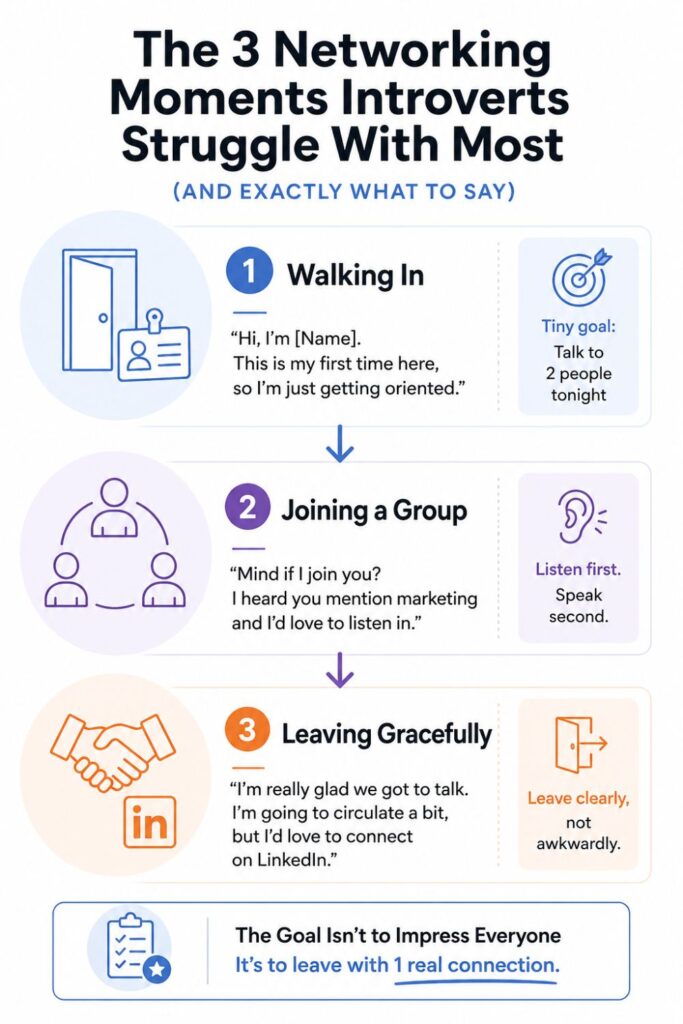
Joining a group conversation can feel like the hardest move in the room. You do not want to interrupt. You do not want to hover. You also do not want to spend the whole event waiting for someone to invite you in.
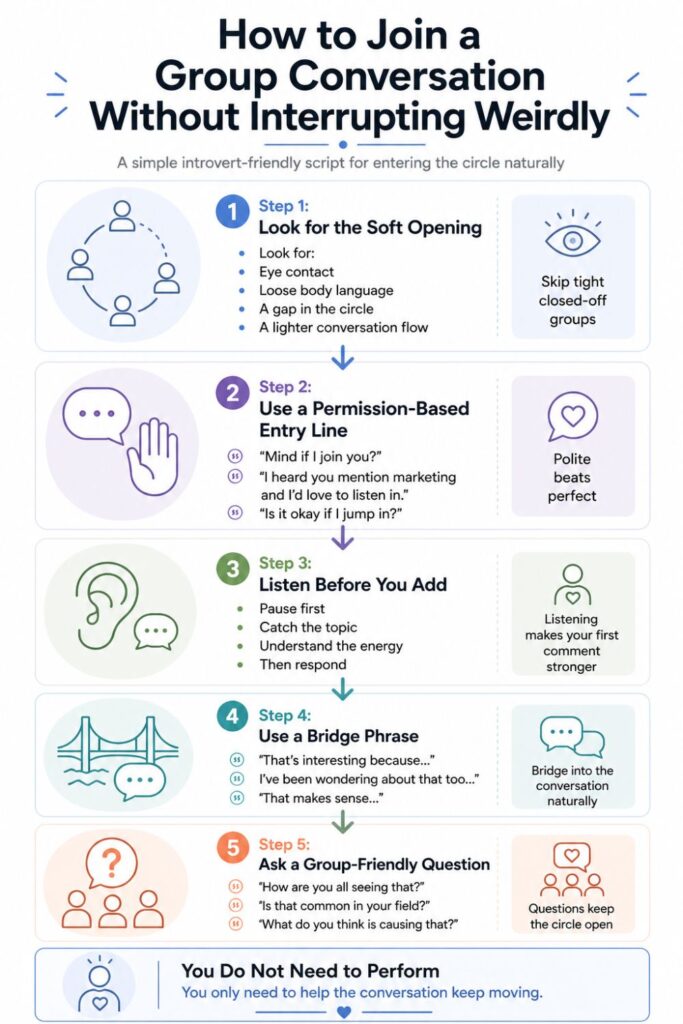
The trick is to look for a soft opening and use a line that asks permission without making the moment heavy.
Look for the soft opening: Choose a group with loose body language, a small gap in the circle, or someone who briefly makes eye contact.
Some groups are closed off. Their shoulders are turned inward, their voices are low, and nobody is looking around. You can skip those.
Better groups to join often look a little more open. People are standing in a wider circle. Someone glances around. The conversation has a lighter rhythm. There is physical room for another person.
If you want to get more from your life, and are looking for concrete action steps to get you there, check out our Request a Coach page. It’s a “cut the fence-sitting and take action” way to tackle your issues and actually find success. To get off the fence and start to take action, click or tap here.
Use a permission-based entry line: Try, “Mind if I join you?” or “I heard you mention [topic], and I’d love to listen in if that’s okay.”
This works because it is polite, clear, and not overly apologetic.
Other lines you can use:
- “Hi, I’m [Name]. Is it okay if I jump in?”
- “I don’t want to interrupt, but this sounds like an interesting conversation.”
- “I’m also curious about that topic. Mind if I join for a minute?”
- “You all seem like you’re talking about exactly what I came here to learn.”
Do not rush to contribute immediately: Listen for a minute before trying to add your own opinion.
When you join a group, your first job is to understand the current thread. Who is speaking? What are they discussing? Is the mood serious, funny, practical, or casual?
A little listening makes your first comment feel natural.
Use a bridge phrase: Start with “That’s interesting because…” or “I’ve been wondering about that too…” before adding your thought.
Bridge phrases help you enter the conversation without sounding like you are taking it over.
If you want to get more from your life, and are looking for concrete action steps to get you there, check out our Request a Coach page. It’s a “cut the fence-sitting and take action” way to tackle your issues and actually find success. To get off the fence and start to take action, click or tap here.
Try:
- “That’s interesting because I’ve heard a few people say something similar.”
- “I’ve been wondering about that too, especially for people changing careers.”
- “That makes sense. I saw something similar in my last role.”
Ask a group-friendly question: Use a question that allows more than one person to respond.
For example:
- “How are you all seeing that play out?”
- “Is that common in your industry?”
- “What do you think is causing that shift?”
- “Has anyone here tried a different approach?”
A group-friendly question takes pressure off you. You do not have to perform. You just have to help the conversation keep moving.
4. What to Say When You Get Stuck in Small Talk
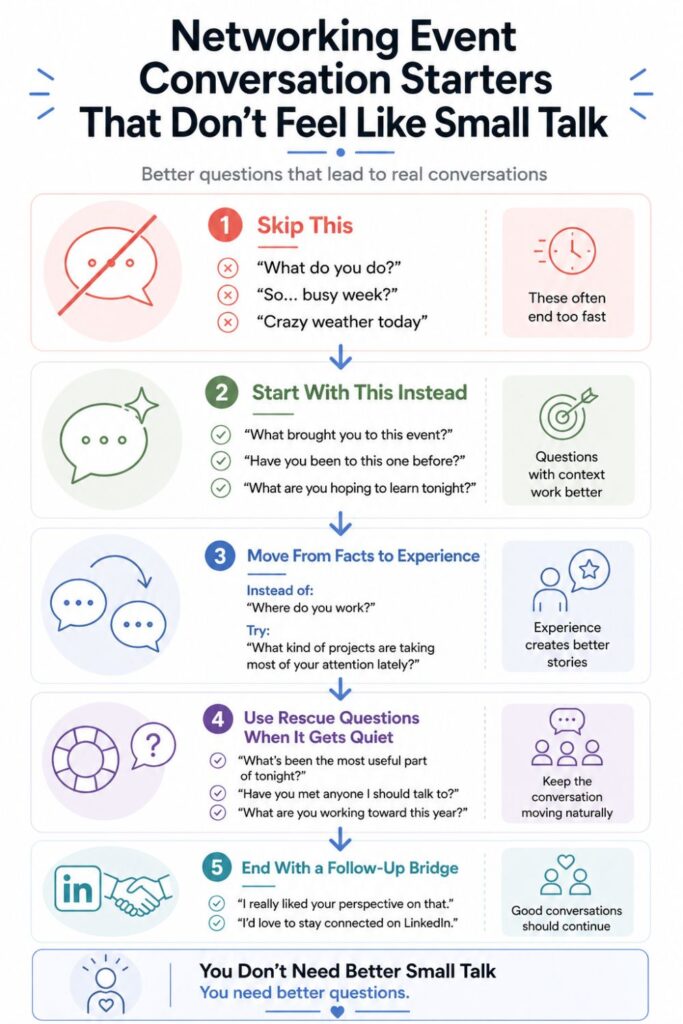
Small talk can feel especially draining when it goes nowhere. You ask what someone does. They answer. They ask what you do. You answer. Then both of you stand there wondering whether it is too early to escape.
The solution is not to avoid small talk completely. Small talk is often the doorway. The real skill is knowing how to move from surface-level questions into something a little more useful.
Turn generic questions into better questions: If someone asks, “What do you do?” answer briefly, then ask a more specific question back.
For example:
If you want to get more from your life, and are looking for concrete action steps to get you there, check out our Request a Coach page. It’s a “cut the fence-sitting and take action” way to tackle your issues and actually find success. To get off the fence and start to take action, click or tap here.
“I work in HR, mostly around employee onboarding. What kind of work are you focused on right now?”
Or:
“I’m in marketing, mainly content strategy. Are you here for business connections, career ideas, or just to meet people in the area?”
Specific questions give the conversation a better chance.
Use “why this event?” as your anchor: Ask, “What made you decide to come to this one?”
This question is simple, but it usually reveals more than “What do you do?” It can lead to career goals, current projects, a job search, a business need, or a shared interest.
You can also ask:
- “Have you been to this event before?”
- “Was there a speaker or topic that caught your attention?”
- “Are you here for work, learning, or meeting new people?”
Move from facts to experience: Replace plain factual questions with questions about what the person is noticing, learning, or working through.
If you want to get more from your life, and are looking for concrete action steps to get you there, check out our Request a Coach page. It’s a “cut the fence-sitting and take action” way to tackle your issues and actually find success. To get off the fence and start to take action, click or tap here.
Instead of:
“What company do you work for?”
Try:
“What kind of projects are taking most of your attention lately?”
Instead of:
“How long have you been in this field?”
Try:
“What has changed the most since you started?”
If you want to get more from your life, and are looking for concrete action steps to get you there, check out our Request a Coach page. It’s a “cut the fence-sitting and take action” way to tackle your issues and actually find success. To get off the fence and start to take action, click or tap here.
Keep a few rescue questions ready: Use these when the conversation starts to stall.
Good rescue questions include:
- “What has been the most useful part of the event so far?”
- “Have you met anyone here you think I should talk to?”
- “What are you hoping to learn more about this year?”
- “What kind of work do you want to do more of?”
Let silence breathe for a second: Do not panic-fill every pause.
A short pause is not always a failure. Sometimes the other person is thinking. Sometimes they are about to ask a better question. Give the moment a little space before deciding the conversation is over.
5. What to Say When You Want to Leave a Conversation Gracefully
Leaving a conversation can feel just as awkward as starting one. You might worry the other person will feel rejected, or that you will seem rude if you move on.
But at networking events, circulating is normal. People expect conversations to open and close. A graceful exit is simply a clear, kind closing line.
Signal the close before you leave: Use a warm wrap-up line like, “I’m really glad we got to talk. I’m going to circulate a bit before the event wraps up.”
This works because it gives the conversation a clear ending. You are not disappearing. You are closing the loop.
If you want to get more from your life, and are looking for concrete action steps to get you there, check out our Request a Coach page. It’s a “cut the fence-sitting and take action” way to tackle your issues and actually find success. To get off the fence and start to take action, click or tap here.
Other exit lines:
- “I really enjoyed this. I’m going to say hello to a few more people before I head out.”
- “This was so helpful. I’m going to grab some water, but I’m glad we connected.”
- “I’m glad we got a chance to talk. I promised myself I’d meet a couple more people tonight.”
- “I don’t want to keep you from the rest of the room, but I really enjoyed hearing about your work.”
Add appreciation so it does not feel abrupt: Mention one specific thing you liked from the conversation.
For example:
- “I really appreciated what you said about switching industries.”
- “That point about client communication was helpful.”
- “I’m glad you mentioned that book. I’m going to look it up.”
Specific appreciation makes the exit feel personal instead of dismissive.
Use a practical reason when needed: Give yourself a simple, honest reason to move.
Try:
- “I’m going to grab a drink.”
- “I want to catch the host before they leave.”
- “I’m going to check out the next table.”
- “I need to step out for a minute.”
You do not need a dramatic excuse. A practical transition is enough.
Offer a follow-up only if you mean it: Say, “Would it be okay if I connected with you on LinkedIn?” or “I’d love to send you that resource we mentioned.”
If you want to get more from your life, and are looking for concrete action steps to get you there, check out our Request a Coach page. It’s a “cut the fence-sitting and take action” way to tackle your issues and actually find success. To get off the fence and start to take action, click or tap here.
Do not offer follow-up just to soften the exit. If you do offer it, make it easy and specific.
Leave cleanly after the closing line: Smile, thank them, and physically move.
This matters. If you keep restarting the conversation after closing it, you make the exit harder for both of you. A graceful ending is kind, clear, and complete.
6. How to Ask for Contact Information Without Making It Weird
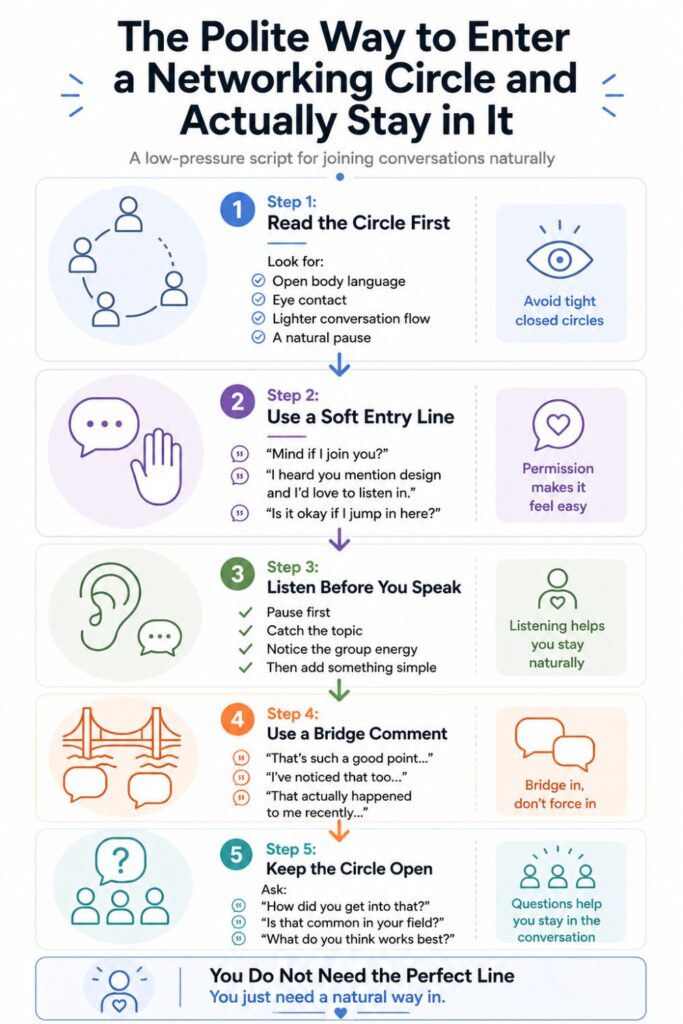
Asking to stay in touch can feel strangely personal, even when that is the whole point of the event. You may worry you are being pushy or that the other person will feel trapped.
The easiest way to make the ask feel natural is to connect it to the conversation you just had.
Connect the ask to the conversation: Say, “I’d like to keep in touch because I’d love to hear how that project develops.”
This gives your request a reason. You are not collecting contacts randomly. You are continuing something that already started.
Other natural lines:
If you want to get more from your life, and are looking for concrete action steps to get you there, check out our Request a Coach page. It’s a “cut the fence-sitting and take action” way to tackle your issues and actually find success. To get off the fence and start to take action, click or tap here.
- “I’d love to connect on LinkedIn so I can follow your work.”
- “Would it be okay if I sent you that article we talked about?”
- “I’d like to stay in touch. This was a really useful conversation.”
- “Would you mind if I connected with you after the event?”
Use the easiest platform: Ask, “Are you on LinkedIn?” instead of asking for a phone number unless the relationship already feels warmer.
LinkedIn is usually the least awkward option at professional events. It also gives the other person context when you follow up later.
You can say:
“Are you on LinkedIn? I’d be happy to connect there.”
Or:
“Would LinkedIn be the best place to stay in touch?”
Make the next step specific: If there is a real reason to follow up, name it.
For example:
If you want to get more from your life, and are looking for concrete action steps to get you there, check out our Request a Coach page. It’s a “cut the fence-sitting and take action” way to tackle your issues and actually find success. To get off the fence and start to take action, click or tap here.
- “I’ll send you the name of that podcast.”
- “I’d love to ask you one or two more questions about that career path.”
- “I can send you the template I mentioned.”
- “I’d be curious to hear how that event goes next month.”
Specific follow-up feels more natural than a vague “Let’s keep in touch.”
Give them an easy out: Use “No pressure at all” when the ask could feel like too much.
For example:
“No pressure at all, but if you’re open to it, I’d love to connect on LinkedIn.”
This makes the interaction feel respectful. It also helps you sound confident without forcing the connection.
Write one detail immediately after: Note what you discussed before you forget.
You can write a quick note in your phone:
- “Met Jordan, product manager, talked about career change.”
- “Met Lena, nonprofit marketing, recommended newsletter.”
- “Met Chris, operations, follow up about project management tools.”
That one detail makes your follow-up sound human instead of generic.
If you want to get more from your life, and are looking for concrete action steps to get you there, check out our Request a Coach page. It’s a “cut the fence-sitting and take action” way to tackle your issues and actually find success. To get off the fence and start to take action, click or tap here.
7. Build a Tiny Networking Event Cheat Sheet
A cheat sheet is not a sign that you are bad at networking. It is a tool that helps you stop relying on panic memory in a crowded room.
Introverts often do better when they have time to think before speaking. A cheat sheet gives you that thinking time in advance.
Pick three starter lines: Write one line for arriving, one for joining a group, and one for introducing yourself.
For example:
- Arrival: “Hi, I’m [Name]. I’m just getting oriented. Is this where check-in starts?”
- Group entry: “Mind if I join you? This sounds like an interesting conversation.”
- Introduction: “I’m [Name]. I work in [field], and I came because I’m hoping to meet more people in [area].”
These do not have to be clever. They just have to be usable.
Choose three better questions: Prepare questions that fit the event, your field, or your goals.
Good options:
- “What brought you to this event?”
- “What kind of work are you focused on right now?”
- “What has been the most useful conversation you’ve had tonight?”
- “Are there any people here you think are especially helpful to meet?”
- “What are you hoping to learn more about this year?”
Questions are powerful because they take pressure off you. You do not need to dominate the conversation. You can guide it.
If you want to get more from your life, and are looking for concrete action steps to get you there, check out our Request a Coach page. It’s a “cut the fence-sitting and take action” way to tackle your issues and actually find success. To get off the fence and start to take action, click or tap here.
Write two exit lines: Have one casual exit and one follow-up exit ready.
Casual exit:
“I’m really glad we got to talk. I’m going to circulate a bit before the event wraps up.”
Follow-up exit:
“I really enjoyed this conversation. Would it be okay if I connected with you on LinkedIn?”
Add your personal goal at the top: Keep it small and clear.
Examples:
- “Talk to two people.”
- “Ask one person about career paths in this field.”
- “Practice joining one group conversation.”
- “Leave with one follow-up contact.”
Review it right before entering: Read your cheat sheet in the car, elevator, lobby, or restroom.
If you want to get more from your life, and are looking for concrete action steps to get you there, check out our Request a Coach page. It’s a “cut the fence-sitting and take action” way to tackle your issues and actually find success. To get off the fence and start to take action, click or tap here.
You do not need to memorize it perfectly. You only need the phrases to feel familiar enough that they are easier to reach for when you need them.
A good cheat sheet does not make you robotic. It makes you prepared.
8. How a Career Coach Can Help You Practice Before the Event
Sometimes the problem is not that you need more scripts. It is that you need to practice saying them out loud before the room is full of strangers.
This is where a career coach can help, especially if networking is tied to a job search, career change, business goal, or professional visibility.
Clarify your networking goal: A coach can help you decide whether you are looking for referrals, industry insight, new clients, career ideas, or confidence practice.
Without a goal, every conversation can feel like it has to become something important. With a goal, you know what you are actually trying to do.
For example, your goal might be:
- Meet people in a new industry
- Learn what hiring managers care about
- Find potential collaborators
- Practice introducing yourself
- Build confidence after a career break
Each goal changes the kind of script you need.
If you want to get more from your life, and are looking for concrete action steps to get you there, check out our Request a Coach page. It’s a “cut the fence-sitting and take action” way to tackle your issues and actually find success. To get off the fence and start to take action, click or tap here.
Turn vague fears into specific scripts: Instead of saying, “I’m bad at networking,” a coach can help you identify the exact moments that make you freeze.
Maybe you freeze when you walk in. Maybe you do fine one-on-one but struggle with groups. Maybe you can start conversations but do not know how to end them.
Each moment needs a different script.
Role-play the awkward parts: Practice joining a group, ending a conversation, asking for LinkedIn, and recovering after a clumsy answer.
Role-play may feel uncomfortable at first, but it helps your body learn that these moments are survivable. The first time you say the line should not have to be at the actual event.
Refine your introduction: A coach can help you make your intro sound clear and natural.
This is especially useful if you are changing careers, returning to work, starting a business, or trying to explain a role that people do not immediately understand.
Create a post-event follow-up plan: Decide who to message, what to say, and when to send it.
If you want to get more from your life, and are looking for concrete action steps to get you there, check out our Request a Coach page. It’s a “cut the fence-sitting and take action” way to tackle your issues and actually find success. To get off the fence and start to take action, click or tap here.
A coach can also help you review what worked afterward. That way, each event becomes practice instead of proof that you are either “good” or “bad” at networking.
Walk Out Knowing You Did Enough
A successful networking event does not have to look impressive from the outside.
It might be two conversations. It might be one LinkedIn connection. It might be practicing your introduction without apologizing for yourself. It might be walking into the room even though part of you wanted to turn around.
That counts.
Define success by follow-through, not charm: Decide what “enough” looks like before the event starts.
If your goal was to talk to two people and you did that, you succeeded. If your goal was to join one group conversation and you tried, that matters. If your goal was to ask one thoughtful question, that is progress.
Networking is not a personality contest. It is a skill built through repeatable actions.
Leave before you are completely drained: You do not have to stay until the final minute to prove you made the most of the event.
If you want to get more from your life, and are looking for concrete action steps to get you there, check out our Request a Coach page. It’s a “cut the fence-sitting and take action” way to tackle your issues and actually find success. To get off the fence and start to take action, click or tap here.
Introverts often follow up better when they leave with a little energy left. If you stay until you are socially exhausted, even a simple message can feel impossible later.
Give yourself permission to leave when you have completed your goal.
Use one quick reset after the event: Before you go home or move on with your day, write down three things.
- Who you met
- What you talked about
- Whether you want to follow up
This takes five minutes and saves you from trying to remember everything the next morning.
Send simple follow-ups: You do not need a perfect message.
Try:
“Hi [Name], it was great meeting you at [Event]. I enjoyed talking about [specific topic]. I’d be happy to stay connected.”
Or:
If you want to get more from your life, and are looking for concrete action steps to get you there, check out our Request a Coach page. It’s a “cut the fence-sitting and take action” way to tackle your issues and actually find success. To get off the fence and start to take action, click or tap here.
“Hi [Name], I liked what you said about [specific point]. Thanks again for the conversation at [Event].”
The main takeaway is simple: networking gets easier when the hardest moments are no longer blank spaces.
When you know what to say as you walk in, how to join a group, and how to leave gracefully, you stop winging every social move. You give yourself a plan.
And for introverts, that plan can make the whole room feel a little less impossible.
***
Want to try this at home? No worries! Download a copy of our Coffee Chat Questions for Introverts.
Need some business or career guidance? Drop on by our directories choc full of business coaches and career coaches to bring your business or career to the next level. Or click here to have us match you to the best.
If you want to get more from your life, and are looking for concrete action steps to get you there, check out our Request a Coach page. It’s a “cut the fence-sitting and take action” way to tackle your issues and actually find success. To get off the fence and start to take action, click or tap here.
Read this next
13 Essential Job Coaching Tips: Career Coaching Plan from a Recruitment Coach
A recruitment coach passes on his top tips when you’re looking for a job.
Read More
10 Crucial Job Search Mistakes and How to Avoid Them
Looking for a job? Make sure you aren’t guilty of making any of these crucial job search mistakes.
Read More
What Would Be Your Ideal Career If You Could Do Anything?
Ask yourself this powerful coaching question: What would be your ideal career- If you could do anything? If you want to get more from your life, and are looking for […]
Read More