







How to Change Careers When You Don’t Know What’s Next Yet

Want to try this at home? No worries! Download a copy of our Career Change Exit Checklist.
*****
You Don’t Need the Whole Answer Before You Start
Changing careers can feel strangely unfair when you know your current path is not right, but you do not know what should replace it. You may feel like you are supposed to have a clear dream job, a confident five-year plan, or a sudden moment where everything clicks.
Most people do not get that.
Career clarity usually comes from movement, not from sitting still and trying to think your way into the perfect answer. You learn what fits by noticing patterns, testing ideas, asking better questions, and gathering real evidence.
That is why the first step is not to quit, enroll in an expensive program, or announce a dramatic reinvention. The first step is to slow the decision down enough to understand what you are actually trying to change.
Maybe you do need a completely different career. Maybe you need a different company, a different role, a different manager, a different schedule, or a better way to use skills you already have. Until you separate those possibilities, everything can feel like one giant messy problem.
If you want to get more from your life, and are looking for concrete action steps to get you there, check out our Request a Coach page. It’s a “cut the fence-sitting and take action” way to tackle your issues and actually find success. To get off the fence and start to take action, click or tap here.
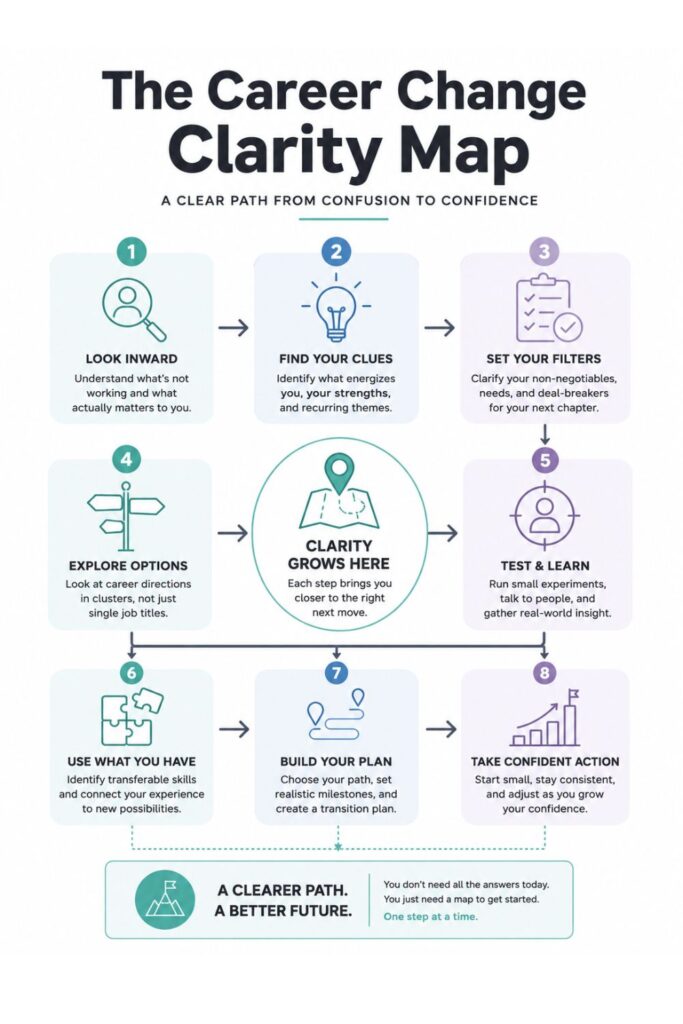
This process gives you a more practical way forward.
Instead of asking, “What should I do with my life?” you will start asking smaller, more useful questions:
- What parts of my current work are actually wrong for me?
- What kinds of tasks give me energy?
- What do I want my next career to protect?
- What options are worth testing before I commit?
- What skills do I already have that can move with me?
You do not need perfect certainty to begin. You need a way to narrow the fog into a few realistic directions, then test those directions before making a major leap.
The goal is not to force yourself into one perfect career title today. The goal is to build enough confidence, clarity, and evidence that your next move feels grounded instead of desperate.
Need some career guidance? Drop on by our directories choc full of career coaches to bring your career to the next level. Or click here to have us match you to the best.
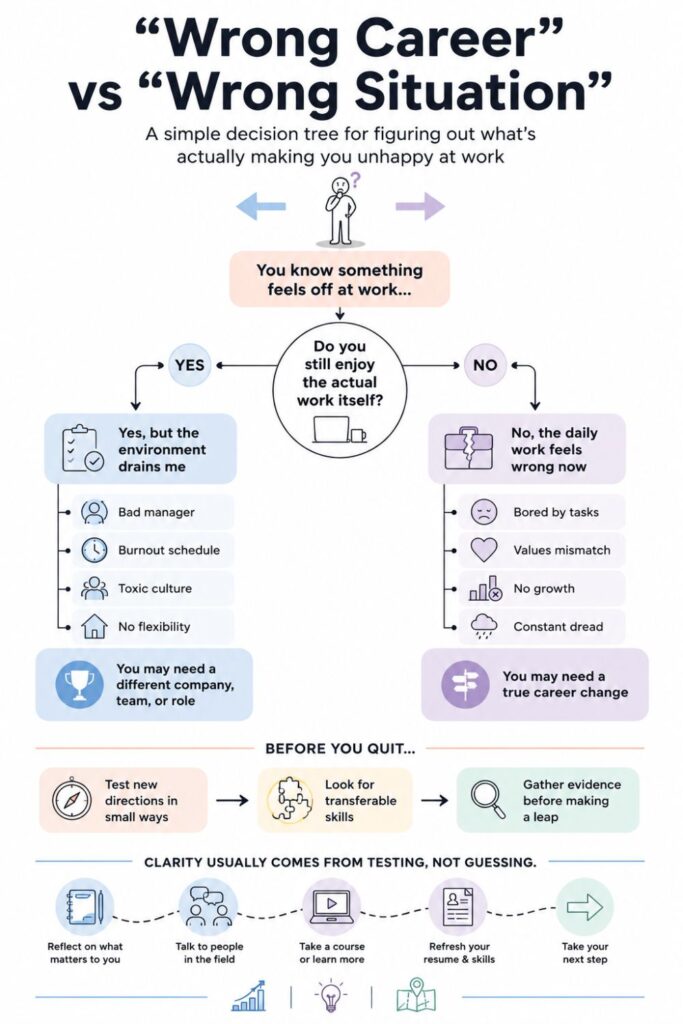
1. Separate “I Need a New Career” From “I Need a Better Situation”
When you are deeply frustrated at work, it is easy to decide the whole career is the problem. That might be true. But sometimes the real issue is more specific than that.
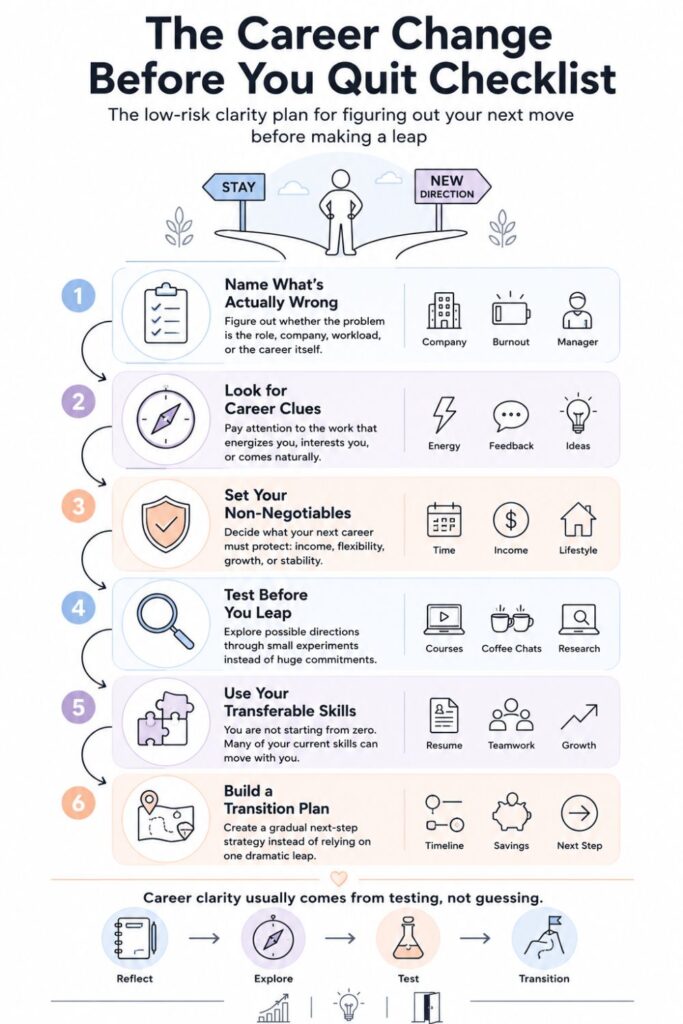
You might be in the wrong company, under the wrong manager, stuck in a bad schedule, or doing a version of your work that no longer fits your strengths. If you skip this step, you may accidentally leave a whole field when what you really needed was a different environment.
Start by naming what feels wrong in plain language. Do not try to make it sound polished or professional. Just write the truth.
If you want to get more from your life, and are looking for concrete action steps to get you there, check out our Request a Coach page. It’s a “cut the fence-sitting and take action” way to tackle your issues and actually find success. To get off the fence and start to take action, click or tap here.
Maybe you are tired of being interrupted all day. Maybe you are drained by constant client contact. Maybe you feel invisible, underpaid, bored, micromanaged, or trapped in work that has no clear future.
Then sort those frustrations into categories.
- Name what is actually wrong: Write down the specific parts of your current work that feel draining, frustrating, boring, or misaligned.
- Sort the problem by category: Separate issues related to role, manager, company culture, pay, schedule, values, growth, and daily tasks.
- Look for repeat patterns: Review past jobs and projects to see whether the same frustration keeps appearing in different places.
- Identify what is fixable where you are: Mark anything that could improve through a new team, clearer boundaries, better pay, a transfer, or a different type of employer.
This step matters because “I hate my career” can hide several different problems. A person who dislikes their manager needs a different solution than a person who hates the daily tasks of the job itself.
For example, if you enjoy strategy but hate constant meetings, your next move may be toward a more independent version of your field. If you enjoy helping people but hate sales pressure, you may need a role where support matters more than quotas.
The goal is not to talk yourself out of a career change. It is to make sure the change you pursue actually solves the right problem.
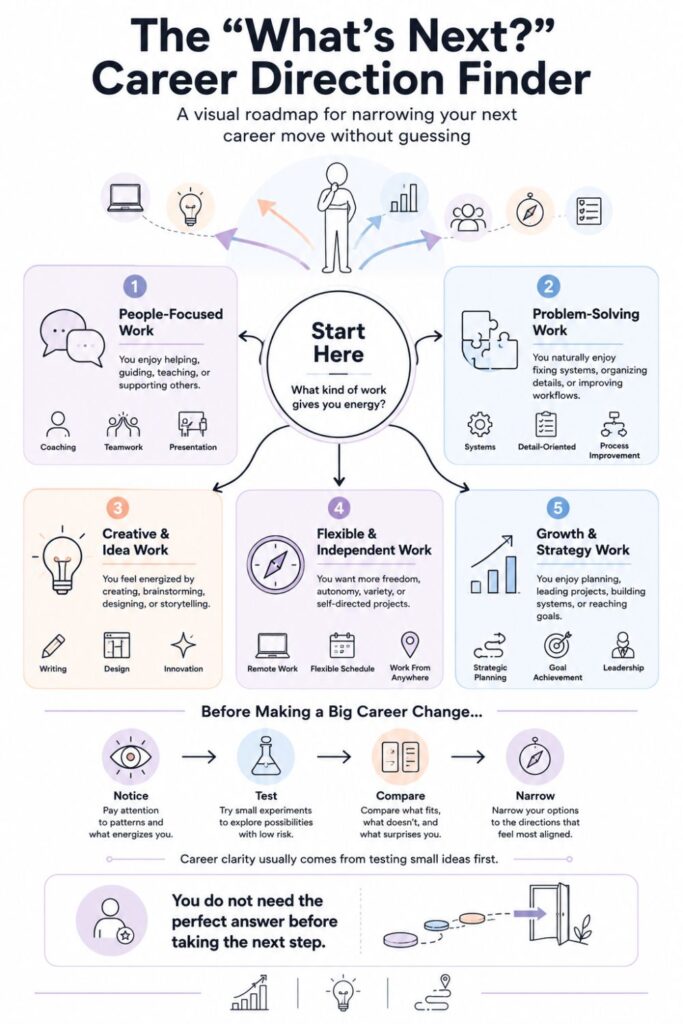
2. Build a “Career Clues” List Before You Look at Job Titles
A lot of people start a career change by searching job titles. That can help later, but it is often overwhelming at the beginning. There are too many options, too many requirements, and too many roles that sound interesting until you read what they actually involve.
Before you look at job titles, look for clues.
Career clues are small pieces of evidence from your real life. They show you what you enjoy, what you are good at, what people trust you with, and what kind of work keeps pulling your attention.
If you want to get more from your life, and are looking for concrete action steps to get you there, check out our Request a Coach page. It’s a “cut the fence-sitting and take action” way to tackle your issues and actually find success. To get off the fence and start to take action, click or tap here.
Start with energy. Think about tasks that make you feel focused, useful, or curious. These do not have to be huge achievements. They might be tiny moments you normally overlook.
Maybe you like organizing messy information into a clear plan. Maybe you enjoy explaining things to people. Maybe you get absorbed in research, design, troubleshooting, writing, planning, coaching, selling, analyzing, or improving systems.
Then look at what people ask you for. This can reveal strengths that feel normal to you because they come naturally.
- Start with energy evidence: List tasks, conversations, projects, and problems that made you feel more engaged or naturally focused.
- Notice what people ask you for: Write down the advice, skills, support, or problem-solving people already come to you for.
- Track what you avoid: Note the tasks you procrastinate on, dread, or recover from slowly.
- Turn clues into themes: Group your notes into patterns such as teaching, organizing, leading, creating, analyzing, supporting, or building.
This is where your next direction starts to become less random. Instead of saying, “Maybe I should go into marketing, tech, HR, coaching, design, or project management,” you begin to see the kind of work underneath the title.
For example, if your clues point toward helping people clarify goals, stay accountable, and make decisions, career coaching, training, management, HR, or client success might become options to explore.
If your clues point toward organizing details, improving workflows, and making messy things easier to manage, operations, project coordination, systems work, or administrative leadership might be worth testing.
You are not choosing yet. You are collecting evidence.
3. Define Your Non-Negotiables Before You Chase Possibilities
A career can look exciting from the outside and still be completely wrong for the life you want. That is why you need to define your non-negotiables before you get too attached to an option.
If you want to get more from your life, and are looking for concrete action steps to get you there, check out our Request a Coach page. It’s a “cut the fence-sitting and take action” way to tackle your issues and actually find success. To get off the fence and start to take action, click or tap here.
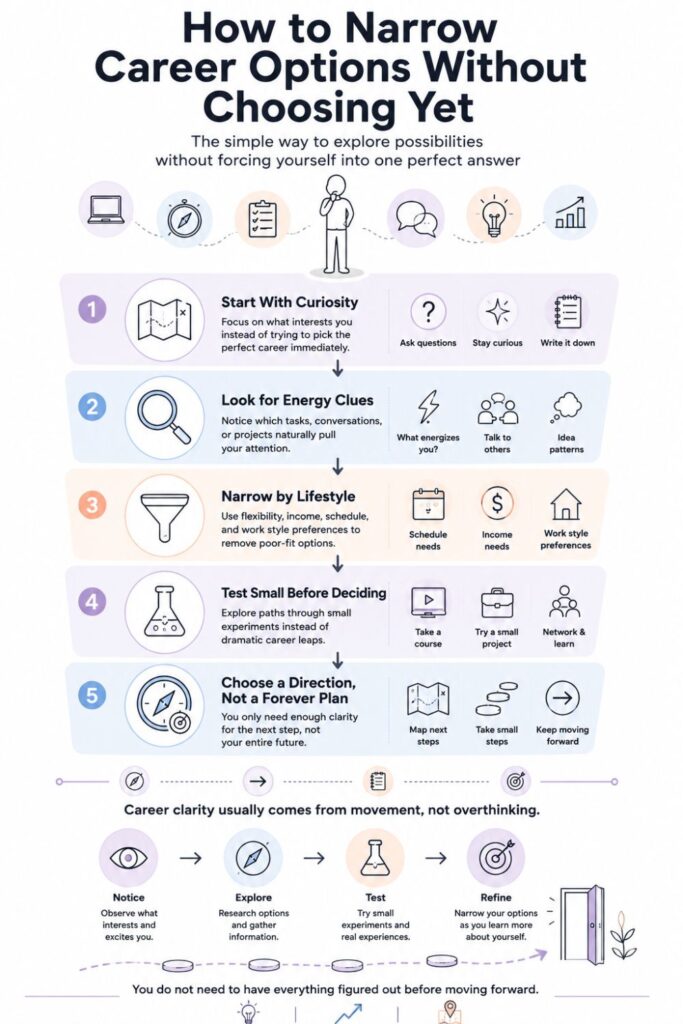
Non-negotiables are the things your next career needs to protect. They are not vague wishes. They are the practical conditions that affect your daily life, health, income, relationships, and long-term stability.
For one person, flexibility might be essential because they have caregiving responsibilities. For another, a stable salary might matter more than creative freedom. Someone else may need remote work, predictable hours, strong advancement potential, or a role that does not require constant social energy.
Write these down before you start exploring new careers too deeply. It will help you avoid chasing paths that sound good but do not match your real needs.
- Choose your life constraints first: Decide what your next career needs to protect, such as income, location, schedule, family time, stability, health, or growth.
- Separate needs from preferences: Mark which requirements are truly necessary and which would simply be nice to have.
- Set your risk tolerance: Decide how much uncertainty you can handle financially, emotionally, and practically.
- Create a “no more” list: Write down conditions you are not willing to repeat, such as constant overtime, low autonomy, unclear expectations, or limited advancement.
This step can feel limiting, but it actually gives you more freedom. Instead of exploring every possible path, you can focus on options that have a realistic chance of working.
For example, if you need to keep your current income level, you may choose an adjacent career path instead of starting over at entry level. If you need flexibility, you may prioritize remote roles, consulting, freelance work, or companies with strong flexible policies.
If you know you cannot handle years of retraining right now, that does not mean you are stuck. It means your next move should use more of the skills you already have.
A good career change is not just about what sounds inspiring. It is about what fits your life well enough to sustain.
4. Explore Career Directions in Clusters, Not One Perfect Job
One of the biggest mistakes people make during a career change is trying to find the perfect job title too soon. That creates pressure. It also makes every option feel like a final decision.
If you want to get more from your life, and are looking for concrete action steps to get you there, check out our Request a Coach page. It’s a “cut the fence-sitting and take action” way to tackle your issues and actually find success. To get off the fence and start to take action, click or tap here.
A better approach is to explore career directions in clusters.
A career cluster is a broad area of possibility. It lets you investigate several related roles without forcing yourself to pick one immediately. This is especially helpful when you know you want a change, but your next step still feels unclear.
For example, you might create clusters like:
- People-focused work
- Creative strategy
- Operations and systems
- Education and training
- Health and wellness
- Technology and product
- Business support
- Writing and communication
- Coaching and personal development
Once you have a few clusters, you can place real job titles underneath each one. This gives your research more structure.
- Choose broad possibility buckets: Create 3 to 5 career direction categories that match your career clues.
- List roles inside each bucket: Add real job titles under each direction so you can compare actual options.
- Compare daily work, not fantasy outcomes: Look at responsibilities, required skills, working conditions, pay range, and growth path.
- Remove poor-fit options early: Cross off any path that clashes with your non-negotiables or repeats the problems you want to leave.
This keeps you from falling in love with the idea of a career without understanding the day-to-day reality. Many careers look appealing from a distance because we focus on the identity, not the work.
You may like the idea of being a designer, but not enjoy constant client revisions. You may like the idea of being a coach, but not want to run a business. You may like the idea of working in tech, but prefer people-focused roles over coding or product analytics.
That does not mean those directions are wrong. It means you need to find the version that fits.
Clusters help you stay open without staying scattered. You are creating a map, not locking yourself into a final destination.
If you want to get more from your life, and are looking for concrete action steps to get you there, check out our Request a Coach page. It’s a “cut the fence-sitting and take action” way to tackle your issues and actually find success. To get off the fence and start to take action, click or tap here.
5. Run Tiny Career Tests Before You Commit
Career change feels risky when everything is theoretical. The more you test, the less you have to guess.
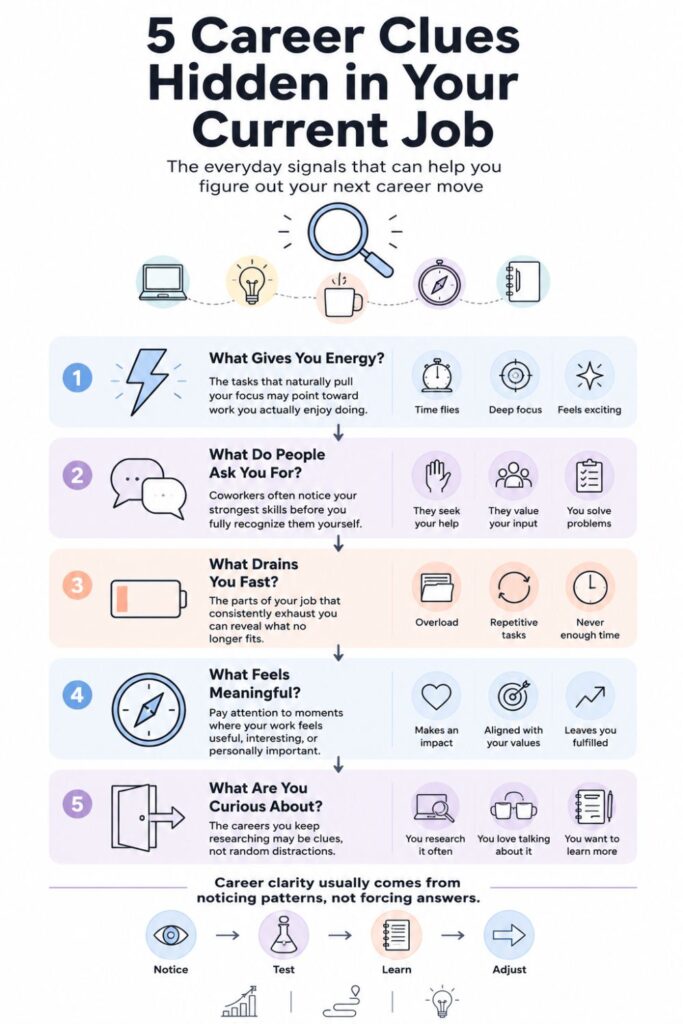
Tiny career tests are small experiments that help you learn what a path actually feels like before you invest too much time, money, or identity into it. They give you real feedback instead of endless mental debate.
You do not need to quit your job to run a test. You do not need to enroll in a full degree program. You just need a way to experience a small piece of the work.
For example, if you are curious about career coaching, you might read coaching case studies, take a short introductory class, interview a career coach, or practice helping a friend map options. If you are curious about project management, you might volunteer to organize a small project at work or take a short course to see whether the tools and thinking style interest you.
- Start with low-risk experiments: Try a short course, shadowing opportunity, volunteer project, weekend assignment, or sample task.
- Interview people already doing the work: Ask about daily responsibilities, hard parts, entry points, pay progression, and what surprised them.
- Notice your real reaction: Track whether you feel curious, bored, drained, intimidated in a good way, or relieved when the test ends.
- Compare evidence, not excitement: Use what you learn from each test to narrow your options instead of relying on the first rush of possibility.
This step is powerful because excitement can be misleading. Sometimes a new career sounds appealing simply because it is different from what you are doing now. Testing helps you find out whether the work itself interests you.
Pay attention to your body and behavior. Did you want to learn more after the test? Did time pass quickly? Did the work feel hard but satisfying? Or did you feel the same kind of dread you feel in your current role?
You are not looking for perfect ease. New things often feel uncomfortable. You are looking for useful discomfort, the kind that makes you curious rather than shut down.
6. Translate Your Current Experience Into Your Next Direction
When people think about changing careers, they often assume they are starting from zero. That fear can make the whole process feel impossible.
If you want to get more from your life, and are looking for concrete action steps to get you there, check out our Request a Coach page. It’s a “cut the fence-sitting and take action” way to tackle your issues and actually find success. To get off the fence and start to take action, click or tap here.
But most career changers are not starting over. They are repositioning.
You already have experience, skills, habits, judgment, communication patterns, and problem-solving abilities that can transfer into a new path. The work now is to identify those pieces and connect them to your next direction.
Start by making a list of skills you have used across jobs, projects, volunteer work, side projects, caregiving, leadership, or personal responsibilities. Do not only list technical skills. Include soft skills and thinking skills too.
Examples include:
- Communication
- Planning
- Research
- Training
- Writing
- Problem-solving
- Conflict resolution
- Customer support
- Sales
- Organization
- Leadership
- Data analysis
- Project coordination
- Process improvement
Then compare your list to job descriptions in the career clusters you are exploring.
- Find your transferable skills: Identify abilities from your current career that can move with you into a new field.
- Match skills to target roles: Review job descriptions and highlight where your existing experience already overlaps.
- Fill only the most important gaps: Choose 1 to 3 skills or credentials that would meaningfully improve your chances.
- Rewrite your story: Practice explaining your career change as a logical next step based on strengths, interests, and evidence.
This helps you avoid overtraining. Many people delay a career change because they believe they need another degree, a long certification, or a complete personal reinvention. Sometimes they do. Often, they need a smaller bridge.
If you are moving from teaching into training, you may already have presentation, curriculum, communication, and people skills. If you are moving from customer service into client success, you may already understand relationship-building, troubleshooting, and retention. If you are moving from admin work into operations, your planning and systems skills may be more valuable than you think.
Your next employer, client, or opportunity needs to understand the connection. That means your resume, LinkedIn profile, and interview answers should not sound like an apology for changing direction. They should show the thread that ties your past experience to your future path.
If you want to get more from your life, and are looking for concrete action steps to get you there, check out our Request a Coach page. It’s a “cut the fence-sitting and take action” way to tackle your issues and actually find success. To get off the fence and start to take action, click or tap here.
7. Create a Transition Plan That Does Not Require a Dramatic Leap
A career change does not have to happen in one huge jump. In many cases, the smartest transition is gradual.
A dramatic leap can sound brave, but it is not always the most practical option. If you leave too quickly without enough information, savings, or direction, you may create pressure that makes decision-making harder.
Instead, build a transition plan. This gives you a path from where you are now to where you want to go, with less chaos in between.
Your transition route will depend on your current situation, finances, target field, and risk tolerance. You might move internally to a different department. You might take an adjacent role that uses your current skills in a new industry. You might study part-time, build a portfolio, start a side project, freelance, volunteer, or network before applying.
- Pick a realistic transition route: Decide whether your best path is an internal move, adjacent role, side project, certification, freelance test, or gradual industry shift.
- Set a decision timeline: Give yourself a clear window for exploration so you do not stay stuck in endless research.
- Build a financial buffer: Estimate what you may need for training, job searching, reduced income, or a slower transition.
- Choose your next brave move: Pick one concrete action, such as updating your resume, messaging three people, applying for one role, or booking an informational interview.
A timeline is especially helpful if you tend to overthink. You might give yourself 30 days to research options, 60 days to run tests, and 90 days to begin applying or building a bridge. The timing can be flexible, but it should create momentum.
Your plan should also include decision points. For example, after three informational interviews and one small test project, you might decide whether a path is worth pursuing further.
This keeps you from staying in permanent “maybe” mode.
A transition plan does not remove all fear. It simply gives fear less control. You are no longer standing at the edge of a cliff. You are building steps.
If you want to get more from your life, and are looking for concrete action steps to get you there, check out our Request a Coach page. It’s a “cut the fence-sitting and take action” way to tackle your issues and actually find success. To get off the fence and start to take action, click or tap here.
8. How a Career Coach Can Help When You Feel Too Close to the Problem
Sometimes you are too close to your own career situation to see it clearly. You know too much, feel too much, and carry too many fears about making the wrong move.
That is where a career coach can help.
A career coach does not magically hand you the perfect answer. A good coach helps you ask sharper questions, notice patterns, sort your options, and take practical steps instead of spinning in circles.
This can be especially useful if your thoughts sound like:
- “I know what I do not want, but I have no idea what I do want.”
- “I have too many interests and cannot choose.”
- “I am scared I will make a mistake.”
- “I do not know how to explain my career change.”
- “I keep researching but never actually move.”
A coach can help turn that mental clutter into a clearer process.
- Clarify the real decision: A career coach can help you separate burnout, boredom, fear, and true misfit.
- Spot patterns you cannot see alone: They can help connect your strengths, frustrations, values, and past experiences into clearer career themes.
- Turn vague options into testable steps: A coach can help you design small experiments, research tasks, and decision checkpoints.
- Strengthen your transition story: They can help you explain your career shift in resumes, interviews, networking conversations, and personal decisions.
This is not just about choosing a job title. It is about making a decision you can stand behind.
For example, a coach may help you realize that you do not actually want a totally different field. You want a role with more autonomy, more meaning, or more room to grow. Or they may help you see that your current career really is misaligned, but that your skills point naturally toward a few practical next steps.
Coaching can also help with accountability. Career change often gets delayed because the work is not urgent enough to force action. A coach can help you keep moving, even when your confidence dips.
If you want to get more from your life, and are looking for concrete action steps to get you there, check out our Request a Coach page. It’s a “cut the fence-sitting and take action” way to tackle your issues and actually find success. To get off the fence and start to take action, click or tap here.
If you feel stuck in your own head, support can shorten the distance between confusion and action.
9. Mistakes to Avoid When You Do Not Know What’s Next
When you feel uncertain, it is tempting to do something dramatic just to feel like you are moving. But not every action creates clarity. Some moves create more pressure.
The first mistake is quitting just to force yourself to figure it out. Sometimes leaving is necessary, especially if a job is harming your well-being or blocking your ability to function. But if you can safely stay while you explore, that may give you more space to make a thoughtful decision.
The second mistake is chasing a career because it looks peaceful from the outside. Every field has hidden pressures. Creative work can involve deadlines and revisions. Helping professions can involve emotional labor. Flexible work can come with income uncertainty. Remote work can feel isolating.
You need the real version, not the fantasy version.
- Do not quit just to create urgency: Leaving without a plan can add financial pressure that makes it harder to think clearly.
- Do not chase a career because it looks peaceful from the outside: Research the daily reality before assuming another path will solve everything.
- Do not confuse fear with a bad fit: Some options feel uncomfortable because they are new, not because they are wrong.
- Do not wait for perfect certainty: Career clarity usually comes from testing and feedback, not from thinking until every doubt disappears.
Another common mistake is asking too many people what you should do. Advice can help, but it can also make you more confused if everyone is projecting their own values onto your decision.
One person may tell you to choose stability. Another may tell you to follow passion. Someone else may push you toward whatever worked for them.
Listen for insight, but come back to your own evidence.
If you want to get more from your life, and are looking for concrete action steps to get you there, check out our Request a Coach page. It’s a “cut the fence-sitting and take action” way to tackle your issues and actually find success. To get off the fence and start to take action, click or tap here.
The final mistake is expecting total confidence before you act. Confidence often comes after small action, not before it. You build it by proving to yourself that you can research, test, decide, adjust, and keep going.
You do not need to eliminate all doubt. You need enough clarity to take the next responsible step.
A Clearer Next Step

You do not have to know your final career path to begin changing careers wisely. You only need to stop treating the whole decision like one giant question.
Instead of asking, “What should I do with the rest of my life?” ask, “What is the next piece of evidence I need?”
That question is much easier to answer.
Maybe your next step is writing your career clues list. Maybe it is sorting what is wrong with your current role. Maybe it is researching three career clusters, messaging someone for an informational interview, or testing one small piece of work before you commit.
The path becomes clearer when you stop waiting for one perfect answer and start collecting real signals.
A career change is not always a sudden transformation. Sometimes it is a series of small, honest decisions that slowly point you in a better direction.
If you want to get more from your life, and are looking for concrete action steps to get you there, check out our Request a Coach page. It’s a “cut the fence-sitting and take action” way to tackle your issues and actually find success. To get off the fence and start to take action, click or tap here.
You notice what drains you. You name what matters. You explore what might fit. You test before you leap. You translate the experience you already have. You build a transition plan that respects your real life.
That is how confidence grows.
Not because you guessed perfectly from the beginning, but because you gave yourself a process that made the unknown feel less overwhelming and more workable.
Your next career does not have to be obvious yet. It only has to become clearer one step at a time.
*****
Want to try this at home? No worries! Download a copy of our Career Change Exit Checklist.
Need some career guidance? Drop on by our directories choc full of career coaches to bring your career to the next level. Or click here to have us match you to the best.
If you want to get more from your life, and are looking for concrete action steps to get you there, check out our Request a Coach page. It’s a “cut the fence-sitting and take action” way to tackle your issues and actually find success. To get off the fence and start to take action, click or tap here.
Read this next

Definitive Coaching Interview Questions Guide (with Do’s and Don’ts from a Life Coach)
How do you impress an interviewer? Knowing good interview questions to ask is key.
Read More
Planning To Be Successful Can End Your Success Before It Begins
Everyone says “I plan on being successful”, but not everyone is successful. And to be honest the only reason some
Read More
8 Tips for Writing a Killer Resume in Today’s Digital World
Follow these simple tips to get noticed by employers!
Read More