







Coaching Techniques: Asking Life Coaching Questions

Coaching techniques: asking life coaching questions
Coaching clients often arrive with several thoughts and emotions competing for their attention. That can make a decision feel more confusing than it really is.
One useful coaching technique is to listen closely, paraphrase what you hear, and ask open-ended questions that help the client examine their thinking. The purpose is not to badger the client or rush toward an answer.
Your questions should help the client organize their thoughts, understand their options, test their assumptions, and make a decision they are prepared to own.
Key Takeaways
- Powerful coaching questions are neutral, not leading. They help clients examine their own thinking instead of steering them toward the answer the coach prefers.
- The next question should match the client’s current state. A client who is emotionally activated may need space and clarification before they can evaluate options, test assumptions, or commit to action.
- Reflection is part of effective questioning. Paraphrasing, summarizing, and allowing silence can produce more useful insight than firing one open-ended question after another.
- Challenge should protect client ownership. Playing devil’s advocate works when the client agrees to pressure-test a decision and remains completely free to reject the coach’s interpretation or preferred direction.
- Insight needs a testable next step. A clear behavior, time, trigger, and obstacle plan turn an interesting coaching conversation into something the client can actually test and review.
How Do You Ask Powerful Life Coaching Questions?
Powerful life coaching questions are open, neutral, relevant to what the client has said, and designed to help the client generate their own insight. They explore goals, assumptions, options, consequences, and next steps without hiding the coach’s advice inside the wording.
Effective questioning also requires active listening. A coach listens for the client’s language, emotions, beliefs, and contradictions, then asks one focused question that moves the thinking forward. The ICF Core Competencies connect active listening, evoking awareness, client autonomy, and facilitating client growth.
A strong question does not need to sound clever. It needs to help the client see something more clearly, make a considered choice, or define what they will do next.
SEE ALSO: If you’re a coach looking to streamline your administrative tasks and save time, check out our Coaching Administration Software. It’s a simple, effective solution designed to help you focus less on paperwork and more on what matters—coaching your clients. From scheduling to client management, our software gives you the tools to run your business efficiently. Ready to reclaim your time and boost productivity? Click or tap here.
What Makes a Coaching Question Powerful Rather Than Leading?
A powerful coaching question creates room for the client’s answer, while a leading question quietly supplies the answer the coach wants.
Compare these two questions:
- “Don’t you think you should speak to your manager?”
- “What conversations could move this situation forward?”
The first question contains a recommendation. The second allows the client to consider a conversation with the manager, a discussion with a colleague, a request for clearer responsibilities, or another option entirely.
You can test a question before asking it:
- Does it allow more than one reasonable answer?
- Does it build on something the client actually said?
- Am I curious about the answer, or am I trying to confirm my opinion?
- Would the client feel free to disagree with the premise?
- Am I asking one question rather than stacking several together?
A career coach might hear a client say, “I cannot stay in this job for another year.” The coach could push toward resignation by asking, “What is stopping you from finally leaving?”
A more neutral response would be: “What feels unsustainable about staying, and what would need to be true for leaving to become a responsible option?”
SEE ALSO: If you’re a coach looking to streamline your administrative tasks and save time, check out our Coaching Administration Software. It’s a simple, effective solution designed to help you focus less on paperwork and more on what matters—coaching your clients. From scheduling to client management, our software gives you the tools to run your business efficiently. Ready to reclaim your time and boost productivity? Click or tap here.
The second question explores urgency and practical reality at the same time.
Questions also work better when they are balanced with reflection. Motivational Interviewing commonly uses the OARS model: open questions, affirmations, reflections, and summaries. Although Motivational Interviewing and life coaching are different disciplines, the model offers a useful reminder that productive conversations require more than a stream of questions.
When you find a neutral question sequence that works well, you can save it as a reusable worksheet or intake form in LCH Core. The support guide on creating and editing coaching forms and tools shows how reusable tools can be adapted to your coaching approach.
For a broader look at how client records, coaching tools, and progress tracking can work together, see the guide to coaching software for life coaches.
Which Questions Belong at Each Stage of a Coaching Conversation?
The right coaching question depends on what the client needs to do next: regulate, connect, externalize, clarify, reframe, challenge, or commit.
A commitment question is rarely useful when the client is still trying to explain what happened. A broad exploration question can also become repetitive when the client already understands the issue and needs to choose an action.
SEE ALSO: If you’re a coach looking to streamline your administrative tasks and save time, check out our Coaching Administration Software. It’s a simple, effective solution designed to help you focus less on paperwork and more on what matters—coaching your clients. From scheduling to client management, our software gives you the tools to run your business efficiently. Ready to reclaim your time and boost productivity? Click or tap here.
Use these seven question categories as a flexible guide:
- Regulating questions help determine whether the client can stay present and think productively.
“What would help you feel able to explore this right now?” - Connecting questions establish the focus and the outcome the client wants from the conversation.
“What would make this conversation useful to you?” - Externalizing questions help the client move competing thoughts out of their head and into a visible form.
“What are all the concerns, choices, and facts you are currently holding?” - Clarifying questions define vague language and separate facts from interpretations.
“When you say the launch failed, what specifically happened?” - Reframing questions help the client reorganize what they now understand.
“What looks different now that you have separated the facts from your assumptions?” - Challenging questions test a decision, belief, or preferred option.
“What evidence would make the opposite conclusion worth considering?” - Commitment questions turn the discussion into an owned next step.
“What will you do, and when will you do it?”
Consider a business coach working with a client who keeps changing the topic of a planned group program.
The client may first need to list the conflicting ideas. Next, they may need to define what “the right offer” means. Then the coach can challenge the belief that the program must appeal to everyone before asking the client to choose one audience and test one version.
The sequence moves the client forward because each question performs a different job.
When Should a Coach Play Devil’s Advocate?
A coach should play devil’s advocate when the client has reached a possible decision and agrees to test its logic, risks, and consequences.
The goal is not to defeat the client’s choice. It is to help the client examine what may have been overlooked.
SEE ALSO: If you’re a coach looking to streamline your administrative tasks and save time, check out our Coaching Administration Software. It’s a simple, effective solution designed to help you focus less on paperwork and more on what matters—coaching your clients. From scheduling to client management, our software gives you the tools to run your business efficiently. Ready to reclaim your time and boost productivity? Click or tap here.
Ask permission first:
- “Would it be useful if we pressure-tested that decision?”
- “Are you open to looking at the strongest argument against this option?”
- “Can I challenge one assumption I heard?”
Then examine the choice from several directions:
- What could make the plan fail?
- Which consequence has not been considered?
- What would someone who disagrees with this choice say?
- What is the strongest case for doing the opposite?
- What information would change the decision?
- Which risk is acceptable, and which is not?
A client who still chooses the same option after examining its weaknesses is often better prepared to follow through. They understand the decision rather than simply feeling enthusiastic about it.
What Questioning Process Moves a Client From Emotion to Action?
The Emotion-to-Action Questioning Sequence moves a client from competing thoughts and emotional reactions toward clarity, a tested decision, and a specific next step.
The seven stages are flexible. You can move backward when new information appears, and not every client will need equal time in every stage.
1. Regulate
Determine whether the client can reflect productively. Offer a pause, slower pace, or agreed grounding exercise when needed.
SEE ALSO: If you’re a coach looking to streamline your administrative tasks and save time, check out our Coaching Administration Software. It’s a simple, effective solution designed to help you focus less on paperwork and more on what matters—coaching your clients. From scheduling to client management, our software gives you the tools to run your business efficiently. Ready to reclaim your time and boost productivity? Click or tap here.
Ask: “What would help you stay present with this conversation?”
2. Connect
Build rapport and agree on the focus. Both coach and client should understand what the client wants from the discussion.
Ask: “What would be most useful to leave with today?”
3. Externalize
Ask the client to write, list, map, or describe the thoughts competing for attention. Turning thoughts into something visible makes it easier to examine them separately.
A client deciding whether to leave a partnership might create four columns: facts, fears, possible gains, and unanswered questions.
In LCH Core, you can assign a worksheet or journal for this kind of reflection before, during, or after a session. The support guides explain how to use journaling with coaching clients and how to use worksheets and forms with coaching clients.
SEE ALSO: If you’re a coach looking to streamline your administrative tasks and save time, check out our Coaching Administration Software. It’s a simple, effective solution designed to help you focus less on paperwork and more on what matters—coaching your clients. From scheduling to client management, our software gives you the tools to run your business efficiently. Ready to reclaim your time and boost productivity? Click or tap here.
4. Clarify and Prioritize
Question each point. Define ambiguous terms, separate assumptions from evidence, and identify which issue has the greatest effect on the decision.
Ask:
- “What does ‘not working’ mean in observable terms?”
- “Which part of this decision is urgent?”
- “What are you assuming but have not confirmed?”
- “Which factor matters most?”
5. Reframe
Invite the client to rewrite or reorganize what they now understand. The goal is not positive thinking. It is a more accurate and useful description of the situation.
A statement such as “Nobody wants my coaching offer” might become: “The five people I invited did not buy, and I do not yet know whether the problem was the audience, message, price, or timing.”
That version creates options for testing.
6. Challenge
Pressure-test the preferred choice. Examine consequences, contradictions, missing information, and the strongest argument for another option.
SEE ALSO: If you’re a coach looking to streamline your administrative tasks and save time, check out our Coaching Administration Software. It’s a simple, effective solution designed to help you focus less on paperwork and more on what matters—coaching your clients. From scheduling to client management, our software gives you the tools to run your business efficiently. Ready to reclaim your time and boost productivity? Click or tap here.
Ask: “What would make doing the opposite a reasonable choice?”
7. Commit
Confirm whether the client is satisfied with the decision and identify the next observable action.
Ask:
- “What have you decided?”
- “What will you do next?”
- “When will it happen?”
- “What could interfere?”
- “How will you respond if that obstacle appears?”
If the client is not satisfied with the choice, return to reframing or clarification. More questions are not always the answer. Sometimes the client needs new information before a responsible decision is possible.
How Do You Turn a Coaching Insight Into a Testable Next Step?
A coaching insight becomes useful when the client converts it into a specific behavior, time, trigger, and response to a likely obstacle.
“I need to become more visible” is an insight.
SEE ALSO: If you’re a coach looking to streamline your administrative tasks and save time, check out our Coaching Administration Software. It’s a simple, effective solution designed to help you focus less on paperwork and more on what matters—coaching your clients. From scheduling to client management, our software gives you the tools to run your business efficiently. Ready to reclaim your time and boost productivity? Click or tap here.
“I will publish one LinkedIn post by Thursday at 11 a.m.” is an action.
“If client work runs late on Thursday morning, I will edit and publish the draft during my 3 p.m. admin block” is an obstacle plan.
Use this implementation sequence:
- What exactly will you do?
- When and where will you do it?
- What will count as complete?
- What is most likely to interrupt the plan?
- What will you do when that obstacle appears?
- How confident are you, from 1 to 10, that you will follow through?
- What needs to change if the confidence score is low?
The obstacle question matters because good intentions often fail at the point of execution. Peter Gollwitzer and Paschal Sheeran’s meta-analysis of 94 independent tests found that implementation intentions, often structured as “if-then” plans, had a medium-to-large positive effect on goal attainment.
A client might leave a session planning to contact three former clients for feedback. Their if-then plan could be:
“If I start rewriting the message repeatedly, then I will send the approved two-sentence version without editing it again.”
SEE ALSO: If you’re a coach looking to streamline your administrative tasks and save time, check out our Coaching Administration Software. It’s a simple, effective solution designed to help you focus less on paperwork and more on what matters—coaching your clients. From scheduling to client management, our software gives you the tools to run your business efficiently. Ready to reclaim your time and boost productivity? Click or tap here.
Inside LCH Core, the final commitment can be recorded as an action item or goal. A worksheet or journal can hold the client’s obstacle plan, while the next session can begin by reviewing what happened rather than relying on memory.
The support guides show how to use action items with coaching clients and how to use goals with coaching clients.
How Can You Tell Whether Your Coaching Questions Are Working?
Your coaching questions are working when the client generates clearer language, new distinctions, an owned decision, or a specific experiment.
A dramatic breakthrough is not required. Sometimes the evidence is a small shift from “I have no options” to “I have three options, but I have been avoiding the one that requires a difficult conversation.”
Use this Question Quality Audit after a session:
- Did the questions build on the client’s words?
- Did I reflect or summarize before changing direction?
- Did I ask one question at a time?
- Did the client do most of the interpretation and decision-making?
- Did I introduce an assumption the client had not expressed?
- Was I attached to a particular answer?
- Did silence have enough room to work?
- Did the conversation produce a clearer choice, test, or next step?
- What client language showed that something had changed?
- Which question should I ask less often?
A coach may discover that they asked twelve open-ended questions in twenty minutes but rarely acknowledged the answers. The questions were technically open, yet the client experienced the conversation as an interview.
SEE ALSO: If you’re a coach looking to streamline your administrative tasks and save time, check out our Coaching Administration Software. It’s a simple, effective solution designed to help you focus less on paperwork and more on what matters—coaching your clients. From scheduling to client management, our software gives you the tools to run your business efficiently. Ready to reclaim your time and boost productivity? Click or tap here.
The correction is not necessarily a more powerful question. It may be a reflection:
“You have named three possible directions, but each one seems to carry the same fear of disappointing someone.”
Then pause.
For longer coaching engagements, review patterns across multiple sessions. Client notes can capture important language and decisions. The support guide to client data, session notes, and progress shows how those records can stay connected.
The Progress Stream can help you review the client’s activity and progress over time, while the Engagement Report can give you another view of participation between sessions.
Making progress visible can also strengthen progress reviews and renewal conversations because coach and client have something concrete to examine. For a deeper look at that business connection, read A Bird in the Hand: The Simple Math of Client Lifetime Value for Coaches.
SEE ALSO: If you’re a coach looking to streamline your administrative tasks and save time, check out our Coaching Administration Software. It’s a simple, effective solution designed to help you focus less on paperwork and more on what matters—coaching your clients. From scheduling to client management, our software gives you the tools to run your business efficiently. Ready to reclaim your time and boost productivity? Click or tap here.
Where Can Coaches Find Free Coaching Question Packs?
Question packs are most useful as a source of prompts, not as scripts that must be followed in order.
Choose questions that fit the client’s goal and current stage in the conversation. Ask fewer questions, listen carefully to the answers, and adapt the next question to what the client actually says.
You can also turn selected prompts into reusable worksheets or journals instead of sending a long list that the client may never complete.
Which Questions Help Clients Identify Their Strengths?
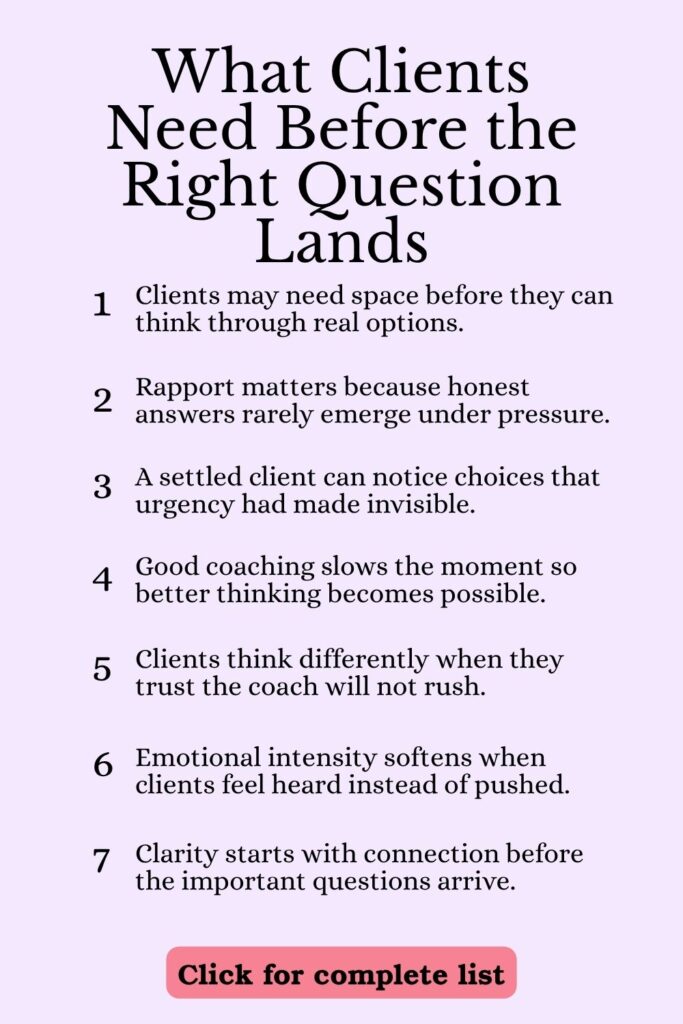
The 25 Powerful Questions to Identify Strengths pack helps clients notice abilities, qualities, and recurring patterns they may overlook.
Clients often describe weaknesses quickly but struggle to name what they do well. Strengths questions can direct attention toward successful decisions, energizing activities, repeated positive feedback, and challenges the client handles more effectively than they realize.
Use the pack during a strengths-focused session or select a smaller group of questions for homework. Five relevant questions usually produce more useful reflection than assigning all 25 without context.
SEE ALSO: If you’re a coach looking to streamline your administrative tasks and save time, check out our Coaching Administration Software. It’s a simple, effective solution designed to help you focus less on paperwork and more on what matters—coaching your clients. From scheduling to client management, our software gives you the tools to run your business efficiently. Ready to reclaim your time and boost productivity? Click or tap here.
Access the strengths question pack.
Which Questions Help Stuck Clients See More Options?
The 37 Coaching Questions to Liberate Your Clients pack helps clients move beyond a narrow view of what is possible.
The questions are arranged to encourage exploration, option generation, and action. They can be useful when a client repeatedly describes the same two choices and cannot see a third path.
A coach working with someone who feels trapped in a job might select questions that explore available resources, experiments, conversations, financial constraints, and low-risk ways to gather information. The goal is not to convince the client to leave. It is to widen the decision space.
Access the questions for exploring more options.
Where Can Coaches Find Questions by Coaching Niche?
The Powerful Coaching Questions guide provides 36 questions organized around different coaching needs and niches.
SEE ALSO: If you’re a coach looking to streamline your administrative tasks and save time, check out our Coaching Administration Software. It’s a simple, effective solution designed to help you focus less on paperwork and more on what matters—coaching your clients. From scheduling to client management, our software gives you the tools to run your business efficiently. Ready to reclaim your time and boost productivity? Click or tap here.
It can help you prepare for sessions involving accountability, motivation, personal development, career decisions, and deeper reflection. Select questions that serve the client’s stated goal rather than trying to use every category in one session.
Download the Powerful Coaching Questions guide.
Where LCH Core Fits
LCH Core fits after you have decided how your questioning process should work and need a consistent way to prepare, document, and follow through.
Before a session, you can use intake forms to collect the client’s focus, current challenge, and desired outcome. Client profiles and notes can then keep the client’s language, decisions, and relevant context connected across the coaching relationship. The support guide on keeping track of client data, session notes, and progress shows how those records fit together.
During and between sessions, reusable coaching tools can support the work without replacing the conversation. You can assign or schedule journals, worksheets, goals, action items, and resources based on what the client needs next. The overview of coaching forms and tools available for clients is a useful reference if you want to see how the different tools can be used.
The Progress Stream can help you review the client’s activity and progress as a connected journey. The Engagement Report can provide another view of participation between sessions, especially when you need to distinguish a client who is actively experimenting from one whose commitments repeatedly disappear after the call.
SEE ALSO: If you’re a coach looking to streamline your administrative tasks and save time, check out our Coaching Administration Software. It’s a simple, effective solution designed to help you focus less on paperwork and more on what matters—coaching your clients. From scheduling to client management, our software gives you the tools to run your business efficiently. Ready to reclaim your time and boost productivity? Click or tap here.
The purpose is not to automate the thinking. It is to keep the questions, insights, actions, and progress from becoming scattered across email threads and disconnected documents.
For the wider system, the guide to choosing coaching software for life coaches explains how coaching tools, client management, progress tracking, scheduling, onboarding, and other parts of a coaching practice can work together. You can also see the complete LCH Core feature set.
Frequently Asked Questions About Life Coaching Questions
What are the best open-ended questions to ask in a coaching session?
The best open-ended questions are the ones that connect directly to the client’s stated goal and most recent answer. Useful starting points include “What would make this conversation valuable?”, “What are you assuming?”, “What options have you not considered?”, and “What will you do next?”
How do you ask powerful coaching questions without leading the client?
Ask questions that allow several reasonable answers and do not contain your preferred solution. Check whether you are genuinely curious about the response or trying to persuade the client indirectly.
Should life coaches avoid asking “why” questions?
Life coaches do not need to avoid every “why” question, but repeated “why” questions can sound accusatory. Questions beginning with “what,” “how,” or “which” often make it easier to examine causes without forcing the client to defend themselves.
How many questions should a coach ask before reflecting or summarizing?
A coach should reflect or summarize whenever the client has expressed something important, complex, or emotionally loaded. There is no universal question count. The quality of listening matters more than maintaining a fixed ratio.
SEE ALSO: If you’re a coach looking to streamline your administrative tasks and save time, check out our Coaching Administration Software. It’s a simple, effective solution designed to help you focus less on paperwork and more on what matters—coaching your clients. From scheduling to client management, our software gives you the tools to run your business efficiently. Ready to reclaim your time and boost productivity? Click or tap here.
How do you challenge a coaching client without becoming confrontational?
Ask permission, connect the challenge to the client’s goal, and make it clear that the client can disagree. Challenge the assumption or decision, not the client’s intelligence, courage, or character.
What should a coach do when a client becomes emotional?
A coach should slow the conversation and determine whether the client can remain present and reflect. Emotion can be explored when the client is able to engage, while distress that prevents reflection may require a pause or support beyond the scope of coaching.
How do you turn a client’s insight into an action step?
Define the exact behavior, when and where it will happen, what completion looks like, and how the client will respond to a likely obstacle. A vague intention becomes more usable when it is written as a specific action and an if-then plan.
Can coaches use the same question list with every client?
Coaches can reuse a question framework, but they should not deliver the same list mechanically to every client. The next question should respond to the client’s goal, language, context, and current stage of thinking.
Sources
Gollwitzer, Peter M., and Paschal Sheeran. “Implementation Intentions and Goal Achievement: A Meta-Analysis of Effects and Processes.” Advances in Experimental Social Psychology, vol. 38, 2006, pp. 69-119. ScienceDirect, https://doi.org/10.1016/S0065-2601(06)38002-1.
International Coaching Federation. “ICF Core Competencies.” International Coaching Federation, https://coachingfederation.org/credentialing/coaching-competencies/icf-core-competencies/. Accessed 19 Aug. 2026.
SEE ALSO: If you’re a coach looking to streamline your administrative tasks and save time, check out our Coaching Administration Software. It’s a simple, effective solution designed to help you focus less on paperwork and more on what matters—coaching your clients. From scheduling to client management, our software gives you the tools to run your business efficiently. Ready to reclaim your time and boost productivity? Click or tap here.
Read this next
Why Journaling Is One of the Most Underrated Client Retention Tools in Coaching
Journaling is a must for all your coaching and courses to help your clients reach their best. Find out why.
Read More
Most Coaches Skip This After a Session, and It Could Be Costing Them Their Best Insights
What if you could do one small thing once a week that could significantly improve your work?
Read More
Three Tips for Making People Love Your Courses: Catering for Diversity in Training
Discover three key tips for helping your individual course members get the most out of your courses.
Read More