


Talk to a coach about Career coaching

Dr Soraya Sawicki, DSW, CPC, RMT
DSW, CPC, CSC, RMT
Personalized wellness coaching for stress relief, energy, and inner harmony.

Robert Bradley Singleton
Certified Master Spiritual Life Coach, Neuropsychologist, and Existential Therapist
Train with the best to be the best you! Don't...

Crystal Faulk
ACC
I help overwhelmed women in transition gain clarity, confidence, and...

Charity Archie
Several Life Coaching Certifications-Intentional Holistic Life Coach
Charity Aumora dedicated to promoting a positive clear & intentional...

Vibeke Pedersen
Certified Life Coach / ThetaHealer®
Crush 2025
Candice Crosgrove
MA
Resilience coach helping individuals recover, rebuild, and reignite their purpose...

CELECIA DENICE JONES
N/A
I am a confident and positive women who believes in...

Rayana Tayler Starre
Certified Guiding Mindful Change Coaching, Certified Business Coach, Certified Human Design Analyst, BA Degree in Psychology, Master NLP Coach, BG5 Human Design Business Consultant, Certified Hypnotherapy Coach, Certified Timeline Therapy Coach
Career Transition/Business Coach, using Human Design, & NLP to fuel...




LinkedIn Networking for Introverts: How to Start Real Conversations Without Feeling Salesy
Want to try this at home? No worries! Download a copy of our 10-Minute Networking Follow-Up System.
***
Why LinkedIn Feels So Awkward When You Hate “Networking”
If you are an introvert, LinkedIn networking can feel like walking into a room where everyone already knows how to talk except you. The platform is full of polished job updates, confident career announcements, and people casually posting about opportunities. It can make a simple message feel much bigger than it is.
But introverts usually do not dislike people. They often dislike forced interaction, vague small talk, and the feeling of interrupting someone. That is why LinkedIn can feel uncomfortable. You are not just sending a message. You are trying to sound professional, friendly, interesting, and not desperate, all in a tiny box.
The good news is that LinkedIn networking does not have to feel like selling yourself. It does not have to start with a pitch. It does not even have to start with asking for a call.
A better approach is to treat LinkedIn like a place for warm, specific conversations. You are not trying to convince strangers to care about you instantly. You are looking for small openings where a real exchange can begin.
That might mean reaching out to someone who works in a role you are curious about. It might mean asking an alumnus how they moved into their field. It might mean responding thoughtfully to a post before ever sending a direct message.
The goal is not to become loud, pushy, or overly visible. The goal is to build a network in a way that fits how you actually communicate.
If you want to get more from your life, and are looking for concrete action steps to get you there, check out our Request a Coach page. It’s a “cut the fence-sitting and take action” way to tackle your issues and actually find success. To get off the fence and start to take action, click or tap here.
This article will walk through a simple process:
- How to choose the right people to contact
- How to make your profile feel more approachable
- How to send connection requests that do not feel awkward
- How to start a conversation without sounding salesy
- How to ask for informational chats naturally
- How to follow up without feeling annoying
Think of this as a quiet networking system. You are not trying to collect random contacts. You are building a warmer professional circle, one thoughtful conversation at a time.
Need some business or career guidance? Drop on by our directories choc full of business coaches and career coaches to bring your business or career to the next level. Or click here to have us match you to the best.
1. Start With the Right Kind of Person, Not the Perfect Message
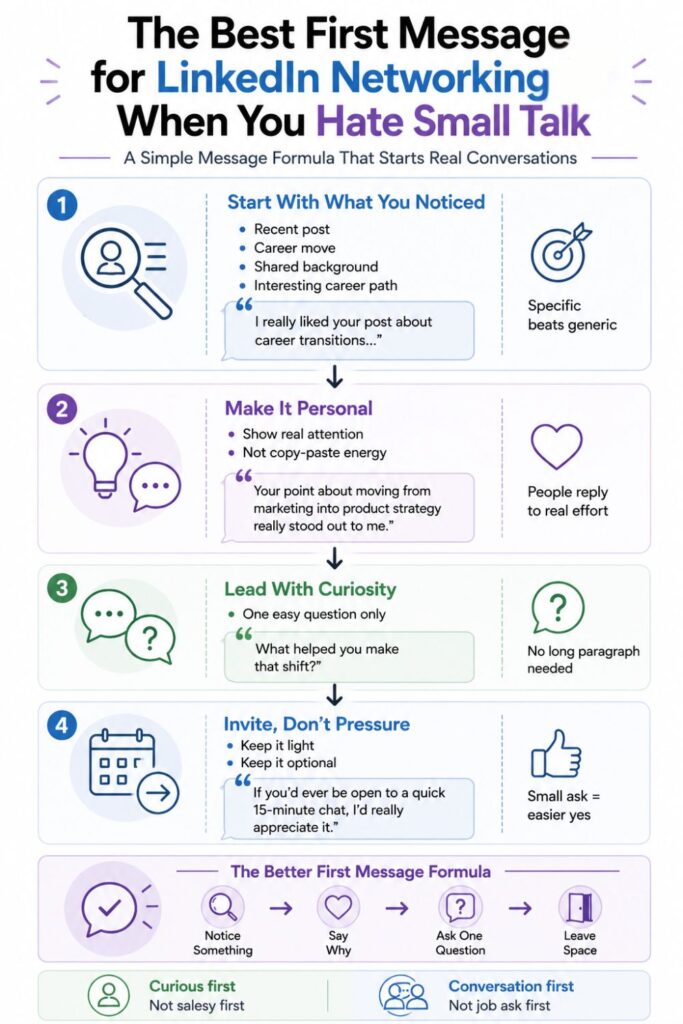
One reason LinkedIn outreach feels so hard is that people start in the wrong place. They try to write the perfect message before deciding who would actually be easy to talk to. That creates pressure because every stranger feels like a cold stranger.
Instead, start by finding people who already have some point of connection to you. The message becomes much easier when there is a natural reason for it.
Choose your warmest connection lane: Look for people who share a small connection with you, such as a school, company, industry, city, professional group, certification, or career path. A shared detail gives your message context. It also makes the other person more likely to understand why you are reaching out.
You do not need to know them personally. A warm connection can be as simple as:
- You went to the same university
- You both worked in nonprofit roles
- You are both in the same LinkedIn group
- They moved into a role you are exploring
- They posted about a topic you care about
- They work at a company you are researching
Sort people by conversation ease: Create three simple categories: easy, medium, and stretch. Easy contacts might be alumni, second-degree connections, or people who recently posted something helpful. Medium contacts might be people in your target role with no shared background. Stretch contacts might be senior leaders, recruiters, or people at dream companies.
If you want to get more from your life, and are looking for concrete action steps to get you there, check out our Request a Coach page. It’s a “cut the fence-sitting and take action” way to tackle your issues and actually find success. To get off the fence and start to take action, click or tap here.
Start with the easy group first. This builds confidence and gives you practice before you reach out to people who feel more intimidating.
Check for real conversation clues: Before sending a message, scan their profile for details you can honestly mention. Look at their headline, About section, recent posts, career path, projects, and featured links.
You are looking for one specific reason to reach out. Not ten. Not a full biography. Just one detail that makes your message feel personal.
For example, you might notice that they moved from teaching into learning design. Or that they posted about changing careers. Or that they work in a role you did not know existed.
Avoid random mass outreach: Sending 50 generic messages might sound efficient, but it often feels awful for introverts. It also leads to weaker replies because the messages feel thin.
A better goal is two or three thoughtful reach-outs per week. That is enough to create momentum without making networking feel like a second job.
The right person makes the message easier. When you begin with a real point of connection, you are no longer trying to force a conversation. You are simply opening one that already has a reason to exist.
2. Make Your Profile Feel Approachable Before You Message Anyone
Before you start messaging people, take a quick look at your own profile. Not because it needs to be perfect, but because most people will click on your name before replying. If your profile is empty, confusing, or overly stiff, your message has to work much harder.
If you want to get more from your life, and are looking for concrete action steps to get you there, check out our Request a Coach page. It’s a “cut the fence-sitting and take action” way to tackle your issues and actually find success. To get off the fence and start to take action, click or tap here.
Your profile should answer one simple question: “Who is this person, and why are they reaching out?”
Clarify your professional snapshot: Start with your headline. This is one of the first things people see when you send a connection request or comment on a post. It should give enough context for someone to place you professionally.
You do not need a dramatic personal brand statement. Clear is better than clever.
For example:
- Marketing Coordinator Exploring Brand Strategy
- Recent Psychology Graduate Interested in UX Research
- Customer Success Professional Moving Into People Operations
- Project Manager Focused on Remote Team Systems
- Career Changer Learning Data Analytics
A clear headline makes you easier to understand. It also makes your outreach feel more grounded.
Make your About section human: Your About section does not need to be long. A few short paragraphs can explain your background, what you are interested in, and what kind of work you are exploring.
Avoid making it sound like a sales page. You are not trying to impress everyone. You are trying to help the right people understand your direction.
You might include:
If you want to get more from your life, and are looking for concrete action steps to get you there, check out our Request a Coach page. It’s a “cut the fence-sitting and take action” way to tackle your issues and actually find success. To get off the fence and start to take action, click or tap here.
- What you currently do
- What kind of work you are interested in
- A few skills or strengths
- A project or topic you are learning about
- What kind of conversations you welcome
Add one credibility anchor: A credibility anchor is something that shows you are taking your career seriously. It could be a project, portfolio piece, certification, volunteer role, article, case study, or thoughtful LinkedIn post.
This does not have to be fancy. If you are changing careers, even a small self-directed project can help. It gives people something concrete to notice.
Remove anything that feels overly salesy: If your profile is full of buzzwords, vague claims, or aggressive language, soften it. Phrases like “disrupting the future” or “helping brands dominate” may not fit if your goal is warm professional conversation.
Make the profile feel like a real person wrote it.
Use your profile as a conversation bridge: If you are exploring a new field, say that. If you are open to informational chats, mention that gently. If you are learning about a specific industry, include that.
A profile does not need to do all the work for you. It just needs to make your outreach feel less random. When someone clicks through and sees a clear, approachable snapshot, replying becomes easier.
3. Use a Low-Pressure Connection Request That Does Not Ask for Too Much
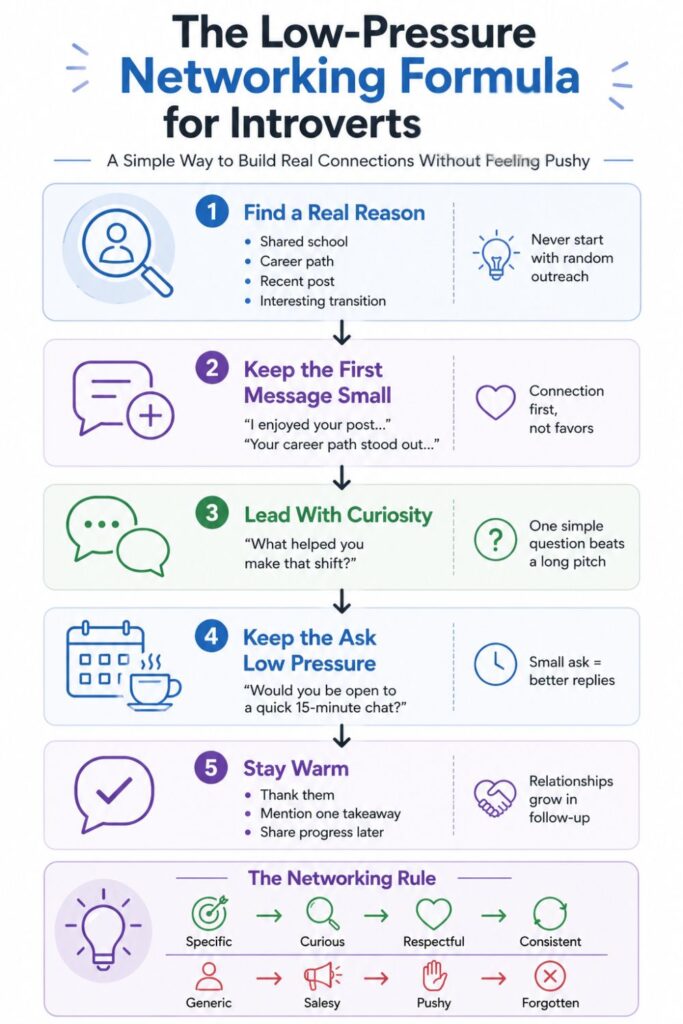
The connection request is not the place to tell your whole story. It is also not the place to ask for a referral, a job lead, or a 30-minute call. The goal is much smaller: open the door.
This is where many people accidentally make LinkedIn networking feel salesy. They try to turn the first message into a full pitch. That can feel heavy for the person receiving it, especially if they do not know you yet.
If you want to get more from your life, and are looking for concrete action steps to get you there, check out our Request a Coach page. It’s a “cut the fence-sitting and take action” way to tackle your issues and actually find success. To get off the fence and start to take action, click or tap here.
Lead with a real reason: A good connection request answers the silent question, “Why me?” You can mention something specific about their profile, company, post, background, or career path.
The reason does not need to be dramatic. It just needs to be real.
For example:
- “I noticed you moved from sales into customer success.”
- “I saw your post about building a portfolio before applying.”
- “I came across your profile while researching nonprofit operations roles.”
- “I saw that we both studied at Michigan State.”
- “Your path into product marketing stood out to me.”
Specificity makes the message feel human. It shows you are not copying and pasting the same note to everyone.
Keep the ask tiny: A connection request should usually ask for only one thing: the connection. That is it.
You can say, “I’d love to connect.” You do not need to add, “and ask you a few questions” yet. You can do that after they accept, once there is a small opening.
This keeps the request light. It also gives the other person more control.
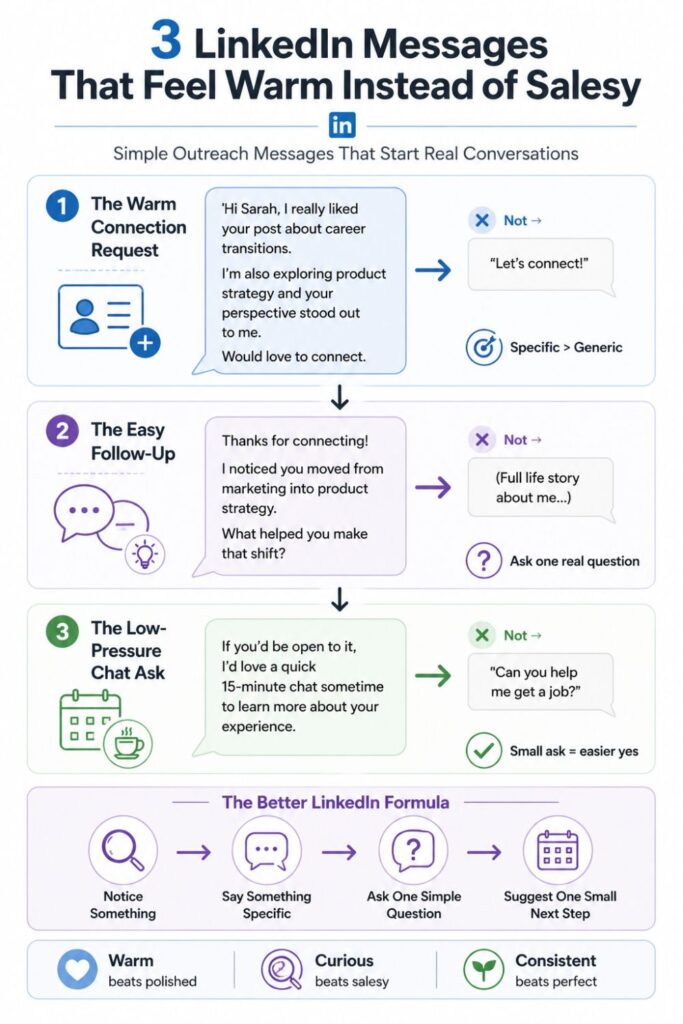
Use a simple connection script: Here are a few easy formats you can adapt.
If you want to get more from your life, and are looking for concrete action steps to get you there, check out our Request a Coach page. It’s a “cut the fence-sitting and take action” way to tackle your issues and actually find success. To get off the fence and start to take action, click or tap here.
For someone in a role you are exploring:
“Hi Maya, I came across your profile while learning more about UX research roles in healthcare. Your path from customer support into research stood out to me. I’d love to connect.”
For an alumnus:
“Hi Daniel, I saw we both studied at Temple, and I noticed you now work in corporate communications. I’m exploring that path and would love to connect.”
For someone who posted something useful:
“Hi Priya, your post about preparing for internal interviews was really helpful. I’m interested in career growth topics and would love to connect.”
Make it easy to ignore without pressure: Avoid lines that create a sense of obligation. “I really need your help” can feel heavy. “Can you give me advice?” may feel too broad. “Can you refer me?” is too much for a first touch.
The lighter the request, the easier it is to accept.
If you want to get more from your life, and are looking for concrete action steps to get you there, check out our Request a Coach page. It’s a “cut the fence-sitting and take action” way to tackle your issues and actually find success. To get off the fence and start to take action, click or tap here.
Create three reusable templates: Make one for alumni, one for people in your target role, and one for people who shared a useful post. Then customize one sentence each time.
You do not need to reinvent the message every time. You just need to make it specific enough that it feels meant for that person.
4. Start the Conversation With Curiosity, Not a Career Pitch
Once someone accepts your connection request, it can be tempting to immediately explain your career goals. You may feel like you need to justify why you reached out. But a long personal pitch can make the conversation feel formal and one-sided.
A better opener is curiosity. Ask something specific, easy to answer, and connected to the person’s experience.
Open with one specific observation: Start by mentioning a detail that made you interested in their perspective. This keeps the message from sounding generic.
For example:
“Thanks for connecting. I noticed you moved from retail management into HR, which is a transition I’ve been curious about.”
That one sentence gives the conversation a reason. It also makes the other person feel seen as an individual, not just as a stepping stone.
If you want to get more from your life, and are looking for concrete action steps to get you there, check out our Request a Coach page. It’s a “cut the fence-sitting and take action” way to tackle your issues and actually find success. To get off the fence and start to take action, click or tap here.
Ask a question they can answer quickly: The best first question does not require a life story. It should be narrow enough that they can reply in a few sentences.
Instead of asking, “Can you tell me everything about your career path?” try:
- “What helped you make that transition?”
- “Was there one skill that mattered most when you moved into that role?”
- “What surprised you about the industry when you started?”
- “Is there anything you wish you had known before applying?”
- “What kind of project helped you get noticed?”
These questions are focused. They invite useful answers without demanding too much time.
Use a warm follow-up script: Here is a simple format:
“Thanks for connecting. I noticed you moved from marketing into employer branding, which is a path I’ve been curious about. Was there one project or skill that helped you make that shift?”
This works because it is short, specific, and respectful. It does not ask for a job. It does not ask for a meeting right away. It starts with genuine curiosity.
Avoid overexplaining yourself: Many introverts try to make outreach safer by adding more context. They explain their background, their worries, their career goals, and why they are reaching out all at once.
That can make the message harder to answer.
If you want to get more from your life, and are looking for concrete action steps to get you there, check out our Request a Coach page. It’s a “cut the fence-sitting and take action” way to tackle your issues and actually find success. To get off the fence and start to take action, click or tap here.
Keep the first real conversation message short. You can share more later if the person engages.
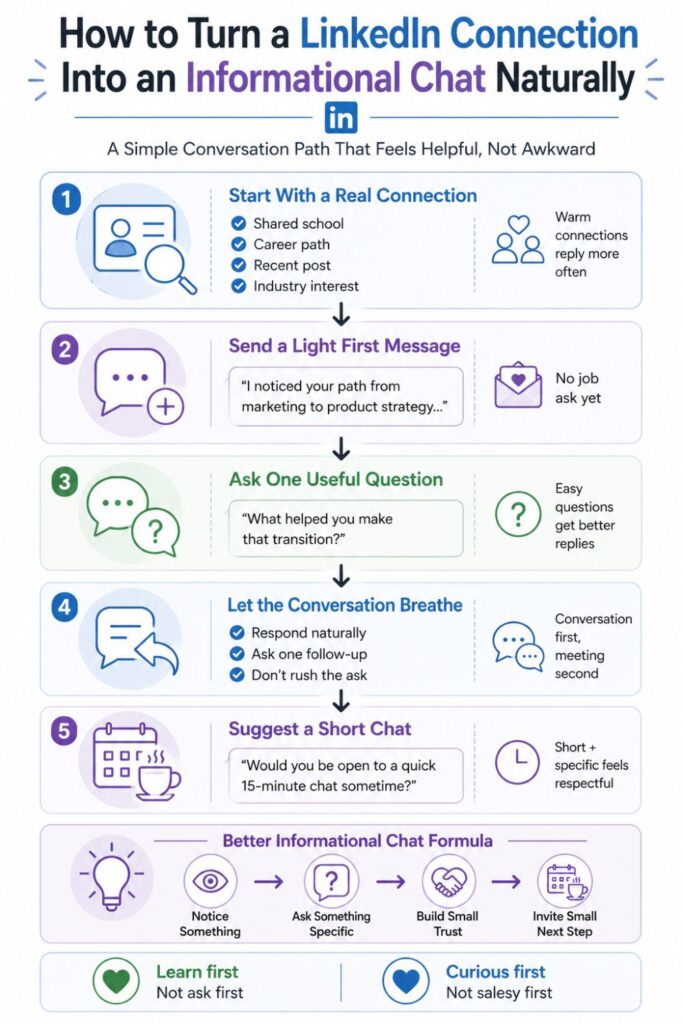
Let the conversation breathe: If they reply, do not rush straight into a bigger ask. Acknowledge what they said. Ask one natural follow-up. Let it feel like a conversation.
For example:
“That makes a lot of sense. I hadn’t thought about using internal projects as proof of interest. When you were starting out, did you build anything on your own, or did you mostly use work examples?”
This is how a real conversation starts. Not with a pitch. With attention.
5. Ask for an Informational Chat Without Making It Weird
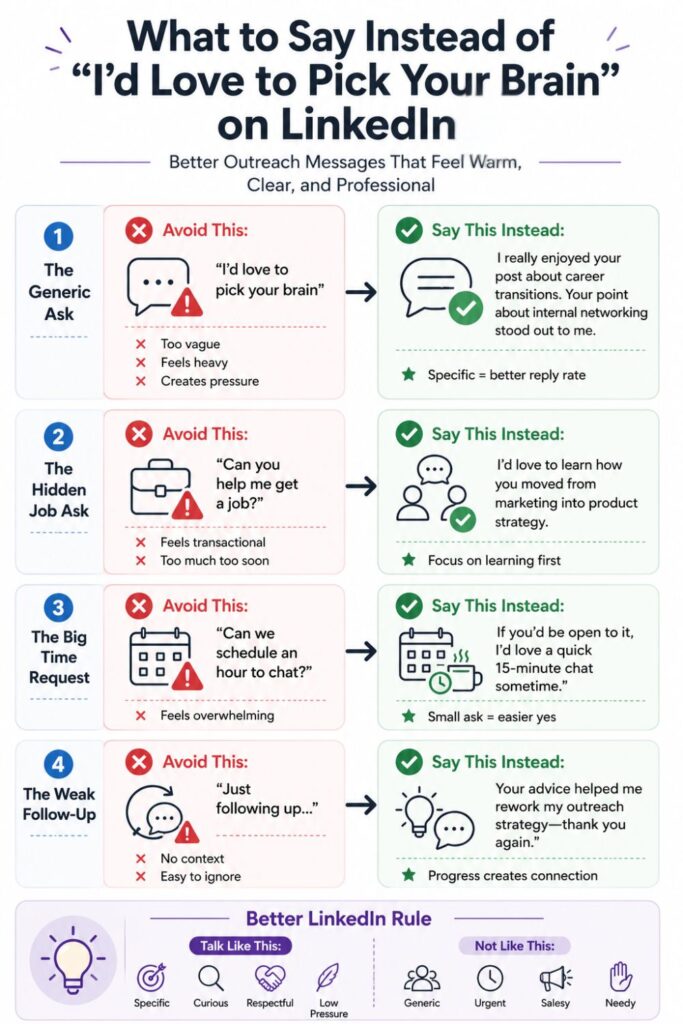
An informational chat can be one of the most useful parts of LinkedIn networking, but asking for one too soon can feel awkward. If your first message asks for 30 minutes with a stranger, the person may ignore it simply because it feels like too much.
The key is to let the ask grow naturally from the conversation.
Wait for a natural opening: Ask for a chat after the person has replied once or twice, especially if they gave a thoughtful answer. This creates a warmer moment. You are not asking out of nowhere. You are continuing a conversation that already exists.
If you want to get more from your life, and are looking for concrete action steps to get you there, check out our Request a Coach page. It’s a “cut the fence-sitting and take action” way to tackle your issues and actually find success. To get off the fence and start to take action, click or tap here.
A natural opening might look like this:
- They shared career advice
- They explained part of their role
- They mentioned a transition you want to understand
- They gave you a resource
- They seemed friendly or open to helping
At that point, a short chat request feels more reasonable.
Frame the chat as learning, not taking: Make it clear that you are not asking them to get you hired. You are asking for perspective.
People are often more open to a learning conversation than a favor request. The words you use matter.
Instead of:
“Can you help me get a job at your company?”
Try:
“I’d love to learn more about how you approached that transition.”
If you want to get more from your life, and are looking for concrete action steps to get you there, check out our Request a Coach page. It’s a “cut the fence-sitting and take action” way to tackle your issues and actually find success. To get off the fence and start to take action, click or tap here.
That feels much less transactional.
Use a low-pressure chat script: Here is a simple version:
“This is really helpful. Would you be open to a 15-minute informational chat sometime in the next couple of weeks? I’d love to ask a few questions about how you got into this area and what you’d suggest learning first.”
This script works because it is specific. It says how long the chat will be, what it is about, and why you are asking.
Offer an easy out: Add a line that removes pressure.
For example:
“Totally understand if your schedule is full.”
This shows respect. It also makes the request feel safer for both of you. You are not demanding time. You are inviting a conversation.
If you want to get more from your life, and are looking for concrete action steps to get you there, check out our Request a Coach page. It’s a “cut the fence-sitting and take action” way to tackle your issues and actually find success. To get off the fence and start to take action, click or tap here.
Keep the chat short and structured: If you ask for 15 minutes, keep it to 15 minutes unless they offer more. Prepare a few questions in advance. Do not make them carry the whole conversation.
You might prepare:
- One question about their career path
- One question about the role or industry
- One question about what they would suggest you do next
A good informational chat is not a hidden job interview. It is a focused learning conversation. When you treat it that way, it feels less weird and more useful for everyone involved.
6. Prepare Better Questions So the Chat Leads Somewhere
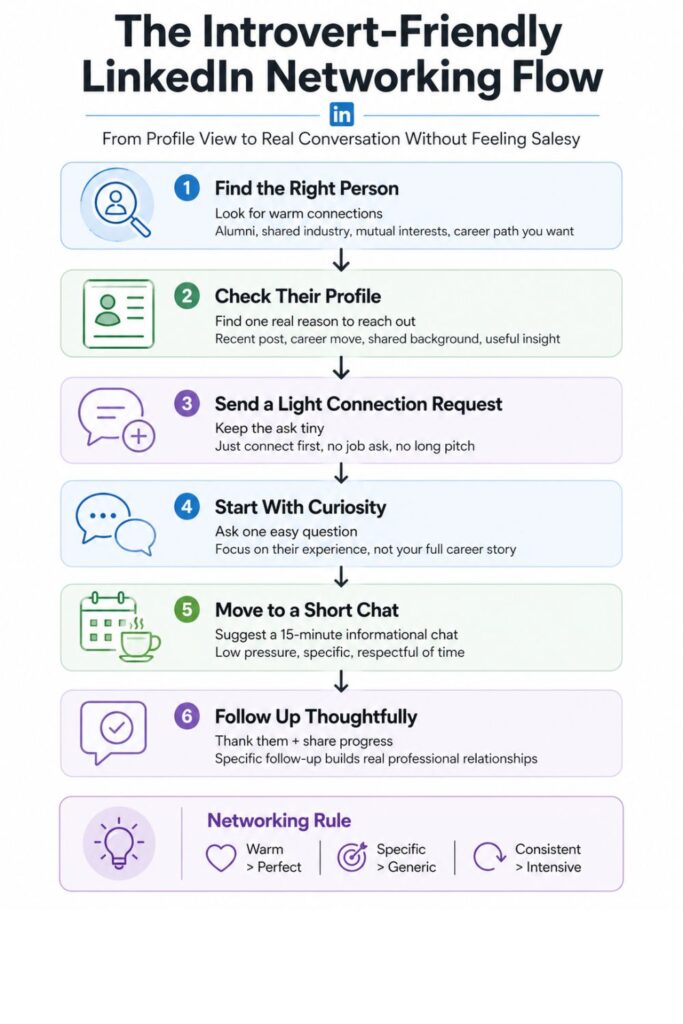
Getting someone to agree to an informational chat is only part of the process. The chat itself needs a little structure. Without preparation, it can turn into vague small talk, and that is exactly what many introverts are trying to avoid.
Good questions make the conversation easier. They give you something to lean on, and they help the other person share useful information without guessing what you need.
Decide what you actually want to learn: Before the chat, choose one main goal. Do not try to learn everything about their career, company, industry, and hiring process in 15 minutes.
Pick one clear focus, such as:
- Understanding what the role is really like
- Learning how they entered the field
- Identifying the skills you should build first
- Understanding what hiring managers look for
- Learning whether the company culture fits you
- Getting advice for a career change
This helps you ask better questions. It also keeps the conversation from wandering.
If you want to get more from your life, and are looking for concrete action steps to get you there, check out our Request a Coach page. It’s a “cut the fence-sitting and take action” way to tackle your issues and actually find success. To get off the fence and start to take action, click or tap here.
Use questions that invite stories: Story-based questions usually lead to better answers than yes-or-no questions. They also feel more natural.
Try questions like:
- “How did you first get interested in this kind of work?”
- “What surprised you most when you started?”
- “What helped you stand out when you were trying to break in?”
- “Was there a project or experience that made the biggest difference?”
- “What would you do differently if you were starting again?”
These questions invite reflection. They also give you practical clues about what to do next.
Mix practical and personal questions: A strong informational chat usually includes a blend of both. Practical questions help you understand the job. Personal questions help you understand the path.
For example:
- Role question: “What does a typical week look like for you?”
- Path question: “How did you move from your previous role into this one?”
- Advice question: “What would you suggest I focus on over the next month?”
That mix keeps the chat useful without making it feel like an interrogation.
Avoid asking for a job directly: Even if you would love a referral, do not make that the center of the conversation. If the chat goes well, you can ask a softer question near the end.
For example:
If you want to get more from your life, and are looking for concrete action steps to get you there, check out our Request a Coach page. It’s a “cut the fence-sitting and take action” way to tackle your issues and actually find success. To get off the fence and start to take action, click or tap here.
“Is there anyone else you think would be useful for me to learn from?”
This keeps the relationship warm. It also gives them an easy way to help without feeling pressured.
Take notes right after: After the call, write down what they said, what you learned, and what action you will take. Do this immediately while the details are fresh.
A conversation becomes valuable when you use it. Otherwise, it is just another nice chat that fades from memory.
7. Follow Up in a Way That Builds the Relationship
The follow-up is where LinkedIn networking starts to feel like a real relationship instead of a one-time transaction. It does not need to be complicated. A thoughtful follow-up simply shows that you appreciated the person’s time and listened to what they shared.
Many people skip this step, which is why doing it well helps you stand out.
Send a specific thank-you message: Do not just write, “Thanks for your time.” That is polite, but forgettable. Mention one specific thing they said that helped you.
For example:
If you want to get more from your life, and are looking for concrete action steps to get you there, check out our Request a Coach page. It’s a “cut the fence-sitting and take action” way to tackle your issues and actually find success. To get off the fence and start to take action, click or tap here.
“Thank you again for chatting with me today. Your advice about building a small portfolio before applying made the path feel much clearer. I’m going to start with one sample project this week.”
This feels more genuine because it reflects the actual conversation. It also shows the person that their advice mattered.
Use a simple follow-up structure: A good thank-you note can be short. You only need three pieces.
- Thank them for the time
- Mention one useful takeaway
- Share one next step you plan to take
Here is another example:
“Thanks again for making time to talk. Your point about practicing stakeholder communication before moving into project management was really helpful. I’m going to look for a small internal project where I can start building that skill.”
This kind of message makes you memorable in a good way.
Share progress later: A few weeks later, send a short update if you used their advice. This is one of the easiest ways to keep a connection warm without asking for anything.
For example:
If you want to get more from your life, and are looking for concrete action steps to get you there, check out our Request a Coach page. It’s a “cut the fence-sitting and take action” way to tackle your issues and actually find success. To get off the fence and start to take action, click or tap here.
“Hi Jordan, I wanted to send a quick update. I took your advice and created a short case study for my portfolio. It helped me explain my work much more clearly. Thanks again for pointing me in that direction.”
People like knowing that their advice helped. It makes the connection feel meaningful.
Stay visible without being pushy: You do not need to message the person constantly. You can stay lightly connected by commenting on an occasional post, congratulating them on a career update, or sharing something relevant if it truly fits your earlier conversation.
The key word is relevant. Do not force it.
Create a light follow-up system: Keep a simple tracker with the person’s name, date, topic, useful advice, and possible follow-up. This prevents good conversations from disappearing.
For introverts, a tracker can also reduce mental clutter. You do not have to remember everything. You just need a gentle system that helps you reconnect when it makes sense.
8. What to Do When They Do Not Reply
No-replies are part of LinkedIn networking. They happen to everyone, including people with strong profiles, polished messages, and impressive experience. A non-reply does not automatically mean you did something wrong.
People are busy. They miss notifications. They check LinkedIn once a month. They open a message during a meeting and forget to return to it. Sometimes they simply do not have the capacity to respond.
If you want to get more from your life, and are looking for concrete action steps to get you there, check out our Request a Coach page. It’s a “cut the fence-sitting and take action” way to tackle your issues and actually find success. To get off the fence and start to take action, click or tap here.
Do not personalize silence: This is the first rule. If you treat every non-reply as rejection, networking will become emotionally exhausting very quickly.
A message can be good and still not get a response. That is normal.
Instead of thinking, “They ignored me because I sounded awkward,” try thinking, “This person may not be available, and I can keep going.”
That small mindset shift matters.
Send one gentle follow-up: If you really wanted to connect with this person, wait about a week and send one short follow-up. Keep it warm and low-pressure.
For example:
“Just wanted to gently follow up in case this got buried. No pressure at all, but I’d still appreciate your perspective if you have a moment.”
That is enough. You do not need to explain again. You do not need to apologize excessively. You do not need to send multiple reminders.
If you want to get more from your life, and are looking for concrete action steps to get you there, check out our Request a Coach page. It’s a “cut the fence-sitting and take action” way to tackle your issues and actually find success. To get off the fence and start to take action, click or tap here.
Know when to move on: If they do not reply after one follow-up, let it go. Respectful networking includes respecting silence.
This protects your energy too. Chasing one person can make networking feel heavier than it needs to be. A better strategy is to build a small pipeline of possible conversations.
Review the message for friction: If several people are not replying, take a look at your message. There may be a simple fix.
Ask yourself:
- Was the message too long?
- Was the ask too big?
- Was my reason for reaching out clear?
- Did I ask a question that is easy to answer?
- Did the message sound like a job request too soon?
- Did I personalize it enough?
Small adjustments can make a big difference.
Keep a bigger list: Do not depend on one perfect contact. Create a list of 20 to 30 possible people over time. That way, each individual message carries less emotional weight.
Introvert-friendly networking works best when it is steady, not intense. Some people will reply. Some will not. Your job is not to win over every person. Your job is to keep creating thoughtful openings.
9. How a Career Coach Can Help You Make LinkedIn Networking Feel Less Random
If LinkedIn networking feels confusing, a career coach can help turn it into a clearer process. This can be especially useful for introverts because the hardest part is often not the actual conversation. It is deciding what to say, who to contact, and when to follow up.
If you want to get more from your life, and are looking for concrete action steps to get you there, check out our Request a Coach page. It’s a “cut the fence-sitting and take action” way to tackle your issues and actually find success. To get off the fence and start to take action, click or tap here.
A coach can help you remove the guesswork.
Clarify your networking goal: Many people start networking because they feel like they “should,” but they do not know what they are trying to learn or build. That makes every message feel vague.
A career coach can help you define your purpose. Are you trying to explore a new field? Find out what a role is really like? Build relationships before applying? Learn how people break into a specific industry?
Once the goal is clear, the outreach gets easier.
Create a message bank: A coach can help you write scripts that sound like you. That matters because many networking templates feel stiff, overly enthusiastic, or fake.
Your message bank might include:
- Alumni connection requests
- First messages after someone accepts
- Informational chat asks
- Follow-up notes
- Replies when someone says yes
- Replies when someone says they are too busy
- Messages for asking about career transitions
Having scripts does not make you robotic. It gives you a starting point so you are not staring at a blank box every time.
Practice the conversation path: If informational chats make you nervous, a coach can help you practice. You can role-play how to start the call, ask your questions, respond to advice, and end gracefully.
If you want to get more from your life, and are looking for concrete action steps to get you there, check out our Request a Coach page. It’s a “cut the fence-sitting and take action” way to tackle your issues and actually find success. To get off the fence and start to take action, click or tap here.
This is useful because confidence often comes from repetition. Once you have practiced the flow, the real conversation feels less intimidating.
Build a realistic outreach rhythm: Some networking advice tells you to send messages every day. That may work for some people, but it can feel draining if you are introverted or already overloaded.
A coach can help you create a plan that fits your actual energy. Maybe that means two messages every Tuesday. Maybe it means one informational chat per month. Consistency matters more than intensity.
Turn chats into action: A coach can also help you use what you learn. After an informational chat, they can help you decide whether to update your resume, build a skill, ask for another introduction, apply to a role, or adjust your direction.
Good networking should lead somewhere. A coach can help you see the next step instead of collecting advice and feeling stuck.
10. Build a Tiny LinkedIn Networking Routine You Can Actually Keep

The best LinkedIn networking routine is not the most ambitious one. It is the one you will actually repeat. For introverts, that usually means making the process small, contained, and predictable.
You do not need to spend hours scrolling LinkedIn. You do not need to comment on everything. You do not need to become a personal brand machine. You need a simple rhythm that helps you build real connections over time.
Choose one weekly networking block: Start with 20 to 30 minutes once or twice a week. Put it on your calendar like any other task.
If you want to get more from your life, and are looking for concrete action steps to get you there, check out our Request a Coach page. It’s a “cut the fence-sitting and take action” way to tackle your issues and actually find success. To get off the fence and start to take action, click or tap here.
This keeps networking from becoming a vague cloud of guilt. You are not “supposed to be networking” all the time. You have a specific time for it.
During that block, focus only on a few actions:
- Find two or three people
- Read their profiles
- Send one or two thoughtful messages
- Reply to any existing conversations
- Update your tracker
That is enough.
Use a repeatable flow: A routine is easier when the steps stay the same. You might use a simple four-part system.
First, search for people in your target role, company, industry, or alumni network. Second, scan their profile for one specific detail. Third, send a short personalized message. Fourth, track the interaction.
The point is to reduce decision fatigue. You should not have to invent a new process every week.
Batch your scripts: Keep your favorite message templates in one document. Include scripts for connection requests, thank-you notes, informational chat asks, and gentle follow-ups.
When it is time to send a message, copy the closest template and personalize it. This makes outreach faster and less emotionally draining.
If you want to get more from your life, and are looking for concrete action steps to get you there, check out our Request a Coach page. It’s a “cut the fence-sitting and take action” way to tackle your issues and actually find success. To get off the fence and start to take action, click or tap here.
Measure conversations, not instant results: Networking can feel discouraging if you only measure job offers or referrals. Those outcomes matter, but they are not the only signs of progress.
Track smaller wins too:
- A new connection accepted
- Someone replied thoughtfully
- You booked an informational chat
- You learned about a role
- You got a helpful resource
- You felt less awkward than last time
These small wins build confidence.
Protect your introvert energy: Stop before you feel drained. It is better to send two thoughtful messages every week for three months than 20 messages once and avoid LinkedIn afterward.
Networking should feel doable, not punishing. When the routine is small enough, you can keep showing up. That is what builds a warmer network over time.
The Real Goal Is a Warmer Network, Not a Perfect Message
LinkedIn networking does not have to feel like selling, begging, or performing. You do not need to become louder or more aggressive to build useful professional relationships. You only need a better way to start.
For introverts, the strongest networking approach is often quieter and more specific. You notice real details. You ask thoughtful questions. You give people room to respond. You follow up with care instead of pressure.
That is not weak networking. It is often the kind people remember.
If you want to get more from your life, and are looking for concrete action steps to get you there, check out our Request a Coach page. It’s a “cut the fence-sitting and take action” way to tackle your issues and actually find success. To get off the fence and start to take action, click or tap here.
The goal is not to collect as many connections as possible. A huge network full of strangers you never speak to is not nearly as useful as a smaller group of people who have had real conversations with you.
Start with people who make sense. Send connection requests that feel light and specific. Ask questions that are easy to answer. Let the conversation build before asking for a chat. Follow up in a way that shows you listened.
If someone does not reply, move on kindly. If someone gives you advice, use it. If a conversation goes well, keep the relationship warm.
You do not have to get every message perfect. You just have to make each message human enough to open a door.
Real conversations usually begin with something simple:
“I noticed this about your path.”
“I’m curious how you made that move.”
“Your advice helped me see this more clearly.”
If you want to get more from your life, and are looking for concrete action steps to get you there, check out our Request a Coach page. It’s a “cut the fence-sitting and take action” way to tackle your issues and actually find success. To get off the fence and start to take action, click or tap here.
“Would you be open to a short chat?”
Those lines are not salesy. They are respectful, specific, and easy to answer. That is the heart of introvert-friendly LinkedIn networking.
You are not trying to become someone else. You are learning how to connect in a way that feels natural enough to repeat. Over time, those small conversations can become informational chats, referrals, mentorship, opportunities, and genuine professional relationships.
A warmer network starts with one thoughtful message. Then another. Then another.
***
Want to try this at home? No worries! Download a copy of our 10-Minute Networking Follow-Up System.
Need some business or career guidance? Drop on by our directories choc full of business coaches and career coaches to bring your business or career to the next level. Or click here to have us match you to the best.
If you want to get more from your life, and are looking for concrete action steps to get you there, check out our Request a Coach page. It’s a “cut the fence-sitting and take action” way to tackle your issues and actually find success. To get off the fence and start to take action, click or tap here.
If you want to get more from your life, and are looking for concrete action steps to get you there, check out our Request a Coach page. It’s a “cut the fence-sitting and take action” way to tackle your issues and actually find success. To get off the fence and start to take action, click or tap here.
Read this next
15 Unique DIY Christmas Gifts Your Coworkers Will Actually Love
The holiday season always sneaks up faster than we expect — and suddenly, it’s time for Secret Santa, gift exchanges, and office parties. You want to give something thoughtful but […]
Read More
Should I Wear Glasses to an Interview? (Career coaching perspective)
You never get a second chance to make a good first impression, so should you wear glasses to your interview?
Read More
What to Wear to a Bartender Interview (Career Coach Tips)
Follow these career coaching tips on what to wear to ace that bartender interview!
Read More