





7 Simple Resume Changes That Make a Better First Impression
A lot of resumes get rejected before the recruiter has even started properly reading the experience section.
That sounds harsh, but it is how resume screening often works. The first pass is usually fast. A recruiter opens the document, scans the top third, notices a few signals, and makes a snap judgment about whether this person looks relevant, clear, and worth a closer look.
That means first impression matters more than most people think.
A weak first impression does not always come from weak experience. More often, it comes from weak presentation. The person may be qualified, but the resume feels vague, cluttered, unfocused, or generic. When that happens, the recruiter may move on before the real value ever gets seen.
This article breaks down seven resume changes that can quietly improve that first impression and increase your odds of getting callbacks.
These are not flashy hacks. They are practical edits that make your resume easier to trust, easier to scan, and easier to match to a real job.
Here is what these changes help fix:
- unclear positioning
- generic summaries
- task-heavy bullets
- cluttered formatting
- weak skill sections
- poor tailoring
- mixed signals at first glance
As you read, think like a recruiter. Imagine someone scanning your resume for ten seconds and asking:
If you want to get more from your life, and are looking for concrete action steps to get you there, check out our Request a Coach page. It’s a “cut the fence-sitting and take action” way to tackle your issues and actually find success. To get off the fence and start to take action, click or tap here.
- What role does this person want?
- Do they look relevant?
- Can I quickly see proof?
- Does this feel polished and professional?
- Is there enough here to justify an interview?
That is the standard your resume has to meet.
The good news is that most first-impression problems are fixable. You do not need a total rewrite every time. Sometimes a few focused changes do more than adding another line of experience ever could.
Need some career guidance? Drop on by our directories choc full of career coaches to bring your career to the next level. Or click here to have us match you to the best.
1. Start with a headline that tells recruiters exactly who you are
Write a job-focused headline: Replace a vague label with a specific role-based headline that tells the recruiter what kind of candidate you are right away.
Align the headline with the rest of the page: Make sure your summary, skills, and recent experience all support that same professional identity.
One of the fastest ways to lose a recruiter is to make them figure out what you do.
A resume headline should remove confusion, not create it. If the top of your resume says something vague like “Results-Driven Professional” or “Experienced Team Player,” it does not help anyone place you. Those phrases sound polished, but they say almost nothing.
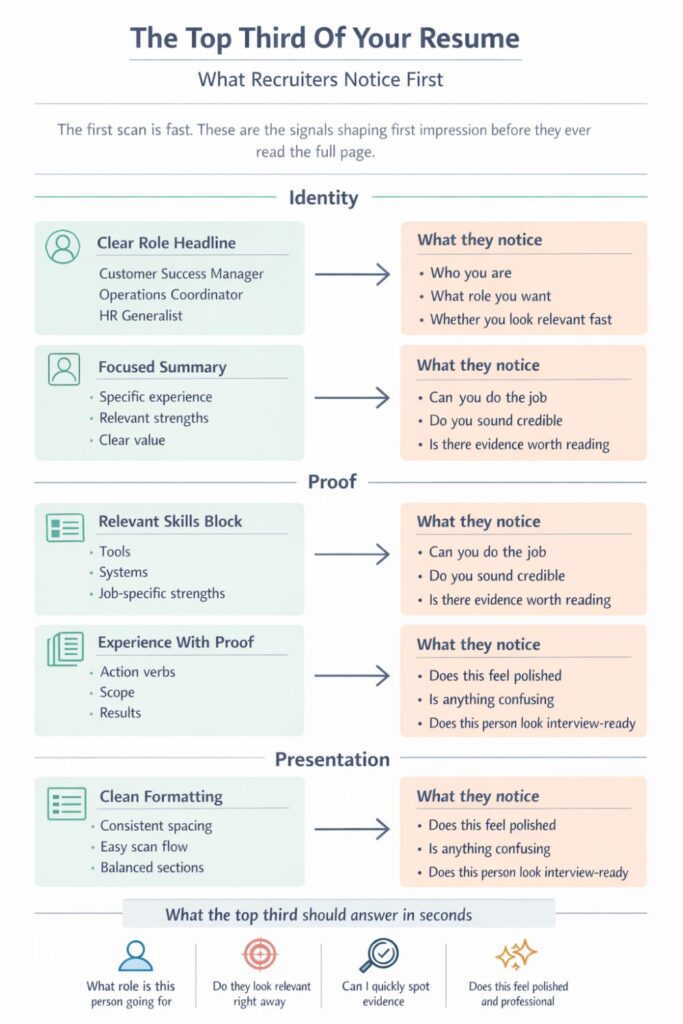
A stronger headline does one simple thing. It makes your target role obvious in seconds.
For example, these are clearer:
If you want to get more from your life, and are looking for concrete action steps to get you there, check out our Request a Coach page. It’s a “cut the fence-sitting and take action” way to tackle your issues and actually find success. To get off the fence and start to take action, click or tap here.
- Customer Success Manager
- Executive Assistant with SaaS Experience
- Senior Graphic Designer
- Operations Coordinator
- HR Generalist
That change matters because recruiters are usually matching quickly. They want to know whether your resume belongs in their pile, not decode your personal brand statement.
Your headline should also fit the role you are applying for now, not every role you have ever done. If you have a mixed background, choose the strongest label for the direction you want to move toward.
A good headline usually reflects one or more of these:
- target job title
- level or seniority
- core specialization
- industry relevance
For example:
- Marketing Coordinator | Email and Content Campaign Support
- Project Manager | Cross-Functional Operations and Process Improvement
- Recruiter | Full-Cycle Hiring and Candidate Experience
Once you choose the headline, check whether the rest of the resume backs it up. If your headline says “Project Coordinator,” but your summary talks broadly about administration and your bullet points lean heavily into customer service, the first impression gets weaker.
That top line should set the tone for everything below it.
Think of the headline as your resume’s answer to the question, “Who is this person in the job market?” If that answer is clear, the recruiter is far more likely to keep reading. If it is fuzzy, the rest of the document has to work much harder just to recover from the opening.
2. Fix the summary so it sounds relevant, not generic
Open with your strongest positioning: Lead with experience, specialization, or industry context instead of soft filler language.
Cut anything that could apply to anyone: Replace empty claims with concrete value that helps a recruiter understand what you bring.
If you want to get more from your life, and are looking for concrete action steps to get you there, check out our Request a Coach page. It’s a “cut the fence-sitting and take action” way to tackle your issues and actually find success. To get off the fence and start to take action, click or tap here.
A weak summary is one of the most common reasons a resume feels forgettable.
Many people use the summary section to sound professional, but not specific. They fill it with phrases like “hardworking,” “detail-oriented,” “motivated,” or “proven track record of success.” None of those lines are technically wrong, but they are not very persuasive either.
The problem is simple. A recruiter cannot do much with abstract praise.
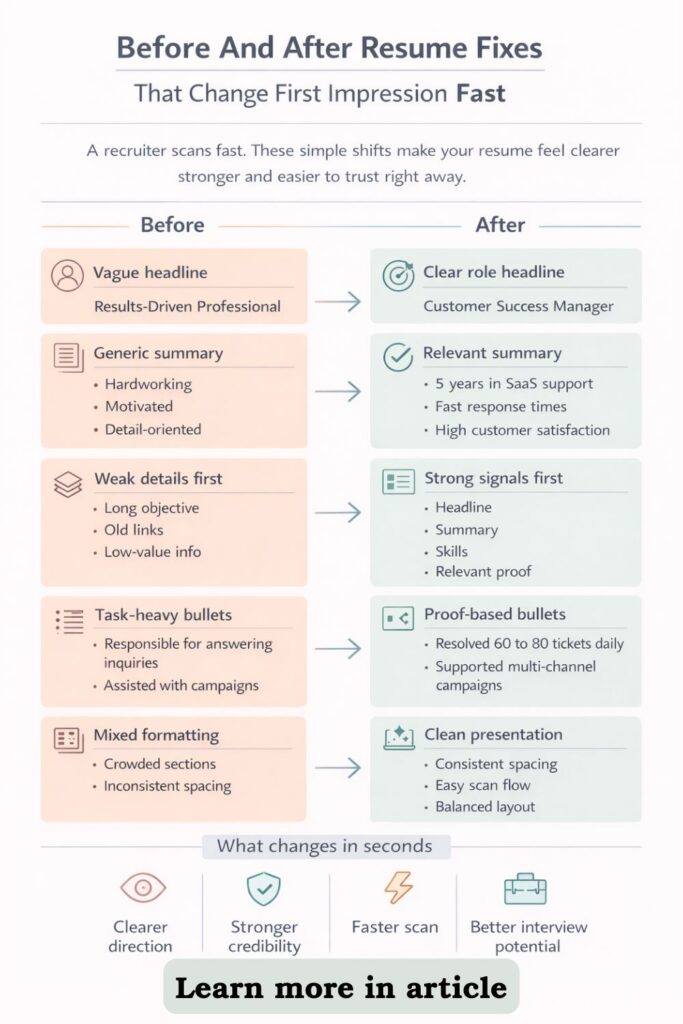
Your summary should quickly answer three things:
- what you do
- what kind of experience you have
- what value or strength makes you relevant
A stronger summary sounds more grounded. It gives the recruiter something they can actually use.
For example, compare these two:
Weak:
“Dedicated professional with excellent communication skills and a passion for helping teams succeed.”
Stronger:
“Customer support specialist with 5 years of experience in SaaS environments, known for reducing response times, improving customer satisfaction, and handling high-volume tickets with accuracy.”
If you want to get more from your life, and are looking for concrete action steps to get you there, check out our Request a Coach page. It’s a “cut the fence-sitting and take action” way to tackle your issues and actually find success. To get off the fence and start to take action, click or tap here.
The second version feels more credible because it says something real.
A good summary often includes:
- years of experience
- job function or specialty
- industry or environment
- signature strengths
- measurable focus when possible
It also helps to remove anything that belongs in a cover letter instead. Your resume summary is not the place for broad enthusiasm about “seeking opportunities to grow” or “bringing my passion to a dynamic organization.” Most recruiters skim right past that language.
Keep it tight. Keep it useful.
A helpful test is this: if you removed your name and gave the summary to five different people, could they tell what kind of role it fits?
If not, it is still too generic.
The best summaries feel like a sharp preview of the resume, not a warm-up paragraph. They tell the recruiter, “You are in the right place. This candidate makes sense for this kind of role.”
That is the real job of the section.
If you want to get more from your life, and are looking for concrete action steps to get you there, check out our Request a Coach page. It’s a “cut the fence-sitting and take action” way to tackle your issues and actually find success. To get off the fence and start to take action, click or tap here.
3. Reorder your top section so the important information lands first
Move the strongest signals higher up: Put the most relevant information where the recruiter’s eye naturally lands first.
Reduce friction in the scan: Make your top third easy to understand without requiring the reader to hunt for relevance.
The top third of your resume carries more weight than many people realize.
Recruiters do not read every line in order like a novel. They scan. Their eyes move quickly across the page looking for anchors. That means the first things they see often shape the rest of the evaluation.
If the top of your resume is filled with low-value information, your strongest assets may arrive too late.
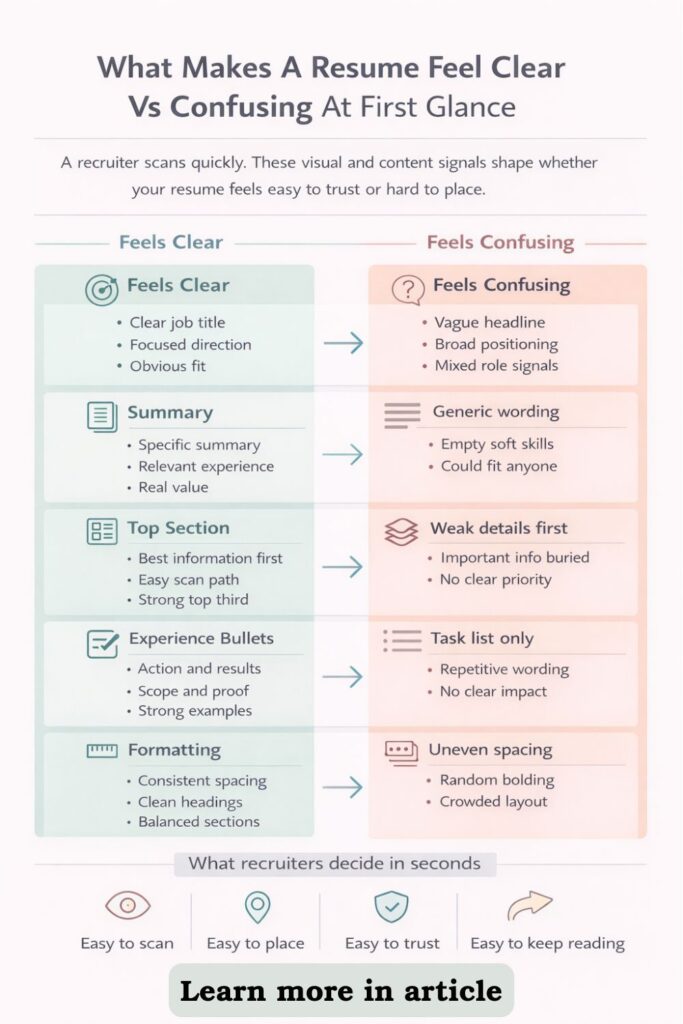
A strong top section usually includes:
- your name and contact details
- a clear headline
- a strong summary
- a relevant skills block or highlighted strengths
- sometimes a certification if it is essential to the role
What should not dominate the top?
- long objective statements
- oversized contact sections
- weak summaries
- outdated links
- irrelevant credentials
- dense walls of text
You want the recruiter to land near the top and immediately understand:
- the type of role you fit
- your level of experience
- your area of strength
- whether it is worth reading further
This is especially important if you are changing careers, applying across industries, or have a varied background. The more complex your work history, the more carefully you need to control what appears first.
If you want to get more from your life, and are looking for concrete action steps to get you there, check out our Request a Coach page. It’s a “cut the fence-sitting and take action” way to tackle your issues and actually find success. To get off the fence and start to take action, click or tap here.
For example, if your strongest selling point is recent experience in operations, that signal should show up before older unrelated work. If a certification matters for the role, it may deserve higher placement than a broad summary. If technical tools are part of the screening, do not bury them at the very bottom.
Here is a simple way to audit your top section:
- Look at only the first half of page one
- Give yourself ten seconds
- Ask what a recruiter would assume about you
- Check whether that matches the role you want
If the answer is unclear, the order likely needs work.
A resume does not just need strong content. It needs strong sequence. When the right information appears early, the whole document feels more convincing. When the most relevant details are buried, even good experience can look weaker than it really is.
4. Rewrite job bullets so they sound like proof, not task lists
Lead each bullet with action and impact: Show what you did and why it mattered, not just what your job included.
Cut repetitive responsibilities: Use space for achievements, improvements, and useful specifics instead of predictable duties.
One of the fastest ways to make a resume feel flat is to fill the experience section with task lists.
A recruiter does not need you to explain the obvious parts of a role. They already know what a customer service rep, office manager, recruiter, or marketing assistant generally does. What they want to know is how well you did it, what you handled, and what made your version of the role worth noticing.
That is why bullet points need to sound like proof.
If you want to get more from your life, and are looking for concrete action steps to get you there, check out our Request a Coach page. It’s a “cut the fence-sitting and take action” way to tackle your issues and actually find success. To get off the fence and start to take action, click or tap here.
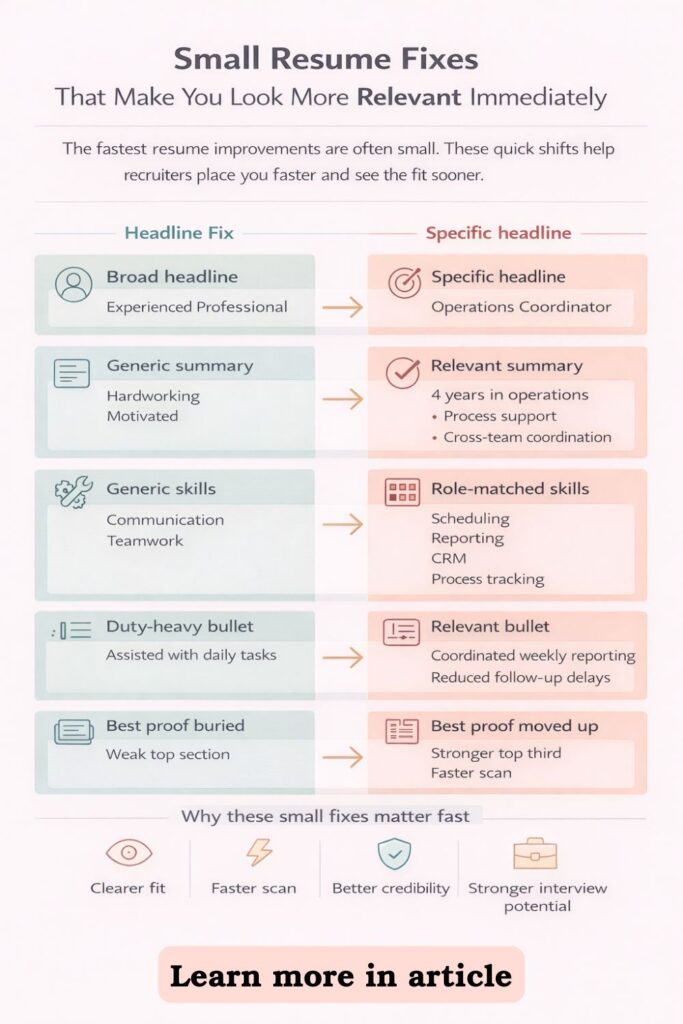
Weak bullets often look like this:
- Responsible for answering customer inquiries
- Managed calendars and scheduled meetings
- Assisted with marketing campaigns
- Worked with team members on daily operations
These lines are not useless, but they do not create much interest. They sound passive and interchangeable.
Stronger bullets give more shape and weight:
- Resolved 60 to 80 customer inquiries per day across chat and email while maintaining high satisfaction scores
- Managed complex executive calendars and coordinated cross-time-zone meetings for senior leadership
- Supported multi-channel marketing campaigns, including email scheduling, reporting, and content updates
- Improved daily operations by streamlining internal tracking and reducing follow-up delays
Notice the difference. The stronger version suggests scale, ownership, and outcomes.
When revising bullets, focus on these upgrades:
- start with a clear action verb
- add context or scope
- show a result, improvement, or business value
- include numbers when they help
- remove filler phrases
You do not need every bullet to be dramatic. But each one should earn its place.
A useful question is: “Would this bullet help a recruiter picture me performing well in the next role?”
If not, it may be too vague.
If you want to get more from your life, and are looking for concrete action steps to get you there, check out our Request a Coach page. It’s a “cut the fence-sitting and take action” way to tackle your issues and actually find success. To get off the fence and start to take action, click or tap here.
It also helps to avoid repeating the same type of bullet over and over. If five bullets all begin with “Assisted with,” the section starts to feel low-impact fast. Mix in ownership, initiative, collaboration, efficiency, and results where they are true.
Good bullets do not just describe your past. They sell your future usefulness.
That is what makes them far more effective than a list of duties.
5. Make formatting look polished before anyone reads a word
Choose one clean structure and stay consistent: Keep fonts, spacing, bullet style, punctuation, and date formatting uniform.
Use white space to support scanning: Make the page easy on the eyes so the recruiter can spot the important information quickly.
Formatting creates an impression before the recruiter reads a single sentence.
That first visual reaction matters. If the resume looks crowded, messy, inconsistent, or hard to scan, the reader may assume the thinking behind it is messy too. That is not always fair, but it is real.
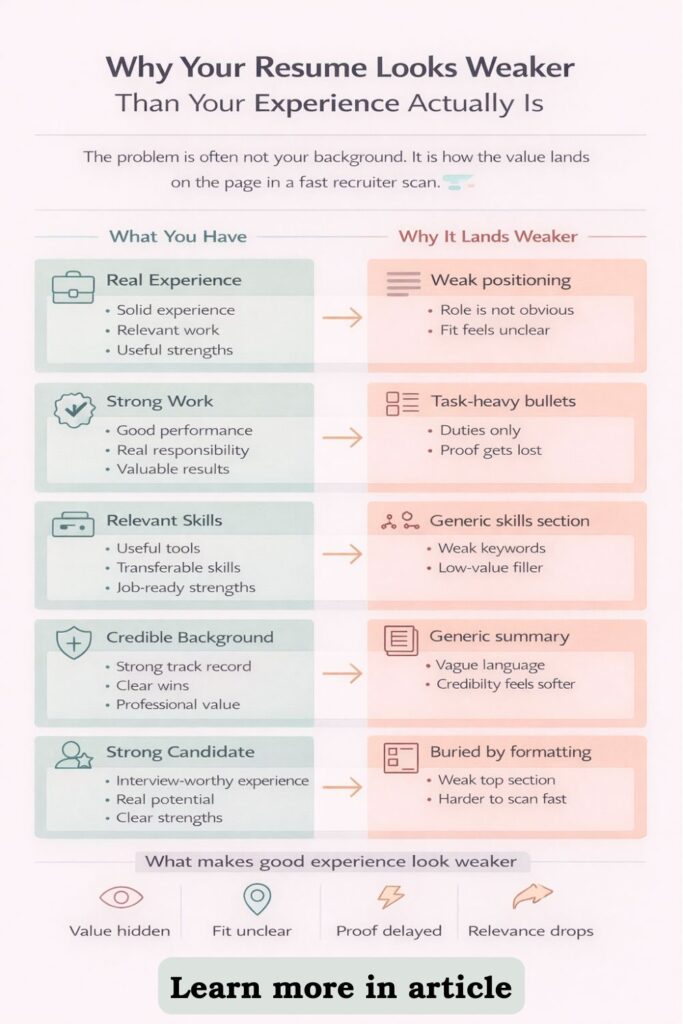
A polished resume does not need fancy design. It needs order.
Strong formatting makes the resume feel:
If you want to get more from your life, and are looking for concrete action steps to get you there, check out our Request a Coach page. It’s a “cut the fence-sitting and take action” way to tackle your issues and actually find success. To get off the fence and start to take action, click or tap here.
- easier to trust
- faster to scan
- more professional
- more confident
Weak formatting often includes small issues that add up:
- different date styles in different sections
- inconsistent spacing between jobs
- random bolding
- crowded margins
- bullets of wildly different length
- fonts that change without reason
- long dense blocks of text
None of those problems alone may seem serious. Together, they make the page feel careless.
The goal is not to make your resume look creative. The goal is to make it readable.
A few formatting principles go a long way:
- use one or two fonts at most
- keep section headings consistent
- line up dates and job titles cleanly
- use the same bullet style throughout
- keep margins and spacing balanced
- break up dense sections so they breathe
Shorter paragraphs and shorter bullet groupings help too. If a recruiter opens your resume and sees a wall of text, they may delay reading it. If they see clean sections with clear spacing, it feels easier to start.
You should also be selective with emphasis. Bold only what deserves attention, such as job titles, headings, or key labels. If too much is bold, nothing stands out.
A helpful final check is to zoom out and look at the page visually before reading the words. Ask:
- Does this feel clean?
- Is there room for the eye to move?
- Do the sections look balanced?
- Is the hierarchy clear?
Formatting should quietly support your content, not compete with it. When it is done well, the recruiter barely notices it. They just feel that the resume is easier to read and more put together, which improves the overall first impression right away.
If you want to get more from your life, and are looking for concrete action steps to get you there, check out our Request a Coach page. It’s a “cut the fence-sitting and take action” way to tackle your issues and actually find success. To get off the fence and start to take action, click or tap here.
6. Tighten your skills section so it supports the role instead of cluttering the page
List skills that match the job you want: Focus on relevant tools, systems, and strengths that strengthen your case for that role.
Remove low-value filler: Cut vague, outdated, or overly broad items that do not improve your positioning.
A skills section should help the recruiter say yes faster.
Instead, many resumes use it as a dumping ground. They list every program ever touched, every soft skill ever claimed, and a few vague traits that do not add much. The result is a section that looks full but says very little.
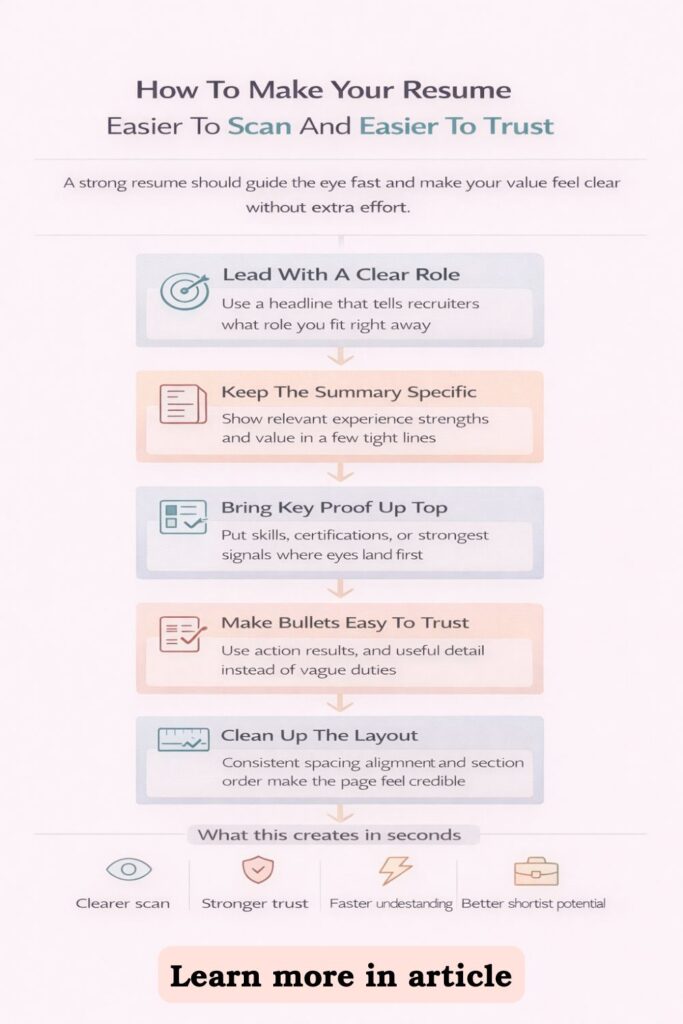
A stronger skills section is selective.
It should support the kind of role you are applying for and reinforce the identity your headline and summary already introduced. If your resume says you are targeting operations roles, your skills should not read like a general office profile. If you are applying for marketing jobs, the section should not feel split between unrelated categories.
Your skills section works best when it includes things like:
- tools and platforms relevant to the role
- technical skills the employer may scan for
- functional strengths tied to the job
- relevant methods or workflows
- certifications or systems if appropriate
For example, a focused skills section for a recruiter might include:
- full-cycle recruiting
- applicant tracking systems
- interview coordination
- sourcing and outreach
- candidate experience
- offer process support
- stakeholder communication
That feels more useful than:
If you want to get more from your life, and are looking for concrete action steps to get you there, check out our Request a Coach page. It’s a “cut the fence-sitting and take action” way to tackle your issues and actually find success. To get off the fence and start to take action, click or tap here.
- communication
- teamwork
- Microsoft Office
- problem solving
- hard worker
- multitasking
The second list is not exactly wrong. It is just too generic to help much.
This is also where keyword strategy matters. Many employers screen resumes for specific terms tied to the job description. That means your skills section should reflect real language the target role uses, as long as it is honest.
A good cleanup process is:
- compare your skills section to the job posting
- remove anything that does not support your case
- group related skills logically
- keep the list readable and not overloaded
Be careful with outdated items too. Listing old software, beginner-level tools, or skills that are assumed for most office roles can make your resume feel less current.
A tighter skills section sends a better signal than a longer one. It tells the recruiter you understand what matters in this role and that you are presenting your strongest fit, not just filling space.
7. Tailor the resume so it feels chosen, not mass-sent
Mirror the job language carefully: Reflect the role’s priorities and vocabulary naturally throughout the resume.
Shift emphasis based on the opportunity: Highlight the parts of your background that matter most for this specific opening.
A resume does not need to be rewritten from scratch for every job. But it should feel chosen.
Recruiters can usually tell when someone is sending the same generic resume everywhere. The wording is broad, the strengths are scattered, and the document feels like it was built to fit any role a little instead of one role well.
If you want to get more from your life, and are looking for concrete action steps to get you there, check out our Request a Coach page. It’s a “cut the fence-sitting and take action” way to tackle your issues and actually find success. To get off the fence and start to take action, click or tap here.
That weakens first impression fast.
Tailoring works because it helps the recruiter see the match without doing extra mental work. If the job posting emphasizes client communication, process improvement, scheduling, campaign reporting, account support, or data accuracy, your resume should make those same themes easy to spot where they are true.
This does not mean copying and pasting blindly. It means adjusting emphasis.
Here are a few ways to tailor more effectively:
- update the headline to reflect the target role
- revise the summary around the most relevant strengths
- reorder bullets so the best examples come first
- swap in more relevant keywords from the posting
- trim less relevant details that distract from the match
For example, if one operations role values vendor coordination and another values internal process improvement, you may use the same job history but highlight different bullets first. If one customer success role leans heavily on retention and another on onboarding, the resume should not emphasize both equally every time.
Tailoring also matters for career changers. If you are moving into a new field, your resume must do more work to connect the dots. That means using language that bridges your past experience to the new role instead of assuming the recruiter will make the leap for you.
A helpful mindset is this: your resume is not a record of everything. It is a curated case for why you fit this role.
That shift changes the writing.
If you want to get more from your life, and are looking for concrete action steps to get you there, check out our Request a Coach page. It’s a “cut the fence-sitting and take action” way to tackle your issues and actually find success. To get off the fence and start to take action, click or tap here.
When a resume feels chosen, it sends a subtle but powerful message. It suggests the candidate understands the role, respects the opportunity, and knows how to present relevant value. That alone can improve how seriously the document is taken, even before the recruiter starts evaluating the details more closely.
8. Do one fast recruiter-check pass before you send it
Use a first-impression checklist: Review the resume the way a recruiter would during a quick first scan.
Test whether the page answers the silent questions: Make sure your value is visible before deep reading begins.
Before sending your resume, do one final pass that is not about writing. It is about perception.
Most people edit resumes line by line. That matters, but it is not enough. You also need to test the whole document the way a recruiter experiences it in real life, which is quickly and with limited patience.
This kind of check can catch problems that normal editing misses.
Open the resume and ask yourself what impression it creates in the first ten seconds. Try not to read every word. Just scan the way a busy recruiter would.
Then ask:
- Is the target role obvious?
- Does the top section feel strong?
- Can I quickly see what this person is good at?
- Do the experience bullets suggest impact?
- Does the layout feel polished?
- Is anything distracting or confusing?
If the answer to any of those is shaky, the resume may still be losing power on first impression alone.
If you want to get more from your life, and are looking for concrete action steps to get you there, check out our Request a Coach page. It’s a “cut the fence-sitting and take action” way to tackle your issues and actually find success. To get off the fence and start to take action, click or tap here.
A short recruiter-style checklist can help:
- clear role headline at the top
- summary that sounds specific
- relevant skills near the top
- strongest experience easy to spot
- bullet points that show results
- consistent formatting throughout
- no obvious clutter or filler
- keywords that match the role
- no mixed signals about direction
You can also do a quick skim test with someone else. Ask them to look at your resume for ten seconds and then tell you what they think you do, what level you seem to be, and whether you look qualified for the kind of role you want. Their answer will tell you a lot.
This step is especially useful because first-impression mistakes are often invisible to the person who wrote the resume. You know your own background too well. A recruiter does not.
That is why this final pass matters so much.
The goal is not perfection. The goal is clarity under speed. If your resume still works when someone barely gives it time, it is much more likely to survive that first screening and earn a closer read.
9. Make sure your LinkedIn and resume create the same impression
Keep your positioning consistent across both: Your role direction, experience level, and strengths should match.
Close obvious credibility gaps: If the resume looks sharper than LinkedIn, or vice versa, fix the mismatch before applying.
Your resume does not live alone.
In many cases, recruiters will look at your LinkedIn profile right after reading your resume, especially if they are interested but want a little more context. When that happens, the two need to support each other. If they create different impressions, trust can drop quickly.
If you want to get more from your life, and are looking for concrete action steps to get you there, check out our Request a Coach page. It’s a “cut the fence-sitting and take action” way to tackle your issues and actually find success. To get off the fence and start to take action, click or tap here.
This does not mean both need to be identical. But they should feel aligned.
Here are some common mismatches that weaken credibility:
- resume headline says one role, LinkedIn headline says another
- resume feels targeted, LinkedIn feels vague
- recent titles or dates do not line up
- LinkedIn summary sounds generic while resume sounds focused
- skills and specialties feel inconsistent
- one profile looks updated and the other looks neglected
These gaps can create doubt, even if the explanation is harmless.
The recruiter may start wondering:
- Which direction is this person actually going?
- Is this resume tailored too aggressively?
- Is the LinkedIn profile outdated?
- Am I missing part of the story?
You want to avoid putting those questions in their head.
A simple alignment check helps:
- compare your headline on both
- make sure recent roles and dates match
- align your main specialty or target direction
- use similar language for core strengths
- update your LinkedIn about section if it feels too broad
- make sure top skills support the same role story
LinkedIn also gives you space to reinforce things your resume may mention only briefly, such as tools, recommendations, project details, or broader career context. But it should still point in the same overall direction.
Think of the resume as the sharp pitch and LinkedIn as the supporting profile. The details can differ, but the identity should stay consistent.
If you want to get more from your life, and are looking for concrete action steps to get you there, check out our Request a Coach page. It’s a “cut the fence-sitting and take action” way to tackle your issues and actually find success. To get off the fence and start to take action, click or tap here.
When both assets tell the same story, your professional brand feels more believable. That does not have to mean polished in a corporate, overly rehearsed way. It just needs to feel coherent.
That kind of consistency strengthens first impression because it tells the recruiter this candidate knows who they are, what they offer, and where they are headed.
Make your resume easier to say yes to
Review the page as a positioning tool: Your resume should make relevant value feel obvious, not hidden.
Use these changes as an editing framework: Strong first impressions come from clarity, not from adding more information.
A better resume first impression is rarely about sounding more impressive.
It is usually about making the right things easier to notice.
That is why small changes can have such a big effect. A clearer headline, a sharper summary, stronger bullet points, cleaner formatting, tighter skills, and smarter tailoring all work together to answer the recruiter’s biggest question fast: “Does this person look like a fit?”
If the answer is yes, your resume gets more time.
That is the real win.
If you want to get more from your life, and are looking for concrete action steps to get you there, check out our Request a Coach page. It’s a “cut the fence-sitting and take action” way to tackle your issues and actually find success. To get off the fence and start to take action, click or tap here.
Need some career guidance? Drop on by our directories choc full of career coaches to bring your career to the next level. Or click here to have us match you to the best.
A strong resume does not try to tell your whole life story. It does not need to prove everything at once. It only needs to do enough, quickly enough, to make the recruiter want the next step.
As you revise, keep coming back to this idea: your resume is not just information. It is positioning.
Use this article as a practical editing framework:
- make your target role obvious
- replace generic language with specific value
- bring the strongest signals higher up
- turn duties into proof
- clean up the page visually
- keep skills relevant
- tailor for the role
- test the first impression before sending
- align LinkedIn with the same story
That is how resumes start feeling stronger without becoming longer.
If your experience is already solid, your job is not to invent more. It is to present what is already there in a way that gets read, understood, and trusted faster.
That is what leads to more callbacks.
And often, it starts with the quiet fixes most people overlook.
If you want to get more from your life, and are looking for concrete action steps to get you there, check out our Request a Coach page. It’s a “cut the fence-sitting and take action” way to tackle your issues and actually find success. To get off the fence and start to take action, click or tap here.
If you want to get more from your life, and are looking for concrete action steps to get you there, check out our Request a Coach page. It’s a “cut the fence-sitting and take action” way to tackle your issues and actually find success. To get off the fence and start to take action, click or tap here.
Read this next

Job Hunting And Mental Health: 4 Tips On Staying Sane
4 Crucial job seeking tips to keep positive while you choose the right job
Read More
Get a Career Role Model
Find someone who did what you want to do, and do what they did. If you were driving, and someone told you a direct way to get to a […]
Read More
Cracking the E-commerce Interview Code: Essential Techniques for Amazon SQL, Stripe, Sephora, and Uber Questions
Prepare for your next e-commerce interview. Use this guide to help you break into the world of the e-commerce industry.
Read More